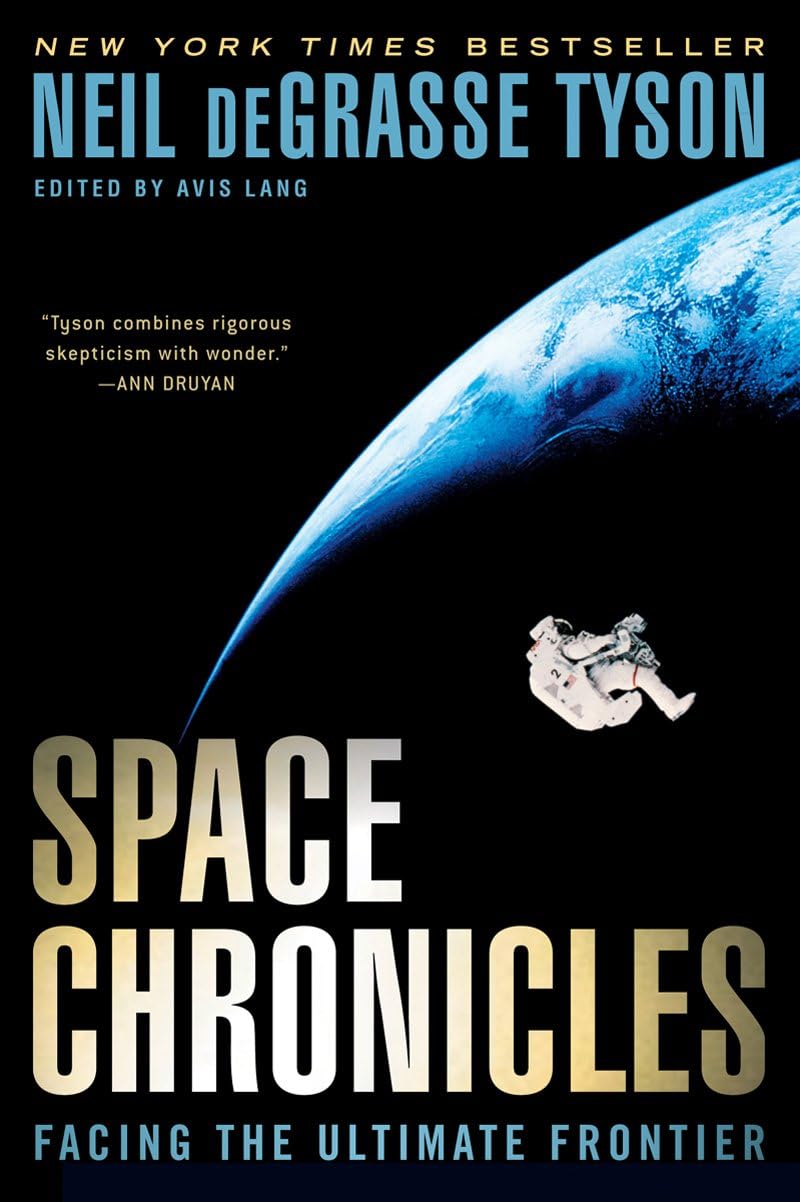
Space Chronicles: Facing the Ultimate Frontier
Product ID: 1035147
Buy anything from 5,000+ international stores. One checkout price. No surprise fees. Join 2M+ shoppers on Desertcart.
Desertcart purchases this item on your behalf and handles shipping, customs, and support to Tunisia.
Americas space program is at a turning point. After decades of global primacy, NASA has ended the space-shuttle program, cutting off its access to space. No astronauts will be launched in an American craft, from American soil, until the 2020s, and NASA may soon find itself eclipsed by other countries space programs.With his signature wit and thought-provoking insights, Neil deGrasse Tysonone of our foremost thinkers on all things spaceilluminates the past, present, and future of space exploration and brilliantly reminds us why NASA matters now as much as ever. As Tyson reveals, exploring the space frontier can profoundly enrich many aspects of our daily lives, from education systems and the economy to national security and morale. For America to maintain its status as a global leader and a technological innovator, he explains, we must regain our enthusiasm and curiosity about what lies beyond our world.Provocative, humorous, and wonderfully readable, Space Chronicles represents the best of Tysons recent commentary, including a must-read prologue on NASA and partisan politics. Reflecting on topics that range from scientific literacy to space-travel missteps, Tyson gives us an urgent, clear-eyed, and ultimately inspiring vision for the future. Review: Tyson Presents an Alluring Look at the Politics, Technological Barriers, and Future of Space Flight - On October 4, 1957, the first artificial satellite, Sputnik 1, was launched into orbit. This technological first marked the beginning of a new era of competition between the former Soviet Union and the United States. While on the surface the Space Race might have appeared to be spurred on by man's desire for knowledge and exploration, in truth, the only thing that made man's footprints on the Moon possible was the looming Cold War and aspiration to assert technological dominance over each other. Adjusted for inflation, the Apollo program today would cost over 200 billion dollars, twenty times the yearly budget of NASA. It is unlikely any of us alive today will ever see man step foot on the Moon or another planetary surface, or see the equivalent of what millions of people witnessed on July 20, 1969 when Apollo 11 landed on the Moon. The overwhelming costs, technological hurdles, and political backdrop are what make the Space Race such a fascinating subject, and it would be hard to find someone who is so passionate about it or conveys these ideas better than astrophysicist Neil deGrasse Tyson. Like his last novel Death by Black Hole: And Other Cosmic Quandaries , Space Chronicles is a compilation of previously-published articles and talks over the last fifteen years, with a central theme of the Space Race and exploration (although some of the chapters don't really fit this theme entirely). It is mostly centered on the United States' involvement with a look at the development of NASA. It contains an original prologue by Dr. Tyson with a discussion on Space Politics, with a focus on the last three presidential administrations. A selection of Dr. Tyson's tweets (which are usually interesting facts about the Universe) are scattered in relevant sections throughout the book, and add short distractions to the current chapter. The rest of the book is divided into three sections: Part 1 - Why - Articles detailing with the reasons humans desire to explore space Part 2 - How - Articles concerned with how we have overcome the barriers to space entry. Part 3 - Why Not - These chapters are mostly ideological articles and speeches about why we should explore space. The last third of the book contain Appendices related to NASA and space travel. I think they're a nice addition to Space Chronicles, although I'm pretty sure they were added as filler, since without them, the actual content of the book is only 220 pages. All of them are easily found online but they make a nice reference while reading and I frequently found myself going back to them. They consist of: National Aeronautics and Space Act of 1958 (the law that created NASA) NASA's budget from 1959-2010 2010 Space Budgets for the United States and Globally Space Budgets: US and Non US: 2010 Anyone who has enjoyed Dr. Tyson's previous books will enjoy Space Chronicles. Since it doesn't deal with as much cosmology, it is a bit easier read than his last book, Death by Black Hole: And Other Cosmic Quandaries . I also found it more persuasive. Space exploration is a subject Dr. Tyson excels at. For anyone who has ever heard him give a speech on the subject, he offers up very convincing reasons for the necessity of a space program, many which will resonate long after finishing the book. A great example of this is the final chapter in the book, which is a speech given at the University of Buffalo that I originally saw two years ago, and still has a powerful impact on me today. Unlike Death by Black Hole, which seemed to be a bit thrown together and thematically forced, the articles that make up Space Chronicles flow much easier into each other and under their relevant chapters, although you will notice some repetition throughout them. The speeches that make up some of the chapters are also well-adapted, although I strongly encourage anyone who enjoys them to go back and watch the original videos, or actually, to just skip those chapters and watch the videos instead (especially the last chapter). The main reason Dr. Tyson is so successful as a media figure is due to his ability to convey subject matter to his audience, and he does this best in person, where his passion and oration can really stand out. Almost all of the material from this book is already available publicly online. The only original material I noticed was the prologue and a poem (Ode to Challenger, 1986). Although it's been published before, I think the editor has done an excellent job in culling through Tyson's large body of work to pick the best material, and arranged it in a way that makes for an intriguing (albeit very short) read. Some of the chapters are as short as one paragraph, others are a dozen pages or so. Tyson's most ardent fans might find the material a bit too familiar, but as a whole, Space Chronicles presents itself as a nicely-wrapped look at the last fifty years of space travel, and what's in store for the future. All of the material works well in the book, but all of the chapters adapted from speeches are much better when viewed in their original video presentation. Other than the length of the book, the only real criticism I could give it is that it doesn't source the original material. A few of the chapters do this and actually state at the top that they are from videos, but most of them don't. I can't figure out any rhyme or reason to including this information on some but not others, which would seem simple enough to do (I was able to find almost all of it in about an hour). If you are interested in reading some of the articles or videos from the book, I will provide links to all of those that I've been able to find that are in the public domain, as well as book previews from the publisher and Google Books in the review comments below. Review: Worth the read!! - ...especially if you know what you are getting. This is a collection of interviews, essays, editorials and missives by Tyson, who I consider to be a phenomenal communicator. This is not a book but a collection of his positions on space, NASA, politics, and science, etc., These individual components are loosely organized by theme, but there is a redundancy throughout the book, which is exactly what you would expect. This is NDT telling us why we should be excited about further exploration of space, and laying out the reasons in many different formats. It is (in this sense) repetitive because his message is consiostent and often certain events are cited repeatedly throughout the book. However, his message, even repetitively stated, is compelling, inspiring, and beautifully delivered. NDTs passion is obvious and his true gift, making these complex topics accessible to lay public, is what makes this book a fun read. It will stimulate reflection, conversation and debate. And this is GOOD!! The book gets a 5, but the audiobook loses some stardust and gets a 4. A warning, and the ONLY reason this gets four insted of five stars. If (like me) you bought the kindle version and listened to some of it via audiobook, take heed. The narrator of the Audible product is (unfortunately) not Tyson, but someone who is a little robotic and who has a tendency to mispronounce just enough of the words to approach "Oh...come on" status. Examples: Anton Von Leowenhoek's name, Jai Alai, tertiary, Xenon (https://www.youtube.com/watch?v=VX1xRtDXIvE), and Saturn "Vee" (as opposed to Saturn V, as in five) all drove me crazy when repeatedly pronounced incorrectly. Knowing Dr. Tyson's respect for language, I suspect he too would cringe at these pronunciations.
| Best Sellers Rank | #6,760,871 in Books ( See Top 100 in Books ) #41 in Astronautics & Space Flight #93 in Aeronautics & Astronautics (Books) #122 in Astrophysics & Space Science (Books) |
| Customer Reviews | 4.6 out of 5 stars 683 Reviews |
J**O
Tyson Presents an Alluring Look at the Politics, Technological Barriers, and Future of Space Flight
On October 4, 1957, the first artificial satellite, Sputnik 1, was launched into orbit. This technological first marked the beginning of a new era of competition between the former Soviet Union and the United States. While on the surface the Space Race might have appeared to be spurred on by man's desire for knowledge and exploration, in truth, the only thing that made man's footprints on the Moon possible was the looming Cold War and aspiration to assert technological dominance over each other. Adjusted for inflation, the Apollo program today would cost over 200 billion dollars, twenty times the yearly budget of NASA. It is unlikely any of us alive today will ever see man step foot on the Moon or another planetary surface, or see the equivalent of what millions of people witnessed on July 20, 1969 when Apollo 11 landed on the Moon. The overwhelming costs, technological hurdles, and political backdrop are what make the Space Race such a fascinating subject, and it would be hard to find someone who is so passionate about it or conveys these ideas better than astrophysicist Neil deGrasse Tyson. Like his last novel Death by Black Hole: And Other Cosmic Quandaries , Space Chronicles is a compilation of previously-published articles and talks over the last fifteen years, with a central theme of the Space Race and exploration (although some of the chapters don't really fit this theme entirely). It is mostly centered on the United States' involvement with a look at the development of NASA. It contains an original prologue by Dr. Tyson with a discussion on Space Politics, with a focus on the last three presidential administrations. A selection of Dr. Tyson's tweets (which are usually interesting facts about the Universe) are scattered in relevant sections throughout the book, and add short distractions to the current chapter. The rest of the book is divided into three sections: Part 1 - Why - Articles detailing with the reasons humans desire to explore space Part 2 - How - Articles concerned with how we have overcome the barriers to space entry. Part 3 - Why Not - These chapters are mostly ideological articles and speeches about why we should explore space. The last third of the book contain Appendices related to NASA and space travel. I think they're a nice addition to Space Chronicles, although I'm pretty sure they were added as filler, since without them, the actual content of the book is only 220 pages. All of them are easily found online but they make a nice reference while reading and I frequently found myself going back to them. They consist of: National Aeronautics and Space Act of 1958 (the law that created NASA) NASA's budget from 1959-2010 2010 Space Budgets for the United States and Globally Space Budgets: US and Non US: 2010 Anyone who has enjoyed Dr. Tyson's previous books will enjoy Space Chronicles. Since it doesn't deal with as much cosmology, it is a bit easier read than his last book, Death by Black Hole: And Other Cosmic Quandaries . I also found it more persuasive. Space exploration is a subject Dr. Tyson excels at. For anyone who has ever heard him give a speech on the subject, he offers up very convincing reasons for the necessity of a space program, many which will resonate long after finishing the book. A great example of this is the final chapter in the book, which is a speech given at the University of Buffalo that I originally saw two years ago, and still has a powerful impact on me today. Unlike Death by Black Hole, which seemed to be a bit thrown together and thematically forced, the articles that make up Space Chronicles flow much easier into each other and under their relevant chapters, although you will notice some repetition throughout them. The speeches that make up some of the chapters are also well-adapted, although I strongly encourage anyone who enjoys them to go back and watch the original videos, or actually, to just skip those chapters and watch the videos instead (especially the last chapter). The main reason Dr. Tyson is so successful as a media figure is due to his ability to convey subject matter to his audience, and he does this best in person, where his passion and oration can really stand out. Almost all of the material from this book is already available publicly online. The only original material I noticed was the prologue and a poem (Ode to Challenger, 1986). Although it's been published before, I think the editor has done an excellent job in culling through Tyson's large body of work to pick the best material, and arranged it in a way that makes for an intriguing (albeit very short) read. Some of the chapters are as short as one paragraph, others are a dozen pages or so. Tyson's most ardent fans might find the material a bit too familiar, but as a whole, Space Chronicles presents itself as a nicely-wrapped look at the last fifty years of space travel, and what's in store for the future. All of the material works well in the book, but all of the chapters adapted from speeches are much better when viewed in their original video presentation. Other than the length of the book, the only real criticism I could give it is that it doesn't source the original material. A few of the chapters do this and actually state at the top that they are from videos, but most of them don't. I can't figure out any rhyme or reason to including this information on some but not others, which would seem simple enough to do (I was able to find almost all of it in about an hour). If you are interested in reading some of the articles or videos from the book, I will provide links to all of those that I've been able to find that are in the public domain, as well as book previews from the publisher and Google Books in the review comments below.
C**N
Worth the read!!
...especially if you know what you are getting. This is a collection of interviews, essays, editorials and missives by Tyson, who I consider to be a phenomenal communicator. This is not a book but a collection of his positions on space, NASA, politics, and science, etc., These individual components are loosely organized by theme, but there is a redundancy throughout the book, which is exactly what you would expect. This is NDT telling us why we should be excited about further exploration of space, and laying out the reasons in many different formats. It is (in this sense) repetitive because his message is consiostent and often certain events are cited repeatedly throughout the book. However, his message, even repetitively stated, is compelling, inspiring, and beautifully delivered. NDTs passion is obvious and his true gift, making these complex topics accessible to lay public, is what makes this book a fun read. It will stimulate reflection, conversation and debate. And this is GOOD!! The book gets a 5, but the audiobook loses some stardust and gets a 4. A warning, and the ONLY reason this gets four insted of five stars. If (like me) you bought the kindle version and listened to some of it via audiobook, take heed. The narrator of the Audible product is (unfortunately) not Tyson, but someone who is a little robotic and who has a tendency to mispronounce just enough of the words to approach "Oh...come on" status. Examples: Anton Von Leowenhoek's name, Jai Alai, tertiary, Xenon (https://www.youtube.com/watch?v=VX1xRtDXIvE), and Saturn "Vee" (as opposed to Saturn V, as in five) all drove me crazy when repeatedly pronounced incorrectly. Knowing Dr. Tyson's respect for language, I suspect he too would cringe at these pronunciations.
M**L
I've enjoyed reading this book more than any other non-fiction I've read
Simply put I enjoyed this book like I enjoy reading good science fiction. Neil's writing is easy to follow and he presents the concepts in a way you do not need a PhD to understand. It's hard to read a chapter in this book and go back to your normal, non-space living life. Very few things in our daily lives can seem interesting in comparison to the workings of the universe! The one negative I have is the book is a collection of essays, and as such there is a tendency to repeat it self. It wasn't overbearing, and many of the repeated themes are the most important, but I would have liked Neil to have written the book as a whole instead of in stand alone parts. I will say after reading the lower reviews here (at the time of my own review) I have to wonder if they read the book. Neil states clearly his support for private space travel. He also points out the cost, the $500 billion to go to Mars, is over 30 years and only an increase of NASA's budget by $100 billion (over those 30 years). He's quite repetitive in stating NASA is 0.5% of the budget (and during the space race it was 4%). He does talk about the expensive mistakes too, including the two shuttle disasters and the Hubble launch. I'm old enough to remember the constant talk show jokes and political sound bites when the Hubble didn't work. Neil points out though that blurry Hubble photos lead to a break through in breast cancer detection and there are women alive today because of a NASA mistake. I'm also old enough to remember being in school when the Challenger exploded. I remember the shock, but I also remember the spirit we had at the time. We were going have a school teacher in space and have a class with her teaching - from space! I had a book that talked about vacation trips to the moon. I expected we would have those by now. And we still might. Just that it won't be the USA leading the charge, but China and USSR. One day we'll wake up and wonder how it all flipped around - why we are working on Foxconn plants and China is the world leader. The answer is simple - the USA stopped dreaming of a better tomorrow.
A**N
A great read; among the best of the genre. Only one small complaint...
Tyson is one of the truly great science insiders, advocates and educators of our time and this is an engaging read. It is a series of essays that covers the era of space exploration in an enlightening and entertaining way. It is book of great stories of our progress, not a mere catalogue of events. It contains all of the main fare for space junkies and it is served up well. It is almost as funny in places as the best bits of Mary Roach's "Packing for Mars", and (appropriately, for a more general book) does not provide as detailed a pathway to human (cf robotic) exploration as Buzz Aldrin in his "Mission to Mars". It is certainly much easier to read for the less technophilic, more emotionally involved reader than Shayler, Shayler and Salmon's "Marswalk One". Its honest but really quite troubling description of the difficulties facing manned exploration of space beyond low Earth orbit will be appreciated by enthusiasts. Tyson comments that much ground-breaking early technology appears quaint when compared to more developed versions. His observation that the now-old Saturn V rockets still evoke the reverence due to the 'latest and greatest', was a powerful lament. I would recommend this book to any space enthusiast; it is amongst the best of the genre. However I do have a complaint. Like it or not, space exploration is now a thoroughly international mission, just as it also now involves private enterprise and robotics. Tyson himself is valued internationally and his (like Aldrin's) nationalistic wish for continued American supremacy in space is itself somewhat quaint and backward-looking. It also risks blindness to, and threatens lack of support for, some of the optimism and exciting achievements of other players such as the Europeans, Indians and Chinese.
G**I
Engaging, Informative, Entertaining...
Tyson has always been a good speaker. This book combines original writing for this book with interviews and presentations he has done over the last 10-15 years. I always enjoyed his presentations and interviews. There is alot on youtube, but it's hard to sort and collate it. You can consider this book a collation of his most popular public interviews and presentations. Having most of it in one book is convenient so I thought it was worth the price rather than spend weeks trawling the internet for the same content. I found the book inspiring and educational about the merits of science and how it can make humanity a better place. There are many dimensions to Tyson's point of view that I can't cover in a review. But what I can say is that he looks at the impact of society, government and religion on science and how science needs to be the cornerstone of education in order for us to get off this rock and explore the universe. Each chapter is digestible and entertaining reading for everyone. It's far from dry. So if you enjoy Tyson's interviews and presentations then you won't be disappointed with this book.
B**K
Great writing from the spokesman for NASA
It's easy to get caught up in Neil DeGrasse Tyson's writing. He's energetic and enthusiastic. But Space Chronicles reads like a promotional presentation on behalf of NASA, rather than a call to reach to the cosmos. To listen to Dr. Tyson is to believe that the only salvation for American space presence is the lumbering juggernaut of NASA. He calls for us to remember all of the things the government's space program has produced for us, from Velcro to cloths used for military and firefighter uniforms. But along the way he totally ignores the fact that much of the research that produced these items was the sweat of private companies who accepted the government's call for new and improved products and materials to enhance our forays into space. He glosses over the colossal blunders, expensive ones, that have been made under the NASA masthead, which contributed to the slowdown of both money and enthusiasm for America's space program. He calls the space program nonpartisan, but then admits that NASA has been politically marginalized, dividing up into competing camps that manifest all of the same competitive tanglefoot that has neutered congress. Just as with the government, when the differing sides refuse to work together, little, if anything, gets done. Rather than pressing for more privatized involvement in space research, he maintains a focus on NASA, repeatedly bringing economies of scale into the conversation to blur the realities of our country's economic position. He points to other countries which are not in the economic straits we're currently experiencing and tries to throw down the gauntlet that we should be able to do better. Yet he also admits that the only place in space exploration that we were ever number one was in landing on the moon --some 40 or so years ago. That was then, in a different economic and national situation, and this is now. That in ratio and proportion so little could be spent to produce a new wealth of advances totally ignores that it's hard to carve extra money from our mind boggling budgetary deficit. One cannot spend what one doesn't have, and right now the government is spending negative dollars. I can't help but think about flagging educational monies and our embarrassing position in terms of schooled minds available to perform the research he speaks of. I have to think that perhaps spending more on education --and putting hooks on the money to have educational institutions focus on the sciences rather than sports might be a better way to spend the dollars we might budget. In America we spend $41 billion dollars a year on pets, so strikes me that the private sector has a lot more money to spend on space than the government currently does. For all of the returns on investment that Dr. Tyson speaks of, I have to wonder why, if it is so lucrative, aren't more companies investing in space? When this question is asked of the relative few companies that are investing in space, they speak of the tremendous governmental obstacles involved. Problems which, as I hear the interviews, point at NASA and Homeland Security as the biggest sticks in the mud. So I have to question whether Dr. Tyson is promoting space, or is he promoting NASA? But Tyson's writing is engaging, and he brings to light a tremendous amount of knowledge in his entertaining writing. He has a ready wit and shows it often as the pages go by. Considering the dryness of much of the information, he makes it palatable with style and grace. But when I lift my head out of the atmosphere he creates, I can see the many things that he readily distracts us from. I metaphor his writing as "Do you want to be rich? It's easy! Get a lot of money." There is just too much missing as he seemingly points the way to future prosperity and growth. I tend to think that if he put his apparently boundless energies into advocating for space, rather than just NASA, that we might tend to see more of the fruits he says are out there for the taking. As he opened the book, he spoke of how after our astronauts strolled on the moon, that people all over the world would smilingly cheer "We did it!" They took part of the credit as members of the human race. He based this on the fact that the achievement was a planetary one rather than national. He lauded this warmly, explaining that space should be a human endeavor and not a national one. Yet his book continually speaks to how well other nations are doing in space advancement, and keeps saying that we are behind. If it's truly the end product that's important, why is is so imperative that Americans lead, rather than playing a supportive role? If it was alright for peoples of other nations to have only moral supporting roles when we reached the moon, why isn't it alright for us to do so now; and why is it so important that it be NASA making the accomplishments? I think this book would be a much more valuable writing if it encouraged mainstream American involvement in space and the reach for the stars. It would have been, in my opinion, better to point to the riches and benefits awaiting investors, encouraging them to jump in. Then add pleas for governmental subsidy and tax benefits for the space efforts of private sector investors. Then too, Dr. Tyson speaks to the fact that we haven't really provided a lot of the minds that went into our accomplishments to date, but imported them from other nations instead. He says that now those minds are going elsewhere or staying home where greater opportunities for careers in space research are more prolific. So it only seems to make sense to fan the flames of generating American minds by encouraging for more places for American minds to build on their dreams of space --while not being confined to Hollywood special effects to do it. I enjoyed this book, and I would recommend it to others with an interest in the heavens. But I would do so with the caveat that it appears to be more a promotion of NASA than a promotion of space study advancement.
W**R
Excellent treatise on the state of the U.S. Space Prog. and Technology Leadership but.....
So much of it rings as so true but he nearly caused me to stop reading when he went on a triade about the planting of the U.S. Flag on the moon and how it should have been the UN flag instead and claiming the U.S. " went back to its imperialist roots". For someone so knowledgable he is so ignorant of the facts. NASA debated long and hard about planing the Flag because the U.S. Did NOT claim the moon as its property but at the same time the U.S. and its Tax payers alone paid for the program in its entirety and itwas the product of their efforts alone. NASA thought it only right that they plant the U.S. Flag to lay claim to WHO did it just as Mr. Tyson puts his name on his books rather than the entire scientific community. . At the same time he criticizes US motivations as being solely and merely an extension of the Cold War and nothing else (a major factor for sure but not exclusively) when he should be praising US for peacefully competing with the USSR via healthy, non-military means and sharing the peaceful technology developed with the entire world for the taking fueling world economic and technology growth for the following 40+ years. He does acknowledge the latter but never states the fact that it was US alone ( and contues to be) who freely shares their space technology for the benefit of the entire world. So typically anti-US, hypocritical and arrogant as so many scientific intellectuals are as a result of their naïveté' of the real world due to their immersion in academia for their entire careers. As well, his pasting over and defense of Obama's killing of the US space program is intellectually dishonest and displays his politics. Otherwise, a mostly informative book and a worthwhile read as long as one is knowledgable enough to see through the author' politics and mature enough to overlook them.
D**T
Space Chronicles and Neil deGrasse Tyson as master communicator
I'm a big Neil deGrasse Tyson fanboy. Partly that's because I'm an Apollo moon mission geek and collect artifacts from the program. (Pretty geeky, right?) But mostly, I'm a fan because Dr. Tyson is such an awesome communicator. When I read his work or watch him on television, I always take away something that I can apply to my own work as a communicator and marketing strategist. His bio says Neil deGrasse Tyson is an astrophysicist and the director of the Hayden Planetarium in New York City. Dr. Tyson is so good at talking and writing about the cosmos and why it is important for us to have an understanding of the wider world in which we live. Space Chronicles: Facing the Ultimate Frontier - is a collection of essays and speech transcripts around the theme of space exploration and how America has not done much to inspire people in the past 40 years outside of some cool robotic missions and the Hubble telescope. I read Space Chronicles in three sittings because it is that good. In the book, he talks about how America boldly embarked on the most audacious scientific endeavor in history by sending humans to the moon. However after 9 lunar missions (6 that landed) we... stopped exploring. For 40 years we've only been to low earth orbit with manned missions. Sure there have been some spectacular robotic missions such as Cassini's photos of Saturn and the various Mars rovers. And the Hubble has delivered spectacular images. But humans haven't explored. Dr. Tyson argues that's a problem because we're not inspiring our young people to study science and engineering and that's a problem for the economy. "Absent such curiosity, we are no different from the provincial farmer who expresses no need to venture beyond the county line, because his forty acres meet all his needs. Yet if our predecessors had felt that way, the farmer would instead be a cave dweller, chasing down his dinner with a stick and a rock." - From Space Chronicles. Quick aside - In high school my buddies and I would go to the Hayden Planetarium (after some appropriate preparations of course) to see evening productions of "Laser Floyd" - a cosmic mixture of loud Pink Floyd with colorful lasers projected on the planetarium dome. I've even got a ticket stub from 1978 to prove it. Neil is close to my age. He grew up in New York City. I wonder if he went too? Nah, probably not. He was studying while I was partying.
L**E
One smart cookie.
Great book, got to say i agree with everything Neil says. Not in a crazy religious way though. Its just downright scientific truth.
L**M
Nettes Buch über die Geschichte und Erfolge der NASA
Nettes Buch über die Geschichte und Erfolge der NASA die dann weitergeführt wird in die moderne Weltraumforschung. Oft kommt es einem jedoch so vor als sei es nur ein Plädoyer wieso wir eine NASA bräuchten.
T**I
Muy buen libro
Un buen libro de un autor que siempre resulta fácil de leer. En inglés porque así puedo tener directamente la versión del autor.
S**A
An absolutely amazingly interesting book to read!!
A great book to read .
C**N
Gran capítulo
Neil explicando el universo como solo él sabe. Si conocer sobre el universo es lo tuyo. No puedes perder este libro
Trustpilot
3 weeks ago
1 month ago