American Nations: A History of the Eleven Rival Regional Cultures of North America
Product ID: 105570352
• A New Republic Best Book of the Year • The Globalist Top Books of the Year • Winner of the Maine Literary Award for Non-fiction Particularly relevant in understanding who voted for who during presidential elections, this is an endlessly fascinating look at American regionalism and the eleven “nations” that continue to shape North America—by the bestselling author of Nations Apart According to award-winning journalist and historian Colin Woodard, North America is made up of eleven distinct nations, each with its own unique historical roots. In American Nations he takes readers on a journey through the history of our fractured continent, offering a revolutionary and revelatory take on American identity, and how the conflicts between them have shaped our past and continue to mold our future. From the Deep South to the Far West, to Yankeedom to El Norte, Woodard (author of American Character: A History of the Epic Struggle Between Individual Liberty and the Common Good ) reveals how each region continues to uphold its distinguishing ideals and identities today, with results that can be seen in the composition of the U.S. Congress or on the county-by-county election maps of any hotly contested election in our history. Review: intriguing historical and sociological thesis might explain a lot - Pursues for this generation the same themes as "Albion's Seed" did for the last ...although with considerably different details. Where "Albion's Seed" was largely about the pre-revolutionary period, a much longer span of years including the Civil War era as well as the present day is analyzed here. A book not of new research through primary sources, but rather of synthesis of other carefully chosen works of history around a theme few even imagined and almost none expressed quite this way. Specifically, the themes here are that the several cultures within the U.S. are more different from each other than quite a few nation-states, and that although the "Borderlanders" were a majority of the population, they were egregiously excluded from political power until the time of Andrew Jackson, and are still often thought of derogatorily. He tries pretty hard -and fairly successfully- to be even-handed. Nevertheless I managed to form the impression his personal tendencies were toward progressive causes and away from the Deep South. And he does say explicitly at one point "Since 1877 the driving force of American politics hasn't primarily been a class struggle or tension between agrarian and commercial interests, or even between competing partisan ideologies, although each has played a role. Ultimately the determinative political struggle has been a clash between shifting coalitions of ethnoregional nations, one invariably headed by the Deep South, the other by Yankeedom." Among other things, this history explains why Ohio is such an important swing state in presidential elections (different land ownership resulted in _three_ different "nations" settling inside a single state ...and in dis-contiguous areas). Although he doesn't explicitly cover it at all, it seemed clear to me from reading that both a large and growing population and economic might are keys to a culture being influential. He very briefly covers the apparently uncontroversial historical maxim that the original settling (or resettling) of an area often determines its culture for hundreds of years, even after both the original people and the original economy have largely vanished. Since there are currently very few pursuing this unfamiliar line of historical inquiry, he perforce paints with quite a broad brush. As a result, some of his details feel "half-baked", and once in a while at the edges there's a whopper that has trouble standing up to a few moments deep thought. U.S. history has become mostly New England history (can you imagine relating the mythology of the U.S. without mentioning Plymouth Rock?). What happened to all the other colonies, including the older one at Jamestown? He explains how the Tidewater culture centered on Virginia was very large and enormously influential through the early decades of the union, but ultimately was hemmed in by geography and ecology and shrank to not a whole lot more than an appendage to the Deep South. He explains how the original Georgia colony was overwhelmed by the economy of the Deep South (which was founded by immigrants from Barbados rather than from Europe) and disappeared into it. And he very briefly explains that the Florida explorations and colonies were originally tied to the Spanish empire and so largely lost to the U.S. He makes a convincing case that the odds were heavily stacked _against_ the very dissimilar "New England", "New Netherland", "Tidewater", and "Deep South" colonies allying to fight for independence and federate under the constitution; splintering of the union was a very real threat for much of the next century. He shows how the settling of the coastal areas of the west coast by immigrants who came by ship (many from New England) produced a culture quite different from the more interior areas of those same states that were settled by different immigrants who came overland. Genesis of "The Left Coast" cultural nation is one of the sketchiest parts of his book, and as one who lived in California for quite a while, I found it maddeningly oversimplified. Still, he's put forward a seemingly reasonable novel point of view that brings order to a lot of loose ends. He opines that although the cultures in the U.S. had to fit reasonably well into their local ecologies, most of them were not really determined by it. (I sometimes felt he actually underplayed some obvious ecological constraints.) The one glaring exception to U.S. cultures not being determined by ecology is the "Far West", whose dryness and vastness completely stymied all the cultures that attempted to expand into it. It ultimately was settled only by following the lead of large corporatist frameworks that could organize thousands of people and support them with pinpoint application of large amounts of capital, and is still dependent on the largesse of the federal government. He's young (not long out of grad school) and he makes his living writing books and articles, rather than as an academic historian, so he has a very fresh approach to everything. For example he explains that in the backcountry folks used "whiskey" as currency (coins were almost completely absent); the tax that prompted the "Whiskey Rebellion" was essentially a blow by the coastal elites against backcountry currency! He explicitly covers every bit of background, not assuming anything at all, so readers never feel like "something's missing". He unabashedly take firm sides on current controveries, for example stating the Civil War was clearly about slavery rather than states' rights. And he's not constrained by either the "conventional wisdom" or the need to publish only defensible interpretations. Without any qualification he refers to the "Far West" as an "internal colony". Often where an academician would remain silent in the face of ambiguous or conflicting primary sources, he'll say frankly what he reads "between the lines". For example he plainly states that the scheme of Robert Morris, Alexander Hamilton, and others after the revolution to redeem federal debt certificates at full face value really was an outrageous and corrupt scheme, with much in common with the financial meltdown of 2008. He even opines (with some supporting evidence) that the "Founding Fathers" were slanted toward carefully circumscribed democracy and economic exploitation by elites. The emphasis here is on empirical description of the U.S., not on theory or polemics. There's almost nothing allowing comparison to other countries. So we're left with the vague notion the countries of North America are "atypical", but without any specifics or quantification or context. His speculations about possible future trends for the North American countries are restricted to a few pages in the last chapter and the Epilogue. Several things he says implicitly lead to the conclusion that the U.S. would have been better off if the South had been allowed to leave the Union quietly without a Civil War. On the other hand he explicitly states -using Canada as his example- that even without the South, encompassing several very different cultures would still be problematic, and the Union might ultimately shrink back in power and authority to little more than a federation of semi-independent states like the original confederation of 1781. Review: Eye opening read. I learned much from this one - Over the years there have been several books and studies available putting forth the concept that American; actually all of North America, is actually a number of different nations which are more or less united. The number of these nations differs, depending upon a given author’s research. Some of these works have been good, others bad and others down right ugly. The book being reviewed here, American Nations, in my opinion is probably the best of the lot and for me makes the most sense. Now that does not mean that I agree absolutely with every thing the author has to say. That would be a sad and silly mistake. But that being said, Woodard does present some very logical reasons why we are the way we are and loads the reader with wonderful historical facts that most certainly not taught in your average high school history course. Mingled with his premise of there actually being eleven nations currently present is a dire warning of which we should all take heed. It also, in my mind, answers many questions as to why we are such a culturally and politically divided nation at this present time. Now I am not a cultural anthropologist nor have I made a dedicated study of the subject. I have though lived in each and every area addressed in this book for extended periods of time and have family members living in these areas as I write this. Folks, for the most part the author are pretty well spot on as to his comments and observations. I myself my not have worded some of these observations the author has documented quite has harshly, but there is never the less great truth in what he writes...for the most part. Now I am neither a ‘conservative’ nor am I a ‘liberal.’ Like most people I am pretty much a mixture; depending upon the subject but I simply admit it. Historical facts and events that you can observe first hand yourself over seven or more decades simply do not lie. Of course as I said in the beginning, each individual should read and study this subject using other sources...just to be sure they have as large an overview as possible. This book is very well researched and like other reviewers here, I must admit that more or less woke me up to many factors present today that I have more or less ignored. It also reinforced my amazement that we actually managed to become a more or less unified country. History, culture and religion, along with geography were most certainly against us as well as Canada and Mexico. This is one of those books that we all should read and contemplate. Weather the author is right or wrong is rather moot in many ways. The strength of this book is that it gives the reader food for thought and may open windows to the mind that the reader never realized existed. This is one of those books that I would love to see offered to each H.S. Senor to be read before graduation. I read this on the Kindle version. I would love to have had provided a set of progressive maps and the author presented his historical story...it would have been a great help. I was constantly digging through a large U.S. map I have on hand here attempting to track the author’s progress. Now as to the various theories and observations the author has made – I will leave the pontifications to others here who are much more qualified than I am to spout their vast reservoir of knowledge...bless their hearts. Don Blankenship The Ozarks

| Best Sellers Rank | #69,339 in Kindle Store ( See Top 100 in Kindle Store ) #4 in United States Local Government #6 in Cultural & Ethnic Studies Social Science eBooks #6 in State & Local Government |
C**S
intriguing historical and sociological thesis might explain a lot
Pursues for this generation the same themes as "Albion's Seed" did for the last ...although with considerably different details. Where "Albion's Seed" was largely about the pre-revolutionary period, a much longer span of years including the Civil War era as well as the present day is analyzed here. A book not of new research through primary sources, but rather of synthesis of other carefully chosen works of history around a theme few even imagined and almost none expressed quite this way. Specifically, the themes here are that the several cultures within the U.S. are more different from each other than quite a few nation-states, and that although the "Borderlanders" were a majority of the population, they were egregiously excluded from political power until the time of Andrew Jackson, and are still often thought of derogatorily. He tries pretty hard -and fairly successfully- to be even-handed. Nevertheless I managed to form the impression his personal tendencies were toward progressive causes and away from the Deep South. And he does say explicitly at one point "Since 1877 the driving force of American politics hasn't primarily been a class struggle or tension between agrarian and commercial interests, or even between competing partisan ideologies, although each has played a role. Ultimately the determinative political struggle has been a clash between shifting coalitions of ethnoregional nations, one invariably headed by the Deep South, the other by Yankeedom." Among other things, this history explains why Ohio is such an important swing state in presidential elections (different land ownership resulted in _three_ different "nations" settling inside a single state ...and in dis-contiguous areas). Although he doesn't explicitly cover it at all, it seemed clear to me from reading that both a large and growing population and economic might are keys to a culture being influential. He very briefly covers the apparently uncontroversial historical maxim that the original settling (or resettling) of an area often determines its culture for hundreds of years, even after both the original people and the original economy have largely vanished. Since there are currently very few pursuing this unfamiliar line of historical inquiry, he perforce paints with quite a broad brush. As a result, some of his details feel "half-baked", and once in a while at the edges there's a whopper that has trouble standing up to a few moments deep thought. U.S. history has become mostly New England history (can you imagine relating the mythology of the U.S. without mentioning Plymouth Rock?). What happened to all the other colonies, including the older one at Jamestown? He explains how the Tidewater culture centered on Virginia was very large and enormously influential through the early decades of the union, but ultimately was hemmed in by geography and ecology and shrank to not a whole lot more than an appendage to the Deep South. He explains how the original Georgia colony was overwhelmed by the economy of the Deep South (which was founded by immigrants from Barbados rather than from Europe) and disappeared into it. And he very briefly explains that the Florida explorations and colonies were originally tied to the Spanish empire and so largely lost to the U.S. He makes a convincing case that the odds were heavily stacked _against_ the very dissimilar "New England", "New Netherland", "Tidewater", and "Deep South" colonies allying to fight for independence and federate under the constitution; splintering of the union was a very real threat for much of the next century. He shows how the settling of the coastal areas of the west coast by immigrants who came by ship (many from New England) produced a culture quite different from the more interior areas of those same states that were settled by different immigrants who came overland. Genesis of "The Left Coast" cultural nation is one of the sketchiest parts of his book, and as one who lived in California for quite a while, I found it maddeningly oversimplified. Still, he's put forward a seemingly reasonable novel point of view that brings order to a lot of loose ends. He opines that although the cultures in the U.S. had to fit reasonably well into their local ecologies, most of them were not really determined by it. (I sometimes felt he actually underplayed some obvious ecological constraints.) The one glaring exception to U.S. cultures not being determined by ecology is the "Far West", whose dryness and vastness completely stymied all the cultures that attempted to expand into it. It ultimately was settled only by following the lead of large corporatist frameworks that could organize thousands of people and support them with pinpoint application of large amounts of capital, and is still dependent on the largesse of the federal government. He's young (not long out of grad school) and he makes his living writing books and articles, rather than as an academic historian, so he has a very fresh approach to everything. For example he explains that in the backcountry folks used "whiskey" as currency (coins were almost completely absent); the tax that prompted the "Whiskey Rebellion" was essentially a blow by the coastal elites against backcountry currency! He explicitly covers every bit of background, not assuming anything at all, so readers never feel like "something's missing". He unabashedly take firm sides on current controveries, for example stating the Civil War was clearly about slavery rather than states' rights. And he's not constrained by either the "conventional wisdom" or the need to publish only defensible interpretations. Without any qualification he refers to the "Far West" as an "internal colony". Often where an academician would remain silent in the face of ambiguous or conflicting primary sources, he'll say frankly what he reads "between the lines". For example he plainly states that the scheme of Robert Morris, Alexander Hamilton, and others after the revolution to redeem federal debt certificates at full face value really was an outrageous and corrupt scheme, with much in common with the financial meltdown of 2008. He even opines (with some supporting evidence) that the "Founding Fathers" were slanted toward carefully circumscribed democracy and economic exploitation by elites. The emphasis here is on empirical description of the U.S., not on theory or polemics. There's almost nothing allowing comparison to other countries. So we're left with the vague notion the countries of North America are "atypical", but without any specifics or quantification or context. His speculations about possible future trends for the North American countries are restricted to a few pages in the last chapter and the Epilogue. Several things he says implicitly lead to the conclusion that the U.S. would have been better off if the South had been allowed to leave the Union quietly without a Civil War. On the other hand he explicitly states -using Canada as his example- that even without the South, encompassing several very different cultures would still be problematic, and the Union might ultimately shrink back in power and authority to little more than a federation of semi-independent states like the original confederation of 1781.
D**P
Eye opening read. I learned much from this one
Over the years there have been several books and studies available putting forth the concept that American; actually all of North America, is actually a number of different nations which are more or less united. The number of these nations differs, depending upon a given author’s research. Some of these works have been good, others bad and others down right ugly. The book being reviewed here, American Nations, in my opinion is probably the best of the lot and for me makes the most sense. Now that does not mean that I agree absolutely with every thing the author has to say. That would be a sad and silly mistake. But that being said, Woodard does present some very logical reasons why we are the way we are and loads the reader with wonderful historical facts that most certainly not taught in your average high school history course. Mingled with his premise of there actually being eleven nations currently present is a dire warning of which we should all take heed. It also, in my mind, answers many questions as to why we are such a culturally and politically divided nation at this present time. Now I am not a cultural anthropologist nor have I made a dedicated study of the subject. I have though lived in each and every area addressed in this book for extended periods of time and have family members living in these areas as I write this. Folks, for the most part the author are pretty well spot on as to his comments and observations. I myself my not have worded some of these observations the author has documented quite has harshly, but there is never the less great truth in what he writes...for the most part. Now I am neither a ‘conservative’ nor am I a ‘liberal.’ Like most people I am pretty much a mixture; depending upon the subject but I simply admit it. Historical facts and events that you can observe first hand yourself over seven or more decades simply do not lie. Of course as I said in the beginning, each individual should read and study this subject using other sources...just to be sure they have as large an overview as possible. This book is very well researched and like other reviewers here, I must admit that more or less woke me up to many factors present today that I have more or less ignored. It also reinforced my amazement that we actually managed to become a more or less unified country. History, culture and religion, along with geography were most certainly against us as well as Canada and Mexico. This is one of those books that we all should read and contemplate. Weather the author is right or wrong is rather moot in many ways. The strength of this book is that it gives the reader food for thought and may open windows to the mind that the reader never realized existed. This is one of those books that I would love to see offered to each H.S. Senor to be read before graduation. I read this on the Kindle version. I would love to have had provided a set of progressive maps and the author presented his historical story...it would have been a great help. I was constantly digging through a large U.S. map I have on hand here attempting to track the author’s progress. Now as to the various theories and observations the author has made – I will leave the pontifications to others here who are much more qualified than I am to spout their vast reservoir of knowledge...bless their hearts. Don Blankenship The Ozarks
H**R
Nice American History Lesson
I discovered this book in an article from the Economist. Although the book was available through the Houston Public Library system, I decided to go ahead and buy the book since it wasn’t too expensive and since I felt I would keep it for future use (i.e. my children could read it as part of the American history class they will take eventually in middle school). The thesis of the book is that North America has 12 cultures or population types with distinct historical experiences and origins) that profoundly and persistently affects our current geopolitical climate. Some of the 12 cultures are obviously well-known – the Deep South, Tidewater, or the Yankee culture based on how different groups of Anglo-Americans colonized and populated the north American coast. The “alliance” between Deep South and Deep South was akin to an unhappy marriage in two ways focusing in building an elite society on the backs of African slaves. The Appalachian culture, based on Scot-Irish immigrants that skipped over the coastal cultures into the heartland, appeared to be the most problematic and angry one in part because they came from a “barbarian” or savage frontier world in the hinterlands of Europe. In contrast, the Midland culture, based on German immigrants dedicated to pacifism, was the most accommodating and adaptable one that spread into the northern heartland of North America; they even shot into Ontario to distinguish themselves from the “New France” culture (Quebec and Louisiana), another very accommodating North American culture. I understood the strong North and South difference, but the author gives a more detailed breakdown of what has been occurring even prior to the formation of the United States. Probably the most useful lesson from the book was that there were and still are diametrically opposing values, politics, and social priorities in our country. The political experiment as our Constitution was thrown together with concessions made and a reluctance to join together as one nation. In addition to the 5 original “Anglo-American” cultures, there were 2 offshoot cultures in the western North American area – the Left Coast (which is basically a Yankee culture in the west coast) and the Far West culture (which is the most nebulous yet influential to modern politics). The idea of the Norteno culture (“El Norte”) is an interesting concept as it is distinct from “Mexicans” from old Mexico; they overflow for hundreds of miles on both sides of the Rio Grande and on the formal political border all the way through west coast. My favorite culture was probably the New Netherlands that emerged and survived around the New York area – its cosmopolitanism and tolerance for diversity (although not embracing democracy versus authoritarianism). The first 2/3rds of the book, especially in the formation of the first Euro-American cultures (Norteno, Yankee, Tidewater, Deep South, New France, and New Netherland) was informative like a history textbook – something I would recommend middle schoolers to read. The development of the Appalachian and Midland immigrant cultures was probably the most interesting part of the book as I did not know much how they were formed after immigrating from Europe. The legacy of slavery and the civil war (1861-5) was very strong in politically dividing Yankees from the Deep South but also from the Appalachians (which remains somewhat unclear to how so since the Appalachians disliked either group). The formation of the Left Coast and Far West cultures was explained in an innovative manner that I did not think earlier in the context of earlier north American cultures; however they underplayed the influence of the Norteno culture into either culture (then again, southern California was overtaken by Nortenos leaving only northern California and the Pacific west coast to the Far Left (which was led by Yankees but populated by Appalachians). However, the last third was a disappointment and the conclusion was empty. The last third of the book contained increasingly biases from the author against the Deep South or Appalachian cultures. While I do not agree with many of the sentiments of either culture, I don’t think the author portrayed these cultures fairly (although, after the Trump election of 2016, one has to wonder). While many practices of the southern United States were indeed backwards and barbaric, his sweeping generalization turned me off. Moreover, I did not agree with the author’s idea that the 19th and 20th century immigrants were simply absorbed into one of the 12 north American cultures based on geography (his theory was that an influx of immigrants do not change the area's cultural paradigm but, over time, it's the immigrants who take on the region's mores). Also, there was no consideration for Afro-Americans, the 12% percent of the population. The author later stated in different articles that they absorbed into one of the 12 cultures, but it is not convincing especially when one think of the unique traditions like the Guhlah culture in South Carolina; Afro-American cultures had their own geographic distinctions like the Euro-American cultures. The last mentioned 12th culture in North America was the least interesting and informative one in the book - the First Nation culture, which is the indigeneous Amerindian culture – again like the Afro-Americans treated homogeneously as if it was one big tribe, whereas the reality was that the Amerindians that once populated the entire North Americas were probably the most diverse culture vis-à-vis Euro- or Afro-Americans.
M**S
Like scales falling from my eyes
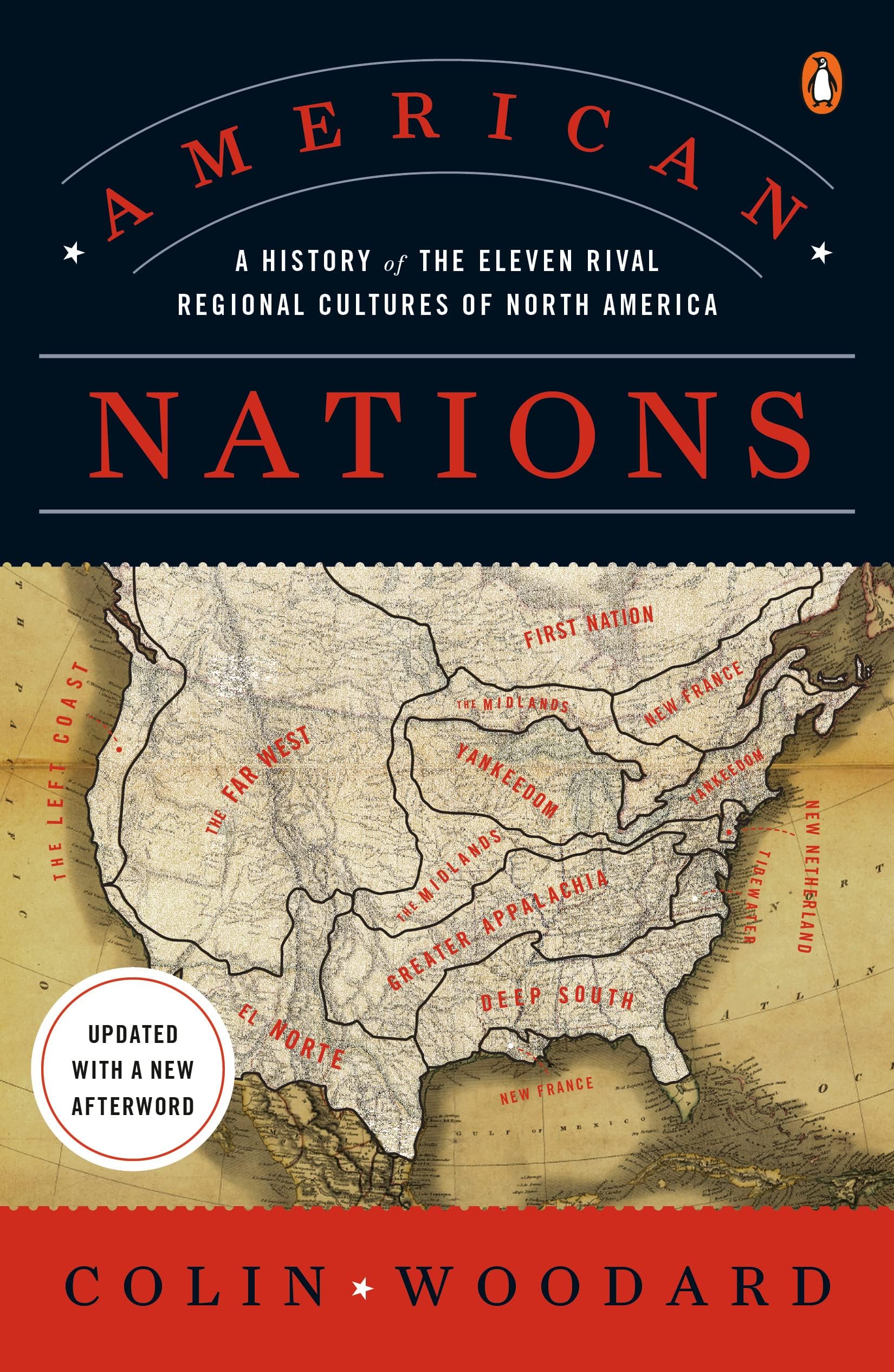
Colin Woodard has written the story of North America that should be taught in school in place of the simplified, sanitized, nearly fictional versions created, like all national histories, for the purpose of welding disparate peoples into a single nation by convincing them they all share a common history. I just got it back from loaning to a friend and re-read it. Like other reviewers here I had read Joel Garreau's "Nine Nations" in the 1980s and more recently Kevin Phillips' "The Cousins Wars" and Dante Chinni's "Patchwork Nation". They were full of interesting information, but Nine Nations and Patchwork Nation didn't address the origins or persistence of the notable regional differences among North Americans. I think Woodard's main thesis is that these regional cultures left their marks so deeply that we are no longer consciously aware of them, and should be. My experience living and working in several of these "nations" indicates that the regional differences do persist, though national media and advertising have masked them. Reading "American Nations" I felt the pieces falling into place. I am undecided on the question of just how valid the thesis of eleven rival nations is as political science, but it makes for a fine explication of our history. And as cultural anthropology it provides the same level of explanatory power for understanding our cultural differences that the theory of evolution provided for understanding biology, or that the theory of plate tectonics did for understanding planetary-scale geologic processes. Just as those two sciences could not advance beyond the observational phase without a theoretical framework, this third dimension of historical immigration patterns transforms a two-dimensional hodgepodge of cultural observations into a meaningful three-dimensional portrait far more illuminating than the usual North-South analysis. The map on the "American Nations" cover showed me that I grew up roughly where the Deep South, Appalachia, and El Norte meet in eastern Texas. We said we were "Scotch-Irish" but seemed to have no knowledge of or interest in how we came to be there, nor did I ever know anyone who was aware that there were early Spanish missions in the pine woods of East Texas or that there had been a large Cherokee village not four miles from my home. Later I learned that my own family had entered the U.S. in South Carolina from Barbados in the 1680s; little is known about them except that they were poor whites, so now we know there is a good chance they were indentured servants to Barbadian slave lords. How many Americans know the Deep South was founded at Charleston by migrants from Barbados? I never did. I had always lumped Tidewater, Appalachia, and the Deep South as "the South", but distinguishing them by origin explains a lot. Now I have some insight into features of my county that have puzzled me for decades: why the tiny community where I attended school in the 1950s and 60s was clustered around its original plantation house, Cumberland Presbyterian church, and cotton fields (it was founded by a slave-holding family from Savannah, Georgia in the 1840s or 50s); why my neighbors had such casual contempt for blacks, Jews, Mexicans, Indians, Catholics, Chinese, and all other foreigners; why Ku Klux Klan actions were still fresh in older folks' memories; why blacks lived either in their own parts of town literally across the tracks or entirely separately in their own towns or isolated communities tucked away in the woods; why my parents were so puzzled that "our Negroes" seemed dissatisfied with our hand-me-down clothes and an occasional pig (I recall puzzled discussions of "What do they want?" implying lack of gratitude); why some neighbors said "Bide a wee" for "stay a while" or occasionally exclaimed "Gott in himmel!" but otherwise spoke in Texas drawl; why hillfolk in remote cabins in the woods practiced subsistence hunting using antique Springfield and Henry rifles, had a near-religious devotion to one-shot kills and complete disregard for hunting season and licenses, and distilled their own liquor (Appalachians for sure!); why there was a deeply ingrained presumption that gentlemen rode horses and peasants walked, so any poor farmer that came into oil money bought horses immediately (Deep South cavaliers influence); why there was hardly any familiarity with or emphasis on attending college, and disdain for the (rare) "know it all college boy" (Appalachian ignorance and apathy influenced by Deep South resistance to education for the masses); why employers referred to employees as "hands"; why our relatives in far southwest Texas seemed to us to live in a different country (they did - El Norte), while relatives in Tennessee and business associates in Mississippi seemed to come from an earlier and more violent time; why Cajuns in south Louisiana and southeast Texas seemed like such an anomaly in the Deep South in their Catholicism and complete disregard of racial boundaries (New France egalitarianism); maybe even why some blacks in East Texas practiced a strange mixture of Southern Baptist services and voodoo lore - one local black church was even named the Voodoo Baptist Church, and the pastor roamed the area on foot wearing an animal skin cape and carrying a long shepherd's staff (West Africa via the West Indies). Does any of this sound like growing up in Michigan? Have you lived in a state with a state religion? Texas has one, best characterized as southernbaptistfootball. Recognition that the region is essentially Appalachia with a strong Deep Southern influence and only faint traces of Spanish and Indian influence remaining provides the key to unlock all those scattered observations made as an ignorant but curious youth. Knowing the origins of Yankeedom, the Midlands, Tidewater, and the cavalier South even sheds light on why North Dakotans and Minnesotans, coastal Northern Californians, Oregonians, Washingtonians, and my in-laws in Evanston, Illinois are so similar to New England Yankees, while my prospective in-laws in northern Virginia were deeply interested in our "bloodlines". Appalachia and the Deep South were of particular interest to me, but the story of the founding and migrations of El Norte, New England, New Netherland, New France, the Midlands, Tidewater, the Far West, the Left Coast, and more recently the founding of the Canadian First Nation are completely fascinating and illuminating, and leave me embarrassed at how much is new to me. (Woodard could've made it an even dozen by including New Sweden, a Swedish colony along the Delaware River in parts of Delaware, New Jersey, and Pennsylvania from 1638 to 1655! I guess it didn't leave enough of a cultural mark.) Lastly, I did not think Woodard unfairly favored the Yankees; his description showed the harsh, violent, and meddlesome parts of their Puritan cultural heritage along with the elements we still cherish (for much more detail see Fischer's "Albion's Seed"). The key difference is that Yankees changed with the times. Nor did I take the epilogue as an unwelcome interjection of personal opinion. I read it as unflinching commentary that grappled with unpleasant realities and made some educated extrapolations regarding possible futures for the U.S. and North America. Woodard is not the first to speculate along these lines of fracture, as he notes. And I have made the same comments on "the Baptist equivalent of sharia law" since the conservative coup of the Southern Baptist Convention in the mid-1990s. The Deep South has been a reluctant participant in the U.S. federation and has routinely made threats to withdraw since the Articles of Confederation days; in the 2010 mid-term election we again heard southern politicians talk of secession. That would be either puzzling or shocking without this deep background. Can a nation-state cobbled together from Dutch, Spanish, French, and multiple waves of incompatible English colonists, along with unwilling Indians and Africans, really hold together for another 200 years? Maybe a mutual divorce based on irreconcilable differences would eventually result in more compatible second marriages for all or even decisions that they prefer to go it alone. And really lastly - I've enjoyed and learned nearly as much from the reviewers and commenters here as from the book.
S**Y
Riveting, Brilliant! Its Epilogue Just Blew My Mind
Here is the story of the regional cultural history of the USA. For the first time, I get us. We do not understand each other because we have 11 different kinds of value systems, different psychological DNAs. Probably it can be a good start to understand our own selves in terms of context, origins, belief systems, values. Woodard needs (for his next update) to add an appendix in which he summarizes, maybe in bullet form, each region / nation as to its values, orgins, geographic spread, alliances and why, enmities and why. I am having to make my own. Even with all that, the writing is clean, clear, economical and understandable. You just need to take a few breathers while your mind unboggles itself. This perspective is as important, authentic, insightful and meaningful -- seminal, actually -- as Howard Zinn's in a different way. I am waiting for the 2025 book and going to read his everything else now. He does not waste a single word and not a minute of my time.
K**R
Must read
I think anyone who is interested in the public life of North America needs to read this book. It is extremely well-written, engrossing, and important to public debate. The first part traces the historical roots of the eleven nations of the northern 2/3 our continent. The argument is well-buttressed with historical observations, and ultimately is persuasive that there are indeed eleven nations within our country (12 if you count Miami, the capital of the Caribbean), it is persuasive about the characteristics of the nations and why they developed and spread the way they did. I accept pretty much everything in the first half of the book and consider it a great addition to my understanding of American history. The second half of the book traces modern developments and looks a bit into the future. It less persuasive but still worth the read, as it applies the eleven-nation concept to more modern times. Disclosure: I view myself as somewhat liberal in outlook with a somewhat libertarian flavor to it. I am an independent but I currently dislike the Republican party more than I dislike the Democratic party. I was born and raised in DC (which, as the author admits, is somewhat unique) and lived in the nation of Tidewater for 30 years. I moved to Pittsburgh in the nation of Midlands and have lived here for 30 years. Perhaps this explains the nagging feeling throughout the book that, despite the historical facts that buttress the arguments, there is a Yankee national bias to the book. Perhaps the frequent representation of the nation of Deep South as the fount of all evil tends to create this expression. Is there nothing about the Deep South that is good? I will leave that to others to answer. I will instead concentrate on some differences between Tidewater and Midlands that I have experienced, which makes me long for some aspects of Tidewater. Perhaps having attending the University of Virginia has warped my outlook, but so be it. The highway departments in both Pennsylvania (mostly Midlands) and Virginia (mostly Tidewater) are both known for their past corruption (though things may be better now). In the Pittsburgh area, while I was living here, Route 51 was paved by a corrupt contractor who not only got the bid through fraud but also used substandard paving so that the entire highway had to be repaved a year or so later. I don't think this kind of corruption happens in Virginia. A different kind of corruption happens (or happened) there. Contracts were awarded to those who had connections, and perhaps offered certain inducements to officials of the highway department. But paving with substandard materials? Simply not done. And, I remember once when I took a crew of folks visiting from Roanoke Virginia (in Tidewater) walking from the University of Pittsburgh to a restaurant in the student-slum area near the University. They were commenting on the amount of trash on the streets and sidewalks, and had to resist the urge to start picking it all up. Perhaps some of this is due to the Appalachian influence in Pittsburgh. In Tidewater, as a middle class developed, some of the principles of the old aristocracy took hold with the middle and even the lower classes, and even regardless of race. Despite being seen by some as a Yankee virtue, neatness, pride in one's houses and village and cities, a sense of responsibility for the land and the people is a core value in Tidewater and indeed in some of the Deep South. It's a sense of noblesse oblige handed down from the originally English aristocracy who originally ruled the land -- people like James Madison, George Washington, and Thomas Jefferson. If you hike the Appalachian Trail, you can see this in the care that goes into trail and shelter maintenance as you hike through Tidewater Virginia. Given these sorts of observations, I wish the MR. Woodard had expanded the work a bit, dealing a bit more with counterexamples to his arguments, accepting some and dismissing others. It would ultimately have been a bit more persuasive and enlightening. Regardless, is is a must-read. I will have my wife and 14-year-old daughter read it and then we will have a family book club discussing it.
P**G
An interesting and informative way to look at American history
In this book, Colin Woodard sets for himself an ambitious goal . He is determined to show how the presumably cohesive American (and Canadian to some extent) culture is in fact an uneasy coexistence of 11 distinct cultures belonging to just as many nations whose characteristics and even geographical boundaries have been largely preserved until this very day. Moreover, he asserts that the differences and the tensions among those nations are today as sharp as ever and, that properly analyzed, they can explain the deep fissures that continue to divide the American society and American politics. To me, the great thing about this book is the scholarly skill with which Colin Woodard punches great holes into, and subsequently demolishes some of the festive and shallowly patriotic narratives that are trotted out every 4th of July and on other such occasions. It turns out that the Mayflower passengers or the Jamestown colonists did not build the first European settlements on the territory of the United States. By the time they arrived, Spanish settlements dotted New Mexico, Colorado and other places. We learn that many colonies did not necessarily fight for freedom and the rights of man. All the southern states were in fact afraid that the new British laws will cause their massive slave populations to revolt. Their "revolutionary" fight was for preserving one of the cruelest and barbaric form of society known in the history of man. Colin Woodward also reveals to us how the conflicts among those nations were sometimes far more serious than their disagreements with the British and, how some colonies did not even want to revolt. For example, New Netherland (the area around New York City) was a staunch loyalist bastion whose population was deeply disappointed when, at the end of the fighting, they were abandoned by the British in the arms of the new republic. The myth of the Far-West genesis, as an achievement of unrepentant individualists who loved freedom and hated government is another target for Woodard's thorough research. In fact he argues that large swaths of the Far West (like today's Arizona, Nevada, etc.) would not even be inhabitable without the huge investments in infrastructure, transportation and overall "welfare" made over the years by the US government. The author is trying hard to prove that the existence of the 11 cultures can explain almost everything about America. Although I am not sure that he completely succeeds, his book has great value for anybody interested in the real history of the United States. The high level of scholarship combined with an easy to follow writing style make "American Nations" a compelling reading experience.
R**T
Accessible Scholarship
I first heard about American Nations through Phi Beta Kappa, so that provides some idea of the respect in which it is held by scholars. One reviewer described Colin Woodard's writing style as "breezy." That's fair if it means that he stays away from jargon and hyper-detailed analysis. It's unfair if it means that his work is shallow. Woodard himself makes it clear in the Preface that he is attempting to popularize work already undertaken by other scholars. His is not a new concept, as illustrated by the recent City at the Center of the World, a history of New York City. Woodard builds on the thesis that North America is best understood in terms of the various groups who settled the continent over the past four hundred years. There are eleven of these, from the Yankees of New England (descendants of the Puritans) to the residents of El Norte (the northern states of Mexico, plus the US states of Arizona, New Mexico, parts of western Texas, and parts of Colorado). American history can be understood in terms of the conflicts and alliances of these groups. "Groups" is actually a misleading word, because we are speaking of frames of mind, ways of approaching reality, that are both highly distinctive and highly mobile. Yankeedom, for instance, emphasizes community. Efforts of individuals have meaning only insofar as they further the strengthening of the community, symbolized by the famous town meeting. Yankeedom spread across the northern tier of states, at least as far as the Mississippi River, so that we find similar elements in places like Ohio, Illinois, and Iowa. The Deep South, by contrast, emphasizes the right of a privileged class to live in luxury, supported by the labors and taxes of everyone else. The "everyone else" used to be slaves and poor whites; now it's poor people in general, both black and white. The greatest surprise, for me, was in Woodard's analysis of the settlement patters of the Deep South. White planters from Barbados in the Indies came to South Carolina in seek of more land as that island filled up. They brought with them the custom of brutally oppressive slavery, and found a climate not unlike their tropical island. Building plantations along the coast, they also created Charleston as a refuge from summer heat and a way to practice patrician ways in closer proximity. The Deep South, Woodard argues, led the rest of the South, including Tidewater Virginia, into seceding from the Yankeedom-dominated federal government in 1861. It's no accident that the War began at Charleston. It's possible to argue that Woodard is weakest when analyzing the present and predicting the future. It's an unfair assertion. First, I feel that his analysis of the present day is spot-on. We are living (2014) in a time when national government is dominated by an alliance between the Deep South and the Far West. The Deep South's focus on patrician privilege is reflected in the unrelenting Republican attacks on the social safety net and advocacy of policies that would further shift public funds into the pockets of the one percent. The Far West's mistrust of government in general provides additional fuel for the fire. Indeed, Woodard's analysis of the Far West may be the best in the book. On my visits to Colorado, New Mexico, Arizona, and similar states, this Yankee-Midwesterner has sometimes wondered how any of them would survive without the national parks they contain. Far Westerners know they are dependent on federal policies, especially regarding water, for their livelihoods. Anyway, Woodard can only sketch possibilities for the future, depending on how long the current alliance lasts and what alliances may follow it. Obviously, the worst-case scenario is that the country splits into several, or many, different areas. For example, proposals are currently (January 2014) being floated that would divide California into four states on the grounds that such a division would more accurately serve the interests of the divergent groups inhabiting our most populous state. Woodard, along with his predecessors, has given me a new framework in which to think about current events, and about history. It allows me to avoid demonizing other Americans, even when I vehemently disagree with their attitudes. At the same time, it gives me an appreciation for just how intractable are the issues created by this strange amalgam we now called the United States of America.
V**�
Historical book
Very interesting book
G**T
Bom para iniciantes
É um livro bem interessante como leitura de início. Se você tem um conhecimento mediano sobre o assunto, não vai encontrar muita coisa nova. A escrita é boa e não é maçante, apesar de focar muito em algumas regiões e pouco em outras.
D**W
Explains thehistoriocal origins of disfunctional state that is the USA
Provides a well researched an written history of the foundation colonies which after the War of independence became the United States. It links the foundation ethos of individual colonies to contemporary events and in doing so helps an outsider appreciate some of the forces that are ripping the nation apart. Based on this analysis it is hard to imagine a future in which the country can survive in its present form.
R**E
Imprescindibile
Se si ha voglia di tentare di capire qualcosa degli Stati Uniti di oggi, questo è un testo imprescindibile. E di piacevolissima lettura.
C**Y
Book Review
Great book ...
Trustpilot
1 week ago
1 month ago