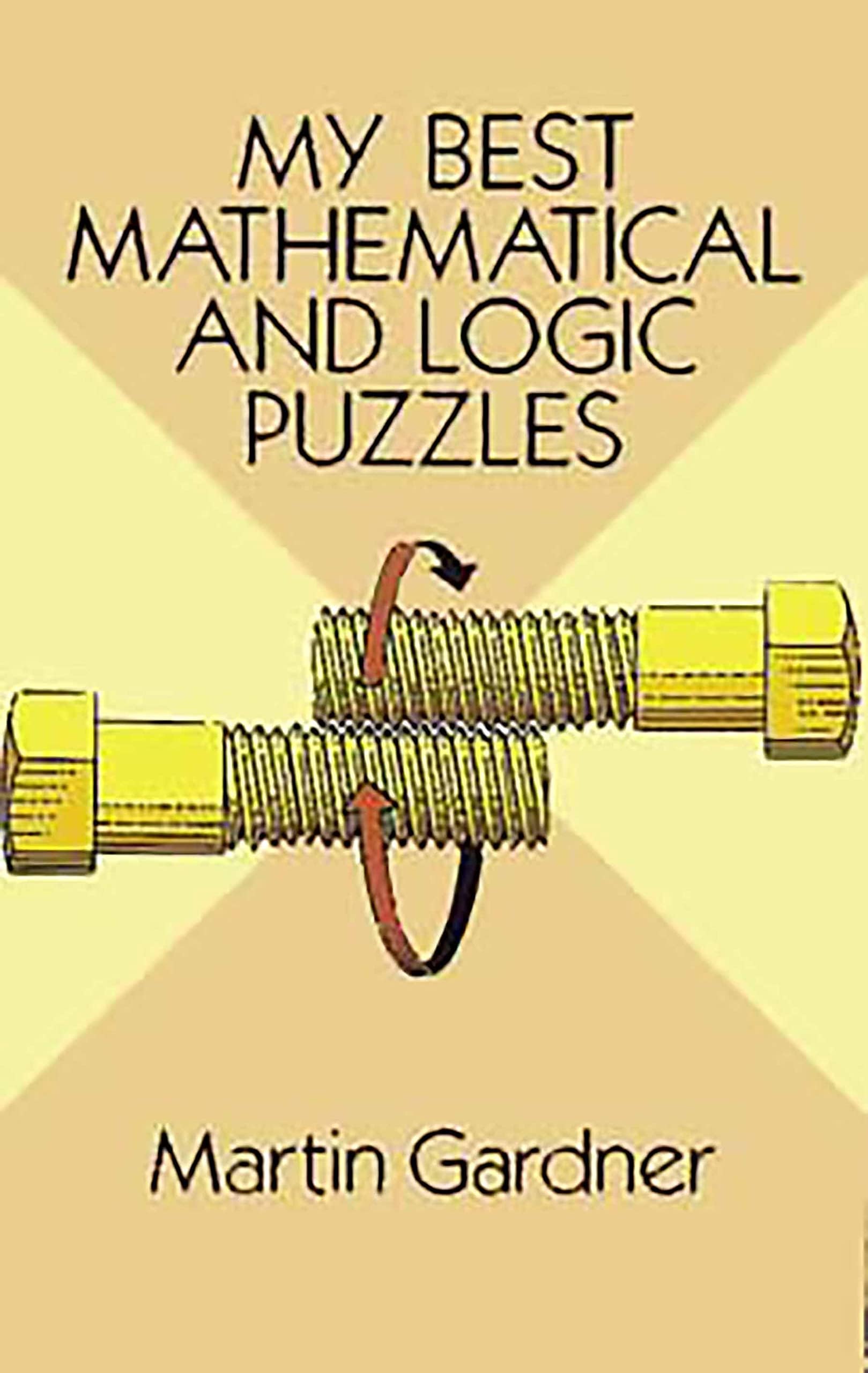
My Best Mathematical and Logic Puzzles (Dover Math Games & Puzzles)
Product ID: 105929609
Desertcart purchases this item on your behalf and handles shipping, customs, and support to Tunisia.
Over a period of 25 years as author of the Mathematical Games column for Scientific American , Martin Gardner devoted a column every six months or so to short math problems or puzzles. He was especially careful to present new and unfamiliar puzzles that had not been included in such classic collections as those by Sam Loyd and Henry Dudeney. Later, these puzzles were published in book collections, incorporating reader feedback on alternate solutions or interesting generalizations. The present volume contains a rich selection of 70 of the best of these brain teasers, in some cases including references to new developments related to the puzzle. Now enthusiasts can challenge their solving skills and rattle their egos with such stimulating mind-benders as The Returning Explorer, The Mutilated Chessboard, Scrambled Box Tops, The Fork in the Road, Bronx vs. Brooklyn, Touching Cigarettes, and 64 other problems involving logic and basic math. Solutions are included. Review: The Wheat of an Energetic Career! - I am really enjoying this short book of Martin Gardner's best logic and mathematical puzzles written for his Scientific American column. The problems range widely in difficulty, with some requiring only a few moments of reflection and other laying quite beyond my cognitive powers. The problems are entertainingly presented. Answers are provided in the back of the book; actually, more than half the length of the book is the answers section. Some readers have complained that the answers are inadequate, but I have not found this to be so. Gardner engages in name dropping, particularly in the answers section, probably to add glamour to his column. He will sometimes note "Two Harvard physics students wrote in with this solution," or "John Campbell of Astounding suggested this solution". Campbell was the famous editor who first published Asimov, Heinlein and Van Vogt, inaugurating the "Golden Age" of Science Fiction. Evidently he was smart in lots of ways! It gives a sense of group endeavor, as if everyone is working these problems. The book is short, but well worth the extremely cheap price from Dover. I wondered while reading this book whether American society as it currently exists would be capable of creating a figure like Martin Gardner. His closest analog might be the conservative columnist John Derbyshire, who is really of English provenance. While Gardner's skill set is technical in nature, I would place his work in the entertainment bracket, sort of a sweet by-product of our technico/literary education system. I'm not sure whether puzzles and brain teasers are strictly entertainment, or if they might serve a purpose similar to weight-lifting and conditioning to the athlete. No one has ever filled Gardner's shoes at Scientific American. The reason I fear is that the American education system and the general spiritual impetus of our culture as it now stands are not able to instill the simultaneous virtues in one individual. Of course, Gardner served no essential purpose--most people get by without challenging brain teasers-- but philosophically the question is worth pondering. Review: Distilled essence of math in its purest form - A math professor turned bartender, now working at the Bar of Philosophy, serves up three shots respectively of logic, probability, and geometry whiskey... and you have to drink them all at once. If that's your style, this is your book.
| Best Sellers Rank | #171,714 in Kindle Store ( See Top 100 in Kindle Store ) #6 in Mathematics Recreation & Games #22 in Puzzles (Kindle Store) #29 in Logic & Brain Teasers (Kindle Store) |
S**S
The Wheat of an Energetic Career!
I am really enjoying this short book of Martin Gardner's best logic and mathematical puzzles written for his Scientific American column. The problems range widely in difficulty, with some requiring only a few moments of reflection and other laying quite beyond my cognitive powers. The problems are entertainingly presented. Answers are provided in the back of the book; actually, more than half the length of the book is the answers section. Some readers have complained that the answers are inadequate, but I have not found this to be so. Gardner engages in name dropping, particularly in the answers section, probably to add glamour to his column. He will sometimes note "Two Harvard physics students wrote in with this solution," or "John Campbell of Astounding suggested this solution". Campbell was the famous editor who first published Asimov, Heinlein and Van Vogt, inaugurating the "Golden Age" of Science Fiction. Evidently he was smart in lots of ways! It gives a sense of group endeavor, as if everyone is working these problems. The book is short, but well worth the extremely cheap price from Dover. I wondered while reading this book whether American society as it currently exists would be capable of creating a figure like Martin Gardner. His closest analog might be the conservative columnist John Derbyshire, who is really of English provenance. While Gardner's skill set is technical in nature, I would place his work in the entertainment bracket, sort of a sweet by-product of our technico/literary education system. I'm not sure whether puzzles and brain teasers are strictly entertainment, or if they might serve a purpose similar to weight-lifting and conditioning to the athlete. No one has ever filled Gardner's shoes at Scientific American. The reason I fear is that the American education system and the general spiritual impetus of our culture as it now stands are not able to instill the simultaneous virtues in one individual. Of course, Gardner served no essential purpose--most people get by without challenging brain teasers-- but philosophically the question is worth pondering.
M**R
Distilled essence of math in its purest form
A math professor turned bartender, now working at the Bar of Philosophy, serves up three shots respectively of logic, probability, and geometry whiskey... and you have to drink them all at once. If that's your style, this is your book.
P**Y
66 brain teasers with explanations and answers
My brain was feeling a bit fuzzy, and figured it was time to start giving my aging bean a workout. I decided to research and add in some thinking challenges via puzzles, games, and word problems. I bought this book by Martin Gardner because I am already a fan of his. I love how he appreciates the sciences and skepticism. He had a long history of creating recreational math problems for the every day person to challenge themselves with. These aren't necessarily difficult, but some are a big challenge. It takes some time to readjust ones thinking in order to work through some of these. HENCE, a brain workout-- especially if not used to thinking along these lines. If you are, then this is just a fun maintenance activity. I ended up buying various books and hands on puzzles for myself, then bought duplicates to make a really neat gift basket. I included stuff like Sudoku, crosswords, search a words, then more complicated stuff including this book and some hands on puzzles. Great for just about anyone.
J**E
Good book, but Kindle edition is hard to navigate
The puzzles are great. However, it is tedious in the kindle edition to navigate from the puzzle to the answer. I believe the paper version may be more convenient for this book.
D**L
A good math puzzle book
If you like math and want to train your brain, this book is good.
B**E
the text and graphics in this book are very nice and clear
I have not had enough time with the book yet to properly review it. I bought it for my 8 year old son who loves math and games. The first thing to notice is that unike other books, the text and graphics in this book are very nice and clear. That is very important when you are trying to concentrate and learn, especially for a younger person. There is another part of the books with answers, they clearly explain every problem in pretty good detail. It is a good mix of puzzles. I recommend this book, will post a better review later.
O**A
Great
It's an amazing book
W**S
Better than expected
This is better than expected! It reminds me of pre-employment tests for some of the maintenance and operations jobs I've applied for. Well except less stress and more fun but I love math, applied mechanical aptitude and logic type puzzles. This is great. I'm not a nerd I swear. Lol. Hehehehe. Great books thanks.
R**J
Very good book
Each puzzle is fun and requires logical thinking to solve it. Another good part is that the solutions given also forces you to think a bit and is a kind of description which will add this extra thing to a question. This book is collection of those puzzle which will let you think intuitively.
D**.
Feinste mathematische Puzzle aus Gardners Kolumne
Martin Gardner war Wissenschaftsjournalist, größte Bekanntheit erreichte er mit seiner Kolumne 'Mathematical Games' im 'Scientific American', die er 25 Jahre ab 1957 verfasste; monatlich stellte er hier allgemein verständliche, spannende mathematische Themen vor, die stets in irgend einer Form überraschend Momente enthielten – Unterhaltungs- Mathematik in besten Sinn des Wortes. Darunter waren auch mathematische Spiele, wie 'Life' (Oktober 1970) von John Conway, der Gardners Leidenschaft für Puzzle und Spiele teilte, und den Puzzle- Großmeister verehrte. Aller sechs Monate widmete der Autor die Kolumne mathematischen Puzzeln oder Rätseln – er war dabei stets bemüht, neue interessante Aufgaben, die noch in keiner bekannten Sammlung enthalten waren, zu veröffentlichen. Das vorliegende Bändchen enthält eine Auswahl von 66 diese Probleme, darunter auch alt bekannte Klassiker, oder Varianten davon, etwa: die Reise des Polarforschers, die Überdeckung eines angesägten Schachbretts mit Dominosteinen, oder eine Version des Lügner Dilemmas; aber auch neue vertrackte Aufgaben sind darunter. Allen gemeinsam ist, dass zu ihrer Lösung weniger aufwendige Mathematik notwendig ist, als viel mehr ein wacher logischer Geist, der auch mal ausgetreten Pfade verlassen, und 'um die Ecke' denken kann. Das Büchlein ist liebevoll arrangiert, das Inhaltsverzeichnis listet alle Rätsel mit Namen, der Seite der Aufgabe und die der Lösung auf. Die Antworten sind ausführlich und vollständig, oft mit illustrierenden Skizzen, meist fügt der Autor auch noch einige Bemerkungen über die Geschichte des Problems und seiner Varianten an; das macht das Nachschlagen der Lösung auch dann lohnend, wenn man die Sache selbst herausgefunden hat.
P**A
🤔
😁👍
J**E
Classic puzzles by a master
Nice set of brain-teasers.
電**ん
青春時代が蘇りました
青春時代にガードナーの数学パズルにはまり,大学も理系に進みました.中年になり,そういえばあの頃読んで解いたパズルは英語ではどんな英語でかかれていたのかな?と思い,検索したところ,Kindle版でお安かったので速攻で購入.内容からいうと星は5個なのですが,他の方も書いておられるように解答に直接とべるようになっておらずそれが煩わしく星は4個になりました. 電子版にするときは,少し工夫してほしいものです.内容がいいだけにおしいかな.英語は簡単で高校生でもまともな人なら読めるでしょう.
Trustpilot
3 weeks ago
2 weeks ago