
Desertcart purchases this item on your behalf and handles shipping, customs, and support to Tunisia.
A New York Times Bestseller “At once a scholar’s homage to The Iliad and startlingly original work of art….A book I could not put down.” —Ann Patchett, author of The Dutch House A thrilling, profoundly moving, and utterly unique retelling of the legend of Achilles and the Trojan War from the bestselling author of Circe A tale of gods, kings, immortal fame, and the human heart, The Song of Achilles is a dazzling literary feat that brilliantly reimagines Homer’s enduring masterwork, The Iliad . An action-packed adventure, an epic love story, a marvelously conceived and executed page-turner, Miller’s monumental debut novel has already earned resounding acclaim from some of contemporary fiction’s brightest lights—and fans of Mary Renault, Bernard Cornwell, Steven Pressfield, and Colleen McCullough’s Masters of Rome series will delight in this unforgettable journey back to ancient Greece in the Age of Heroes. “A captivating retelling of The Iliad and events leading up to it through the point of view of Patroclus: it’s a hard book to put down, and any classicist will be enthralled by her characterisation of the goddess Thetis, which carries the true savagery and chill of antiquity.” — Donna Tartt, The Times Review: A twist on a classic tale. Lyrical and poetic. - When I was in high school (mid 80’s) Greek mythology (Iliad/Odyssey) was required reading. I tortured myself for hours attempting to understand the heavily worded passages filled with war and death. So, when my book club member picked “The Song of Achilles”, I read the summary and feared that it would be difficult to start, never-mind finish. And while I love to read, this didn’t seem like a book I would have selected or enjoyed. Yes, I like movies like “300” and “Gladiator”, and TV shows like “Spartacus”, but was I really ready to voluntarily enter the world of the Trojan war? Guess what? I did and I really, really liked it. The language was not difficult to understand, and the novel was not so heavily worded that I had to reread the passages over and over. The writing was simple (of course I stumbled over some of the names) and filled with new and inventive plot possibilities. But the most interesting thing about this story is how the story is told. We see the rise and fall of Achilles, through the eyes of his companion/lover, Patroclus. Exiled Prince, Patroclus, meets Achilles when he is sent to live with King Peleus. Achilles is the son of Peleus and the Sea Nymph, Thetis. Achilles is confident, handsome, fearless, not to mention destined for great things. Clumsy, awkward and shy, Patroclus is everything that Achilles is not. So, when Achilles picks Patroclus as his companion, everyone is shocked and dismayed. Soon we are allowed to follow their growing relationship from young boys to grown men, and from friends to lovers. Eventually, they are sent to train with Chiron (half horse/half man/Centaur) until Achilles (commanded by his mother) is sent into hiding (as a woman) in another kingdom. There he secretly marries the princess and sires a child. Patroclus finds him and they are dispatched to fight in the war (Paris has taken Helen to Troy and won’t return her). This is Achilles’ opportunity to show and prove his greatness. They toll for 10 years (even overcoming a plague) outside the gates of Troy. And then, following an affront to his reputation (the greedy King Agamemnon attempted to claim one of his possessions, Briseis, who he only saved to appease Patroclus), Achilles refuses to fight until he gets an apology, although this will mean several of his people will die. Without their greatest warrior, they are doomed. Patroclus tries to reason with Achilles but to no avail. So, in an attempt to make things better (amongst the men), restore Achilles reputation and help win the war, Patroclus sets out on a fool’s errand to attack the gates of Troy. Unfortunately, he is killed by Hector (Achilles arch enemy). Grieving (and dealing with a lot of guilt), Achilles sets out to avenge Patroclus’ death. He will stop at nothing until he gets his revenge by killing Hector. And while he achieves his goals, he too is killed (by Paris, with the help of Apollo). What I liked: 1. While you may think that Achilles is the hero or what the story is about, it is really about Patroclus, who loved him unconditionally regardless of his flaws. Yes, Achilles was beautiful, musically talented (lyre) and a skilled warrior, but he was also aloof and at times difficult. And while Patroclus saw his shortcomings, he loved him in spite of them. Eventually even giving his life to make sure that Achilles remained whole. 2. The dynamic between Achilles, his mother (Thetis) and Patroclus. While Thetis never thought Patroclus was good enough for her son and never understood their love, it is his telling their life stories and their mutual love that in the end softened her outer shell (ok, kind-of). She came to understand that Patroclus loved her son. 3. Briseis’ story. Her words of love to Patroclus and her willingness to stay with him forever, even if that meant sharing him with Achilles was simply beautiful. Not to mention, in the end she died on her own terms, refusing to be claimed (by Agamemnon) or enslaved again. 4. Achilles’ rage. I could imagine what Achilles was feeling as he circled the gates of Troy dragging Hector’s body behind him. I understood his grief and sympathized when he refused to give Priam his son, Hector’s remains. And I could visualize Achilles leaning over and caring for Patroclus’ remains, hoping that he would awaken or be resurrected. 5. Achilles’ death. It was beautifully written. “He turns his head a little, as if to watch it come. He closes his eyes and feels its point push through his skin, parting thick muscle, warming its way past the interlacing fingers of his ribs.” Once he avenged the death of the person he loved, he had nothing really to live for. He did not want to live in a world without his soulmate. I am undecided about: 1. The hasty conclusion. I would have liked to really see more of Pyrrhus’ reign. I did find it ironic that unlike Achilles (who was reared by his mortal father and Chiron), his son, Pyrrhus was allowed to grow and develop under Thetis. She believed that Achilles humanness made him vulnerable, so I was curious to see did this opportunity to raise another version of Achilles make a difference. Pyrrhus, while a great warrior and strategist, was cold, entitled, selfish and mean. The opposite of Achilles, who while aloof, was able to love, and yet they both had the same fate. Neither was fated to live forever. Ironically, Achilles’ son died for the same affront (claiming or taking a woman) that caused Achilles to stop fighting. In conclusion, I only touched on a few things from the book in this review. But be assured, there is a lot that made this a fascinating read. There was romance, treachery, war, passion (because there is a difference between romance and passion), tragedy and good old Greek mythology. What else do you need? 4.5 stars Review: FEELS. LOTS OF FEELS - 4.5 stars! “We were like gods at the dawning of the world, & our joy was so bright we could see nothing else but the other.” The Song of Achilles is a retelling of the life of Achilles through the point of view of his childhood friend Patroclus. Patroclus was a prince who made a mistake as a young boy and was exiled. He became friends with Achilles and the two were inseparable; they even both began training under Chiron the Centaur together even when Patroclus was not meant to be trained. There had always been a strong connection between Achilles and Patroclus, but over time friendship grew to love, and love into passion. Though their relationship may anger some, the two do not care, they only wished to be together. But then war against Troy comes calling, for both of them. And they must face fate, together. “He is a weapon, a killer. Do not forget it. You can use a spear as a walking stick, but that will not change its nature.” I picked up this book because I went to a book signing for author Taylor Jenkins Reid and she recommended this book to the crowd. After hearing her rave about it I was curious. I work in a library and requested it, and when another coworker saw I was going to read it she freaked out and became so excited because she loved this book. So basically at that point I had to read it. This book completely blew me away. I normally don’t read contemporary fiction, at least not anymore. But this book is something special. I love retellings, even if the story isn’t exact because I love other people’s interpretations. Plus I am a sucker for the male/male romance. Beautifully written, poetic, I fell in love with both characters despite their faults. And if you’ve read The Iliad, or seen any movies based on it, you know the outcome. Yet knowing what would happen, Miller still put her own unique spin on it and it was like reading a new ending. So so many feels, and I may have let a tiny tear escape (A TINY ONE). I will hold these men in my heart very dearly, their story is one I could never forget. “Name one hero who was happy." I considered. Heracles went mad and killed his family; Theseus lost his bride and father; Jason's children and new wife were murdered by his old; Bellerophon killed the Chimera but was crippled by the fall from Pegasus' back. "You can't." He was sitting up now, leaning forward. "I can't." "I know. They never let you be famous AND happy." He lifted an eyebrow. "I'll tell you a secret." "Tell me." I loved it when he was like this. "I'm going to be the first." He took my palm and held it to his. "Swear it." "Why me?" "Because you're the reason. Swear it." "I swear it," I said, lost in the high color of his cheeks, the flame in his eyes. "I swear it," he echoed. We sat like that a moment, hands touching. He grinned. "I feel like I could eat the world raw.”


| Best Sellers Rank | #283 in Books ( See Top 100 in Books ) #1 in Coming of Age Fantasy (Books) #1 in Greek & Roman Myth & Legend #1 in LGBTQ+ Classic Fiction |
| Customer Reviews | 4.5 out of 5 stars 133,391 Reviews |
M**K
A twist on a classic tale. Lyrical and poetic.
When I was in high school (mid 80’s) Greek mythology (Iliad/Odyssey) was required reading. I tortured myself for hours attempting to understand the heavily worded passages filled with war and death. So, when my book club member picked “The Song of Achilles”, I read the summary and feared that it would be difficult to start, never-mind finish. And while I love to read, this didn’t seem like a book I would have selected or enjoyed. Yes, I like movies like “300” and “Gladiator”, and TV shows like “Spartacus”, but was I really ready to voluntarily enter the world of the Trojan war? Guess what? I did and I really, really liked it. The language was not difficult to understand, and the novel was not so heavily worded that I had to reread the passages over and over. The writing was simple (of course I stumbled over some of the names) and filled with new and inventive plot possibilities. But the most interesting thing about this story is how the story is told. We see the rise and fall of Achilles, through the eyes of his companion/lover, Patroclus. Exiled Prince, Patroclus, meets Achilles when he is sent to live with King Peleus. Achilles is the son of Peleus and the Sea Nymph, Thetis. Achilles is confident, handsome, fearless, not to mention destined for great things. Clumsy, awkward and shy, Patroclus is everything that Achilles is not. So, when Achilles picks Patroclus as his companion, everyone is shocked and dismayed. Soon we are allowed to follow their growing relationship from young boys to grown men, and from friends to lovers. Eventually, they are sent to train with Chiron (half horse/half man/Centaur) until Achilles (commanded by his mother) is sent into hiding (as a woman) in another kingdom. There he secretly marries the princess and sires a child. Patroclus finds him and they are dispatched to fight in the war (Paris has taken Helen to Troy and won’t return her). This is Achilles’ opportunity to show and prove his greatness. They toll for 10 years (even overcoming a plague) outside the gates of Troy. And then, following an affront to his reputation (the greedy King Agamemnon attempted to claim one of his possessions, Briseis, who he only saved to appease Patroclus), Achilles refuses to fight until he gets an apology, although this will mean several of his people will die. Without their greatest warrior, they are doomed. Patroclus tries to reason with Achilles but to no avail. So, in an attempt to make things better (amongst the men), restore Achilles reputation and help win the war, Patroclus sets out on a fool’s errand to attack the gates of Troy. Unfortunately, he is killed by Hector (Achilles arch enemy). Grieving (and dealing with a lot of guilt), Achilles sets out to avenge Patroclus’ death. He will stop at nothing until he gets his revenge by killing Hector. And while he achieves his goals, he too is killed (by Paris, with the help of Apollo). What I liked: 1. While you may think that Achilles is the hero or what the story is about, it is really about Patroclus, who loved him unconditionally regardless of his flaws. Yes, Achilles was beautiful, musically talented (lyre) and a skilled warrior, but he was also aloof and at times difficult. And while Patroclus saw his shortcomings, he loved him in spite of them. Eventually even giving his life to make sure that Achilles remained whole. 2. The dynamic between Achilles, his mother (Thetis) and Patroclus. While Thetis never thought Patroclus was good enough for her son and never understood their love, it is his telling their life stories and their mutual love that in the end softened her outer shell (ok, kind-of). She came to understand that Patroclus loved her son. 3. Briseis’ story. Her words of love to Patroclus and her willingness to stay with him forever, even if that meant sharing him with Achilles was simply beautiful. Not to mention, in the end she died on her own terms, refusing to be claimed (by Agamemnon) or enslaved again. 4. Achilles’ rage. I could imagine what Achilles was feeling as he circled the gates of Troy dragging Hector’s body behind him. I understood his grief and sympathized when he refused to give Priam his son, Hector’s remains. And I could visualize Achilles leaning over and caring for Patroclus’ remains, hoping that he would awaken or be resurrected. 5. Achilles’ death. It was beautifully written. “He turns his head a little, as if to watch it come. He closes his eyes and feels its point push through his skin, parting thick muscle, warming its way past the interlacing fingers of his ribs.” Once he avenged the death of the person he loved, he had nothing really to live for. He did not want to live in a world without his soulmate. I am undecided about: 1. The hasty conclusion. I would have liked to really see more of Pyrrhus’ reign. I did find it ironic that unlike Achilles (who was reared by his mortal father and Chiron), his son, Pyrrhus was allowed to grow and develop under Thetis. She believed that Achilles humanness made him vulnerable, so I was curious to see did this opportunity to raise another version of Achilles make a difference. Pyrrhus, while a great warrior and strategist, was cold, entitled, selfish and mean. The opposite of Achilles, who while aloof, was able to love, and yet they both had the same fate. Neither was fated to live forever. Ironically, Achilles’ son died for the same affront (claiming or taking a woman) that caused Achilles to stop fighting. In conclusion, I only touched on a few things from the book in this review. But be assured, there is a lot that made this a fascinating read. There was romance, treachery, war, passion (because there is a difference between romance and passion), tragedy and good old Greek mythology. What else do you need? 4.5 stars
R**L
FEELS. LOTS OF FEELS
4.5 stars! “We were like gods at the dawning of the world, & our joy was so bright we could see nothing else but the other.” The Song of Achilles is a retelling of the life of Achilles through the point of view of his childhood friend Patroclus. Patroclus was a prince who made a mistake as a young boy and was exiled. He became friends with Achilles and the two were inseparable; they even both began training under Chiron the Centaur together even when Patroclus was not meant to be trained. There had always been a strong connection between Achilles and Patroclus, but over time friendship grew to love, and love into passion. Though their relationship may anger some, the two do not care, they only wished to be together. But then war against Troy comes calling, for both of them. And they must face fate, together. “He is a weapon, a killer. Do not forget it. You can use a spear as a walking stick, but that will not change its nature.” I picked up this book because I went to a book signing for author Taylor Jenkins Reid and she recommended this book to the crowd. After hearing her rave about it I was curious. I work in a library and requested it, and when another coworker saw I was going to read it she freaked out and became so excited because she loved this book. So basically at that point I had to read it. This book completely blew me away. I normally don’t read contemporary fiction, at least not anymore. But this book is something special. I love retellings, even if the story isn’t exact because I love other people’s interpretations. Plus I am a sucker for the male/male romance. Beautifully written, poetic, I fell in love with both characters despite their faults. And if you’ve read The Iliad, or seen any movies based on it, you know the outcome. Yet knowing what would happen, Miller still put her own unique spin on it and it was like reading a new ending. So so many feels, and I may have let a tiny tear escape (A TINY ONE). I will hold these men in my heart very dearly, their story is one I could never forget. “Name one hero who was happy." I considered. Heracles went mad and killed his family; Theseus lost his bride and father; Jason's children and new wife were murdered by his old; Bellerophon killed the Chimera but was crippled by the fall from Pegasus' back. "You can't." He was sitting up now, leaning forward. "I can't." "I know. They never let you be famous AND happy." He lifted an eyebrow. "I'll tell you a secret." "Tell me." I loved it when he was like this. "I'm going to be the first." He took my palm and held it to his. "Swear it." "Why me?" "Because you're the reason. Swear it." "I swear it," I said, lost in the high color of his cheeks, the flame in his eyes. "I swear it," he echoed. We sat like that a moment, hands touching. He grinned. "I feel like I could eat the world raw.”
J**N
The Song of Achilles: Fate, Fury, and Friendship Make For A Rave Review
Originally posted on my blog at https://rantandraveaboutbooks.com/2016/07/29/the-song-of-achilles-fate-fury-and-friendship-make-for-a-rave-review/ First, I think it’s important to mention that The Iliad is my favorite book, so my connection to the characters and this story is much deeper than most. I read The Iliad in 2001 and have since been obsessed with all things Greek mythology as well as anything related to the Trojan War. I’ve read The Iliad a total of six times in its entirety, so when I read The Song of Achilles, a work of historical fiction based on the book, I was completely blow away. I can’t remember the last time I stared at the last page of a novel and felt that satisfied. I recently wrote a post about The Iliad if you want to learn more about the original and the modern-day spin I added to it. We read The Song of Achilles as our Book of the Month for Hype or Like Friday, a Goodreads group I co-created with Britt and Larkin, and I’m looking forward to reading the reviews. If you’re a member of the group or have reviewed this book in the past, feel free to share the link to your review in the comments. I often switch up my review style, and I’ve decided to break the novel into 5 categories: Writing, Characters, Plot, Historical Accuracy, and Themes. Note: If you haven’t read The Iliad or are unaware of the history/mythology surrounding the Trojan War, then consider this your warning that there are major spoilers below that explain both The Iliad and The Song of Achilles in great detail. The Writing… Madeline Miller’s prose is so beautiful I was instantly drawn into this novel from the first page. It’s really brilliant, and that’s a word I’ve only used to describe Stephen King’s prose, so that actually means something to me in terms of quality. I’m impressed with very few authors’ writing style, which made this book unputdownable for me. I didn’t realize until after I read the novel that Miller studied and teaches classic literature, and it really shines through. The Song of Achilles is so well written I couldn’t believe this was her first novel. I avoided this one for a while because I was afraid it couldn’t live up to my favorite book. I never thought a re-telling could do Homer justice, but this book knocked it out of the park. The Characters… Choosing Patroclus as the narrator of this story was a BRILLIANT idea! My first thought was how can Patroclus narrate from first person POV when his death is what drives Achilles to kill Hector in a fit of rage, knowing it will lead to his own death? I don’t think this counts as a spoiler considering The Iliad is over three thousand years old and most people know the story of Achilles by now. And that’s not even the most important aspect of this book. I’ve always loved Patroclus and Achilles together. They are The Iliad, at least they are for me. Homer never mentions they’re lovers in his work, but some historians believe the reason Achilles was so distraught over Patroclus’ death was because they were in a relationship. His pain would’ve been real whether they were friends or lovers. Who wouldn’t mourn the loss of their best friend, someone they grew up with? But that’s the spin Miller takes on my favorite classic that really intrigued me. My other favorite character is Briseis, who we later meet during the Trojan War when King Agamemnon holds her captive. The Iliad starts off with Achilles fighting with Agamemnon over Briseis. It plays out almost the same but a bit different in this book. Regardless of the representation, we still get the same gist that the trio spent years living together, which is another part of The Iliad and this book I really liked. “She is in Agamemnon’s custody, but she is Achilles’ prize still. To violate her is a violation of Achilles himself, the gravest insult to his honor. Achilles could kill him for it, and even Menelaus would call it fair.” Achilles is such a tough, strong-willed character that overpowers Patroclus’ more sensitive side, but the two of them work so well together. When Achilles is about to go off the rails, it’s always Patroclus that can rein him in. The Plot… Patroclus was a prince, exiled and sent to live at King Peleus’ court. Achilles’ father wasn’t keen on Patroclus and Achilles’ friendship because he was no longer a prince, but Achilles chose him and that was all that mattered. Everyone listened to what the prince said, and when Achilles speaks in the book, I really felt the power behind his words. His arrogance and air of entitlement can be an issue with some readers, but I see his character from a completely different perspective than most. I like that Miller starts off with Patroclus at age five, drawing you into the world of Achilles, the handsome demi-god with skills that would’ve made every Greek jealous except Patroclus. He admired Achilles, loved him from a distance for years until one day they kissed and the rest is history. When Helen of Sparta, later known as Helen of Troy, is allegedly kidnapped and taken to Troy this prompts Achilles’ need to fight. In The Iliad, Aphrodite promises Paris, Prince of Troy, a beautiful woman, and Helen was considered one of the most beautiful women of that time. This is not shown in the novel, but I thought I’d mention it to give you some context. The entire war and story is set in motion by Helen and Paris’ relationship that angers her husband Menelaus, who convinces his brother King Agamemnon to go to war. “Yet this beautiful spear had been fashioned not in bitterness, but love. Its shape would fit no one’s hand but Achilles’, and its heft could suit no one’s strength but his. And though the point was keen and deadly, the wood itself slipped under our fingers like the slender oiled strut of a lyre.” Slight Confession: I shed a few tears at Patroclus’ death. I cry every time I read The Iliad because it’s so powerful and emotionally draining to read and feel Achilles’ pain over his friend, and in this story, his lover. I won’t spoil the ending for you, but I will say that I absolutely loved the conclusion to Patroclus and Achilles’ story. The Historical Accuracy… Everything from Odysseus’ search for Achilles in a foreign court to the divine intervention from the gods was completely accurate. We see Apollo help Paris shoot the arrow that leads to Achilles’ death. He tells him that Achilles might be part god but he’s also man and even gods can be killed. I was afraid this book would take liberties with history. I was thoroughly pleased that did not happen here. While some things were not exactly the same, it was spot on for the most part, which made me smile every time I read another part that lived up to what I’d hoped. I had so many expectations before I opened the book on my Kindle, and I’m thrilled that I can Rave over The Song of Achilles for all the right reasons. The Themes… There are five recurring themes in The Iliad that are also presented in this novel. Achilles knows his destiny is to be the best fighter to ever live, and when his mother Thetis, a sea goddess, tells him he will die if he goes to Troy, he chooses fame and glory over homecoming. He was raised with the assumption he would be the greatest warrior the Greeks had ever seen. While this is true, his pride is a problem that starts to wear on the Greek companies in Troy after Achilles is unable to come to a truce with Agamemnon. The last of her fire was gone; only marble remained. “It is true. But there is more, and worse that he has not said.” The words came tonelessly, as a statue would speak them. “If you go to Troy, you will never return. You will die a young man there.” Achilles’ face went pale. “It is certain?” This is what all mortals ask first, in disbelief, shock, fear. Is there no exception for me? “It is certain.” We see homecoming after the war in the Odyssey with Odysseus, but fate is determined by the Fates themselves, the spinners of life and death. Achilles’ mother pleads with the gods to save her son, but his fate was already set and unavoidable. Odysseus inclines his head. “True. But fame is a strange thing. Some men gain glory after they die, while others fade. What is admired in one generation is abhorred in another.” He spread his broad hands. “We cannot say who will survive the holocaust of memory. Who knows?” He smiles. “Perhaps one day even I will be famous. Perhaps more famous than you.” Another important theme is the concept of honor. Achilles goes to Troy because he knows it’s the honorable thing to do. He also fights with Agamemnon over Briseis because he believes that the king is a dishonorable man and by taking his war prize, who later becomes his friend, he’s showing Achilles a lack of respect and therefore has not earned his in return. The Wrath of Achilles is the most notable theme of The Iliad. His anger for Agamemnon is present from the beginning of the book until the bitter end, and his anger over Patroclus’ death only intensifies that fury that he’s waited to unleash. He tears through Trojans like they’re nothing, ripping apart their best fighters until he finally gets the chance to make Hector, Prince of Troy and best of the Trojans, suffer for what he did to his friend. Hector’s eyes are wide, but he will run no longer. He says, “Grant me this. Give my body to my family, when you have killed me.” Achilles makes a sound like choking. “There are no bargains between lions and men. I will kill you and eat you raw.” His spearpoint flies in a dark whirlwind, bright as the evening-star, to catch the hollow at Hector’s throat. The one thing I really liked about The Iliad is that we saw a great deal of Hector. We saw very little of Hector in The Song of Achilles, and I suppose that’s because of the first person narration by Patroclus. There’s so many wonderful quotes I would’ve loved to have read from The Iliad that perfectly capture the words spoken between Hector and Achilles. Hector and Achilles are such a great match for each other because they both want the fame and glory that comes with death, and I really liked Hector in The Iliad. I only wish I would’ve seen more of him in this story. This may either tie or beat Red Rising for the longest review I’ve ever written. I hope this all makes sense and doesn’t come off as a Greek lit fangirl ramble.
Y**2
If you enjoy Greek mythology
The Song of Achilles is one of my all-time favorite novels. I’ve read it more than once, and each time it leaves the same lasting impression. Madeline Miller takes a familiar Greek myth and transforms it into a beautiful, emotional story filled with love, loyalty, destiny, and heartbreak. The relationship between Achilles and Patroclus is written with incredible depth and tenderness, making the characters feel vivid and real. Even knowing the outcome of the myth, I found myself completely invested in their journey. If you enjoy Greek mythology, historical fiction, or character-driven stories, you’ll love this novel. Miller’s prose is lyrical and captivating, and the ending stayed with me long after I turned the final page. A truly unforgettable read.
L**N
An amazing story from an amazing author
My first book by M. M. , and can't wait to read more. Again out of my typical genre but just beautifully written, stunning character development on a topic that most have no real interest in. Just perfection
G**E
my hear
I’m literally crying right now. This was written so beautifully, and now my interest has peaked. I took Latin in high school for two years, and my teacher spoke a lot about Greek mythology. I was barely listening then, but now I wish I could go back and soak up everything he taught us.
J**I
Such a great read
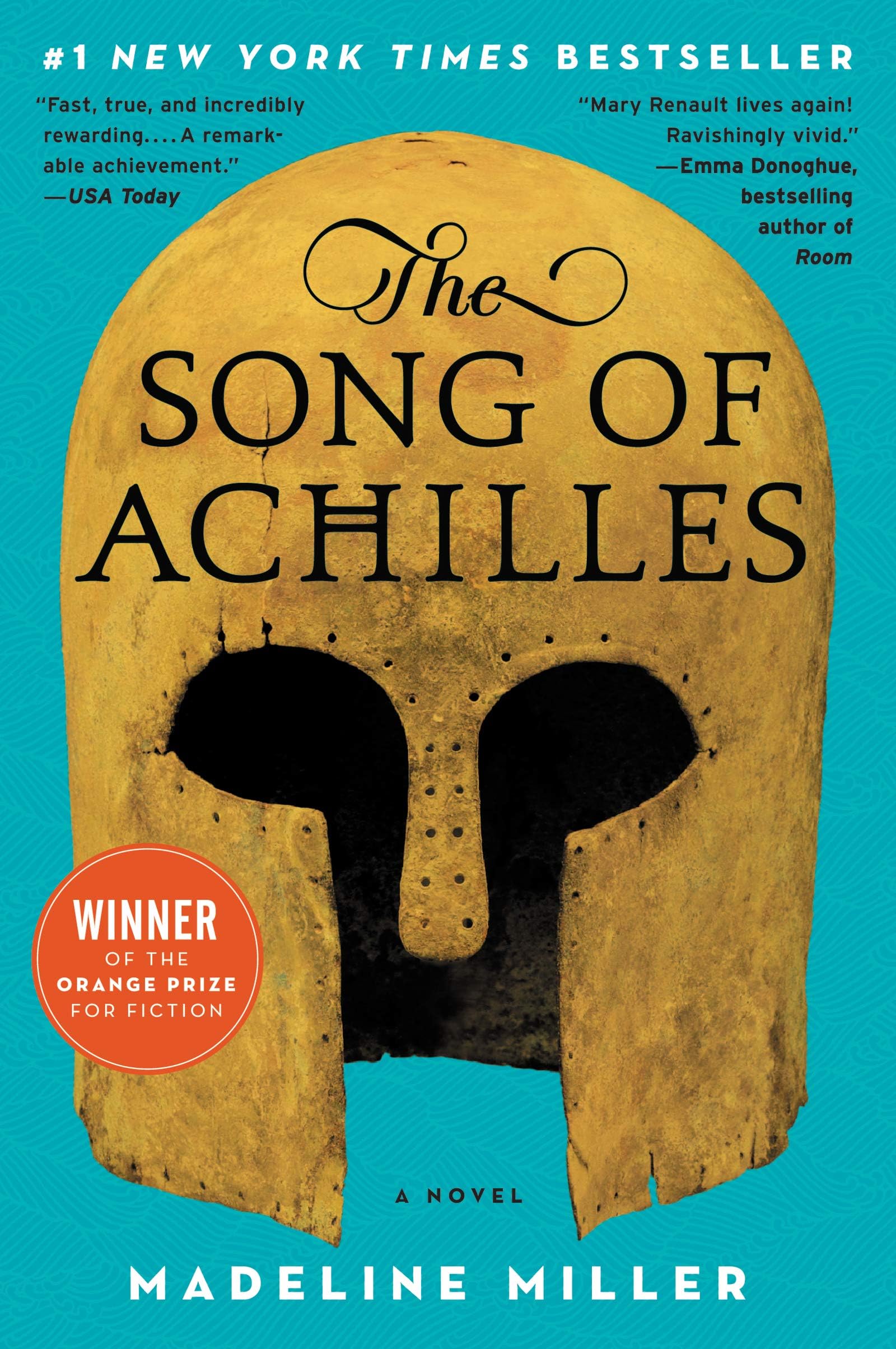
This book wrecked me in the most beautiful way. A New York Times bestseller and winner of the Orange Prize for Fiction, and it absolutely earns every bit of praise. That cover with the worn bronze helmet against the bright teal is so perfect — simple, iconic, and it hints at the humanity underneath the legend. It’s not just a war story, it’s a love story told with so much tenderness and care. No spoilers, but Miller retells the myth of Achilles through Patroclus, and it changes everything. The writing is lyrical without ever feeling distant. It’s intimate, warm, and devastatingly human. I felt like I was growing up alongside them, training, laughing, and dreading what the myths say must come. I went in knowing the broad strokes of the Iliad, but I was not prepared for how deeply I would feel this version. It’s about love, honor, fate, and choice, and it lingers long after the last page. If you love myth retellings, gorgeous prose, or stories that break your heart and put it back together, read this. An instant favorite and an easy five stars.
A**S
Great read, but not nearly as powerful as Circe
Song of Achilles was Miller's first attempt at a re-telling of a Greek myth, but is greatly inferior to her second, last year's masterpiece Circe. Here she has chosen probably the most famous series of stories in the canon -- Achilles' exploits in the Trojan War -- and the fact that we all know the story makes for an odd sensation. It basically IS the Iliad (and other Greek sources). She's a beautiful, fluid writer, but frankly, you're better off reading the original, which is even better. What saves Song of Achilles is the fact that the blood-and-guts of the war scenes are only half the novel. The other half tells of Achilles' -- who is half-god half-human -- childhood, and his relationship with Patroclus, Achilles' chosen companion and a minor character in the epics, but here the narrator and second protagonist. The sources differ somewhat as to the nature of their relationship, but Miller (wisely, for drama's sake) unambiguously makes it romantic, which makes the whole dramatic conclusion as much a love story as anything else. This thread -- Patroclus' and Achilles' love for each other -- binds the novel together, which is a very fine thing. The greatness of Circe, which Miller wrote several years after Song of Achilles, lies in her taking an obscure goddess and, while never venturing far past the ancient texts, making her, well, all too human. A lot more thought went into that work than this one, and a lot more is said along the way. Song of Achilles is, in the end, just a Greek myth retold in modern language. For its few readers who don't know the story (btw, it stops before the famous wooden horse scene, sadly) it will be a marvelous read, an exciting, rollicking adventure, although thanks to frequent godly intervention and various ironclad fates that are revealed early in the story, the outcome's never in doubt. For those of us who know the story, it's something less than that, though still a lot of fun. A word must be said about Miller's skill, though. She's marvelous at this. Her tone is dead-perfect and never wavering. She writes in perfectly modern English but maintains an epic edge to her language, as if she truly was repeating a story borne over centuries in an oral tradition, to a bunch of friends by a fire. Which, of course, the Iliad and most of the rest of the epics were. That can't be easy, and I look forward to the next one she takes on. There are, to be sure, some slip-ups in Song of Achilles, befitting her first attempt at it in novel form (for me, the biggest is when she tries to create another love interest for Patroclus in the form of a girl seized in combat, as if she didn't want his gayness to be complete, and then kills her off in the end ... the character does appear in the texts, playing a quite crucial role actually, but the love interest is completely made up). There are none that I remember in Circe. So read them both, they are well worth it, but this one is just the appetizer.
T**K
A breathless, beautiful masterpiece that stays with you.
The Song of Achilles is an extraordinarily well-built and totally immersive journey into Ancient Greece. I was captivated by the relationship between Achilles and Patroclus—watching it evolve from a prickly, uncomfortable childhood connection into a flourishing, unbreakable bond. Madeline Miller’s writing makes you feel their romance deeply, yet it never feels like a "modern" romance; it is a profound, soul-deep knowing forged during their years under the centaur, Chiron. When they finally face the savage chaos of the Trojan War, their devotion remains the one steady thing in an upside-down world. Miller’s pacing is flawless and her prose is so clear and purposeful that my mind never once strayed. I truly couldn't put it down—housework and errands were completely forgotten! I finished the final page holding my breath. While I enjoyed Circe, this story reached my core in a way few books ever do. Highly recommended.
R**A
5/5 ! Indispensable for a personal library!
Achilles was the son of a mortal king, Peleus, and an immortal, cold and cruel goddess, Thetis. He was born for glory and trained as such. Every inch a Prince, he was the most skilled warrior, the most irresistible youth and impeccable in his demeanor. He met Patroclaus by chance when the latter was exiled to the kingdom of Peleus for committing a shameful crime. He was an awkward, fumbling teenager, the exact opposite of Achilles. The two develop an unflinching bond of friendship, much to the surprise of everyone and displeasure and chagrin of Peleus and, particularly, Thetis. However, they were trained by the Centaur, Chiron - Achilles to be an unconquerable soldier and Patroclaus to be dexterous in the art of medicine. Their relationship is fleshed out from the age of 12 until the end of this tragic story. However, they move beyond tragedy as they unite in the afterlife. The book reads like a verse rather than prose. The narrative is descriptive, sensual, lyrical, captivating and, at times, haunting. I found it hard to shut down my Kindle every time I had to pause my reading. In fact, the portrayal painted a vivid picture in my imagination as if the scenes were taking place before my very eyes! Anyone with the love for Greek mythology will love this book to the core. It's a must have for every personal library!
D**.
My new favorite book
Miller has a way with words, that's undeniable. In this book, we are presented with the history of Achilles and Patroclus and the development of their friendship (and love!) throughout their lives. Prepare to laugh, prepare to cry. I enjoyed it immensely and it is very easy to like the characters as flawed as they are. My love for Ancient Greek mythology has been revived. Just do yourself a favor and buy this book - you won't be disappointed.
H**A
Amazing!
The beginning is good but towards the middle it’s pretty slow and you might wonder if it’ll live up to the hype but once you enter the ending it’s just so intense and emotional and it’s an experience! I loved it!
W**S
I love it!
perfect
Trustpilot
1 day ago
2 months ago