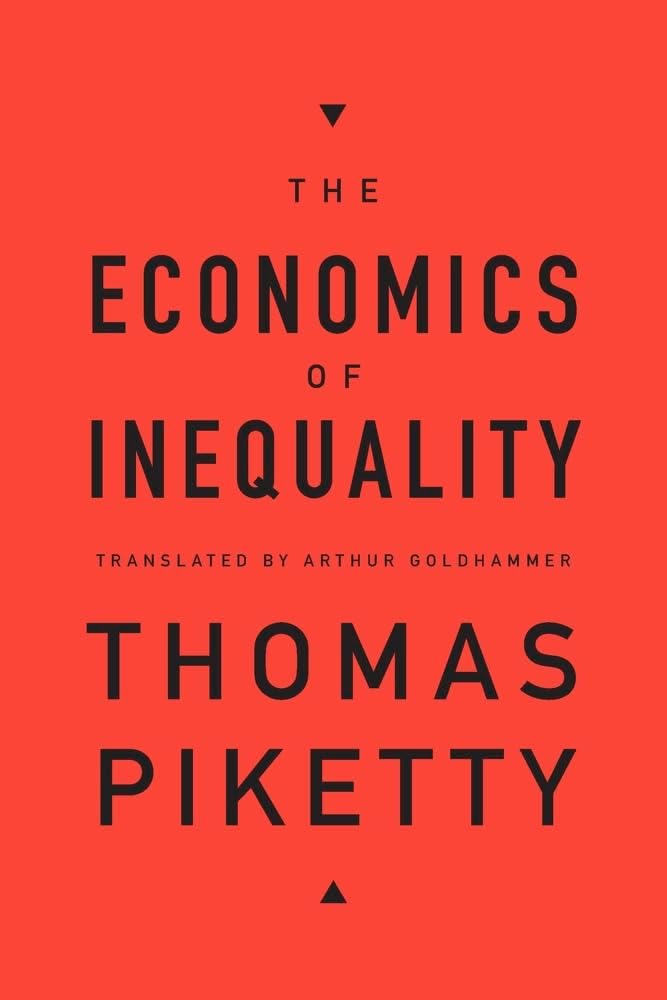
The Economics of Inequality
Product ID: 16419040
Desertcart purchases this item on your behalf and handles shipping, customs, and support to Tunisia.
Thomas Piketty―whose Capital in the Twenty-First Century pushed inequality to the forefront of public debate―wrote The Economics of Inequality as an introduction to the conceptual and factual background necessary for interpreting changes in economic inequality over time. This concise text has established itself as an indispensable guide for students and general readers in France, where it has been regularly updated and revised. Translated by Arthur Goldhammer, The Economics of Inequality now appears in English for the first time. Piketty begins by explaining how inequality evolves and how economists measure it. In subsequent chapters, he explores variances in income and ownership of capital and the variety of policies used to reduce these gaps. Along the way, with characteristic clarity and precision, he introduces key ideas about the relationship between labor and capital, the effects of different systems of taxation, the distinction between “historical” and “political” time, the impact of education and technological change, the nature of capital markets, the role of unions, and apparent tensions between the pursuit of efficiency and the pursuit of fairness. Succinct, accessible, and authoritative, this is the ideal place to start for those who want to understand the fundamental issues at the heart of one of the most pressing concerns in contemporary economics and politics. Review: Extremely Valuable Book - Thomas Picketty, as an author, make reading enjoyable. As a scholar, he has an uncanny ability to process large amounts of data, interpret and expand theoretical explanations, and turn complex ideas and problems into understandable written works. Review: Mixes theory and empiricism well - Having read Capital prior to The Economics of Inequality, I expected empiricism to come first and theory second. However, I was pleasantly surprised to find a more palatable balance of the two. Piketty's goal is to determine whether or not "social justice" policies can be justified using economic reasoning, and if so what is the best policy mix. Piketty quickly introduces the reader to Rawls' "Maxamin" social justice theory, the idea that policies should aim to maximize the minimum opportunity available to everyone. In order to satisfy this goal, he offers two broad policy categories: direct redistribution (wage/price/industrial policies) vs. fiscal redistribution (tax and transfer). His aim is to separate the policies that pull economies from Pareto efficiency (pure redistribution), and those that push economies toward Pareto efficiency. Thus, while Marxist political theory is always in the background, political ends are not necessarily placed ahead of economic ends. A constant theme throughout the book involves the role of prices. Are they allocative or simply distributive (between capital owners and laborers)? Supporters of the allocative role of prices note that if the price of labor is lower relative to capital, labor-intensive firms will expand more than capital-intensive firms given the relative cheapness of labor...and vice-versa. Supporters of the distributive role of prices believe that the aggregate workforce is a fixed function of the capital stock, focusing on bargaining power of the laborer relative to the capital owner in wage setting. As long as capital-labor substitution is possible, fiscal redistribution allows for capital income to be shifted to labor without the negative effects on the cost of labor/level of employment that generally accompany direct redistribution (i.e. increasing minimum wage and benefits). In this case, fiscal redistribution does not have an allocative impact on prices, though it may impact saving/capital accumulation. If the elasticity of capital-labor substitution is >1, a 1% increase in wages will result in a >1% decrease in employment. Labor's share of income would fall in this scenario. If <1, direct redistribution may be better. If =0, then prices are arguably purely distributive and not allocative. If the elasticity of capital-labor substitution were to truly equal 0, Marxism would be supported in that the capital owner need not exist. The existing stock of capital must simply be matched to an appropriate workforce and a certain amount of output directed to its maintenance and increase over time (although Piketty acknowledges that this still doesn't fully address the price system's ability to direct production). Regarding the impact of fiscal redistribution on saving/capital accumulation, one must look to the elasticity of the supply of capital. Empirically, the elasticity of the supply of capital is close to zero for individual households, implying that a 1% reduction in the return on capital does not translate into a similar reduction in savings. It actually suggests people save more to achieve desired future income, despite increased attractiveness of current consumption. This applies to interest rate levels as well, in that higher rates may actually lead to less saving since desired future income can be achieved without giving up as much current consumption. For firms, however, even if the elasticity of the capital supply is low, on an international stage firms can shift capital to low-tax regimes, potentially causing domestic unemployment. In the context of bargaining power, Piketty discusses the battle between the monopoly power of unions and the monopsony power of employers. Monopsony power comes from firm-specific human capital and limitations on geographical mobility. If an employer is in fact a monopsony, fiscal redistribution would simply allow employers to lower wages, negating positive effects. He talks about low wage opportunities disappearing (underemployment and lower participation rates) starting in the '70s, offering explanations like incarceration. He also notes increased inequality since 1970 may be due to skill-based technological change, where new technology places a premium on previously untapped skills. However, more broadly, he notes that the standard of living was roughly 10 times higher in 1990 than in 1870, undeniably due to increases in the productivity of labor. Piketty highlights that, due to the inter-temporal nature of credit markets, issues such as adverse selection, moral hazard, lack of borrowing credit data, concentrated ownership, and political risks may impede international capital flows, slowing convergence between poor and rich countries. He says that credit rationing as a solution has often failed for lack of direction on how to allocate, and that granting land and capital (redistribution) has been more successful. Additionally, Piketty attacks the "Kuznets inequality curve," which says that inequality is high when countries are in the early stages of development but then converge thereafter, for the lack of any natural mechanism to support it. Regarding education, Piketty states that compulsory education should have large effects on human capital, but more funding/resources may not impact generational mobility if family well-being is a benchmark for individual success. In other words, if inequality is sourced at the family level, throwing more money at education may be in vain. Towards the end, Piketty touches on Keynesian stimulus, saying tax and spend may be useful for redistribution but as stimulus it's on shaky theoretical grounds. He seems to acknowledge and accept the "stickiness" of wages and prices, but rejects the paradox of thrift, stating that purchasing power is nearly always consumed or invested in some way. Thus it doesn't matter if the wealthy are investing or the poor are spending, tax and spend doesn't logically provide stimulus. However, he points out that the makeup of consumption (i.e. the industries stimulated) may matter, but notes that stimulus tends to be short term. For deficit stimulus, he notes that the return on capital may increase as the stock of public debt grows (presumably from a crowding-out-type effect), potentially resulting in undesirable upward redistribution. Overall, particularly in the first half of the book, Piketty creates an easy to follow flow from theory to empiricism and back. The step-wise process is reader friendly and is helpful for understanding how external effects of policy ripple from one area to another. I really appreciate the fact that he often restated free-market arguments in full, committing serious time to ensuring the reader understands both sides of the discussion...an intellectually honest strategy that my have been lost a little in Capital.




| Best Sellers Rank | #305,516 in Books ( See Top 100 in Books ) #13 in Unemployment #166 in Income Inequality #192 in Economic Policy & Development (Books) |
| Customer Reviews | 4.4 out of 5 stars 243 Reviews |
S**E
Extremely Valuable Book
Thomas Picketty, as an author, make reading enjoyable. As a scholar, he has an uncanny ability to process large amounts of data, interpret and expand theoretical explanations, and turn complex ideas and problems into understandable written works.
D**G
Mixes theory and empiricism well
Having read Capital prior to The Economics of Inequality, I expected empiricism to come first and theory second. However, I was pleasantly surprised to find a more palatable balance of the two. Piketty's goal is to determine whether or not "social justice" policies can be justified using economic reasoning, and if so what is the best policy mix. Piketty quickly introduces the reader to Rawls' "Maxamin" social justice theory, the idea that policies should aim to maximize the minimum opportunity available to everyone. In order to satisfy this goal, he offers two broad policy categories: direct redistribution (wage/price/industrial policies) vs. fiscal redistribution (tax and transfer). His aim is to separate the policies that pull economies from Pareto efficiency (pure redistribution), and those that push economies toward Pareto efficiency. Thus, while Marxist political theory is always in the background, political ends are not necessarily placed ahead of economic ends. A constant theme throughout the book involves the role of prices. Are they allocative or simply distributive (between capital owners and laborers)? Supporters of the allocative role of prices note that if the price of labor is lower relative to capital, labor-intensive firms will expand more than capital-intensive firms given the relative cheapness of labor...and vice-versa. Supporters of the distributive role of prices believe that the aggregate workforce is a fixed function of the capital stock, focusing on bargaining power of the laborer relative to the capital owner in wage setting. As long as capital-labor substitution is possible, fiscal redistribution allows for capital income to be shifted to labor without the negative effects on the cost of labor/level of employment that generally accompany direct redistribution (i.e. increasing minimum wage and benefits). In this case, fiscal redistribution does not have an allocative impact on prices, though it may impact saving/capital accumulation. If the elasticity of capital-labor substitution is >1, a 1% increase in wages will result in a >1% decrease in employment. Labor's share of income would fall in this scenario. If <1, direct redistribution may be better. If =0, then prices are arguably purely distributive and not allocative. If the elasticity of capital-labor substitution were to truly equal 0, Marxism would be supported in that the capital owner need not exist. The existing stock of capital must simply be matched to an appropriate workforce and a certain amount of output directed to its maintenance and increase over time (although Piketty acknowledges that this still doesn't fully address the price system's ability to direct production). Regarding the impact of fiscal redistribution on saving/capital accumulation, one must look to the elasticity of the supply of capital. Empirically, the elasticity of the supply of capital is close to zero for individual households, implying that a 1% reduction in the return on capital does not translate into a similar reduction in savings. It actually suggests people save more to achieve desired future income, despite increased attractiveness of current consumption. This applies to interest rate levels as well, in that higher rates may actually lead to less saving since desired future income can be achieved without giving up as much current consumption. For firms, however, even if the elasticity of the capital supply is low, on an international stage firms can shift capital to low-tax regimes, potentially causing domestic unemployment. In the context of bargaining power, Piketty discusses the battle between the monopoly power of unions and the monopsony power of employers. Monopsony power comes from firm-specific human capital and limitations on geographical mobility. If an employer is in fact a monopsony, fiscal redistribution would simply allow employers to lower wages, negating positive effects. He talks about low wage opportunities disappearing (underemployment and lower participation rates) starting in the '70s, offering explanations like incarceration. He also notes increased inequality since 1970 may be due to skill-based technological change, where new technology places a premium on previously untapped skills. However, more broadly, he notes that the standard of living was roughly 10 times higher in 1990 than in 1870, undeniably due to increases in the productivity of labor. Piketty highlights that, due to the inter-temporal nature of credit markets, issues such as adverse selection, moral hazard, lack of borrowing credit data, concentrated ownership, and political risks may impede international capital flows, slowing convergence between poor and rich countries. He says that credit rationing as a solution has often failed for lack of direction on how to allocate, and that granting land and capital (redistribution) has been more successful. Additionally, Piketty attacks the "Kuznets inequality curve," which says that inequality is high when countries are in the early stages of development but then converge thereafter, for the lack of any natural mechanism to support it. Regarding education, Piketty states that compulsory education should have large effects on human capital, but more funding/resources may not impact generational mobility if family well-being is a benchmark for individual success. In other words, if inequality is sourced at the family level, throwing more money at education may be in vain. Towards the end, Piketty touches on Keynesian stimulus, saying tax and spend may be useful for redistribution but as stimulus it's on shaky theoretical grounds. He seems to acknowledge and accept the "stickiness" of wages and prices, but rejects the paradox of thrift, stating that purchasing power is nearly always consumed or invested in some way. Thus it doesn't matter if the wealthy are investing or the poor are spending, tax and spend doesn't logically provide stimulus. However, he points out that the makeup of consumption (i.e. the industries stimulated) may matter, but notes that stimulus tends to be short term. For deficit stimulus, he notes that the return on capital may increase as the stock of public debt grows (presumably from a crowding-out-type effect), potentially resulting in undesirable upward redistribution. Overall, particularly in the first half of the book, Piketty creates an easy to follow flow from theory to empiricism and back. The step-wise process is reader friendly and is helpful for understanding how external effects of policy ripple from one area to another. I really appreciate the fact that he often restated free-market arguments in full, committing serious time to ensuring the reader understands both sides of the discussion...an intellectually honest strategy that my have been lost a little in Capital.
A**E
Short, very important, book on economic inequality in America and Europe
Piketty's other books tend to run 500 pages or more (~700 pages for "Capital in the 21st Century"), tomes that require a significant time commitment to get through. In "The Economics of Inequality", Piketty boils down the data to about 140 pages (plus endnotes), and explains the causes of economic inequality. This book blew my mind, because Piketty showed clearly the problem in America is *not* the billionaires. The diverging wages between average college grads (particularly tech trained ones) and folks with a high school degree and no special skills over the last 50 years is the problem. In 1970, the wages of the top of the middle 80% of full-time workers were about 3.4X higher than full-time workers at the bottom. Today that ratio is 4.8X. In Sweden today, the ratio is 2.4X. Economic inequality in America is caused by lower wage full-time being paid dramatically less than higher wage full-time workers. The pay of full-time fast food workers vs. software engineers, not the wealth of the 99% vs. the 1%, is the cause of economic inequality in America. But don't believe me. Read "The Economics of Inequality" for yourself.
D**.
A great book/a terrifying explanation of why prejudice, mysogeny, and repression will alway exist
This is the nastiest and most useful, best written and terrifying description of why prejudice and inequality will remain as long as humans exist.
P**D
Very good and important book
Very good and important book, that everybody should read. If you can handle the truth about the EVIL that Capitalism is causing to other countries, you should read this book. If you enjoy being ignorant and living a lie, then dont read this book.
K**S
offer any advice as to what to do about it other than to continue what we are presently doing to put in place safety-nets to tak
Although Thomas Piketty's book is entitled "The Economics of Inequality" there is no economic argument to show how inequality gets into the capitalist economy or to identify some fault in capitalism to account for it. It is simply assumed to exist. Nor does his analysis of the problem, if that is what it really is, offer any advice as to what to do about it other than to continue what we are presently doing to put in place safety-nets to take care of the less fortunate, the aged, the unemployed, the unemployable, the ill and the maimed, out of the public purse. Piketty goes straight to the problem of what he calls, in English translation, the "capital/ labour split", that is, between the profits on capital and the wages of labour earned on every investment. He implies that there is a single income from investment made of the sum of the profits earned and the wages earned in its operation and that the solution to the problem of inequality of incomes between capital and labour is to adjust the ratio of profits to wages to direct a greater share to labour. The main methods are by direct re-distribution by increasing the minimum wages or by fiscal re-distribution by varying the tax rates. My problem with Piketty's model of a single income to be shared two ways is that industry produces two separate and distinct incomes, namely, the wages of the workers which are already decided and begin to flow from the commencement of production and the dividends on the capital invested which cannot even begin to be calculated until production is complete. Profits on capital are far from arbitrary but are determined, at the existing levels of wages and the labour productivity of the machines, by the actual level of output. Profits are thus proportional to labour costs, with a different constant of proportionality or coefficient applying at every level of production. Yet, strangely, one section heading is "Are capitalists necessary", a la Marx? You only have to look at the poverty in the under-developed countries, where capitalism does not yet exist, to answer that question. On page 28 he writes that "without any governmental redistribution, the capital/labour split will depend on the negotiating power of the unions and the ability of employers to appropriate (Marx again?) a portion of the product: in short on the relative powers of the capitalists and the workers". I would not have though these long-discredited theories did much to support his arguments. Piketty also refers to things like "capital/labour substitution, which implies that employers can switch back and forth between manual production and machine production. But as machines are only used when their labour productivity is greater than 1.00 this would hardly be a way to run a business. Unfortunately, there seems to be few references to modern economic knowledge, such as the way profits are generated and even the nature of capitalism or the origin of surplus value. I found it necessary to read this book very closely to follow the argument, but all-in-all I found this book on a very important subject very disappointing
S**I
Very Complex Subject and Hard Reading
Generally very complex subject matter and a hard topic to comprehend and follow. Authur provides a multitude of charts and graphs along with varios arguments of many different topics in a very short and compressed sections. Also added to the complexity of the subject matter is the constant going back and forth to France and Europe and then comperason to US and UK. This may be a more appropriate reading for social economic students in university than an average reader.
M**5
Non Equality in wealth worsening.
Lots of statistics make a compelling case. Upper marginal tax bracket in USA was about 83% for fifty years, 1930 - 1980. It is half that now. In that past we could pay for education for all in public schools, with classes in the arts and trades shop classes) . The public Colleges and Universities were quite affordable then. The State and Federal government had enough money from taxes to pay for it. Today little money from government to support education, so the burden falls on students paying high tuition and debt Haven't finished yet.
A**R
Five Stars
Best book you can ever read in your life !
V**Y
Good read
Came in perfect condition. Interesting read.
M**Y
Five Stars
Great research and well presented.
J**R
Interesting reflections on inequality
This book is now 20 year's old but it still provides a lot of food for thought, especially for non-economists like me. I bothers me that the average voter will struggle to understand which economic strategy is correct for her. Even the average political decision maker could go badly wrong. So best if they all read this book.
M**E
A MUST READ
It had to be written. It has to be read. It needs to become action. Its many critics are merely defending an indefensible status quo. But after the first few chapters it is not a pleasurable read for the layman. In the end the statistics and details are overwhelming. But sometimes we have a duty not to be entertained and Piketty's ideas demand serious attention from all of us who benefit unfairly from our current social structure as well as the less advantaged who will probably never read it.
Trustpilot
2 weeks ago
1 week ago