Traffic: Why We Drive the Way We Do (and What It Says About Us)
Product ID: 1694553
Desertcart purchases this item on your behalf and handles shipping, customs, and support to Tunisia.
Traffic: Why We Drive the Way We Do (and What It Says About Us) [Vanderbilt, Tom] on desertcart.com. *FREE* shipping on qualifying offers. Traffic: Why We Drive the Way We Do (and What It Says About Us) Review: Slave to the Traffic Light - Driving is something that I've become very interested in over the past year or so, and something that I've been interested in learning more about. It's very rare that I come across a book that really challenges a lot of the perceptions that I have about something, but Tom Vanderbilt's fantastic examination of driving, Traffic: Why We Drive the Way We Do (And What It Says About Us) really did the trick. Traffic looks at, well, Traffic, in all of its numerous and complicated elements, and in doing so, has become a book that is absolutely essential for everyone who gets behind the wheel of an automobile, and even those who come across a road with any regularity. Vanderbilt has put together a wonderfully comprehensive, exhaustive and accessible read that explains just why we drive the way we do and what it says about us. There are several main arguments and elements of driving that Vanderbilt covers over the course of the book. The first is largely psychological, looking at the first major aspect of driving: The Driver. Without a driver, a car just sits in the driveway or a parking lot, and is for all intents and purposes, harmless. Putting a person behind the wheel subjects the car, driver and passengers to the judgment, attention and skill of the driver. Attention seems to be the most important element for the driver, and this is something that Vanderbilt tackles right away in the book. Driver error is arguably one of the leading causes of crashes, and in this day and age, there's certainly no shortage of things to distract the driver, from other cars on the road, to mobile phones that are increasingly more complicated. Vanderbilt explains that driving is an extremely complicated process, and that in order to drive around safely without crashing into anything, the brain receives and processes a lot of information - eye tracking cameras have found that a driver is looking all over the place, to the side of the road, in front of the car and ahead, all while analyzing their surroundings and making decisions accordingly that minimize the risk to the occupants. In the instance of driving, eating, talking, fiddling with the radio and so forth, the brain has to essentially divert resources and stimuli in order to properly make those actions. Drivers who look down to text on their phone take their eyes off the road while moving, which creates an incredibly dangerous situation, as the car, moving at speed, is now captained by a driver who isn't acting on their surroundings. Besides the driver looking at the road, the mentality of the drivers also comes into play. Vanderbilt describes the road as a place where a number of people who don't know each other must interact and cooperate, for the good of the system. Humans are social creatures - look to the difficulty of communicating online, where you are deprived of access of someone's voice and subsequent inflections, facial cues and so forth, and think back to the last time someone honked at you, passed aggressively, and so forth - the road is a place where numerous people come together, with a huge variety of training, habits and attitudes, and where there is virtually no feedback as to how you are doing on the road. Vanderbilt notes that just because a driver doesn't get into an accident, that doesn't necessarily mean that they aren't a poor driver - they've just been lucky. Most problems on the road stem from these relationships between drivers - miscommunications, the absence of communication and drivers not interpreting traffic correctly. As more drivers enter the road - and Vanderbilt notes that traffic is on the rise in the United States - it becomes more crucial for people to work better together while on the road. Congestion and traffic is the next major issue that is covered in the book. It is noted several times that as highways were constructed in the 1950s and 1960s, they were put together with a certain intent for capacity. In the ensuing years since these roads were constructed, the ceilings for traffic volume has shot through the roof and roads are carrying far more than they were ever intended for. Vanderbilt looks at several issues associated with this: the various ways in which traffic is dealt with, but also how some solutions are really not solutions at all. With a higher volume of vehicles on the roads, Vanderbilt notes that traffic systems have to jockey all these cars around - traffic lights and signs have been longtime elements that have managed traffic, but have severe limitations. Similarly, their very presence impacts the behavior in of cars in ways that are sometimes counter to what is good for the overall system. Traffic lights stop cars completely, which stops the vehicles behind them. Once the green light clicks on, cars go though, but there is an inherent risk there, as cars travel through a projected path of the cars to the side of the intersection. I've long been a fan of rotaries - there is one here in Montpelier, with another one just opened after a couple months of construction, and I believe that they should be put into far more widespread use, as it not only keeps traffic moving smoothly (once people get used to using them), but it keeps drivers on their toes, rather than automatically expecting that they will be safe going through an intersection. A major issue with congestion is traffic volume, and how driving impacts the rest of an overall system. Vanderbilt notes that often times, roads can handle a high number of cars, provided that there are no bottlenecks, such as accidents and slow-moving cars. He compares the system to a bucket of rice going through a funnel. A certain volume can be handled going through, but with more and more added, everything backs up. He cites one example of stop-lights that monitor the volume of an interstate, and will allow cars on accordingly, at lulls in the system, allowing traffic to move smoothly as a whole. At times, what is best for an individual driver can be harmful to the overall health of the system. With that in mind, consider that the best thing for the system as a whole is the health and well being of the driver, and in order for that to be achieved most often, drivers need to drive safely, and to be alert. Vanderbilt suggests an argument that on the face seems very counter-intuitive, but one that makes a lot of sense: In order for drivers to be safer, they need to drive in unusually unsafe conditions. Think back to the time when you drove in unfamiliar territory, or a road that was somewhat dangerous, such as a mountain road. I've done that recently, and remembered that I was more alert, a little slower, and more conscious of my surroundings. Thus, I was paying far more attention to the road, and less on what was far less important, such as my mobile phone. This argument has been tried out in various countries, where municipalities have removed road signs from the road in order to make drivers more aware of their surroundings. The result was fewer accidents, not more, as drivers were forced to pay more attention to the cars and roadside than before, where they could not assume safety in the regulations. Branching off from that argument, Vanderbilt notes that there is an increasingly seductive move to give drivers more space, more warning, and more comfort in order to take cars further apart from one another, or to give drivers more warnings about hazards. The result is that drivers feel more comfortable with their surroundings, but instead of making the road safer, it provides a sense of security that allows drivers to drive more hazardously. Top Gear, the popular BBC show, has ranted about an excess of road signs, placed in towns to mitigate liability for accidents, such as `Falling Rocks' (What am I meant to do with that information) and `Changed Priorities Ahead' (I'd been thinking that I'll be more responsible, pay off my mortgage and eat healthier, but when I saw that, I said screw it, I'll go to the pub). Similarly, cities with large numbers of bicycles and pedestrians have noted trends that follow this information: as drivers are more aware of less protected people, they tend to act accordingly. I recently read an article on a city that saw an increase in bike traffic, and rather than a rapid rise in collisions, there were fewer. The problem as I see it is that that drivers do not realize that driving is an inherently risky activity - seatbelts, airbags, crumple zones and the like give us the illusion that we are safer than we really are. To be fair, these instruments are still essential - it may make drivers feel safer, but in an accident, they will absolutely help to save people's lives. The overall effect of this book is taking a familiar activity and looking at it in an incredible amount of detail. Prior to reading this book, I had no idea of much of the information, and after reading it, I've noticed a number of bad habits with my own driving - things that I'm mindful of now that I'm going to be working to correct. At the very least, I, and I'm sure far more people, are largely unaware of how our actions impact those around us. I've gone, in my mind, from a good driver to an average one, and I'm honestly surprised that I haven't been in an accident before. It's a revelation that needs to be imparted to the rest of the driving population, simply because of one chilling statistic: every time you drive, you have a 1 in a 100 chance of dying in a car accident over the course of your lifetime. This book, in a way, is about risk-management, and examining driving in a way that helps us become more aware of the risks that we take every time we get behind the wheel of the car. Similarly, it helps to put into perspective just how traffic works. It will certainly make me more responsible, knowing the overall context the roadway. Review: Could Have Been Much Better - Tom Vanderbilt’s “Traffic: Why We Drive the Way We Do (And What It Says About Us)” is a layman’s book on a subject we all experience daily, but rarely think deeply about: traffic and driving. Vanderbilt explores the science behind traffic from a journalist’s viewpoint. Although this is a good effort, ultimately it fails to live up to its billing. The book is typical for its type: the author traveled the country and the world to talk to experts, and wrote each chapter about one subject, using focusing on his interview with the experts. He traveled Los Angeles to discuss traffic management, India to see how chaotic traffic patterns still work, and the Netherlands to see how alternative traffic management works (especially in a society with heavy bicycle and pedestrian traffic). The book is engaging and enlightening, as Vanderbilt explains (or at least discusses) the psychology of driving, lane merging, traffic flow, the efficiency of roundabouts, etc. He explores the new minimalist approach to traffic control, which fights back at over-engineered highways with too many signs and external controls. But while Vanderbilt’s discussions are often interesting and in-depth, at times he never really answers the question posed. For example, after spending a chapter discussing “late mergers” approaching construction zones, he states with finality that late merging is more efficient – based solely on the results of one study, without squaring those results with everything else he had discussed in that chapter. I found that somewhat unfulfilling. Overall, this is a good book for anyone who has looked out at the traffic and wondered why a bottleneck forms with no apparent reason, or why perfectly normal people have a different personality behind the wheel. Unfortunately, it could have been much better – and I would give it 3 1/2 stars if I could.
| Best Sellers Rank | #340,672 in Books ( See Top 100 in Books ) #238 in Sociology of Urban Areas #343 in Medical Social Psychology & Interactions #547 in Popular Social Psychology & Interactions |
| Customer Reviews | 4.3 out of 5 stars 548 Reviews |
A**K
Slave to the Traffic Light
Driving is something that I've become very interested in over the past year or so, and something that I've been interested in learning more about. It's very rare that I come across a book that really challenges a lot of the perceptions that I have about something, but Tom Vanderbilt's fantastic examination of driving, Traffic: Why We Drive the Way We Do (And What It Says About Us) really did the trick. Traffic looks at, well, Traffic, in all of its numerous and complicated elements, and in doing so, has become a book that is absolutely essential for everyone who gets behind the wheel of an automobile, and even those who come across a road with any regularity. Vanderbilt has put together a wonderfully comprehensive, exhaustive and accessible read that explains just why we drive the way we do and what it says about us. There are several main arguments and elements of driving that Vanderbilt covers over the course of the book. The first is largely psychological, looking at the first major aspect of driving: The Driver. Without a driver, a car just sits in the driveway or a parking lot, and is for all intents and purposes, harmless. Putting a person behind the wheel subjects the car, driver and passengers to the judgment, attention and skill of the driver. Attention seems to be the most important element for the driver, and this is something that Vanderbilt tackles right away in the book. Driver error is arguably one of the leading causes of crashes, and in this day and age, there's certainly no shortage of things to distract the driver, from other cars on the road, to mobile phones that are increasingly more complicated. Vanderbilt explains that driving is an extremely complicated process, and that in order to drive around safely without crashing into anything, the brain receives and processes a lot of information - eye tracking cameras have found that a driver is looking all over the place, to the side of the road, in front of the car and ahead, all while analyzing their surroundings and making decisions accordingly that minimize the risk to the occupants. In the instance of driving, eating, talking, fiddling with the radio and so forth, the brain has to essentially divert resources and stimuli in order to properly make those actions. Drivers who look down to text on their phone take their eyes off the road while moving, which creates an incredibly dangerous situation, as the car, moving at speed, is now captained by a driver who isn't acting on their surroundings. Besides the driver looking at the road, the mentality of the drivers also comes into play. Vanderbilt describes the road as a place where a number of people who don't know each other must interact and cooperate, for the good of the system. Humans are social creatures - look to the difficulty of communicating online, where you are deprived of access of someone's voice and subsequent inflections, facial cues and so forth, and think back to the last time someone honked at you, passed aggressively, and so forth - the road is a place where numerous people come together, with a huge variety of training, habits and attitudes, and where there is virtually no feedback as to how you are doing on the road. Vanderbilt notes that just because a driver doesn't get into an accident, that doesn't necessarily mean that they aren't a poor driver - they've just been lucky. Most problems on the road stem from these relationships between drivers - miscommunications, the absence of communication and drivers not interpreting traffic correctly. As more drivers enter the road - and Vanderbilt notes that traffic is on the rise in the United States - it becomes more crucial for people to work better together while on the road. Congestion and traffic is the next major issue that is covered in the book. It is noted several times that as highways were constructed in the 1950s and 1960s, they were put together with a certain intent for capacity. In the ensuing years since these roads were constructed, the ceilings for traffic volume has shot through the roof and roads are carrying far more than they were ever intended for. Vanderbilt looks at several issues associated with this: the various ways in which traffic is dealt with, but also how some solutions are really not solutions at all. With a higher volume of vehicles on the roads, Vanderbilt notes that traffic systems have to jockey all these cars around - traffic lights and signs have been longtime elements that have managed traffic, but have severe limitations. Similarly, their very presence impacts the behavior in of cars in ways that are sometimes counter to what is good for the overall system. Traffic lights stop cars completely, which stops the vehicles behind them. Once the green light clicks on, cars go though, but there is an inherent risk there, as cars travel through a projected path of the cars to the side of the intersection. I've long been a fan of rotaries - there is one here in Montpelier, with another one just opened after a couple months of construction, and I believe that they should be put into far more widespread use, as it not only keeps traffic moving smoothly (once people get used to using them), but it keeps drivers on their toes, rather than automatically expecting that they will be safe going through an intersection. A major issue with congestion is traffic volume, and how driving impacts the rest of an overall system. Vanderbilt notes that often times, roads can handle a high number of cars, provided that there are no bottlenecks, such as accidents and slow-moving cars. He compares the system to a bucket of rice going through a funnel. A certain volume can be handled going through, but with more and more added, everything backs up. He cites one example of stop-lights that monitor the volume of an interstate, and will allow cars on accordingly, at lulls in the system, allowing traffic to move smoothly as a whole. At times, what is best for an individual driver can be harmful to the overall health of the system. With that in mind, consider that the best thing for the system as a whole is the health and well being of the driver, and in order for that to be achieved most often, drivers need to drive safely, and to be alert. Vanderbilt suggests an argument that on the face seems very counter-intuitive, but one that makes a lot of sense: In order for drivers to be safer, they need to drive in unusually unsafe conditions. Think back to the time when you drove in unfamiliar territory, or a road that was somewhat dangerous, such as a mountain road. I've done that recently, and remembered that I was more alert, a little slower, and more conscious of my surroundings. Thus, I was paying far more attention to the road, and less on what was far less important, such as my mobile phone. This argument has been tried out in various countries, where municipalities have removed road signs from the road in order to make drivers more aware of their surroundings. The result was fewer accidents, not more, as drivers were forced to pay more attention to the cars and roadside than before, where they could not assume safety in the regulations. Branching off from that argument, Vanderbilt notes that there is an increasingly seductive move to give drivers more space, more warning, and more comfort in order to take cars further apart from one another, or to give drivers more warnings about hazards. The result is that drivers feel more comfortable with their surroundings, but instead of making the road safer, it provides a sense of security that allows drivers to drive more hazardously. Top Gear, the popular BBC show, has ranted about an excess of road signs, placed in towns to mitigate liability for accidents, such as `Falling Rocks' (What am I meant to do with that information) and `Changed Priorities Ahead' (I'd been thinking that I'll be more responsible, pay off my mortgage and eat healthier, but when I saw that, I said screw it, I'll go to the pub). Similarly, cities with large numbers of bicycles and pedestrians have noted trends that follow this information: as drivers are more aware of less protected people, they tend to act accordingly. I recently read an article on a city that saw an increase in bike traffic, and rather than a rapid rise in collisions, there were fewer. The problem as I see it is that that drivers do not realize that driving is an inherently risky activity - seatbelts, airbags, crumple zones and the like give us the illusion that we are safer than we really are. To be fair, these instruments are still essential - it may make drivers feel safer, but in an accident, they will absolutely help to save people's lives. The overall effect of this book is taking a familiar activity and looking at it in an incredible amount of detail. Prior to reading this book, I had no idea of much of the information, and after reading it, I've noticed a number of bad habits with my own driving - things that I'm mindful of now that I'm going to be working to correct. At the very least, I, and I'm sure far more people, are largely unaware of how our actions impact those around us. I've gone, in my mind, from a good driver to an average one, and I'm honestly surprised that I haven't been in an accident before. It's a revelation that needs to be imparted to the rest of the driving population, simply because of one chilling statistic: every time you drive, you have a 1 in a 100 chance of dying in a car accident over the course of your lifetime. This book, in a way, is about risk-management, and examining driving in a way that helps us become more aware of the risks that we take every time we get behind the wheel of the car. Similarly, it helps to put into perspective just how traffic works. It will certainly make me more responsible, knowing the overall context the roadway.
T**C
Could Have Been Much Better
Tom Vanderbilt’s “Traffic: Why We Drive the Way We Do (And What It Says About Us)” is a layman’s book on a subject we all experience daily, but rarely think deeply about: traffic and driving. Vanderbilt explores the science behind traffic from a journalist’s viewpoint. Although this is a good effort, ultimately it fails to live up to its billing. The book is typical for its type: the author traveled the country and the world to talk to experts, and wrote each chapter about one subject, using focusing on his interview with the experts. He traveled Los Angeles to discuss traffic management, India to see how chaotic traffic patterns still work, and the Netherlands to see how alternative traffic management works (especially in a society with heavy bicycle and pedestrian traffic). The book is engaging and enlightening, as Vanderbilt explains (or at least discusses) the psychology of driving, lane merging, traffic flow, the efficiency of roundabouts, etc. He explores the new minimalist approach to traffic control, which fights back at over-engineered highways with too many signs and external controls. But while Vanderbilt’s discussions are often interesting and in-depth, at times he never really answers the question posed. For example, after spending a chapter discussing “late mergers” approaching construction zones, he states with finality that late merging is more efficient – based solely on the results of one study, without squaring those results with everything else he had discussed in that chapter. I found that somewhat unfulfilling. Overall, this is a good book for anyone who has looked out at the traffic and wondered why a bottleneck forms with no apparent reason, or why perfectly normal people have a different personality behind the wheel. Unfortunately, it could have been much better – and I would give it 3 1/2 stars if I could.
J**L
Driven to distraction
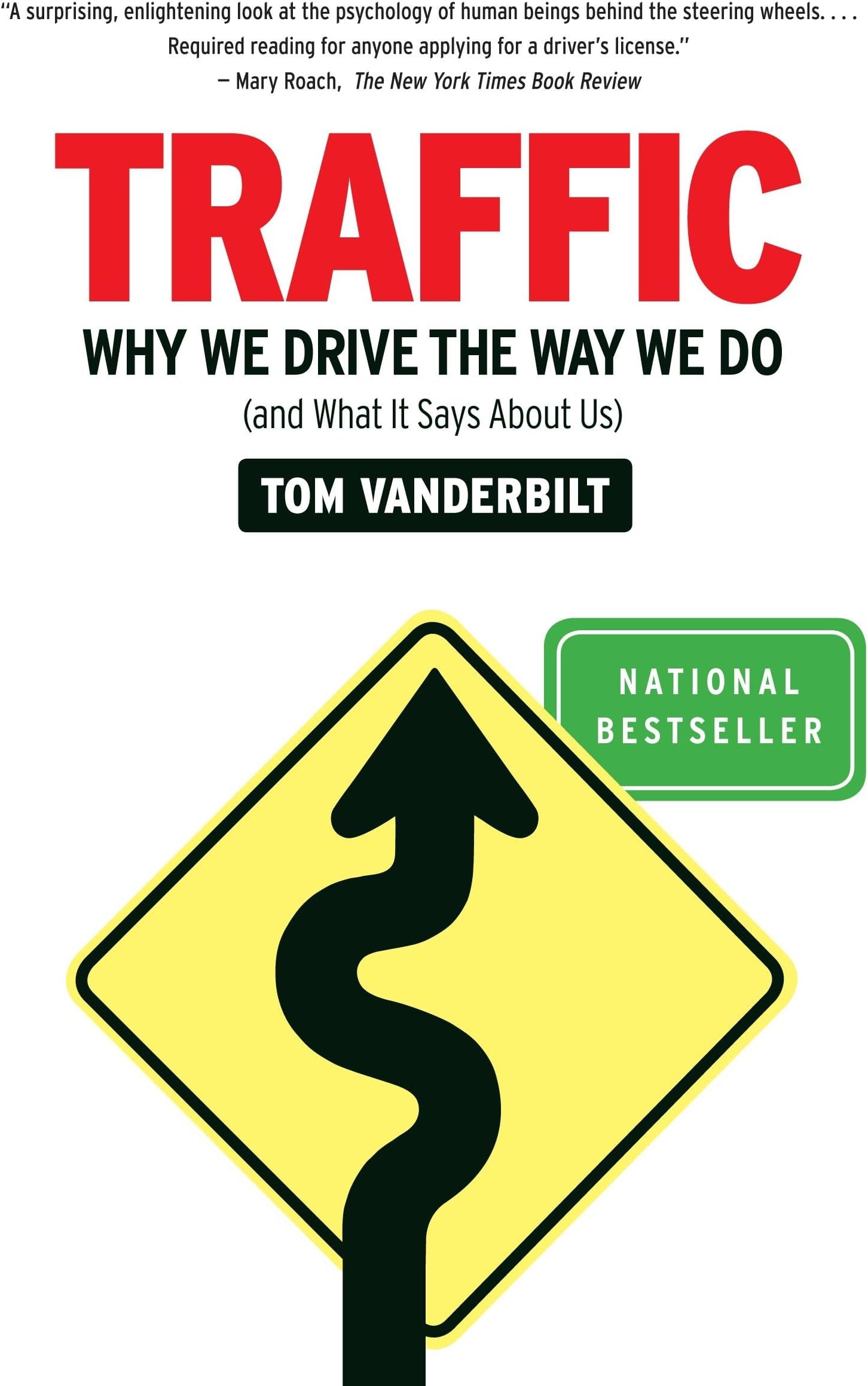
This is an interesting book from cover to cover. Its breezy writing makes it an easy read. Author Tom Vanderbilt's research is exhaustive and impressive. Anyone reading Traffic will learn maybe more than they want about human nature. It changed me from an early merger to a late one. From here on out, I'm ignoring those dirty looks. It just means the drivers haven't read this book yet. Why do people behave they way they do when they drive? The reasons are complex and fascinating. This book examines the history of driving, traffic in other countries, bumperstickers, the physiology of driving and much, much more. Vanderbilt includes references as varied as Cheers , Crash , Jane Austen's Mansfield Park , The Matrix , Seinfeld and the 1950 Walt Disney short Motor Mania . Traffic explores non-automotive traffic dilemmas as well. Disney has had to manage the flow of people at its theme parks since they opened Disneyland in the 1950s. Sometimes the solutions are counterintuitive. Disney learned that REMOVING one of its monorails instead of adding one actually increases the speed people can travel to the park. This is because each train has a buffer zone in front of it, for safety; as a monorail nears another one, it has to slow down or stop. Taking a train out means they all move faster. Vanderbilt calls the FastPass system at the Disney parks the "ultimate solution" in managing traffic to the most popular rides. "Rather than waiting in line, the user waits in a 'virtual queue,' in time rather than space, and can in the meantime move on to other, less crowded rides." I can vouch for the FastPass system myself as a Disney travel guide writer; I never, ever wait in line for the big rides. FastPass has changed the way people can experience Disney parks. The clever cover shows a squiggly arrow traffic sign that has been coated to be reflective, like a real traffic sign is. Under the dust jacket the book is black with a yellow spine. Here's the chapter list: Prologue: Why I Became a Late Merger (and Why You Should Too) 1. Why Does the Other Lane Always Seem Faster? How Traffic Messes with Our Heads * Shut Up, I Can't Hear You: Anonymity, Aggression, and the Problems of Communicating While Driving * Are You Lookin' at Me? Eye Contact, Stereotypes, and Social Interaction on the Road * Waiting in Line, Waiting in Traffic: Why the Other Lane Always Moves Faster * Postscript: And Now, the Secrets of Late Merging Revealed 2. Why You're Not as Good a Driver as You Think You Are * If Driving Is So Easy, Why Is It So Hard for a Robot? What Teaching Machines to Drive Teaches Us About Driving * How's My Driving? How the Hell Should I Know? Why Lack of Feedback Fails Us on the Road 3. How Our Eyes and Minds Betray Us on the Road * Keep Your Mind on the Road: Why It's So Hard to Pay Attention in Traffic * Objects in Traffic Are More Complicated Than They Appear: How Our Driving Eyes Deceive Us 4. Why Ants Don't Get into Traffic Jams (and Humans Do): On Cooperation as a Cure for Congestion * Meet the World's Best Commuter: What We Can Learn from Ants, Locusts, and Crickets * Playing God In Los Angeles * When Slower Is Faster, or How the Few Defeat the Many: Traffic Flow and Human Nature 5. Why Women Cause More Congestion Than Men (and Other Secrets of Traffic) * Who Are All These People? The Psychology of Commuting * The Parking Problem: Why We Are Inefficient Parkers and How This Causes Congestion 6. Why More Roads Lead to More Traffic (and What to Do About It) * The Selfish Commuter * A Few Mickey Mouse Solutions to the Traffic Problem 7. When Dangerous Roads are Safer * The Highway Conundrum: How Drivers Adapt to the Road They See * The Trouble with Traffic Signs -- and How Getting Rid of Them Can Make Things Better for Everyone * Forgiving Roads or Permissive Roads? The Fatal Flaws of Traffic Engineering 8. How Traffic Explains the World: On Driving with a Local Accent * "Good Brakes, Good Horn, Good Luck": Plunging into the Maelstrom of Delhi Traffic * Why New Yorkers Jaywalk (and Why They Don't in Copenhagen): Traffic as Culture * Danger: Corruption Ahead -- the Secret Indicator of Crazy Traffic 9. Why You Shouldn't Drive with a Beer-Drinking Divorced Doctor Named Fred on Super Bowl Sunday in a Pickup Truck in Rural Montana: What's Risky on the Road and Why * Semiconscious Fear: How We Misunderstand the Risks of the Road * Should I Stay or Should I Go? Why Risk on the Road Is So Complicated * The Risks of Safety Epilogue: Driving Lessons
M**M
Interesting book on an often overlooked subject--good gift idea for commuters
One day I saw an accident in the middle of the afternoon, on a clear sunny day, on a straight stretch of road. I commute 100 miles a day and so driving takes up an inordinate amount of my brain space. This accident got me thinking about why accidents happen in places where they should not. Why someone tapping on their brakes two miles ahead causes a traffic jam for me. Those kind of questions occur to me while I'm driving. If you have ever thought about these or other driving related questions you will enjoy this book. It is an interesting look at the history of traffic, driving and different types of drivers. As an example, he discusses the first commissioner of roads in New York who had to insist the all drivers driver in the SAME direction around Columbus Circle. Try to imagine that traffic nightmare! If you have never thought of these types of questions I'm surprised you are even reading this and you probably wonder what I am talking about. However, if you read the book you will find out that there are different kind of people and they are very different when they drive. How do we all manage to use the same roads? Anyway, this book is funny and interesting and I have enjoyed reading it. Give it to that relative who always asks the drivers around them why they are cutting in front of them, not changing lanes, driving so slow, etc.--you know who I'm talking about. Tell them finally someone has the answers to their questions. I don't know if they will find the answers, but they will probably be amused along the way.
J**L
"Why safe roads are more dangerous. Story at 11."
While the topic of the book is nominally "traffic", the real topic is about human psychology and how it deals with the situations involving traffic. The material is chock full of "things that make you go, 'hmm.'" In spite of being intriguing, the information the author conveys is rarely useful information. The reader will likely be left unmoved by the author's reasoned advocacy of late merging, for instance. Similarly, the style of writing feels like that of a news or talk show, where the announcer/host will "tease" an interesting bit of info, run a commercial, discuss things about which you don't care, run another commercial, and then, in the last 2 minutes of air time, give you the anticlimactic answer to the story headline you found interesting enough to make you sit and watch. Unfortunately, most of the book is like this, and the cool things that the author has to say are just that. Cool, but not quite meriting a book. Of the book's 400 pages, nearly 100 are end notes. I am happy that the author's work is well-sourced (books of this genre often lack sources, preferring to rely on anecdotes), but it conveys how the author had to work fairly hard to turn a very large set of disjointed facts into any sort of readable narrative. In this regard, the author's narrative is interesting and readable. It definitely made me keep reading the whole way through. At the end, however, I felt kind of empty and unenlightened, so I had to sit back and figure out why. The reason appears to be because it's like a long magazine article: interesting, longer than a newspaper story, full of interesting insights, but in the end, it's light fare. In spite of the author's thorough research, we really don't know much about traffic in a scientific context, and even the scientists are forced to speculate anecdotally about why certain statistical artifacts are true. Of the author's many nuggets of info, I found a couple to be very interesting. Making roads safer appears to increase the accident rate, for example. There's really nothing backing up this observation other than statistics, so anything we might derive is of questionable value, but ... it appears that when a road feels safer, drivers are encouraged to drive more hazardously - because, well, it's safer to do so. I'll leave it to the reader to speculate what this implies in other areas of life (or to read the book and read the author's speculations). Another nugget is along the same lines: adding more road signs and traffic controls to alert drivers (e.g., to alert drivers of pedestrians and bicycles, giving bicycles their own lane, putting up rails to allow pedestrians to only cross at intersections) isn't nearly as effective as simply letting cars drive on roads in which there are obviously several hazards. A dead deer carcass on the side of the road appears to encourage far more safety than a deer crossing sign. Again, I'll let the reader ponder that rather than waste time with my own unsubstantiated insights. There are a few places where the author says/advocates things with which I expressly disagree, though I understand his motivations and reasoning for saying them. The primary item of this sort is that he explicitly says, discussing the risk due to terrorism vs. the risk due to driving, "Ironically, the normal business of life that we are so dedicated to preserving is actually more dangerous to the average person than the threats against it." This seems a simple, straightforward statement: 40,000 lives lost due to traffic each year, but only about 5000 killed by terrorism (total, not per year, since 1960). On the one hand, I agree with this as a sentiment, because we definitely overestimate risk in spectacular cases, while ignoring risk in mundane cases. I don't, however, agree with the statement outside of that specific context: while it's easy to point out the large number of traffic deaths, that ignores the massive public benefit of being able to drive anywhere, anytime. Terrorism, on the other hand, doesn't have any accompanying net benefit. In summary, I like this book, and it is an interesting book, but it should not be regarded as science so much as an accumulation of well-sourced statistics, interesting anecdotes, and a thoughtful discussion of an activity in which nearly all of us participate every day.
M**O
Another Look At The Road Ahead
I had read a couple of reviews and decided to get the audiobook rather than attempt to read this book, and I'm glad I did. I doubt I would have had a successful time finishing this book, but on audio it was pleasant enough. The topic is actually quite fascinating, and the book gives much to think about. There is a whole lot of information to process, though, and that can seem overwhelming. Some of the points I do agree with are that the majority of people consider themselves to be good drivers - but just ask their passengers, drivers are inundated with signs on the road (if one watches how many signs are ignored or missed, this becomes obvious), and I do believe that when roads are made safer drivers are more inclined to drive faster and with less caution. And, of course, there's the whole driving while talking on a cell phone phenomena! There is a lot of information here, and not everything will be interesting to everyone. But the author does back up what he states with facts and studies, which are interesting. And I found it interesting to listen to the audiobook while driving and actually view what the book was referring to in action. I think it may have helped my own driving. (But I'll have to ask a my passenger then next time I have one in my car!) I would recommend this book, though it does seem long. I know I enjoyed the audiobook, and I think that might be a better option for those who do not look forward to actually reading a longer tome.
M**.
I think anyone who drives a car, and knows how to read, should read this book
I think anyone who drives a car, and knows how to read, should read this book. It is a pleasurably readable analysis behind the science and psychology of driving. A thousand times I nodded in agreement while reading Vanderbilt's descriptions of the events and reasons behind what we all do while at the wheel of our cars. His writing is so clear and eloquent, that his explanations not only ring true, but you'll remember them in such detail you'll find yourself telling anyone who will listen about all this fascinating stuff you just learned about traffic. Like: - there were more pedestrian fatalities due to vehicles per week over a hundred years ago in NYC than there are now, despite having WAY less people, and having the vehicles be horse-drawn carriages. - slower is faster. I'm convinced. One example: accidents slow up traffic. Increasing speed causes more accidents than it does improve flow. Decreasing speed will improve overall flow. Unfortunately... - we do what we think is right for us individually, which is exactly wrong for everybody else. Hence, we speed. - anonymity breeds aggression. If you're in a convertible, you are less likely to give someone the bird than if you are safely contained behind the windows of your hardtop. - there are parking "condors" and parking "barn owls." Do you cruise the lanes looking for the "perfect spot," or do you hunt down someone leaving the mall to get theirs? If you just pull in to the first spot you see and walk, you'll get inside the mall faster anyways. Reading about traffic circles and roundabouts, I honestly wanted to see how I could get involved with city planning, and replace dangerous intersections with efficient and safe circles. The evidence is that clear. With gas prices disabling a segment of our economy, shouldn't we be looking at simple things that can save thousands of gallons of gas a day? The reduction (or elimination) of idling time at intersections does that very thing. So much of this book makes perfect sense. It's as if you are in the presence of a wonderful professor who has you hypnotized with his favorite topic. You will find you can't stop talking about the stuff you learn here...it's a conversation starter to be sure. Next time you are stuck at a traffic light, thirty different facts and ideas will pop into your head, and you'll smile while everyone else looks like they're getting a root canal. I could not possibly recommend this book more.
V**Y
Great book for anyone on a city council, on a P&Z Committee, or in traffic planning
This a great digest of the best traffic research. It is well written and well researched. It is getting a bit dated, but the insights and research are still valid. I wrote a review on this for the Western Planner Magazine many years ago. I wish more folks in planning would read this book and get better information on what does and doesn't work with traffic and planning. Should be required reading at every civil engineering school and all public administration courses and for every city council and P&Z board.
Trustpilot
5 days ago
3 days ago