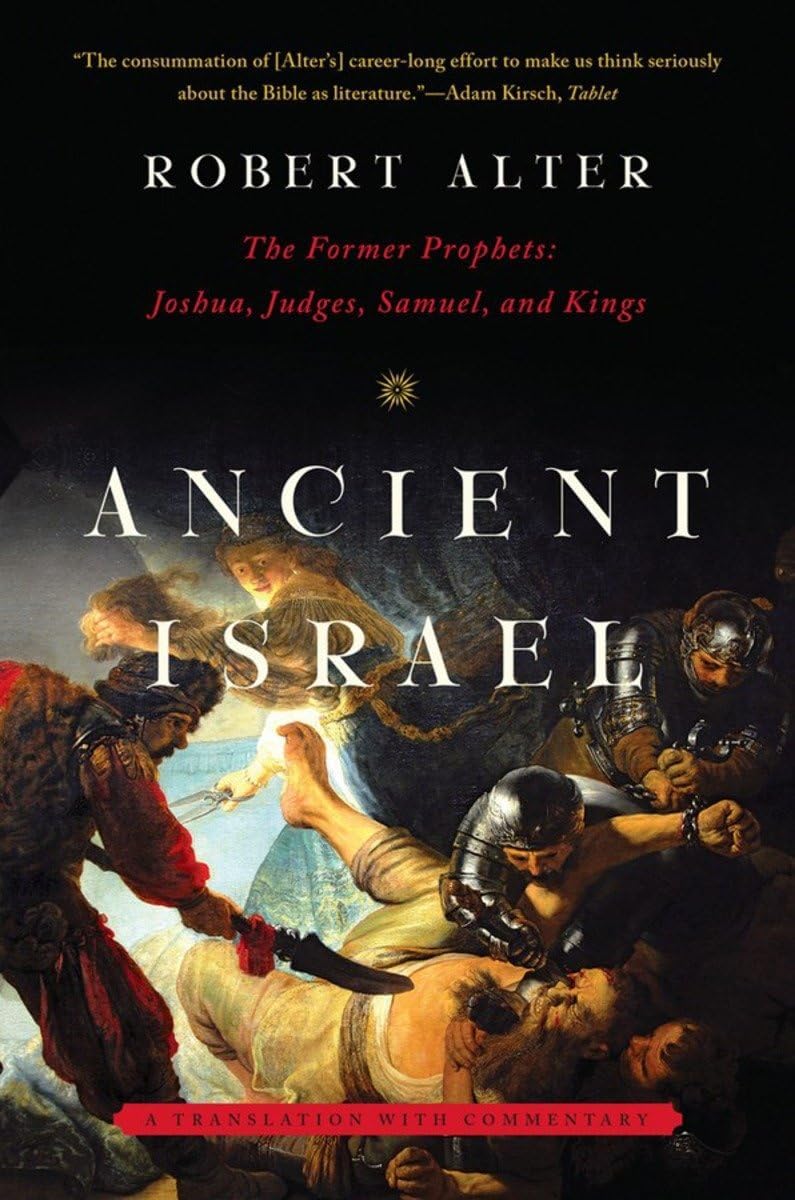
Ancient Israel: The Former Prophets: Joshua, Judges, Samuel, and Kings: A Translation with Commentary
Product ID: 1695793
Robert Alter’s award-winning translation of the Hebrew Bible continues with the stirring narrative of Israel’s ancient history. To read the books of the Former Prophets in this riveting Robert Alter translation is to discover an entertaining amalgam of hair-raising action and high literary achievement. Samson, the vigilante superhero of Judges, slaughters thousands of Philistines with the jawbone of a donkey. David, the Machiavellian prince of Samuel and Kings, is one of the great literary figures of antiquity. A ruthless monarch, David embodies a life in full dimension as it moves from brilliant youth through vigorous prime to failing old age. Samson and David play emblematic roles in the rise and fall of ancient Israel, a nation beset by internal divisions and external threats. A scattering of contentious desert tribes joined by faith in a special covenant with God, Israel emerges through the bloody massacres of Canaanite populations recounted in Joshua and the anarchic violence of Judges. The resourceful David consolidates national power, but it is power rooted in conspiracy, and David dies bitterly isolated in his court, surrounded by enemies. His successor, Solomon, maintains national unity through his legendary wisdom, wealth, and grand public vision, but after his death Israel succumbs to internal discord and foreign conquest. Near its end, the saga of ancient Israel returns to the supernatural. In Elijah’s fiery ascent to heaven many would find the harbinger of a messiah coming to save his people in their time of need. map Review: Worth buying and reading - Robert Alter, an award winning author, has many skills including knowing Hebrew, understanding the Bible, and writing well. He translated and commented on many biblical books. He translates and comments upon "The Former Prophets: Joshua, Judges, Samuel, and Kings" in this volume. Ancient Judaism divided the Hebrew Bible into three parts: Torah (the Five Books of Moses), Neviim (the prophetical books - books derived by prophecy), and Ketuvim (writings - inspired books). The entire collection is called Tanach, which is an acronym made up of the names of the three parts. Later scholars divided the second section Neviim into two parts, the former and later prophets. Actually, the "former Prophets" are not books of prophecy, but historical books. Alter does not attempt to give his readers an extensive commentary on the four books. However he does introduce each with about a half dozen pages in which he explains the history and contents of the book. He also places about half a page of commentary on each page of each book. Alter's translation is much clearer than many others. For example, just a simple sentence in the Art Scroll edition of I Samuel 11:1 translates: "Then Nahash the Ammonite sent up and besieged Jabesh-gilead, and all the people of Jabesh said to Nahash, `Seal a covenant with us, and we will serve you.'" Alter has: "And Nahash the Ammonite came up and encamped against Jabesh-Gilead. And all the men of Jabesh said to Nahash, `Make a pact with us, and we shall be subject to you.'" In more than half a page under this sentence, Alter explains what the Ammonite kingdom is, its relationship to King Saul and King David, what is the settlement of Jabesh-Gilead, its relationship to Saul, what was found in Cave 4 of Qumran in the twentieth century that throws light on this episode. Review: The things that you're liable to read in the... - Does any other text have such a discrepancy between the amount of time generations have devoted to studying it and the actual understanding derived from this huge effort?? Century after century people have been told that these books were God's word, an instruction manual on how to live. Generation after generation, people have lived in houses with copies of the Bible. Family history, marriages, births and deaths were recorded in it. Dedicated missionaries spent lifetimes hard at work at their desks, just so they could translate the ancient Hebrew text into obscure languages. Just what the 19th century Hawaiians made of these brutal tales is beyond me. Did they actually read it? I have relatives who defend "Biblical marriage," -- did they actually read about all the concubines? Or was it just a sacred object? So I tried to read it, first as religious guidance, then as poetry and then as history. But I either couldn't follow it, or I just didn't believe it could be saying what I thought it was saying: all that murder, rape, genocide, pillage. As an archivist, I like to get as close to the original text as possible. Robert Alter seemed to be the most qualified guide, and I decided to make one last attempt. After reading the Five Books of Moses with Robert Alter's commentary, I was addicted and went on to read "Ancient Israel," translations and commentary on Joshua, Judges, Samuel, and Kings. only with Alter's footnotes could I make sense out of the narratives. And when the actual text itself is garbled, he points out the likely reasons. For me this time, reading the OT became something of a soap opera with lots of dramatic irony as the reader sees looming disaster, "No! Don't do that!...Oh, no, they did..." There is lots of dual causality, disaster comes because the deity is mad about the worship of idols, and also because of more mundane factors like superior forces. Alter is upfront about the overall effect of the first half of "Ancient Israel" -- ruthlessness, and the general impression made by the second half -- tedium. And " nowhere in the Bible is there a more palpable discrepancy between the values and expectations of the ancient Near Eastern era in which the book was written and those of twenty-first century readers." The story of the defeat of the Canaanites is apparently mythical, not supported by archeological evidence. According to his theory, the genocide against the Canaanites as described with great approval in the Bible, probably never actually happened. The later battles with the Assyrians and Babylonians have more of a basis in fact. Alter's notes puts all of these discrepancies and correspondences between text and extra-biblical evidence in context. The Bible's fundamental if brutal honesty however comes out in the deep moral ambiguity of nearly all the great biblical heroes, so even King David, actually especially King David, they all did pretty dastardly things, that is essentially true to human nature. With Alter's framework, the folklore elements woven into the mythical and historical narratives stand out. Elijah is simply different from any of the other prophets before him. He works wishful-thinking miracles and helps the downtrodden. He miraculously provides food in times of hunger, an early model for the loaves and fishes (like the fairy tale "Tischlein Deck Dich"). Apparently these features made him the star of Jewish folklore over the centuries. Alter convincingly concludes that Elijah provides the template for many of the Jesus stories of the New Testament. The interconnections are starting to make sense to me. I'm grateful to Alter for using both his erudition and his deep insights to help non-specialists such as myself get a sense of what the OT is all about. I'm not about to give the Bible a rating, that's rather presumptuous, but Alter's notes definitely deserve 5 stars. Worth the time and effort to work through...I'm still not about to use the Bible as a guide to living, but as a guide to human nature, it's all in there.
| Best Sellers Rank | #1,241,265 in Books ( See Top 100 in Books ) #291 in Christian Prophets (Books) |
| Customer Reviews | 4.7 out of 5 stars 135 Reviews |
I**N
Worth buying and reading
Robert Alter, an award winning author, has many skills including knowing Hebrew, understanding the Bible, and writing well. He translated and commented on many biblical books. He translates and comments upon "The Former Prophets: Joshua, Judges, Samuel, and Kings" in this volume. Ancient Judaism divided the Hebrew Bible into three parts: Torah (the Five Books of Moses), Neviim (the prophetical books - books derived by prophecy), and Ketuvim (writings - inspired books). The entire collection is called Tanach, which is an acronym made up of the names of the three parts. Later scholars divided the second section Neviim into two parts, the former and later prophets. Actually, the "former Prophets" are not books of prophecy, but historical books. Alter does not attempt to give his readers an extensive commentary on the four books. However he does introduce each with about a half dozen pages in which he explains the history and contents of the book. He also places about half a page of commentary on each page of each book. Alter's translation is much clearer than many others. For example, just a simple sentence in the Art Scroll edition of I Samuel 11:1 translates: "Then Nahash the Ammonite sent up and besieged Jabesh-gilead, and all the people of Jabesh said to Nahash, `Seal a covenant with us, and we will serve you.'" Alter has: "And Nahash the Ammonite came up and encamped against Jabesh-Gilead. And all the men of Jabesh said to Nahash, `Make a pact with us, and we shall be subject to you.'" In more than half a page under this sentence, Alter explains what the Ammonite kingdom is, its relationship to King Saul and King David, what is the settlement of Jabesh-Gilead, its relationship to Saul, what was found in Cave 4 of Qumran in the twentieth century that throws light on this episode.
E**N
The things that you're liable to read in the...
Does any other text have such a discrepancy between the amount of time generations have devoted to studying it and the actual understanding derived from this huge effort?? Century after century people have been told that these books were God's word, an instruction manual on how to live. Generation after generation, people have lived in houses with copies of the Bible. Family history, marriages, births and deaths were recorded in it. Dedicated missionaries spent lifetimes hard at work at their desks, just so they could translate the ancient Hebrew text into obscure languages. Just what the 19th century Hawaiians made of these brutal tales is beyond me. Did they actually read it? I have relatives who defend "Biblical marriage," -- did they actually read about all the concubines? Or was it just a sacred object? So I tried to read it, first as religious guidance, then as poetry and then as history. But I either couldn't follow it, or I just didn't believe it could be saying what I thought it was saying: all that murder, rape, genocide, pillage. As an archivist, I like to get as close to the original text as possible. Robert Alter seemed to be the most qualified guide, and I decided to make one last attempt. After reading the Five Books of Moses with Robert Alter's commentary, I was addicted and went on to read "Ancient Israel," translations and commentary on Joshua, Judges, Samuel, and Kings. only with Alter's footnotes could I make sense out of the narratives. And when the actual text itself is garbled, he points out the likely reasons. For me this time, reading the OT became something of a soap opera with lots of dramatic irony as the reader sees looming disaster, "No! Don't do that!...Oh, no, they did..." There is lots of dual causality, disaster comes because the deity is mad about the worship of idols, and also because of more mundane factors like superior forces. Alter is upfront about the overall effect of the first half of "Ancient Israel" -- ruthlessness, and the general impression made by the second half -- tedium. And " nowhere in the Bible is there a more palpable discrepancy between the values and expectations of the ancient Near Eastern era in which the book was written and those of twenty-first century readers." The story of the defeat of the Canaanites is apparently mythical, not supported by archeological evidence. According to his theory, the genocide against the Canaanites as described with great approval in the Bible, probably never actually happened. The later battles with the Assyrians and Babylonians have more of a basis in fact. Alter's notes puts all of these discrepancies and correspondences between text and extra-biblical evidence in context. The Bible's fundamental if brutal honesty however comes out in the deep moral ambiguity of nearly all the great biblical heroes, so even King David, actually especially King David, they all did pretty dastardly things, that is essentially true to human nature. With Alter's framework, the folklore elements woven into the mythical and historical narratives stand out. Elijah is simply different from any of the other prophets before him. He works wishful-thinking miracles and helps the downtrodden. He miraculously provides food in times of hunger, an early model for the loaves and fishes (like the fairy tale "Tischlein Deck Dich"). Apparently these features made him the star of Jewish folklore over the centuries. Alter convincingly concludes that Elijah provides the template for many of the Jesus stories of the New Testament. The interconnections are starting to make sense to me. I'm grateful to Alter for using both his erudition and his deep insights to help non-specialists such as myself get a sense of what the OT is all about. I'm not about to give the Bible a rating, that's rather presumptuous, but Alter's notes definitely deserve 5 stars. Worth the time and effort to work through...I'm still not about to use the Bible as a guide to living, but as a guide to human nature, it's all in there.
L**S
and 2 Samuel is great at explaining and clarifying some of the biblical quirks ...
This translation of the books of Joshua, Judges, 1 Samuel, and 2 Samuel is great at explaining and clarifying some of the biblical quirks and questions that are part of the modern reader's approach to these ancient texts. Of course the footnotes are the most valuable part, as the were in Alter's The Five Books of Moses. 1 and 2 Chronicles are referenced in the translation of Samuel but are not explored on their own, as so much of the material in them is redundant to Samuel. Alter is a fine scholar, and I look forward to reading his additional translations. He tries very hard not to impose his theology on the reader. Nevertheless, he gets tripped up by any suggestion that God could have a body or look like a human being (scriptural references that "anthropomorphize" God are treated as purely symbolic) and he often dismisses the idea that God could speak directly to His prophets, trying instead to explain how a prophesy must have been received through a series of yes and no answers as the result of questions to an oracle. But we all have our limits and Alter is brilliant in his cross-referencing, explanations of most things, and identification of themes, as well as bringing in the best of the work of other biblical scholars.
S**.
Masterful Translation, Instructive Commentary
By and large, Alter's work is a milestone in the art of translation and is in and of itself an instructive resource for students of the Bible in general, and students of Hebrew in particular. Typically, the practice of translation is viewed through the lens of a false dichotomy: either translations are mechanical, wooden, and "literal" or they are dynamic, thought-for-thought, or otherwise paraphrastic. Alter demonstrates cogently and forcefully that translation is not a game of viewing words as equations to be solved, nor is it the practice of grabbing what the author was trying to say and rendering it in an "abridged" kind of way (see his article in his "Five Books of Moses" entitled, "On the Heresy of Explanation"). As a Hebraist I was immediately gripped by Alter's command of the Hebrew, and stunned by his grasp of the subtle distinctions between literary expressions in the Hebrew text. It goes without saying that what the author has done in this volume and the others of his series is to demonstrate that translation is as much of an art as it is a science; biblical literature often makes sudden and abrupt changes from prose to poetry, and not to mention careful and calculating choices in vocabulary and diction. Translation is just as much about translating art as it is about saying, "this word means this, and that word means that..." Unfortunately the artistry of the text is usually compromised in many English translations because of false assumptions about "literal" versus "dynamic" and paraphrastic translations of the text. In so many ways, Robert Alter is changing the way that scholars and layman alike are viewing the art of translation, especially among those that know Hebrew and Aramaic. If you have never picked up Alter's translations before, perhaps now would be a good time. His commentary alone is provocative enough, but his translation alone is worth the price of this volume. My ONLY complaint about this volume has to do with the absence of the section that is typically at the end of his works entitled, "For Further Reading." I contacted him about this and he insists that the bibliography would have been too cumbersome and not particularly helpful for readers. In his volume, "The David Story," there is a run-down of the characters in the narrative of 1 and 2 Samuel as well as a brief list of some of the resources that he consulted in the production of that translation that are absent in this one. While I wish that those appendices would have been included in the present volume, I understand his decision, and I am not deterred in recommending his work in the slightest. Hebrew Bible translation is moving into a new age in a BIG and GREAT way. Check out this volume and others of his translations to see some of where Bible translation is heading and you might just find some insightful surprises along the way; passages that were once obscure are now clear, passages that translators flattened into clarity by way of the heresy of explanation stand ambiguous as they were in the Hebrew. Altogether, this work is extremely readable, powerfully insightful, and a sober challenge to the excuses of translators past. Happy reading!
L**E
Not a timid translator!
Robert Alter delivers another Masterpiece in translation / commentary of Joshua, Judges, Samuel and Kings. While I didn't agree with all of his conclusions expressed in the footnotes, his insight, and for lack of a better word, his "take" on the historical events in these accounts of Ancient Israel were downright delightful! One thing about Alter is that no one can accuse him of being a timid translator. His contributions are just so arresting and striking. They add just enough spice to the reading without taking away from the meaning of the passages. They also bring out themes, ideas, and parts of the narrative that many other translators seem to miss. Clergy and Christians would do themselves a favor to read Alter's books. They are a refreshing addition to consider if you are doing a Bible in a year reading program or just enjoy reading Bible books in various translations.
K**R
Superb Translation and Bible Study Aid
This is a great help to me in my study of these Bible books. The translation is excellent, but the real benefit is in all of the notes that are included. These are usually at least the bottom half of each page. The notes explain where a lot of the places mentioned are located. They also explain why Alter has translated some of the words and phrases as he does. We are using this in a Bible study where I read from the Alter text and everyone follows in their own translation. Then we talk about the differences and what is really happening in the text. Brilliant!
K**N
Great!
I've found anything this man writes to be worth the candle. He gives the reader a window into the Bible stories that makes one say, "Oh, that is what that means." Reading this makes Bible reading like reading Steinbeck or Hemingway.
M**T
A Review by a Student
I really enjoyed these translations. We read three books by Alter, all translations with commentaries of the Bible. Hands down the best course I've taken in college, and I do believe these translations facilitated honest, naive discussion about the Bible. Alter somehow makes the texts engaging and invite you to read the stories as stories, not as archiac or imaginable chapters of The Holy Book. PS: do be sure to get the hardcover editions. You'll want to keep these translations around for years, I imagine.
C**S
5-star translation; 4-star book quality
No need for me to offer another review of this excellent translation. Instead, I only want to say a few things about the quality of the book itself. The cover and paper are lower quality than the Psalms and Five Books of Moses. However, the paperback will lay open on a desk, which is handy.
T**R
The 'Alter-nate Version of the Former Prophets"
This is a masterful Translation of Joshua, Judges, Samuel, and Kings. Alter seems to be motivated by a love both the hebrew and english languages for only such a dual love could produce such a work. I find that Alter is at his best when translating Prose, and in this volume his translation of the david story in the books of Samuel is second to none. If all I was getting was the translation, that alone would make me a happy man, but I find the linguistic commentary even better than the translation it is a commentary upon. His highlighting of particular or repeated use of words and phrases casts new light on entire works(his mention of the repeating motif of the cloak in samuel is but one example) and is a fresh approach to biblical exegesis. I really cannot highlight this work and biblical translations by him highly enough. All biblical translations should be thus 'Altered'
R**.
Four Stars
Excellent history of the Jewish people
L**Z
Please, Professor Alter, keep going!
I am hoping that Robert Alter will eventually complete his translation of the entire Tanakh/Bible -- it is elegant, scholarly, and above all goes a long way in capturing the flavour of the original. A real translator's translation -- the commentary explores the process and problems of translating such an important text, and is always illuminating Keep 'em coming, Professor Alter -- only the Latter Prophets and a bit of Ketuvim to go....!!!
J**X
An overview, rather than an in-depth look at the former prophets.
Alter really knows his stuff when it comes to the Old Testament. Most of what he writes is pure gold, but I was left wanting more...
Trustpilot
3 days ago
1 month ago