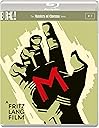
M (Masters of Cinema) Dual Format (Blu-ray + DVD) [1931]
Product ID: 209159976
Details
- ColorBlack & White
- FormatCD+DVD
- LanguageGerman
- Number Of Discs1
- Runtime1 hour and 50
Desertcart purchases this item on your behalf and handles shipping, customs, and support to Tunisia.
SYNOPSIS: Of all Fritz Lang s creations, none have been more innovative or influential than M , the film that launched German cinema into the sound era with stunning sophistication and mesmerising artistry. A spate of child killings has stricken a terrified Berlin. Peter Lorre gives a legendary performance as the murderer Hans Beckert, who soon finds himself chased by all levels of society. From cinema s first serial killer hunt, Lang pulls back to encompass social tapestry, police procedural, and underworld conspiracies in an astonishingly multi-faceted and level-headed look at a deeply incendiary topic. One of the greatest psychological thrillers of all time, M remains as fresh and startling 80 years on. SPECIAL DUAL FORMAT EDITION Review: "I can't help what I do! I can't help it, I can't..." - So how is it that one who enjoys movies, good and bad, as much as I do, has never seen Fritz Lang's M (1931) until last night? I've certainly heard about it, I've seen clips from it, I've read John J. Muth's beautifully rendered four issue comic/graphic novel adaptation of it, heck, I even bought the film at the end of last year, and it's been sitting on my `to be watched' shelf ever since...perhaps there was a sense of intimidation on my part, or fear...fear that I may not have liked the film that many acknowledge as a classic work of cinema, and one of the best examples of early German expressionist films (it's also one of the first, big German talkie films), from which so many others have since drawn upon for inspiration. After finally buckling down and watching it last night, I have to say, I really didn't know what I was missing, especially given how much I enjoy the noir films released by Hollywood in its heyday. Co-written and directed by Fritz Lang (Metropolis, The Blue Gardenia), the film stars Peter Lorre (The Man Who Knew Too Much, Mad Love), whom I first became familiar with, unknowingly, when I was a child, watching the Warner Brothers cartoons, shown on Saturday morning. It wasn't until later when I actually saw Lorre in Arsenic and Old Lace (1944) that I made the connection and realized his distinctive manner and appearance (bedroom voice, bug eyes, and moon face) was the one characterized within the various cartoons. As the story begins, the city streets are buzzing with news of a child murderer on the loose, one whose just recently claimed yet another victim. We learn there have been eight murders so far, in as many months. The general public is visibly distressed, especially with the authorities and their inability to catch the killer who leaves very little behind in terms of useful clues. Soon people begin pointing fingers at each other, making accusations based on paranoid reactions...if you're seen on the street even near a child you're the killer...if you're seen being arrested by the police for something completely unrelated, you're the killer, and so on...the police may have very little to go on, but that doesn't mean they're not working the case. On the contrary, they're working themselves to exhaustion, following up anything and everything in hopes it will pan out into a viable lead...the problem is, besides the fact that they are being inundated with dead end leads, is that there's no seeming connection between the killer and his randomly chosen victims. The authorities have even begun scouring the criminal districts, in hopes of turning up something, which, of course, upsets the criminals as there's a heightened sense of awareness permeating the city and interfering with their trade. In an interesting juxtaposition, we see two groups meeting separately, yet at the same time, one being the authorities, the other being a criminal syndicate of sorts, both striving for the same outcome, but for relatively different reasons. The authorities want this murdering psychopath off the streets for obvious reasons, while the criminal element wants to catch him because not only is the intensive manhunt interfering with their business, but also because there reputations are suffering given the public's inclination to not distinguish one criminal from another. Based on the respective outcomes of the meetings, the authorities broaden their search to include the recently released individuals who were wards of the state, deemed `harmless' to society, while the criminals employ a very different, unique, and ultimately effective strategy. Eventually both methods pay off and the killer is identified (by the most unlikely source), and the real manhunt begins...who will find him first, the police, or the `organization'? I have to say, this is probably the best film I've seen in an awhile. The one aspect that really stood out was the exquisite beauty within the cinematography, the usage of shadows along with an incredibly wide array of shots used to tell the story and develop tension throughout. Normally when someone uses that many different kinds of shots, it tends to draw unwanted attention, but here they seemed to have been chosen and ordered in such as ways as to feel seamless, hardly ever disrupting the flow. There was one shot, in particular, that comes to mind and it's when Lorre, who plays the killer, is being chased by emissaries of the underworld, through darkened streets. There's a high angled long shot, featuring an expansive view of a wide street, and we can see Lorre's character down below looking like a cornered animal, his escape routes cut off as various individuals appear, blocking off the exits. There are also many scenes featuring dialog being spoken by a character not on the screen, describing to another in detail what we're seeing as an example on the screen. One example of this was after the police raids on the criminal districts, we hear voice of one of the authorities speaking to another about the raids, while seeing a slow pan across a long table featuring all the contraband confiscated, including guns, knifes, brass knuckles, burglary tools, stolen booty, etc. Lorre's performance was amazing, even more so considering he wasn't even really featured in the first half of the film. The scenes were he's leading a potential victim around, buying candy and such, were particularly creepy, whistling that tune, but his real talent comes through near the end, as he tries to explain his despicable actions to an audience bent on seeing him destroyed. Despite the ugly nature of the character, Lorre almost makes you feel sympathetic towards his monstrous character...almost. One element that surprised me was the very subtle comedic touches included in the film dealing with such serious material. An example of this can be seen during the meeting of the criminals to discuss the effect the investigation of the killer is having on their business ventures. One individual asks another for the time, to which the one calls and asks the operator, and then proceeds to remove watch after watch from his garments to set the time...obviously he's a pickpocket by trade, and there was something comical about him taking out all these stolen watches to set the time. I've read that, with regards to some elements of the film, Lang intended to surreptitiously comment on his distaste for the prevalent Fascist regime within Germany at the time, and I can see collaborative material within the film to justify such a claim, specifically in terms of the public's reactions (accusations, finger pointing, apathy), and the authorities general sense of contempt for those it is trying to protect...whether this is true or not, I do not know, as I'm not one of historical knowledge, especially of a political sense...regardless, this is an excellent film, with a definite contemporary relevancy even after nearly 70 some odd years, and worth watching, if, for nothing else, to gain an appreciation for its influence on films that followed. The film on this Criterion Collection DVD release runs 110 minutes, and looks beautiful in its original aspect ratio of 1.19:1. The picture is very clear and clean, as is the Dolby Digital monaural audio. This release also features a `new and improved' English subtitle translation. This is a two disc set, the first featuring a new, restored in high definition digital print, along with an audio commentary by German film scholars Anton Kaes and Eric Rentschler. The second disc contains a conversation with Fritz Lang (50 minutes), a short film titled "M le Maudet", by Claude Chabrol, classroom tapes of M editor Paul Falkenberg discussing the film and its history, an interview with Harold Nebenzal, son of the producer, a physical history of M, and a still gallery with behind the scenes photos and production sketches. Also included is a 32-page booklet with essays, interviews, and a script for a missing scene. Cookieman108 By the way, as far as the meaning of the one letter title, it's pretty simple, one that's made perfectly clear within the film, so there's no sense in my spoiling it here... Review: It is the very model of a modern police procedural! - "Who knows what it's like to be me?" An anguished cry from a tortured man, one that can't help elicit sympathy, despite the fact that the man in question in a serial killer. "M" is a revolutionary, incredible movie in many ways. It began the career of Peter Lorre. It was the last gasp of German Expressionism before the Nazi takeover. It is, in many ways, Frtiz Lang's best film. It's haunting, moving and memorable like few other movies ever are. Many people today forget what a major impact German cinema had on the development of movies. Starting with The Cabinet of Dr. Caligari (Special Collector's Edition) in 1920, and moving up through movies by greats like F W Murnau ( Nosferatu , Faust , Sunrise - A Song of Two Humans ) and Fritz Lang ( Metropolis (Restored Authorized Edition) , The Testament Of Dr. Mabuse - Criterion Collection ), Germany manged to put forth some of the best, most amazing images ever projected up onto a screen. Who can forget the arrival of the plague ship in "Nosferatu", or Rotwang's robot in "Metropolis"? These images are iconic in our society, a fact made all the more interesting when you consider that not long after "M" another German would make the Swastika a very memorable and iconic image. "M" tells the story of a serial killer who preys on children. We see him meeting a young girl as she goes home from school. We see him buying her a balloon. We see her mother wondering why she isn't home and calling out her name as the camera focuses on the pathetic place setting for a lunch the girl will never eat. We see her ball rolling away into the dirt near some bushes. We see her balloon rise up into the telephone wires. As the populace gets more and more concerned about these killings, the Berlin police get more and more frustrated, as does the criminal element. Sales of their various wares are down. Business is hurting. They resent being lumped in together with this child murder and even consider taking out an add in the papers to say that he isn't one of them. Eventually the criminals decide to act and begin to hunt for the killer themselves. What happens after they catch him is something that needs to be seen to be believed, as a kangaroo court of crimal masterminds puts the killer on trial, saying that many of them are quite well informed of the way the legal system works. "M" can be viewed as the start of two major genres; film noir and police procedural. Much like in The Silence of the Lambs (Two-Disc Collector's Edition) and The Fugitive , you see the slow, steady process the police use as they try to track down a killer before he strikes again. And the film's status as the earliest form of noir is obvious to anyone who has ever seen any movie in that particular genre. "M" is at times a hard movie to watch. You will find yourself feeling sympathy for Peter Lorre's character, vile though he is. His performance occupies maybe 20 minutes of screen time, but was so memorable that it resulted in him being typecast for the rest of his career. Given how good he was in those roles, maybe we should be thankful for that. "M" was released on DVD as part of the Criterion Collection. The two-disc set can be bought for a surprisingly reasonable price on desertcart.com and is well worth purchasing, if for no other reason than the fact that you're not likely to find it in your local Blockbuster (though you can get a basic copy from Netflix). It includes many extras. The German dialogue with English subtitles may turn off some poeple, but it frankly adds an air to the film that dubbing would miss. To conclude: If you're a fan of movies like this, or just enjoy a good film, I highly recommend you make time for "M".
| Color | Black & White |
| Customer Reviews | 4.5 out of 5 stars 851 Reviews |
| Format | CD+DVD, Widescreen |
| Language | German |
| Number Of Discs | 3 |
| Runtime | 1 hour and 50 minutes |
C**8
"I can't help what I do! I can't help it, I can't..."
So how is it that one who enjoys movies, good and bad, as much as I do, has never seen Fritz Lang's M (1931) until last night? I've certainly heard about it, I've seen clips from it, I've read John J. Muth's beautifully rendered four issue comic/graphic novel adaptation of it, heck, I even bought the film at the end of last year, and it's been sitting on my `to be watched' shelf ever since...perhaps there was a sense of intimidation on my part, or fear...fear that I may not have liked the film that many acknowledge as a classic work of cinema, and one of the best examples of early German expressionist films (it's also one of the first, big German talkie films), from which so many others have since drawn upon for inspiration. After finally buckling down and watching it last night, I have to say, I really didn't know what I was missing, especially given how much I enjoy the noir films released by Hollywood in its heyday. Co-written and directed by Fritz Lang (Metropolis, The Blue Gardenia), the film stars Peter Lorre (The Man Who Knew Too Much, Mad Love), whom I first became familiar with, unknowingly, when I was a child, watching the Warner Brothers cartoons, shown on Saturday morning. It wasn't until later when I actually saw Lorre in Arsenic and Old Lace (1944) that I made the connection and realized his distinctive manner and appearance (bedroom voice, bug eyes, and moon face) was the one characterized within the various cartoons. As the story begins, the city streets are buzzing with news of a child murderer on the loose, one whose just recently claimed yet another victim. We learn there have been eight murders so far, in as many months. The general public is visibly distressed, especially with the authorities and their inability to catch the killer who leaves very little behind in terms of useful clues. Soon people begin pointing fingers at each other, making accusations based on paranoid reactions...if you're seen on the street even near a child you're the killer...if you're seen being arrested by the police for something completely unrelated, you're the killer, and so on...the police may have very little to go on, but that doesn't mean they're not working the case. On the contrary, they're working themselves to exhaustion, following up anything and everything in hopes it will pan out into a viable lead...the problem is, besides the fact that they are being inundated with dead end leads, is that there's no seeming connection between the killer and his randomly chosen victims. The authorities have even begun scouring the criminal districts, in hopes of turning up something, which, of course, upsets the criminals as there's a heightened sense of awareness permeating the city and interfering with their trade. In an interesting juxtaposition, we see two groups meeting separately, yet at the same time, one being the authorities, the other being a criminal syndicate of sorts, both striving for the same outcome, but for relatively different reasons. The authorities want this murdering psychopath off the streets for obvious reasons, while the criminal element wants to catch him because not only is the intensive manhunt interfering with their business, but also because there reputations are suffering given the public's inclination to not distinguish one criminal from another. Based on the respective outcomes of the meetings, the authorities broaden their search to include the recently released individuals who were wards of the state, deemed `harmless' to society, while the criminals employ a very different, unique, and ultimately effective strategy. Eventually both methods pay off and the killer is identified (by the most unlikely source), and the real manhunt begins...who will find him first, the police, or the `organization'? I have to say, this is probably the best film I've seen in an awhile. The one aspect that really stood out was the exquisite beauty within the cinematography, the usage of shadows along with an incredibly wide array of shots used to tell the story and develop tension throughout. Normally when someone uses that many different kinds of shots, it tends to draw unwanted attention, but here they seemed to have been chosen and ordered in such as ways as to feel seamless, hardly ever disrupting the flow. There was one shot, in particular, that comes to mind and it's when Lorre, who plays the killer, is being chased by emissaries of the underworld, through darkened streets. There's a high angled long shot, featuring an expansive view of a wide street, and we can see Lorre's character down below looking like a cornered animal, his escape routes cut off as various individuals appear, blocking off the exits. There are also many scenes featuring dialog being spoken by a character not on the screen, describing to another in detail what we're seeing as an example on the screen. One example of this was after the police raids on the criminal districts, we hear voice of one of the authorities speaking to another about the raids, while seeing a slow pan across a long table featuring all the contraband confiscated, including guns, knifes, brass knuckles, burglary tools, stolen booty, etc. Lorre's performance was amazing, even more so considering he wasn't even really featured in the first half of the film. The scenes were he's leading a potential victim around, buying candy and such, were particularly creepy, whistling that tune, but his real talent comes through near the end, as he tries to explain his despicable actions to an audience bent on seeing him destroyed. Despite the ugly nature of the character, Lorre almost makes you feel sympathetic towards his monstrous character...almost. One element that surprised me was the very subtle comedic touches included in the film dealing with such serious material. An example of this can be seen during the meeting of the criminals to discuss the effect the investigation of the killer is having on their business ventures. One individual asks another for the time, to which the one calls and asks the operator, and then proceeds to remove watch after watch from his garments to set the time...obviously he's a pickpocket by trade, and there was something comical about him taking out all these stolen watches to set the time. I've read that, with regards to some elements of the film, Lang intended to surreptitiously comment on his distaste for the prevalent Fascist regime within Germany at the time, and I can see collaborative material within the film to justify such a claim, specifically in terms of the public's reactions (accusations, finger pointing, apathy), and the authorities general sense of contempt for those it is trying to protect...whether this is true or not, I do not know, as I'm not one of historical knowledge, especially of a political sense...regardless, this is an excellent film, with a definite contemporary relevancy even after nearly 70 some odd years, and worth watching, if, for nothing else, to gain an appreciation for its influence on films that followed. The film on this Criterion Collection DVD release runs 110 minutes, and looks beautiful in its original aspect ratio of 1.19:1. The picture is very clear and clean, as is the Dolby Digital monaural audio. This release also features a `new and improved' English subtitle translation. This is a two disc set, the first featuring a new, restored in high definition digital print, along with an audio commentary by German film scholars Anton Kaes and Eric Rentschler. The second disc contains a conversation with Fritz Lang (50 minutes), a short film titled "M le Maudet", by Claude Chabrol, classroom tapes of M editor Paul Falkenberg discussing the film and its history, an interview with Harold Nebenzal, son of the producer, a physical history of M, and a still gallery with behind the scenes photos and production sketches. Also included is a 32-page booklet with essays, interviews, and a script for a missing scene. Cookieman108 By the way, as far as the meaning of the one letter title, it's pretty simple, one that's made perfectly clear within the film, so there's no sense in my spoiling it here...
K**T
It is the very model of a modern police procedural!
"Who knows what it's like to be me?" An anguished cry from a tortured man, one that can't help elicit sympathy, despite the fact that the man in question in a serial killer. "M" is a revolutionary, incredible movie in many ways. It began the career of Peter Lorre. It was the last gasp of German Expressionism before the Nazi takeover. It is, in many ways, Frtiz Lang's best film. It's haunting, moving and memorable like few other movies ever are. Many people today forget what a major impact German cinema had on the development of movies. Starting with The Cabinet of Dr. Caligari (Special Collector's Edition) in 1920, and moving up through movies by greats like F W Murnau ( Nosferatu , Faust , Sunrise - A Song of Two Humans ) and Fritz Lang ( Metropolis (Restored Authorized Edition) , The Testament Of Dr. Mabuse - Criterion Collection ), Germany manged to put forth some of the best, most amazing images ever projected up onto a screen. Who can forget the arrival of the plague ship in "Nosferatu", or Rotwang's robot in "Metropolis"? These images are iconic in our society, a fact made all the more interesting when you consider that not long after "M" another German would make the Swastika a very memorable and iconic image. "M" tells the story of a serial killer who preys on children. We see him meeting a young girl as she goes home from school. We see him buying her a balloon. We see her mother wondering why she isn't home and calling out her name as the camera focuses on the pathetic place setting for a lunch the girl will never eat. We see her ball rolling away into the dirt near some bushes. We see her balloon rise up into the telephone wires. As the populace gets more and more concerned about these killings, the Berlin police get more and more frustrated, as does the criminal element. Sales of their various wares are down. Business is hurting. They resent being lumped in together with this child murder and even consider taking out an add in the papers to say that he isn't one of them. Eventually the criminals decide to act and begin to hunt for the killer themselves. What happens after they catch him is something that needs to be seen to be believed, as a kangaroo court of crimal masterminds puts the killer on trial, saying that many of them are quite well informed of the way the legal system works. "M" can be viewed as the start of two major genres; film noir and police procedural. Much like in The Silence of the Lambs (Two-Disc Collector's Edition) and The Fugitive , you see the slow, steady process the police use as they try to track down a killer before he strikes again. And the film's status as the earliest form of noir is obvious to anyone who has ever seen any movie in that particular genre. "M" is at times a hard movie to watch. You will find yourself feeling sympathy for Peter Lorre's character, vile though he is. His performance occupies maybe 20 minutes of screen time, but was so memorable that it resulted in him being typecast for the rest of his career. Given how good he was in those roles, maybe we should be thankful for that. "M" was released on DVD as part of the Criterion Collection. The two-disc set can be bought for a surprisingly reasonable price on Amazon.com and is well worth purchasing, if for no other reason than the fact that you're not likely to find it in your local Blockbuster (though you can get a basic copy from Netflix). It includes many extras. The German dialogue with English subtitles may turn off some poeple, but it frankly adds an air to the film that dubbing would miss. To conclude: If you're a fan of movies like this, or just enjoy a good film, I highly recommend you make time for "M".
I**N
A very interesting film, superbly directed and acted
Fritz Lang (1890-1976) one of the greatest German film directors, who directed German and American films, considered M his greatest film. His mother was born Jewish but converted to Catholicism. Because of his family's Jewish origin, he escaped Germany in 1934 and came to the US. M was filmed while he was still in Germany in 1931. It was his first film with sound. In Germany, in 1927, he directed the sci-fi film Metropolis, which is considered by many to be the best silent film ever. The film stars Peter Lorre (1904-1964, he died at age 59). Lorre generally, as in this film, played sinister roles, but did act as a detective in a short-lived series. He made an international sensation in M, which was his first film. He acted previously on the stage. He was Jewish and escaped from Germany in 1933. His first English speaking film was Alfred Hitchcock's "The Man Who Knew Too Much" in 1934. He made it when he knew no English and his dialogue was written for him in phonetics. The film takes place in 1930 when a German town is beset with about a half dozen murders of young girls for some eight months. The film is in German with easy to read English subtitles. Everyone in the town is perplexed and afraid. The police are confused. Suspects are harassed. Innocent people are arrested. People blame the police for inaction and hate them. The police raid clubs and other gatherings without success. They gather beggars who are found on most streets to look out for a man talking to young girls and offer a large award. Men talking to young girls are beaten by onlookers. There is pandemonium. The criminal element in the town is bothered by the search for the murderer because with the police watching everything, their opportunities to commit crimes is reduced. This fact plays a significant role in the film. Fritz Lang told an interviewer that he likes a film where people can sympathize with the villain. Peter Lorre plays such a man. In the film he explains that he did not want to do what he did and usually does not remember what he did. It is an uncontrollable compulsion forcing him to kill young girls. This raises the question, assuming that he has such a compulsion should he be executed or sent to an institution where with time and treatment, he may be released and may, as some, including mothers of slain girls, scream out in the film, kill again.
K**R
An Important Piece of Classic Film History
I recently bought a used DVD of 'M'- The Criterion Collection. I had not seen 'M' since I was a film student, long ago! This two-disk set has many insights into the times of the early 30s when it was made. It enhanced the careers of both Fritz Lang & Peter Lorre as well as focusing on a sensitive social problem - Pedophilia! As one of the very-early sound films, Lang was way ahead of his time in his handling of the many problems of sound work of the day. His Mastery of the medium led the viewer to see the Lorre character as the horrid creature that he was, with overlapping sound and visual enhancements, like close-ups and shadows and silhouettes, which we take for granted today! A well- developed script and unique story line helps to make this film a real classic. The extras on the 2nd disk really help, too. I reasoned that anyone buying this would have a certain reverence and not mistreat the disks, so don't be afraid to try the used product! I'm very happy to include this in My Collection!
R**S
One of the Greatest Films Ever
I had the Criterion version of M kicking around the house for about two years now. I had the best intention to watch it, but decided to go to a retrospective at a campus theater instead. Wine, crackers, and other people to share it with was a draw for me. Well, my plans got interrupted by a blizzard. As it turned out this was actually a fortunate outcome. I still got crackers and cheese, wine, unlimited bathroom brakes, and scintillating film discussion thanks to my husband. M was filmed in Germany before director Fritz Lang and the movie's star made their way to Hollywood about two steps ahead of the Third Reich. I like a lot of different movies for a lot of reasons, but M has got to be one of the best of the best. The Criterion version does not suffer from dubbing. I 'd rather not suffer from dialogue adapted to look somewhat synchronized coming out of someone's mouth. The subtitles move the plot along and if you are into this on a certain level this can almost seem like you are hearing the spoken word. Instead of playing this on our monster flat screen, we opted for a our new projector theater system and a really big projection screen. The clarity of the image left me feeling like I was in the campus theater. Everything was perfect. The plot involves the serial murder of three children and the taunting killer dropping notes to the enraged public. The killer is thoroughly enjoying his cat and mouse game. We see him in shadows stalking his prey. The killer seems huge in contrast to his victim. As the hunt for the killer and the attempts to stop him before he kills again mounts, a certain stifening tension mounts. Like the ordinary people reacting to the escalating situation, the viewer starts to react to the call for mob action. The philosophy becomes does the public take care of the situation or do they turn the problem over to the authorities? There is a mob scene at the end that is chilling in part because the actors were criminals. Peter Lorre plays the serial killer Hans. He is so creepy that his essence is hard to shake. He is a prowler, a shadow man, a virus on society, projecting himself as the victim. This is one of those tour de force performances that occur rarely. The photography adds to the general darkness that is shadowy and devoid of natural light. The camera angles add to the strangeness and general atmosphere. The best add on feature is an interview with Lang conducted by Peter Bogdonovich. Freely acknowledged as not necessarily being truthful or even reliable, it is clear that Lang was quite a storyteller. He said he cast Lorre because he looked innocent. My husband and I were sort of shocked and felt if there had been a lineup with potential deviants Lorre would have been picked out hands down. No doubt this was a powerful and moving film as well as a successful experiment in film making. .
T**T
M the KOREAN DRAMA by YA...........NOT THE AMERICAN MOVIE
M the KOREAN DRAMA by YA........NOT THE AMERICAN MOVIE Frustrated that the reviews are for the American move. I hope this will help you. Company.................................................................YA Type........................................................................paranormal /thriller (new type of drama) ONE OF A KIND IN ORIGINALITY........................SUSPENSEFUL English Subtitles.....................................................EXCELLENT Picture quality.........................................................EXCELLENT REGION 1 .............................................................UNITED STATES AND CANADA ONLY Discs......................................................................4 Durability of set......................................................EXCELLENT RATED...................................................................VERY GOOD WARNING.............................................................ABORTION SPAWNED SUPERNATURAL Story line...............................................................see description by YA How to find this drama..........................................search YA Koran drama MY LIST OF SELLERS........................................USED FOR THREE YEARS BLG WORLD ASIAN DRAMA STORE TIMOTHYNG001 ASIAN MALL SUI_GENEIS ASIAN ENTERTAINMENT KONA & MORE CINFLIX ( used ) I am testing out new sellers for used dramas that, so far are excellent. But I want to wait to make sure that they stay that way before giving names to you. I want you to have the best shopping experience on Amazon and to keep you with the best sellers in mind. Nothing is more frustrating than a bad seller. These sellers can answer questions. Examples.....Dose it have English subtitles? Will it play in my country? Where is it made? What spoken language is it? Have you had any problems with sets? If a disc doesn't play, can I get a replacement disc. With these sellers that problem is solved easily. Any good seller will be able to answer questions for you. I avoid the ones who don't, it usually ends in a bad purchase for me. SOME OF MY FAVORITE PARTS OF THE SHOW I can't really do a better review than the one one this page. I'm sorry for that. It's to hard to explaine, but I will try. Forgive me if its not very good. This is a drama about a spirit of an aborted baby that comes to our world for vengeance. When possssed by the M spirit , also known as the M virus, their eyes will glow an eerie color. And murder isn't far behind. M kills many people and some foolish doctors think they can manage the situation and control it. But will they join the dead? I'm sure you can probably guess the answer. Can the person ever be freed permately of the M virus? What do you do if it likes your body the best? Can it be destroyed? See what I mean, hard to describe. This drama does have a part that I find truely funny though. These girls are having a sleepover in a house and lock up for the night and go to bed. That is when these men break into the house. They break the window to enter the house and are considerate enough to put on slippers before trying to have their evil ways with the girls. Wearing slippers is very polite when you enter a house by a houseguest. Little did they know that M won't leave any alive. Well, except the person who has the virus that is. The M virus can jump from person to person. And the M virus has a hit list too. It wants to track down those people that it feels is responsible for the unborn baby to have been aborted. This is creepy enough, that I don't watch it often. But it is a must for my collection. I never knew a drama was made like this before. I originally bought it because it was cheap. I compared the price of this, I bought it new, against a American movie I wasted $30 on and never wanted to see again. I definately got my money's worth here. If this is the type of show you would be interested in, then it might be for you. If you also like vampires I can recommend The Scholar Who Walks At Night/ Blood 1&2( female doctor and vampire) /Orange Marmalade( teen ). But these are more on the romance side with vampires. Freeze is another vampire drama, but it is short by YA. It is very strange and the vampires actually have a way to kill themselves. But that is one I would try to rent first, watch on YouTube or check out of a library. I review dramas and CDs from Korea, Taiwan, China, and Japan. I am slowly reviewing my drama and cd collections. I like to list as many details as possible to help you buy a quality set. Remember that it pays to buy the best set first. When you replace the set with a better set later the price is almost doubled when you add the costs of both sets. If you do that, hopefully you have a friend to give them to, or a bookstore that will give you about $5.00 for it. When you think in terms of the cost of a drama, compare it to the cost of a season of a TV series. They usually have about the same number of episodes or less. The writers never go on strike, you get the who storyline at once. Occasionally, there is additional seasons but not often. Some older dramas that are historical have multiple seasons, but now are sold as complete sets. So, ask questions if you like these types. If you like my reviews, click on my name at the top to see more. This is review 71, I think. I stick to this area only, it makes it easier to find reviews of what you want. THERE'S A DRAMA FOR THAT
N**K
DVD would NOT play (Only for DVD version listed as "July 9, 2015")
GREAT movie (have seen before) but the DVD I received would not play. This problem was with the version listed as "July 9, 2015 DVD" with the "M" on hand on cover -- WITHOUT the face of Peter Lorre. List price was $8.99 (paid $5.99) new item, shipped/sold by Amazon. I was trying to save money compared to the Criterion version (it was the cheapest listed disk) but no luck. I have no idea if the other cheaper $9.95 versions play but this version did not. Low-quality graphics on box front and back were a warning sign. Again, great film and I was very excited to own a copy at such a low price. However, the disk simply wouldn't play in multiple players, both high-end multi-format players and older DVD-only machines. Just a warning you so you don't make the same mistake. Amazon was great about the return and I'll probably just order on Prime but I really wanted my own copy. Maybe I will pick up a used Criterion version.
C**N
The "Noir" Influence
This particular motion picture came to my attention as I researched Nazi Germany.The opinions unearthed as it were suggested that "M" was an influenced film which was in effect Fritz Lang's departure from Germany.There was a good deal of intimidation present with Fritz Lang being personally threatened as having Jewish Blood in his Family Line.Events in Germany were to follow that would only solidify Nazi opinion and extend the influence of the office of Propaganda headed by Joseph Goebbels.In 1934 "M" was banned from being exhibited in Germany.Though "M" was shown on the 11th of May,1931.It was premiered in the United States in 1933.Adolf Hitler was sworn in as Chancellor on Jan.30th 1933.Peter Lorre,Like Lang were truly aware of the world around them.There were many German Jews who were leaving Germany as life in Nazi Germany was no place for a Jewish person,there was only promises of more to come.It should be stated that though there were Racial Laws already on the books.The "Volkish State" were laws that forbade the intermingling of Aryan and Non-Aryan peoples.This included any relation whereby there was Sex between A Non-Aryan and an Aryan.This was designed specifically to target A Non-Aryan person.There was an attempt by Nazi Administrators to characterize a Jew through the films story telling ability.Fritz Lang as Director was documented by a researcher as having kicked Peter Lorre down the stairs better than 25 times.This was done in the hope of extracting a performance worthy of the scene.Later on in Peter Lorre film career Lang went to Peter Lorre with an offer for another film and Peter Lorre turned it down.This film apparently did not always sit well with him.Fritz Lang admitted to have hired many criminals to perform in the film with some 23 arrests having been made during the making of the film.Nazi Administrators also expressed opinions as to the scene's where the individual is brought into the basement.It is a particular good scene with the performance in general being subjected to such suggestion as to suggest that is how they are.Fritz Lang said that there was no relative merit to suggestions as to one Peter Kurten.Peter Kurten was a particular dangerous serial killer in German Criminal History. He was a very brutal human being who was equally as terrfying.Peter Kurten was in a manner of speaking the real thing whereas "M" may be suggested to be merely a motion picture.Fritz Lang prior to the filming did research by going to Mental Hospitals,talked to Police about the likes of Peter Kurten and was ably assisted by his wife, Thea von Harbou.I was interested in the whistled tune by this films protagonist "In the Hall of the Mountain King" by Edvard Grieg.Edvard Grieg in his commentary as to The Peer Gynt Suite No.1 says that Peer Gynt is "full of himself".The liklihood of a self important individual may work however the film uses the referred to music(the whistling)to anticipate a crime.There is present in the suggestion that this "self Important" individual wanted to provide the public with an involvement in the ways by which he intends to kill.There is a unmistakable underwriting of hysteria brought about by the actions of the protagonist,one Hans Beckert played by Peter Lorre.The scene where a child is viewed through a reflection by Hans Beckert is useful as it pertains to a deviant,even un-natural association of such an image and this individual.The thought of not so much desire but of thirst is suggestive of a depraved notion of pleasure.The camera angle may have as much to do with how one is seen as would be a depraved notion of pleasure.I'am of the opinion that these scenes are meant to provide a suggestion further these suggestive scenes are as well leading the viewer.The scene where it concerns another child and Hans Beckert is useful.The child has a good deal of confidence in herself as she handles the protagonist with care and resolve.It seems the child does not know danger or perhaps does not anticipate danger whatever it may suggest it appears as if the child does not want to let go.There is some suggesting beyond imminent peril with Beckert showing a knife which is handled by this particular child.The symbolic relationship indicates that there is in fact some bonding that has occurred between the two individuals.Those individuals being both Hans Beckert and a particular child.This is merely a reminder that the reference to Peter Kurten earlier has a place here as well.Peter Kurten killed the female who he had a relationship with.Fritz Lang denied that there was any direct attempt to use or reflect upon the life of Serial Murderer Peter Kurten however there are some scenes that do seem to share some information. The Category of "Film Noir" is said to have evolved from this very film.The Film Noir perhaps if anything may be suggestive of subject matter not generally viewed.It is also more than that it maybe be that subject matter is not necessarily popular as well.This film is an attempt to vilify a Jew.There is a mob like mentality that is themetic in its treatment not unlike what was to occur in Nazi Germany.This is to be certain "M" is an interesting motion picture.The photography is very good,the scenes are excellent to very involved.There is treatment of subject matter that is if anything useful though most certainly this referred to treatment is not a definitive portrayal of the "Noir" subject matter.A question is raised is if in fact the life of Peter Kurten was not the source of this films "Noir" then what was.The "Noir" like Nazi Germany could be very smart and perhaps as unfriendly as this suggestion. There is something to learn from how Nazi Germany looked at the Arts.The word "Noir" simply means Black or perhaps it maybe something of the unknown.If what Fritz Lang suggests, that Serial Killer Peter Kurten was not the source of the particular treatment then what was?There is some frustrating elements that represent the equal to getting in someone's way.That may very well be the equal as to the source.This source needs to get its way and it will get its way irregardless of what is in its way.This "Noir" finding is useful as both a Psychological Profile and an inability to take no for an answer are inherent in the very makeup of this invention.This invention and its effect influenced more than merely this particular film.The film has that going for it,it is useful as a unknown theater,however the inventor is known and so is his invention.The field was present on the Earth from the very first broadcast which occurred in New York 1920 with Berlin being on board as of 1921.Indeed some of the very suggestion made evident by statements coming from Fritz Lang can ably place suggestion as an influence.That influence being hereby associated with the "Noir" influence.
5**.
M le maudit.
5sur5 satisfait, film au combien cult.
M**O
Consegna riguardo dvd Il mostro di Dusseldorf
Ottimo prodotto.
J**S
Good Quality
Arrived in good time and good quality.
I**N
"Und jeder, der neben dir sitzt kann der Mörder sein ..."
Berlin in den frühen 30er-Jahren: Eine Stadt ist in Aufruhr. Über einen Zeitraum von acht Monaten verschwanden acht Kinder, die zum Opfer eines Serienmörders wurden. Die Handlung setzt mit dem Verschwinden der kleinen Else ein. Dies wird zum Ausgangspunkt einer akribischen und verzweifelten Suche der örtlichen Polizei. Da verhöhnt der Täter mit einem Brief auch noch die Gesetzeshüter. Da das öffentliche und schattenhaft-zweifelhafte Leben immer schwieriger auszuüben ist, beschließen die Kleinkriminellen und deren Vereinigung, allem voran die Bettler, nun selbst tätig zu werden und den Mörder zu fassen. Und tatsächlich: ein blinder Ballonverkäufer liefert ausgehend von einer gepfiffenen Melodie den entscheidenden Hinweis. Ein Kampf mit der Zeit entbrennt... Die vorliegende DVD ist die der "Edition Deutscher Film" der Spiegel-Reihe. Die hier dargebotene 2002er Filmfassung des 1931 erschienen Films schließt eher, - mehr dazu unten - aber Achtung leichte Spoilergefahr. Fritz Langs früher Tonfilm überzeugte und begeisterte mich auf ganzer Linie. Einfach überragend. Das beginnt schon mit der Symbolik ganz am Anfang: Schulschluss einer "Gemeinde-Schule" - das "D" ist aber verdeckt, demnach eine Schule für das "GEMEINE Volk". Die kleine Else schwimmt gegen den Strom - sie bewegt sich entgegen aller anderen Kinder, landet so in den Fängen ihres Mörders, den man nur als Schatten vor einen Litfaßsäule sieht. Er kauft ihr bei dem blinden Ballonhändler einen heliumgefüllten Ballon, der als Symbol ihres Ablebens in den Himmel steigt, somit die Himmelfahrt der kleinen Else andeutet. So bleibt das Tellerchen Elses leer und zeigt wie alles andere andeutungsvoll, was Sache ist. Gelungen auch die Darstellung des trostlosen Lebens in den Hinterhöfen - die Kargheit, die Enge - auch durch das verwinkelte und heruntergekommene Treppenhaus dargestellt. Zudem weist selbiges neben der Enge bedrohliche Strukturen (Geländer...) auf. Der Mörder, dessen Schatten wir bislang kennen, schreibt einen Brief - à la Jack the Ripper - an die Polizei. Verhöhnt sie. Scheint ungestraft mit dem Morden davonzukommen und eine Stadt mit über vier Millionen Einwohnern in Angst und Schrecken zu versetzen. Jeder verdächtigt jeden. Hysterie und Angst an der Grenze zur Psychose grteift um sich. Prägnant und pointiert reiht Fritz Lang Szenen aneinander, die dies eindrucksvoll belegen und den Zuschauer erschauern lassen. Eine Saat des Misstrauens und des Zweifels wird gesät. Berlin wird stimmungsvoll und ungeheuer atmosphärisch dargestellt, voller Lokalkolorit. Gelungen auch die Charakterstudie des Mörders. Man erlebt eingängig und nachhaltig seine Zwänge und Ängste mit. Eine sehr gute Darstellung eines kranken Geistes. Lorres Mienenspiel, gerade am Ende, ist eine Klasse für sich. Er verkörpert sehr eindrucksvoll den gejagten, von seinen Trieben geleiteten und besessenen Mann, der einem im Grund vor dem Tribunal fast - aber nur fast - schon leid tut. Sein Abgleiten in den wahnhaften, besessenen Zustand wird durch Ausblenden der anderer Geräusche, als auch durch zunehmend heftigeres Pfeifen Peer Gynts symbolisiert. Allerdings dachte ich mir, Beckerts Geschichte hätte etwas mehr psychotischen Background. So war ich ob der Auflösung der psychischen Komponente doch ein klein wenig enttäuscht. Will aber an dieser Stelle nicht mehr verraten. Krass, wie Lorre es schafft die Augen einzusetzen. Einige Male mal war ich geneigt anzunehmen sie springen gleich heraus ... Man erkennt, dass der Film ein früher Tonfilm ist - teils überzogen-manieriert wirkende Gestik, Mimik und Sprechweise, trotzdem nie deplatziert. Lang bedient sich des Stilelements "Subjektiver Ton" d. h. er stellt die Szene aus Sicht des jeweils erlebenden Subjekts dar. So ist der Mörder so in seiner Welt versunken und pfeift Auszüge aus der Peer-Gynt-Suite vor sich hin, alle anderen Alltagsgeräusche sind ausgeblendet. Merkwürdig allerdings die Razzia-Szene: hier ist plötzlich der Ton weg. Man ist geneigt zu denken, dass dies aus Sicht der Kleinkriminellen dargestellt wird, die im Keller von nichts wissen. Allerding ist die Aufnahme aus der Vogelperspektive dargestellt (wie vieles andere in diesem Film auch - lediglich einmal ist mir die Froschperspektive aufgefallen, aber der Sinn warum gerade Frosch erschloss sich mir nicht so wirklich), deswegen sollte man eigentlich Geräusche vernehmen. Weiteres Stilmittel: die Fortführung von Dialogen über Szenewechsel hinweg, genannt Parallelmontage. Da greift geht Gangster-Szene nahtlos in die Polizei-Szene über, denn Halbsätze werden von dem anderen vervollständigt. Zum Regisseur Lang ist folgendes zu sagen: zusammen mit seiner Frau Thea von Harbou verfasste Lang ein Drehbuch, das vor allem von seiner intensiven täglichen Zeitungslektüre geprägt war. So basiert der Film auf wahren Tatsachen. Quasi inspiriert von Peter Kürten, dem "Vampir von Düsseldorf", weiterhin von Carl Großmann und Karl Denke (Mord an den Schwestern Fehse); auch der Hannoveraner Mörder Fritz Haarmann (berühmt bis heute das Haarmann-Lied) findet Eingang. Am stärksten aber erstgenannter Kürten. Sein Prozess und das Urteil endeten kurz vor der Erstaufführung Ms. In anderen europäischen Ländern dann gleich werbewirksam unter M - "El Vampiro de Dusseldorf" vermarktet, wobei Dialekt und Einwohnerzahl definitiv auf Berlin hindeutet. So recherchierte das Paar ausgiebig u.a. in psychiatrischen Kliniken, als auch bei der Berliner Polizei. Die Figur Karl Lohmann ist eine Reminiszenz an den berühmten Berliner Kriminalbeamten Ernst Gennat, der im Fall Kürten ermittelt hatte in Langs Dr. Mabuse hat er einen weiteren Auftritt.. Interessant ist auch der Anklang auf Zeitgeschichtliches im Bezug auf das Plädoyer des Tribunals am Ende: "Diese Bestie hat kein Recht zu existieren, die muss ausgerottet werden." (Anmerkung: nur ein Volk kann ausgerottet werden). Hier wird eindeutig auf das Unrechtsregime angespielt. Auch greift der Film die Ohnmacht der Weimarer Republik gegenüber dem erstarkenden Unrechtsregime auf. Dargestellt in der Wühlarbeit im Bürogebäude. Der Schränker erinnert dabei in seinem Ledermantel und Auftreten/Gebaren an eine namhafte Größe. ***** Achtung Spoiler bzgl. Ende ***** Die restaurierte 2002er Fassung schließt die Endszene mit dem Todes-Urteil aus. Sie schließt mit den Worten der Mutter, aus denen ich allerdings die gleiche Schlussfolgerung zog. Während mein Mitschauer anderer Ansicht war. Also wer es ganz genau wissen möchte - einfach nachlesen. Nun verstehe ich auch, warum die Mutter am Ende mitten im Satz - nach einem Wort abbricht! Mich hat es aber nicht sonderlich gestört. Die DVD weist für das Alter eine überragende Bildqualität auf, in Folge der Restaurierung. ******* Spoiler-Ende ****** Fazit: Geniales, frühes Dokument des Tonfilmes mit eindrucksvoller, tiefsinniger Geschichte! Unbedingt empfehlenswert. Ob man nun die Jubiläums-Sonderediton oder die Edition Deutscher Film wählt ist wohl Geschmackssache, als auch Preisfrage. Ich bin mit dieser vollauf zufrieden.
S**O
Absolutamente insuperable.
Naturalmente si a alguien le interesa 'y conoce' este tipo de cine hasta el extremo de estar pensando en comprar este BR+DVD, entiendo que sabe perfectamente de qué se trata y lo que se va a encontrar; Por ello, no tengo ni la más mínima intención de referirme a ningún aspecto acerca de esta obra maestra del cine alemán de entreguerras y de Fritz Lang, en particular. Sí lo haré, en cambio, a propósito de esta edición especial 80 aniversario. Y diré que es, sencillamente, una verdadera obra de arte. Creo que no tengo otro DVD o BR, de ningún tipo, más bonito, mejor editado, más completo, más logrado, más inspirado y más lujoso. Es una preciosidad irresistible para cualquier coleccionista/fetichista de este tipo de cosas (libros, discos, películas); un auténtico objeto de deseo. Es una edición digna de ser expuesta es una vitrina. Ya tenía esta película en otras ediciones anteriores, pero eso no ha sido obstáculo para hacerme con esta maravilla. Además me ha llegado, por parte de Amazon, en perfectas condiciones, con su precinto de origen y sin el más mínimo desperfecto, a pesar de lo delicadas que resultan las cajas de cartón de discos y/o películas, sobre todo si, como es el caso, son de color negro.
Trustpilot
4 days ago
1 month ago