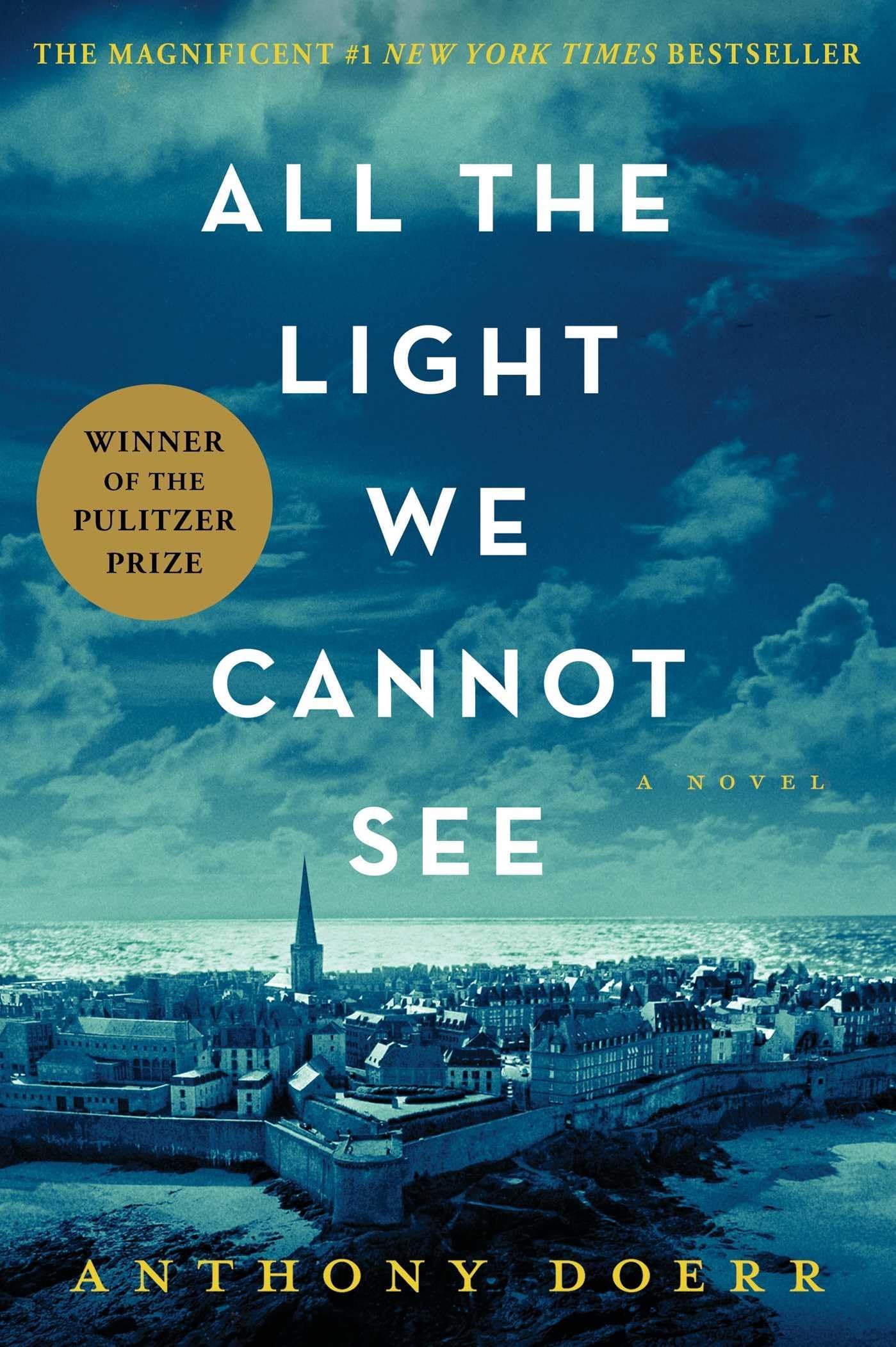
All the Light We Cannot See
Product ID: 253577427
🏆Pulitzer Prize Winner
📚172K+ Reviews, 4.6⭐
📺Netflix Limited Series
Desertcart purchases this item on your behalf and handles shipping, customs, and support to Tunisia.
📖 Unlock the unseen stories that everyone’s talking about!
All the Light We Cannot See is a Pulitzer Prize-winning novel by Anthony Doerr, now a Netflix limited series. It tells the intertwined stories of a blind French girl and a German boy during WWII, celebrated for its poetic prose and emotional depth. With over 172,000 reviews and top rankings in war and historical fiction, it’s a must-read for those craving a moving, immersive literary experience.
| Best Sellers Rank | 154,542 in Books ( See Top 100 in Books ) 57 in War Story Fiction 298 in Film & Television Tie-In 426 in Historical Fiction (Books) |
| Customer Reviews | 4.6 out of 5 stars 172,758 Reviews |
K**R
A moving WWII novel with stunning writing
All the Light We Cannot See is a beautifully written and emotionally absorbing novel. I loved how Anthony Doerr brings Marie‑Laure’s world to life — the way her father builds miniature models of Paris so she can learn her way around is one of the most touching details in the book . Werner’s storyline is equally compelling, especially his fascination with radios and how a “broken radio fills his life with possibility”. Even though it’s set during World War II, the heart of the story is about kindness, resilience, and the small ways people try to be good to one another, even in terrible circumstances. It’s a gentle, moving read that builds slowly but rewards you with unforgettable moments. I can see why it won the Pulitzer Prize and became a worldwide bestseller.
D**W
THE INVISIBLE WAVES
Movement and love. Gravity and time. Chance and physics. Sound and light. Fear and greed. We as humans are insignificant flecks of dust in a vast universe. We are guided by light we cannot see, driven by desires we cannot fathom, shaped by forces we cannot comprehend. The invisible waves of the heavens crash against the shores of our existence, reshaping, revealing, sweeping us away to oblivion. In All The Light We Cannot See by Anthony Doerr the waves of sound, colour and light weave a lyrical tale using the magic of words to travel back and forth in time through the lives of two people fated to intersect for only a brief moment during World War II. Marie-Laure is a blind French girl in Paris lovingly cared for by her devoted father, a locksmith for the Musee de l'Histoire Naturelle. He unlocks her from her sightless prison by building scale models of her neighbourhood to help her navigate, teaches her Braille, and transports her with Jules Verne and the power of language. Werner is a young German orphan in the coal mining region of Germany who is allowed to escape, if that is the right word, a grim future as a miner due to his prowess with electronics. He is admitted to a school for the Nazi youth, the Schulpforta, designed to mold the elite of Aryan youth into heartless, ruthless killers. These two are linked through the sightless couriers of the air- radio waves, and by the bludgeonings of chance. They are both guided by the voice of Marie-Laure's grandfather in the past, broadcasting from the attic of the family home in St. Malo, who exhorted his listeners to 'open your eyes and see what you can with them before they close forever'. They do just that, metaphorically, and this book is the story of how their lives (and their fate) become intertwined. We all have saviours we cannot see. We call them angels. A stone plays a central role in the story, a cursed diamond which through pressure and time captures fire within it, and becomes the object of the evil greed embodied in the least successful character, a cardboard cutout Nazi. But as her father tells Marie-Laure, stones are just stones, rain is just rain, and misfortune is just bad luck. Doerr's prose is spare, poetic, and mesmerising. This is writing of the highest calibre. It is a book which treads the rare fine line between making one want to greedily lap up one finely crafted sentence after another and taking the time to savour each morsel, between sating a hunger to find out what will happen next and not wanting the meal to end. The ending, when it comes, is deeply unsatisfying at first. Upon reflection, it becomes like life itself, a mystery full of chance where the logic of existence, the rationale, the whys and wherefores, are all invisible. What do we call visible light?, asks the voice across the airwaves. We call it colour. But the electromagnetic spectrum runs to zero in one direction and to infinity in the other, so really, children, mathematically all of light is invisible. And later: So how children, does the brain, which lives without a spark of light, create for us a world full of light? The book answers its own question. Through imagination. The same imagination which enabled a gifted writer like Doerr to create this beautiful story, a story like the sea, only a receptacle for all the prodigious, supernatural things that exist inside it. It is only movement and love; it is the living infinite. FIVE STARS
R**K
” I’m a sucker for beautiful writing and this is a very beautifully written novel
“What mazes there are in this world. The branches of trees, the filigree of roots, the matrix of crystals, the streets her father recreated in his models... None more complicated than the human brain, Etienne would say, what may be the most complex object in existence; one wet kilogram within which spin universes.” I’m a sucker for beautiful writing and this is a very beautifully written novel. Doerr always has full imaginative command of his detail and, even if occasionally he feeds too much protein into his sentences, is thus able to evoke his images searingly and poignantly. The novel is a visual delight which is an especially brilliant achievement when you consider he’s often writing about blindness. Doerr’s poetic sentence writing often transfigures the familiar, allowing us to see the natural world afresh. His prose strips us of our own blindness to the beauty in the commonplace. The natural world pervades this novel like a kind of scripture. The goodies are aligned to the natural world; the baddies see it as little more than resources for furthering ambition. This being one of the many fairy tale motifs the novel dramatises. Because it can be read as a fairy tale. There’s a magical stone in the custodianship of Marie Laure’s father, a kind of Wizard (Etienne’s brother who transmits stories over the radio which Werner and his sister listen to as children) and a very clear unwavering distinction between the good guys and the baddies with few grey areas. The innocents are pure. The corrupted are beyond help. All the Light tells the story of Marie Laure who is blind (To shut your eyes is to guess nothing of blindness. Beneath your world of skies and faces and buildings exists a rawer and older world, a place where surface planes disintegrate and sounds ribbon in shoals through the air) and lives in Paris with her father (an idealised character in keeping with the fairy tale subtext of this novel), a locksmith and keeper of the keys at the Muséum National d'Histoire Naturelle. There, hidden in its vaults for the past 200 years, is an accursed gem, a greyish-blue sea diamond with a red hue at its centre: the Sea of Flame. When war comes Marie Laure and her father will become guardians of this stone. The other central character is Werner. Werner and his sister Jutta are orphans in the German mining town of Zollverein, near Essen in the Ruhr valley, heartland of the Nazi war industry. Werner has a gift of mending things and is especially attracted to radios. At night he and Jutta listen to an enigmatic French man telling stories for children over the radio – “a voice on the radio offering a loom on which to spin his dreams.” As straightforward storytelling this novel is ravishing. I liked the short chapters and the flashing back and forwards in time. It reminded me of David Mitchell in its disregard for the perimeters between literary and commercial fiction. Doerr, like Mitchell, romps back and forth between the two camps with great poise and ease. I’m not quite sure what Dave Eggers means when he says Doerr “sets a new standard for what storytelling can do” because there’s nothing groundbreaking about this novel. Like I said it’s straightforward brilliant storytelling. On one occasion Doerr uses a cheap trick, introducing a new POV to crank up tension (an informer who lives near Marie Laure) and then discarding the POV for the rest of the novel but on the whole the artistry of this novel was spellbinding. One of the novel’s themes is guardianship, executed especially well with Werner’s protective but ultimately impotent feelings towards the dreamy Frederick at the bullyboy Nazi college, but shown as a constant facet of the novel’s every relationship. Everyone is guarding some precinct, some stone or calling of the heart. How, above all else, we are all guardians of our own flame which, in the novel, is often seen as our relation to how we use our time and best dramatised through Marie Laure’s great-uncle, the shellshocked Etienne who after WW1 became agoraphobic and never leaves his house until circumstances force him out. This idea is also expressed by Werner – “He thinks of the old broken miners he’d see in Zollverein, sitting in chairs or on crates, not moving for hours, waiting to die. To men like that, time was a surfeit, a barrel they watched slowly drain. When really, he thinks, it’s a glowing puddle you carry in your hands; you should spend all your energy protecting it. Fighting for it. Working so hard not to spill one single drop.” Transmitters/transmission is another constant theme. The diamond transmits a curse, coal transmits energy, light transmits codes and of course the radio transmits a channel through which Marie Laure and Werner first connect and establish their elective affinity. Doerr creates a world we’re all blind to, a world pulsing with invisible transmitting circuitry. So what began as a clever stroke of emotional manipulation – the positing of a blind girl at the heart of the novel – becomes a tour de force of thematic choreography. Map-making is another theme. Etienne’s broadcasts create a map that unites Werner and Marie Laure. Marie’s father builds her a miniature scaled model of her Paris neighbourhood and then, when they move, a miniature model of Saint-Malo in order that she may feel her way through a perfect replica of her surroundings. Werner is mapping out enemy transmitters during the war. Once again Doerr is exploring the invisible grid that maps out our lives, the light we cannot see. The bitchiness of Carmen Callil’s review in the Guardian was astonishing. Rarely do fellow writers publically ridicule each other in public. Just the opposite. There seems to be a you-pat-my-back-and-I’ll-pat-yours attitude to reviewing so you have to wonder why her review seemed so personally malicious. Often the reviews seemed to have this novel down as a brilliant page-turner but not great literature. I’ve been wondering about this. I adored reading this novel and then perhaps, a day after finishing it, felt maybe I had been somehow tricked into liking it better than it deserves. Does Doerr lack a little subtlety in his emotional manipulation of the reader? If you write a novel about a blind girl with an adoring ideal father and an orphan boy who protects his younger sister you’re obviously going to almost immediately command a great deal of sympathy for your characters. These are the innocents of fairy stories. Also the stalker von Rompel who Doerr makes no attempt to portray as anything but pantomime villain. But all these motifs belong to the fairy story aspect of this novel and within that context are managed well I think. It’s also been said Doerr doesn’t deal with Nazism very convincingly. Is that a valid criticism? The English patient is a WW2 novel and it could be said that doesn’t deal with Nazism very well either. Doesn’t prevent it from being a brilliant thought-provoking novel. “Impossibly, the static coalesces into music. Volkheimer's eyes open as wide as they can. Straining the blackness for every stray photon. A single piano runs up scales. Then back down. He listens to the notes and the silences between them, and then finds himself leading horses through a forest at dawn, trudging through snow behind his great-grandfather, who walks with a saw draped over his huge shoulders, the snow squeaking beneath boots and hooves, all the trees above them whispering and creaking. They reach the edge of a frozen pond, where a pine grows as tall as a cathedral. His great-grandfather goes to his knees like a penitent, fits the saw into a groove in the bark, and begins to cut.”
J**N
Fade away and radiate
Marie-Laure is a French blind girl who’s taught by her father to navigate her town using a model of the neighbourhood he’s built. Werner is a German orphan with an aptitude for repairing and operating radios. Set in WWII, this is their story. They're introduced skillfully - Marie Laure visits the museum where her father works and learns about the exhibits by touch: "the breast feathers of a stuffed and mounted chickadee are impossibly soft, its beak as sharp as a needle." [p20], whilst Werner grows up in an orphanage whose rooms are "populated [...] with battered trunks inside which drowse the last possessions of deceased parents: patchwork dresses, tarnished wedding cutlery, faded ambrotypes of fathers swallowed by the mines" [p24]. Their separate worlds are perceived by feeling and hearing (Werner isn't blind, but his fascination with the sound coming out of a radio means he's more often listening than looking: he thinks of "a voice on the radio offering a loom on which to spin his dreams" [p389]). There's good portrayal of the people around them: Marie's father feels pride that his daughter “is so resilient, so curious. There is the humility of being a father to someone so powerful, as if he were only a narrow conduit for another, greater thing" [p189], and when Werner tells the nun in charge of the orphanage that he has to leave, "her eyes filled slowly, as if some internal flood were gradually overwhelming her" [p113]. Later, a dying German soldier tells Werner how he'd visited his father whilst on leave the previous year. "He was old; he was old all my life [...] He said 'You don't have to stay. I'd like you to stay, but you don't have to. You probably have things to do'. I left. I went down the stairs and into the street. I had nowhere to go. Nobody to see. [...]. But l left, just like that." [p306]. The writing is good (the reader soon forgets to notice that the whole book - all 530 pages of it - is written in the present tense), and the structure - which alternates between the two viewpoints, and marches forward in time as the two worlds slowly draw closer - draws the reader into a place that's a mixture of fable and technology, with a promise of shedding light on how people try to be kind to one another, even in the most degraded circumstances. Overall, an interesting, moving story, I thought.
B**L
Such a fantastic book - Loved it
All the light we Cannot See by Anthony Doerr was another book for my book club. It was my choice so I was really hoping that it would be a good read. This book covers the themes of war, resilience, hope, human connections and unseen connections (radio waves). The book tells the parallel story of Marie-Laure in France and Werner in Germany. The book opens in August 1944 at the end of the story. It then goes back to 1934 and introduces us to Marie-Laure who lives in Paris with her father. Marie is 12 years old and blind. Just prior to the occupation of Paris by the Nazis, Marie and her father flee to the city of Saint Malo, where her reclusive great Uncle Etienne lives. Her father worked at the Museum of Natural History and when he leaves Paris he is entrusted with the museum's most valuable jewel. In Germany, Werner grows up in an orphanage in a mining town. He has an aptitude for electronics, building and fixing radios which eventually attracts attention. He goes to a Nazi run school and eventually is enlisted to help track down radios used by the French resistance. Marie-Laure and Werner eventually meet and we learn how their lives are intertwined. The only negatives I found were; the length of the book initially put me off, as it is over 500 pages (however, as I loved reading this I finished the book very quickly), and the initial changing between different character perspectives and time zones took me a little bit to get used to. The positives were numerous. This is a beautifully written book, with such wonderful prose. The story was so interesting and kept me wanting to read on. I loved the character development of both Marie-Laure and Werner, I thought that they were such interesting characters and I had empathy for both of them. Even the other minor characters were well written. The plot was so interesting and moving. I liked the ending and how we learned what happened to the characters. I kept pondering the meaning of the title ‘All the light we cannot see’ and liked the passage ‘The brain is locked in total darkness…. It floats in a clear liquid inside the skull, never in the light. And yet the world it constructs in the mind is full of light. It brims with color and movement. So how… does the brain, which lives without a spark of light, build for us a world full of light? I think the book is exploring themes of light and darkness in people. Marie-Laure is blind and in darkness but she is filled with light. Werner and the others can see but are filled with darkness. Only at the end of the book does Werner really see ‘Open your eyes and see what you can with them before they close forever’.
N**C
A fantastic read
A captivating book.
M**E
Not bad
I like the way the book is structured into short chapters, going from one character to the next and back again. It helps to keep it from getting too boring, and encourages me to read one last little chapter before bed. Had the book not been structured on such a way, I might have gotten through it much more slowly, if at all. The story was gripping in places, nothing in others. I was somewhat taken in by the location of Saint Milo however, and it made me want to visit. The writing is generally very good. It was ok, nothing too special on the whole. Very slow book. There were some parts that could have been very disturbing, but strangely came off a little blase. It makes the book feel quite flat and uneventful, when it describes what would obviously be pretty horrific occurances.
R**8
Human, so Human…
Books like this only arrive once every 10-20 years. I feel as though 1.000.000+ emotions have been carefully, skilfully and beautifully drawn out of me in reading this story. When learning to read as a child, great books had a way of making you ‘feel, taste, smell, sense, hear, see and ‘live’ the; words, emotions, people, story lines and places. It helped you to ‘experience’ the very inducement of why we should read. This story travels through one of the most truly horrific and debased times in human history itself. Characters are depicted from the spectrum of nations, but more importantly, a host of backgrounds and life circumstances. The main characters are, quite simply, ‘so human’ and so ‘fallible’ it makes you want to keep reading for the beauty and simplicity of it. It took me a little over a day to ‘consume’ the book in a few sessions. The way it’s written in short chapters, flitting between the cast and the storylines is quite perfect. Go ahead and form your own opinions. It’s a ‘if you only read one book this year’ moment with this one. At the end of the book, it felt as though I’d lived through something amazing, truly understanding how people overcame, and moved forward. Less than 24 hours after reviewing a different book (I read 2 days ago) ‘Tunnel 29’, where at the end of the review, I said it was my favourite book of the year, here I am today, now proclaiming, ‘this’ is now my favourite book of the year, so far. Only by a fraction, though, as that other book is tumultuous in a different style.
A**O
Very touching
Beautiful book, even better than the movie, as usual!
M**D
World War II
Two fragile young people's destiny during WWII. Books and series about this period are necessary. It's our duty to remember so that it won't happen again. It's a very good book for teen-agers and adults who won't forget.
E**L
Good read
Good read for a 14yr old
M**K
Mi gusto.
mi libro que quería leer y resulto buenisismo.
D**I
Bom
Pouco cansativa, mas muito boa pra treinar o idioma
Trustpilot
1 month ago
4 days ago