
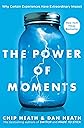
Simon & Schuster The Power of Moments: Why Certain Experiences Have Extraordinary Impact
Product ID: 254480026
🏆NYT bestseller status
📖durable hardcover binding
📚320 premium pages
Desertcart purchases this item on your behalf and handles shipping, customs, and support to Tunisia.
✨ Create moments that matter, because life’s best memories aren’t accidental!
Simon & Schuster’s hardcover edition of The Power of Moments offers 320 pages of transformative insights from bestselling authors on how brief, meaningful experiences can elevate your personal and professional life. With a 4.7-star rating from over 2,400 readers and top rankings in social psychology categories, this book equips managers, educators, and leaders with the tools to intentionally craft unforgettable moments that foster connection, pride, and insight.
| Best Sellers Rank | #26,373 in Books ( See Top 100 in Books ) #14 in Sociology of Marriage & Family #65 in Social Psychology & Interactions #90 in Interpersonal Relations |
| Customer Reviews | 4.7 out of 5 stars 2,465 Reviews |
S**M
Awesome
The book was in great condition
A**K
A good book!
Good book on moments and the important of moments! Nice anecdotes, written in an easy manner!
T**S
Wie man besondere Momente schafft
Dieses Autoren-Duo ist schon unglaublich stark und hat auch hier wieder ein ganz besonderes Buch geschrieben. Die Grundidee: es sind besondere Momente, die uns in Erinnerung bleiben und die so letztlich auch unser Leben mitbestimmen. Was bleibt von einem bestimmten Abschnitt in unserem Leben? Woran erinnern wir uns? Sind es positive Erinnerungen oder negative? Es ist gar nicht die Frage, ob das Leben immer einfach war. Es kann auch ruhig schwer und anstrengend gewesen sein. Solange es besondere "Peak"-Momente gab, werden wir uns an diese erinnern und so werden sie die Erinnerung an den ganzen Abschnitt bestimmen. Das Buch hat zwei Ziele: 1) werden diese besonderen Peak-Momente analysiert (was kennzeichnet sie? was haben sie gemeinsam?) und 2) wird aufgezeigt, wie man solche Peak-Momente selber erzeugen kann! D.h. das Buch hat auch einen sehr praktischen Nutzen. Am stärksten fand ich den ersten Abschnitt "Elevation", in dem es darum geht, wie man eben besondere Momente, die aus dem Alltäglichen herausragen, schafft. Die nächsten Abschnitte "Insight", "Pride" und "Connection", in denen es jeweils um bestimmte Aspekte von besonderen Momenten geht, fand ich persönlich etwas schwächer. Insgesamt für mich daher ein Buch zwischen vier und fünf Sternen. Jeder kann hier aber etwas mitnehmen und lernen, wie er für sich, seine Freunde oder seine Familie, für seine Mitarbeiter oder seine Schüler und Studenten besondere Momente schaffen kann, die ihnen in Erinnerung beiben und ihr Leben bereichern werden!
J**N
“Beware the Soul-Sucking Force of Reasonableness”
If you happen to be buying gifts for family and co-workers today, I can make it easy for you. Buy a dozen copies of “The Power of Moments.” Here’s the big idea: “A defining moment is a short experience that is both memorable and meaningful.” And…oh, my—are we in short supply of significant moments in our boring staff meetings, workplaces, churches, schools, and homes. You can change that! Buy this book for: YOUR STAFF. Here’s an idea: bring popsicles to your next staff meeting and play the audio from the first chapter, “Defining Moments,” and ask the team why the Magic Castle Hotel in Los Angeles does this: “Let’s start with a cherry-red phone mounted to a wall near the pool. You pick it up and someone answers, ‘Hello, Popsicle Hotline.’ You place an order, and minutes later, a staffer wearing white gloves delivers your cherry, orange, or grape Popsicles to you at poolside. On a silver tray. For free.” What will your staff learn? “What the Magic Castle has figured out is that, to please customers, you need not obsess over every detail. Customers will forgive small swimming pools and underwhelming room décor, as long as some moments are magical. The surprise about great service experiences is that they are mostly forgettable and occasionally remarkable.” (p. 9) YOUR FAVORITE CHARITIES. If I could wave a magic wand, I’d ask every relief and development organization leader to read Chapter 5, “Trip Over the Truth,” about a methodology called Community-Led Total Sanitation (CLTS). The authors begin with a warning to readers: “The story ahead is full of disgusting images, and it also makes frequent use of the ‘s-word” for feces.” The researcher in this Bangladesh brilliant/brilliant epiphany “believes that it’s a mistake to soft-pedal the word using medical terms…or more kid-friendly terms. When he works in new countries, he makes sure to ask for the crude slang… He wants the word to shock.” The researcher’s ingenious approach to dramatically improved community health is the polar opposite of the way leaders, teachers, and preachers seek change. Instead of pulpits, podiums, and lecterns, Dr. Kamal Kar used observation, probing (shocking) questions, and demonstrations. Brilliant! (p. 97) YOUR TEACHERS. In the chapter “Stretch for Insight,” the authors describe a study of 44 seventh-graders who wrote essays about a personal hero. Teachers marked up the essays and Group 1 students received generic feedback. Group 2 students received personalized “wise criticism.” Both groups could resubmit their essays in hopes of higher grades. You guessed it: almost 80 percent of Group 2 students resubmitted compared to about 40 percent of the first group. (p. 122) YOUR PASTOR. Whew. How do pastors inspire a congregation—weekend after weekend, 52 weeks a year? (Few do.) But creative teams can create extraordinary experiences along the way—by defying “the forgettable flatness of everyday work and life by creating a few precious moments.” (p. 265) And speaking of teaching, don’t skip the insights about a weeklong program, the Course Design Institute (CDI). “The dirty secret of higher education [and maybe seminaries] is that the faculty aren’t taught how to teach,” says Michael Palmer, a chemistry prof at the University of Virginia. So Palmer invites groups of 25 to 30 profs, per course, to meet the ugly truth in the mirror. It begins with an interactive fill-in-the-blanks exercise, where each prof completes one sentence: an aspirational objective for students that will be realized three to five years later. Then each prof compares that aspiration with his or her course syllabus. Palmer asks, “How much of your current syllabus will advance your students toward the dreams you have for them?” You guessed it! Chip Heath and Dan Heath describe one prof’s head-slapper moment, after an awkward silence: “You look at your syllabus, and you go, ‘Zero.’” (p. 106) The book includes a link to a complete syllabus with “before” and “after” examples—showing how a professor changed the content, as a result of the weeklong course. You should also buy this book for: PARENTS AND GRANDPARENTS. The dinner table question from Spanx founder Sara Blakely’s dad: “What did you guys fail at this week?” (p. 130) HR TEAM. On creating extraordinary moments on a team member’s first day on the job: “Imagine if you treated a first date like a new employee.” (p. 18) MARKETING STAFF. “One simple diagnostic to gauge whether you’ve transcended the ordinary is if people feel the need to pull out their cameras. If they take pictures, it must be a special occasion.” (p. 63) FUNDRAISERS AND OTHERS. On the topic of unheralded achievements in the chapter, “Thinking in Moments,” the authors ask: “We celebrate employees’ tenure with organizations, but what about their accomplishments? Isn’t a salesman’s 10 millionth dollar of revenue earned worth commemorating? Or what about a talented manager who has had 10 direct reports promoted?” (p. 36) And I’d add: And what about celebrating a single mom’s faithful $10-a-month donor gifts when her total giving reaches the $500 or $1,000 milestone? That’s a moment to celebrate! Plus, don’t miss the creative way one organization sends personalized thank you notes to donors. (p. 151) BOARD MEMBERS. Recently, I played the book’s audio of “Clinic 1: The Missed Moments of Retail Banking” to my fellow board members at Christian Community Credit Union. The question, “Could banks learn to ‘think in moments’?” Convicting—but very, very applicable to all organizations. I could go on—but you get my drift. This book changed—changed!—my thinking in so many ways. You’ll appreciate the powerful and poignant stories. Example: how a priest gathered a widow’s friends together (five years after her husband had died) for a therapeutic wedding vows ceremony—but in the past tense. “Were you faithful?” The result: she was finally ready to date again. You’ll underline the “whirlwind reviews” for each of the four major sections (Elevation, Insight, Pride, and Connection). You’ll be delighted by the bonus resources, like the “clinics,” the free app referenced, “36 Questions,” and why one company empowers employees to give away a certain number of free drinks and food items every week! (p. 73) The “Clinic 2” (p. 89) is a must-read about church boards. The question: “How do you refresh a meeting that’s grown rote?” One approach: “Break the script.” And finally, Chip Heath and Dan Heath warn: “Beware the soul-sucking force of reasonableness.” Example: “Couldn’t we just put the Popsicles in a cooler by the ice machine?” (LOL!)
P**)
¡Fantástico!
Lectura muy recomendada para todo el mundo. Cómo mejorar nuestras experiencia de vida (pensar la vida en momentos), las relaciones personales, el trabajo, etc. Los autores diseccionan los componentes de los momentos significativos en 4 elementos: - Momentos de Elevación - Momentos de Orgullo - Momentos de Conocimiento/Revelación - Momentos de Conexión Y dan ejemplos y pautas concretas para implementarlos en nuestra vida cotidiana. Sin duda una de los libros más reveladores e inspiradores que he leído, que me ha llenado de momentos fascinantes.
Trustpilot
5 days ago
1 month ago