Desertcart purchases this item on your behalf and handles shipping, customs, and support to Tunisia.
🚀 Power Your Network Like a Pro — Stay Connected, Secure, and Ahead of the Pack!
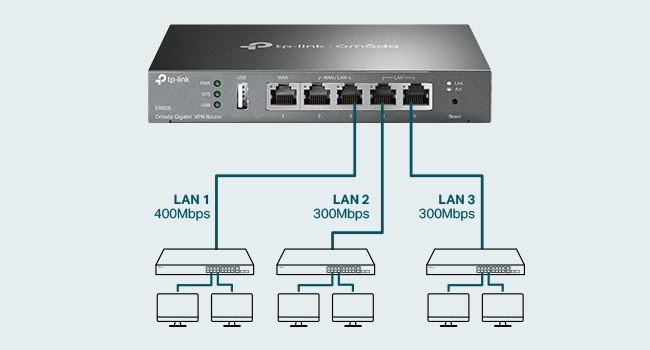
The TP-Link ER605 V2 is a wired Gigabit VPN router featuring 5 high-speed ports (1 WAN, 2 WAN/LAN, 2 LAN), USB WAN support for 4G/3G backup, and robust security with advanced firewall and VPN capabilities supporting up to 52 simultaneous tunnels. Designed for professional-grade network management, it integrates seamlessly with TP-Link's Omada SDN for centralized cloud control, making it ideal for small businesses and tech-savvy home offices demanding reliable, high-performance connectivity.


| ASIN | B08QTXNWZ1 |
| Antenna Location | Home |
| Best Sellers Rank | #207 in Computers & Accessories ( See Top 100 in Computers & Accessories ) #18 in Computer Routers |
| Brand | TP-Link |
| Built-In Media | Gigabti VPN Router ER605, Power Adapter, Quick Installation Guide, RJ45 Ethernet Cable |
| Color | silver |
| Compatible Devices | Personal Computer |
| Connectivity Protocol | Ethernet |
| Connectivity Technology | Ethernet |
| Control Method | Remote |
| Controller Type | Switch |
| Coverage | Multi-WAN and VPN supported connectivity |
| Customer Reviews | 4.4 out of 5 stars 4,942 Reviews |
| Data Transfer Rate | 1 gigabits_per_second |
| Frequency | 5 GHz |
| Frequency Band Class | Tri-Band |
| Global Trade Identification Number | 00845973089597 |
| Item Dimensions L x W x H | 6.22"L x 3.98"W x 0.98"H |
| Item Weight | 12.64 ounces |
| LAN Port Bandwidth | 10/100/1000 Mbps |
| Manufacturer | TP-Link |
| Maximum Upstream Data Transfer Rate | 4000 megabits_per_second |
| Mfr Part Number | TL-R605 |
| Model Name | ER605 |
| Model Number | ER605 |
| Number of Ports | 1 |
| Operating System | Windows |
| Other Special Features of the Product | WPS |
| Router Firewall Security Level | Advanced |
| Router Network Type | wired |
| Special Feature | WPS |
| UPC | 840460604635 845973089597 |
| Unit Count | 1 Count |
| Voltage | 240 volts |
| Warranty Description | 5 Year Manufacturer |
| Wi-Fi Generation | Wi-Fi 6 |
| Wireless Communication Standard | 802.11ax |
| Wireless Compability | 802.11ax |
S**E
TL:DR- Initial Integration Issue But Worth It
Unit arrives with IP 192.168.0.1 which is annoying and makes plug and play integration not possible for many networks. The Omada Controller see’s the unit but cannot provision it. Once you change your terminal device to some IP like 192.168.0.X, you can log into 192.168.0.1 and change the router IP to be on your network. Not sure why they don’t just select 192.168.1.65 or some other random IP. Anyway, once I did that the router provisioned and I was in business. It’s faster than my older Edgemax 5 port, integrates really well, and has a bunch of other features. The full blown Omada control interface (not standalone mode, I have an Omada controller, a separate box that plugs into the network) takes some time to understand. Not a knock on Omada as there are many features and options for all devices. The way it all integrates is pretty powerful and easy to navigate after you ingest it all. The router stand alone UI is fine, too, if you just need a pretty fast and feature rich home router. So I have two wall mounted access points, a POE switch, an outdoor AP, and this router (all Omada). Adding the new router made a noticeable improvement to overall improvement and the system does seem to optimize very well. My only gripe is the initial setup could be a little more seamless for the router. Every other Omada I have integrated perfectly. I would also like it to be POE powered but that’s a “nice to have.” Some background if interested: I’ve been gradually moving my wifi system over to the Omada ecosystem. My first purchase was their wall mounted access point, which mounts in a junction box and has a couple Ethernet ports. Great product. After that experience to picked up an Omada POE switch to directly power the APs. Then I got an outdoor AP. AP Performance was (and is) great in a very challenging urban SF environment. There are so many wifi networks on my block. I was coming from a Google wifi which was ok at first but after more networks popped up or a SW update it would just grind to a 3Mbps halt. The Google isn’t flexible at all. With that said I know some people have great success with it in suburban environments. The Omada APs just work and it’s been great. The Omada controller box is also worth it. The whole system is a bit overkill for a residential system, but overkill is underrated and I have a bunch of cameras on switches spread all around. I tried Ubiquity but had some issues and didn’t like the cloud interface. I prefer the Omada interface and the Omada controller box isn’t hundreds of dollars. Hope this helps.
A**N
Router Installation
I made purchase of this item because my mikrotic got damage in a lightning storm. I could not get any LAN from however i had store this item in cart for a long time and have been watching itso finally it was baught. I had no doubt about if or not it would work having experience with TP-Link i felt 100% confident in their products. I have been using one of their access point in organization for a couple years now it works perfectly fine. This router is solid from the company going with their switch i baught last year. I was amaze with their soft ware even my cousin was taken back becaus he loves another brand but he loved the set up inside. It can take in up to two ISP it wasn't hard to set up quick and easy to log in create new password and in the quick set up to get internet set up. I didn't have to read the manual for that. Once your all set you will experience a new smooth service right off the bat, there few things to keep in mind it is a home and business router so it has high end set up inside so it is capable of handling DHCP, VPN, 2WAN and other smart set up. In some cases may need someone experience to set it up properly depending your desire. NOTE it is not a POE router meaning it cannot send that extra power for cameras that may need POE I would recommend it at anytime for small set up like mind because i have multiple tv, cable box, access points, routers and printer so its a for a home set up which handles alot of load at time. So i have a dedicated switch for that too which is a TP-LINK. Because of that this router can handle that load and also has lighting protection. You can also down load the app and control it from cloud so you don't really need to be physically around to login and make adjustment. There are videos on you tube that can help with that set up. Make sure the device is on a good ups for protection read through notes before buying make sure the setup you are doing is the correct set up for this router and then if it is an know your going to enjoy your purchase.
K**S
Solid little router with useful features
This TP-Link ER605 V2 has been a solid router for my network setup. I like that it gives me more control than a basic home router without being overly complicated to get running. The wired gigabit ports have been reliable, setup was straightforward, and the interface is easy enough to work through once you know where the main options are. The VPN and network management features are useful, especially if you want something more flexible for a home office or small business style setup. It is compact, looks clean on the shelf, and has handled regular traffic without any issues. For the value, ports, speed, and ease of use, it has been a dependable little router.
C**S
Lots of oddities and short comings but fast and mostly functional
I am using this load balance and failover for two isps. It has good speed when doing this however there are some oddities It supports 802.1q trunks and vlans but it is confusing when you set them up. You have to create additional "lans" that create the vlans as part of the setup automatically, you cant create vlans and associate to the SVIs like you would on any normal network device. If you create a vlan fist you cant create the SVI for it, If you create a "lan" and tell it to use a vlan it will create them both and work fine. Its confusing on the screen because it looks at first glance to just be where you setup DHCP It will not run ANY routing protocol - this is one of the biggest down sides for me built in DHCP is very clumsy and limited. You cant set scope options (like DNS for example) differently on IP reservations. looking through the DHCP list is also very difficult because it wont sort it. If you want to run your own DNS server to get this options you will fine it also cannot set DHCP helper address on subquent vlans so you have to physically put a DHCP server in each one you want real DHCP in. It does not support any routing protocol so everything has to be static routes. Its not very good that way When using multiple isps they expect an odd situation where each ISP has its own transit network instead of being on a single layer 2 and just having multiple next hops. if you try to force it to do that it flakes out. You have to set each one in its own IP space and vlan (it auto creates the vlan) Some settings like wan changes require you to reboot the router to set. This isnt a huge deal but it does take an exceedingly long time to do so. 3-5 mins. You will seriously thing its broken while you wait for it to come back The policy based routing seems to have a VERY detrimental impact on speeds through the router. This is a nice feature but don't turn it on unless you don't have allot of wan bandwidth to start with. At 250M/S connections it cuts the speed down to around 100 for all clients - even when this is turned on for just a single IP The isp circuit up tracking and failover seems to work but is slow like every 30-45 seconds it checks. It is unclear if you need static routes to force internet traffic for checking purposes or not. I put them in anyway because I monitor and alert on uptime via a script running on a host internally. There are no controls to change this behavior, only a place for an IP for icmp and dns tracker. The failover process itself is very hard on IOT devices. PCs and phone seem to handle it fine but anything that calls home for instructions like Echo Dots, Smart plugs etc, just dont do well. the only real way to get them to behave is to reboot them each individually, or force a wireless re-association or reboot the router completely, I suspect this is a nat refresh problem - the router is not force resetting the existing NAT translations. This corelates to the comment i had above about not supporting multiple next hop routers on the same layer 2 transit network, if they either force refreshed the Nat translations or would allow all the wan links on the same layer2 network then i think it would work much much better for most people There is no way to not run nat for the wan side on these which can be problematic if you are also forced to have nat running on the next hop. There is no route tracking on these, so you can't have static routes turn on or off based on the wan link tracker which is a less intensive way to achieve some of the results of PBR Overall these are nice units and seem to get full line speed on the connections I'm using (dual 250s/50). These are high performance routers that have nice features but certainly not everything you're looking for implemented. They are most definitely not designed for anyone who has a strong networking background. Price point against comparable performance routers however is very attractive and for a home user that is not all that technical would do reasonably well with these
G**Z
A Robust Router with a Quirky Interface
Our home is 4,000 sqft on two levels and the wifi distribution was built using an older Netgear wifi/router with a first generation Rockspace wifi mesh. As more smart devices, tablets, IOT's and such being added, the system really began to choke and just couldn't handle the load. That's when I decided to rebuild the topology using a standalone router and upgraded wifi mesh. There isn't a huge selection of standalone routers in the home networking category, and the selection came down between Ubiquity and TP-Link. I settled on the TP-link ER605 and am very pleased with the overall results, though it did come with pretty steep learning curve, due to its (in my opinion) confusing GUI interface. For instance: setting a DHCP address pool is hidden within a category called "Network List". All that is displayed is a Network Name "LAN", the IP address of the router, and a couple other parameters. You must select an edit icon to expand the display which will allow you to customize your LAN set up. It's subtle, and easy to miss if you don't understand the GUI design intention of the programmers at TP-Link. The MAC/IP Reservation controls are straightforward, but there is no obvious way to sort the list by IP or MAC address. I have nearly 70 devices hanging off my network, and not being able to sort the lists makes for a tedious effort when looking for a specific device. I contacted TP-Link support about this and told me that, no, you cannot sort the DHCP IP listing, but you can if you use their add-on OMADA Hardware Controller (at a cost of about $100), but I really don't want another layer of hardware or complexity to deal with. There are other quirks in the interface that slowed my setup time, only because I had to spend more time just to find where the specific option I was looking for is buried within the GUI. Now, anytime you migrate to a new topology, there will be a learning curve, but most of the quirks I ran up against could easily be addressed with a bit of effort on the GUI design. Things like Port Forwarding (Called "Virtual Servers" in the GUI), Dynamic DNS, and OpenVPN services are all there and are fairly straight-forward to set up. So, overall, this little modem has delivered everything I expected and need and this, coupled with the new wifi mesh system (Eero 6+ with 4 nodes with backhaul to the router) has dramatically improved our overall network and wifi service throughout the house. The ER605 modem has proven to be very well suited and is a fast and efficient workhorse of a router. With a bit of pain, effort, and patience to get through the learning curve of the interface, there will be only a few minor disappointments in the interface.
J**N
Reliable, Stable, and Feature-Rich Networking Gear
Before switching to the TP-Link ER605 V2, I was restarting my cable company’s modem/router combo once or twice a week due to constant dropouts and poor Wi-Fi performance. Since installing the ER605 and putting the modem in bridge mode, it has been running flawlessly for over 3 years—the only reboot I’ve done was after making configuration changes myself. At home, I use the ER605 with a TP-Link EAP610 for Wi-Fi, managed via the OC200 controller. At another property I manage, it’s paired with a TP-Link EAP225, controlled through the Omada software running on Proxmox. The entire Omada ecosystem—covering load balancing, firewall, VPN, and network management—is stable, intuitive, and enterprise-grade yet budget-friendly. If you need more ports with VLAN control and Omada integration, the TP-Link TL-SG2008 is an excellent choice. This smart managed PoE-in switch supports VLANs, L2/L3/L4 QoS, static routing, IGMP snooping, and link aggregation. It integrates seamlessly with the ER605 and is perfect for home labs or small business networks requiring flexibility and control. If you don’t need advanced management features, the TP-Link TL-SG108 is a simple, plug-and-play option. It’s unmanaged, fanless, built tough, and just works right out of the box—ideal for quickly expanding your wired network without fuss.
C**S
Avoid. Missing key features and has poor performance
I spent a TON of money on this ER605 and an OC300, along with several switches (24pt and several 8pt units), a lot of WAPs and more based on the positive reviews here. Well the reviews must be padded or fabricated by the company (who apparently doesn't read and certainly doesn't respond to any of the reviews here) because this unit pretty much SUCKS. Latency is terrible, turning 14ms pings into 44-540ms on average. It regularly freezes, hiccups and otherwise requires reboots in the middle of the day, even though the logs show little to nothing in the way of problems and the ISPs attached remain in an unchanged, running state. This is truly frustration in a box… The fail-over feature is a joke; spotty at best with large lag times IF it works at all (very rare that it works at all and when it does, it takes several minutes to do so no matter the settings.) Aggregation doesn't work in any way, shape or form. And the real icing on the cake is there is NO local DNS solution provided AT ALL. This is a basic feature that even the cheapest, worst equipment brands supply, yet TP-Link seems to think isn't necessary to include. It IS NECESSARY - by very definition!!! Unless you like going back about 30 years in network capability... AND, the entire Omada promise is reduced to almost nothing without it, unless you like remembering or documenting every single device’s IP address… HUGE DISAPPOINTMENT. For the load balancing feature, if you want the unit to test all ISPs/WAN connections to suggest and implement a load balancing formula, the speed testing algorithm often gets hung and will 'spin' for hours or days if you let it. You can just enter the balancing ratio yourself (which most likely you will be forced to do because the auto-ratio speed test routine will probably just loop forever as mentioned) because even when the auto-ratio test does actually complete, the ratio it suggests is grossly inaccurate relative to known statistics. I purchased all this TP-Link equipment to replace an older Ubiquiti infrastructure because Ubiquiti's newer UniFi products have become garbage themselves, and Ubiquiti doesn't seem to care. Perhaps both companies are secretly one and the same because TP-Link's products are just as bad or even worse (i.e. no local DNS - at least UniFi gear DOES have that, as it should!) and their support is about equal - non-existent. Calls (well messages left), emails, posts on their support forums, etc. that are requests for support go unanswered. The few answers that do come offer little to no help, and a “just wait, we’ve put in a request” is the best I’ve seen in about a year’s time. So the supposed TP-Link "lifetime warranty" is basically useless. A lifetime warranty with no one to honor it is no warranty at all. As the headline says - AVOID! Unless you LIKE continuous frustration, outages and below lackluster performance... If you do, this gear is definitely for you; go for it and good luck with that! I am beyond disappointed and feel I wasted thousands of dollars in a system that I cannot trust. As much as I hate to say it (and I do), I guess I’m going back to Ubiquiti and scrapping all this TP-Link junk. Update Sept 2023: I didn’t go back to Ubiquiti, but instead purchased a Peplink Balance Two (WAY more expensive than the ER605 mind you) to replace the TP-Link ER605, and it actually WORKS. And it has expected basic functionality, like local DNS resolution, etc. I’ll be converting all my TP-Link equipment as time and budget allows since removing the ER605 dilutes the Omada management platform value proposition close to entirely. My advice: unless you just want unmanaged network equipment, stay away from TP-Link.
C**E
Read Both The Positive and Negative Reviews - Works Well For Me
This is a great value for my needs - has been a rock solid set-up for 2 weeks. Not a single hiccup. That is how I evaluate network equipment - absence of reboots and random speeds. The online user manual and interface is so so and requires some minimal effort to figure out some of the configuration specifics. Installed the router with the associated PoE switch and a Ubiquiti U6 Lite access point in a 2000 sq ft city condo. I had this up and running with updated firmware and a basic configuration in <10 minutes. Same with the access point via my iPhone (no controller). Mounted all on a wall in a closet in the ~middle of the condo where the cables enter the apartment. I am comfortable with technology but have no formal training in networking or computer science. I am not using the VLAN functionality but do have two connected WANs for work from home redundancy (ATT fiber and Google Webpass - both 1 gig achieving ~950 gbps up and down via CAT 6 and 200 to 400 mbps via the wifi access point). I am currently running a VPN on the router. Some of the reviews were critical of some of the more advanced features, such as VLAN. Based on research, I decided I did not plan to use the features included in the critical reviews. I can't speak to the validity of the VLAN and other feedback. I'd never setup a VPN on a router and that took me about 30 minutes mostly on online research to find configuration examples applicable to my installation. The VPN is currently enabled and my network is hidden outside the WAN. Not sure I need that level of security and the slight performance hit (50-150 mbps for me). Would assume other features have similar incomplete documentation and require some effort by novices to configure appropriately. Also, no automated notification of the availability of firmware upgrades.
S**E
Very good product. Works well.
This product is very good, did latest bios update and working perfectly. It has multiple vpn support which works perfectly, but the only issue is with the wireguard vpn that it doesn't work in full mode, so had to setup openvpn which has lower speed alongside the wireguard which works in full mode and solved my purpose fully. Was unable to configure the mobile app though but it doesn't matter to me much.
F**Z
Muy útil para enlaces redundantes
La solución más simple para configurar un enlace redundante. A demás, ofrece muchas herramientas para VPNs. Lo recomiendo para casa o incluso empresas y negocios medianos.
J**N
Excellent routeur fiable avec failover efficace
Très bon routeur pour le prix. Le TP-Link ER605 est facile à configurer et l’interface est claire. Je l’ai acheté principalement pour le failover WAN, et cette fonctionnalité fonctionne très bien. Avec un léger ajustement via le policy routing, on peut obtenir exactement le comportement souhaité. Stable, fiable et efficace — excellent choix.
S**T
Easy to setup and use
Great product
A**H
I've put this unit to the maximum test
I bought this unit because I only have vdsl. I bought a second line to gain more bandwidth. I I run alot of services in my homelab. Even when I'm downloading or uploadeding large files it only sits at 60 percent. Great for people who need a backup line or load balance between 4 connections. I it has good fetures like port forwarding and all standerd networking. I works with cloudflare tunnels
Trustpilot
3 weeks ago
2 weeks ago