
Buy anything from 5,000+ international stores. One checkout price. No surprise fees. Join 2M+ shoppers on Desertcart.
Desertcart purchases this item on your behalf and handles shipping, customs, and support to Tunisia.
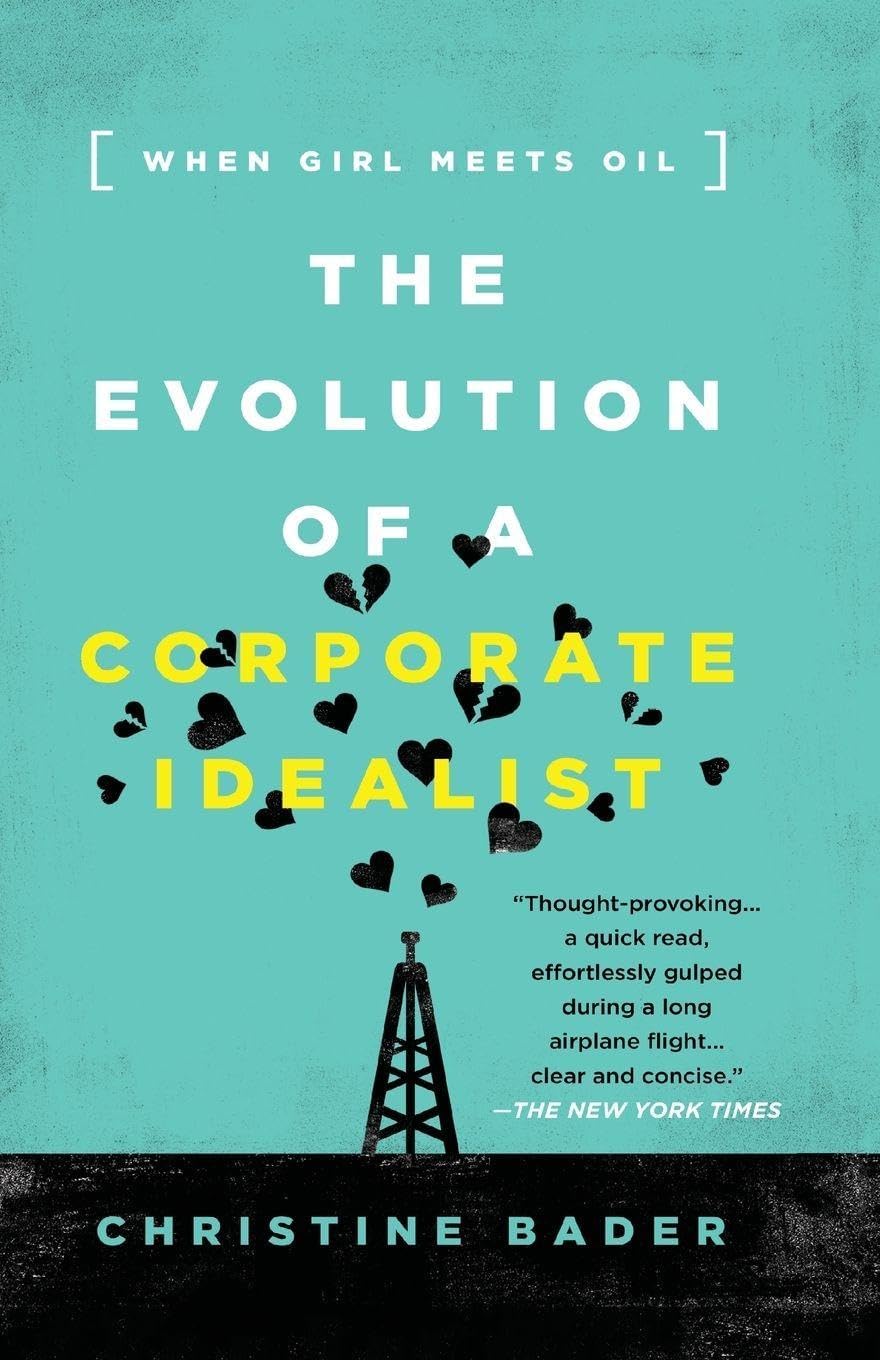
There is an invisible army of people deep inside the world's biggest and best-known companies, pushing for safer and more responsible practices. They are trying to prevent the next Rana Plaza factory collapse, the next Deepwater Horizon explosion, the next Foxconn labor abuses. Obviously, they don't always succeed. Christine Bader is one of those people. She worked for and loved BP and then-CEO John Browne's lofty rhetoric on climate change and human rights--until a string of fatal BP accidents, Browne's abrupt resignation under a cloud of scandal, and the start of Tony Hayward's tenure as chief executive, which would end with the Deepwater Horizon disaster. Bader's story of working deep inside the belly of the beast is unique in its details, but not in its themes: of feeling like an outsider both inside the company (accused of being a closet activist) and out (assumed to be a corporate shill); of getting mixed messages from senior management; of being frustrated with corporate life but committed to pushing for change from within. The Evolution of a Corporate Idealist: When Girl Meets Oil is based on Bader's experience with BP and then with a United Nations effort to prevent and address human rights abuses linked to business. Using her story as its skeleton, Bader weaves in the stories of other "Corporate Idealists" working inside some of the world's biggest and best-known companies. Review: ...at least we're on the right track - It's all in here. The corporate lawyers terrified of disclosure. The failure of some executives to see either the business or the moral cases for securing social licence to operate, and those executives somehow always being slightly senior to the ones that do (the great and visionary John Browne being a notable exception). Transparency and its admitted risks versus benefits. Procurement departments that just don't get it. Pushing the message up the supply chain. The futility of shouting "ethics!" at a spreadsheet. The great high-level corporate policies, made in plush head offices, that somehow seem impotent at the muddy boots level, especially on the minor projects in out-of-the-way places where NGOs and the press are unlikely to tread. All in all, a superb outline of the debates, battles and small victories along the way. The section on the U.N. illustrates that small - OK, sometimes even big - victories are possible, even in the context of that fundamentally flawed organization. What's missing - and what I think is required for the big picture, is an insight into the world of the CSR contractors who prepare impact assessments and the like. In years of working for such contractors I have only heard consultants rewarded for being profitable by swiftly producing light-weight impact assessments, for successfully avoiding public hearings, for giving the client the report they need to present to (sometimes suspiciously un-rigorous) local permitting authorities. Never once for achieving what a social impact or human rights assessment is supposed to - i.e. to level the playing field between a powerful oil and gas company and the disempowered locals that have to play host to it. On one job I was informed by the project manager that my report was only impartial "in theory" as we were being paid by the client. Such is the realpolitik of those who seek to make a living in the business of assisting multinationals to improve their performance. As Christine points out "we want to rock the boat, but we also need to stay in it". This is punchy and very readable. A rare thing - a business book which manages, at least for us idealists, to be an exciting page-turner. Fabulous. And its conclusion is heartening - that although we may be tearing our hair out at our failures, and at times the work can seem futile, the small successes we achieve collectively move the corporate responsibility message forward. At least we're on the right track. Review: An engaging and fascinating read - (Full disclosure: Christine Bader and I went to college together (overlapping one year) and she is a friend.) Christine Bader has written an engaging, brutally honest, thought-provoking book about her experiences, first with BP and later with the United Nations, as what she calls a Corporate Idealist. (This term is used throughout the book and always capitalized, as if it were an official title.) She defines the term in her prologue as referring to members of "a global army of people fighting for better social and environmental practices inside multi-national companies -- with mixed success." I came to the book a decided skeptic about whether major corporations ever see it in their best interests to commit resources towards socially and environmentally responsible practices, particularly when there is often such an obvious profit motive in ignoring such issues in favor of doing everything as efficiently (i.e. cheaply) as possible. Bader, as one would expect, makes a convincing case that corporations ignore these concerns at their peril, and does a fine job outlining the hidden costs of ignoring the social consequences of corporate actions. (She frequently uses the example of how much money can be lost when business operations have to be shut down, even just for a couple of days, due to protesters who are objecting to the business' practices.) The detailed accounts of her work for BP in Indonesia and China are fascinating and, at times, inspiring, as the reader sees how Bader and her fellow Corporate Idealists were able to achieve concrete successes that served both the interests of BP and the communities in those countries in which it was operating. I still count myself somewhat skeptical on the issue, but Bader shows that it can at least be done on a micro level. By the time the Deepwater Horizon disaster thrust BP into the international headlines, Bader had moved on to a position at the United Nations. Although her disappointment in BP's response to that incident is palpable within the pages of the book, I myself was disappointed not to read a more detailed criticism of the way in which BP addressed the disaster and what it said about the company in general. It's possible I wanted more inside politics than Bader was willing to deliver. The final chapter of the book, in which Bader surveys several of her fellow Corporate Idealists in a sort of State-of-the-Revolution summary, reads like a manifesto for anyone interested in this line of work, and indeed for anybody who is frustrated that more companies don't seem to pay attention to any motivation other than the almighty bottom line. The statements of Bader and her other CI's are candid about how difficult and frustrating it can be to battle against corporate policies and practices that have been in place for decades or even centuries, but these declarations are tempered with appreciation of how far this movement has come. You don't have to be an idealist (corporate or otherwise) to enjoy this book. Christine Bader has a lot to say about how major corporations should operate and the obligations they owe to the communities in which they operate and the world at large. Even if you don't agree with what she says, she will force you to think about the role of corporations in contemporary society. It ought to be required reading at business schools around the country, if not the world.
| Best Sellers Rank | #2,556,231 in Books ( See Top 100 in Books ) #236 in Green Business (Books) #277 in Business Infrastructure #348 in Business Ethics (Books) |
| Customer Reviews | 4.5 out of 5 stars 97 Reviews |
B**R
...at least we're on the right track
It's all in here. The corporate lawyers terrified of disclosure. The failure of some executives to see either the business or the moral cases for securing social licence to operate, and those executives somehow always being slightly senior to the ones that do (the great and visionary John Browne being a notable exception). Transparency and its admitted risks versus benefits. Procurement departments that just don't get it. Pushing the message up the supply chain. The futility of shouting "ethics!" at a spreadsheet. The great high-level corporate policies, made in plush head offices, that somehow seem impotent at the muddy boots level, especially on the minor projects in out-of-the-way places where NGOs and the press are unlikely to tread. All in all, a superb outline of the debates, battles and small victories along the way. The section on the U.N. illustrates that small - OK, sometimes even big - victories are possible, even in the context of that fundamentally flawed organization. What's missing - and what I think is required for the big picture, is an insight into the world of the CSR contractors who prepare impact assessments and the like. In years of working for such contractors I have only heard consultants rewarded for being profitable by swiftly producing light-weight impact assessments, for successfully avoiding public hearings, for giving the client the report they need to present to (sometimes suspiciously un-rigorous) local permitting authorities. Never once for achieving what a social impact or human rights assessment is supposed to - i.e. to level the playing field between a powerful oil and gas company and the disempowered locals that have to play host to it. On one job I was informed by the project manager that my report was only impartial "in theory" as we were being paid by the client. Such is the realpolitik of those who seek to make a living in the business of assisting multinationals to improve their performance. As Christine points out "we want to rock the boat, but we also need to stay in it". This is punchy and very readable. A rare thing - a business book which manages, at least for us idealists, to be an exciting page-turner. Fabulous. And its conclusion is heartening - that although we may be tearing our hair out at our failures, and at times the work can seem futile, the small successes we achieve collectively move the corporate responsibility message forward. At least we're on the right track.
D**N
An engaging and fascinating read
(Full disclosure: Christine Bader and I went to college together (overlapping one year) and she is a friend.) Christine Bader has written an engaging, brutally honest, thought-provoking book about her experiences, first with BP and later with the United Nations, as what she calls a Corporate Idealist. (This term is used throughout the book and always capitalized, as if it were an official title.) She defines the term in her prologue as referring to members of "a global army of people fighting for better social and environmental practices inside multi-national companies -- with mixed success." I came to the book a decided skeptic about whether major corporations ever see it in their best interests to commit resources towards socially and environmentally responsible practices, particularly when there is often such an obvious profit motive in ignoring such issues in favor of doing everything as efficiently (i.e. cheaply) as possible. Bader, as one would expect, makes a convincing case that corporations ignore these concerns at their peril, and does a fine job outlining the hidden costs of ignoring the social consequences of corporate actions. (She frequently uses the example of how much money can be lost when business operations have to be shut down, even just for a couple of days, due to protesters who are objecting to the business' practices.) The detailed accounts of her work for BP in Indonesia and China are fascinating and, at times, inspiring, as the reader sees how Bader and her fellow Corporate Idealists were able to achieve concrete successes that served both the interests of BP and the communities in those countries in which it was operating. I still count myself somewhat skeptical on the issue, but Bader shows that it can at least be done on a micro level. By the time the Deepwater Horizon disaster thrust BP into the international headlines, Bader had moved on to a position at the United Nations. Although her disappointment in BP's response to that incident is palpable within the pages of the book, I myself was disappointed not to read a more detailed criticism of the way in which BP addressed the disaster and what it said about the company in general. It's possible I wanted more inside politics than Bader was willing to deliver. The final chapter of the book, in which Bader surveys several of her fellow Corporate Idealists in a sort of State-of-the-Revolution summary, reads like a manifesto for anyone interested in this line of work, and indeed for anybody who is frustrated that more companies don't seem to pay attention to any motivation other than the almighty bottom line. The statements of Bader and her other CI's are candid about how difficult and frustrating it can be to battle against corporate policies and practices that have been in place for decades or even centuries, but these declarations are tempered with appreciation of how far this movement has come. You don't have to be an idealist (corporate or otherwise) to enjoy this book. Christine Bader has a lot to say about how major corporations should operate and the obligations they owe to the communities in which they operate and the world at large. Even if you don't agree with what she says, she will force you to think about the role of corporations in contemporary society. It ought to be required reading at business schools around the country, if not the world.
T**N
A Terrific Resource for Realistic Idealists in Business
I teach business ethics and leadership at Fuqua School of Business, Duke University. So many of our students love business and are equally passionate about making a positive difference in the world. They are not comfortable with business focusing solely on increasing shareholder wealth, at the expense of people, the planet and the fundamental moral virtues. Most of our students don't want to compartmentalize -- to strive to be ethical human beings in their non-work lives, while submitting to an amoral life at work. Many of our students wonder whether they need to work at nonprofits in order to meet their own moral standards for their lives. They want to feel proud about themselves, their work and their companies. Is this realistic or idealistic? Christine Bader's book, The Evolution of a Corporate Idealist, is a terrific resource -- not just for our students, but also for all of us who are striving to help business achieve high financial performance and also high "social" performance. I found her book realistically encouraging. Yes, we can make a positive difference within businesses, but it's very difficult and not a given. After much hard work, we will experience minor, incremental advances, significant setbacks, and now and again transformations. Overall, if we are sufficiently committed and persistent, we can make progress. Christine points out in a section on Career Paths that it is not easy to figure out how to get into the role of CSR and "Corporate Idealist." She astutely encourages Corporate Idealists to determine the fundamental tension points between the core business of a company or industry and the best interests of society. Where, specifically, does doing well for a company pose threats to the well-being of people and the planet? The upside of there not being one, official career path for Corporate Idealists is that there are multiple ways for people of diverse backgrounds, skills and interests to make a difference. Another encouraging take-away is Christine's highlighting the large and growing community of sister/fellow Corporate Idealists. It is easy to feel alone, to feel like an outsider, in any particular company. Her book reminds us that there are thousands of "realistic idealists" in business who are connecting with each other in myriad ways. They share encouragement, ideas and resources. Disclosure: Christine generously agrees to speak annually to our ethics class at Fuqua. The students love her! She exudes a deep character of compassion and she embodies the mature, realistic optimism so evident in her book.
E**L
A valuable guide and call to arms: personal and practical
When Girl Meets Oil in some respects is a valuable exposรฉ, providing the layman with an insider's 'warts and all' view on how large corporations are grappling with what can seem lie contradictory objectives of growing profits and doing good. However, as another reviewer has pointed out, they're not mutually exclusive, but rather interdependent. If corporations take a long term view, and if institutions - as the US government did in Deepwater - levy costs for damaging common goods, responsibility can become a prerequisite for doing right by shareholders. I personally find it comforting knowing that there are people in companies working to do good, and that companies are changing, one hopes largely for the better. But call me an idealist. In other respects, the book is a guide to people already working in business, and it is here that it truly excels. At a most basic level, it is reassuring to see how one person has found a personal story with meaning in a corporate career, which is not necessarily an easy thing to do. The book is also inspiring, and a call to arms, in showing how so many people have caused positive change in large, slow-moving companies. Finally, it provides some useful tools for thinking about issues, whether you work in apparel, natural resources or the most innocuous of industries, in growth economies or developed ones. Christine Bader's engaging style makes accessible a topic that could easily be academic. All in all, a great read and important book.
A**R
Read this book if you want to be reminded that your people are out there and learn from an expert corporate idealist.
When I met this author five years ago, I was 26 years-old and 10 years into my evolution from student activist to nonprofit leader to corporate idealist. Armed with an MBA, passion and lasting beliefs about how a company should operate, I dove headfirst into corporate responsibility and the human rights guidance being developed by the UN. Christine's candid advice shaped my approach and career path. I read this book two years into a detour from corporate responsibility and at a time when I was so frustrated by public policy challenges that I was clinging to remnants of idealism. Within a few pages, I was relieved to learn that some of her experiences paralleled my own. It reminded me of the army of idealists who so deeply believe in their goals of scalable change, they are willing to challenge their own absolutes and evolve. They don't sell out - they understand and navigate the grey without losing sight of their values. They toe the line and push for continual improvement until they can build proven concepts and support for change at scale. Read this book if you are discouraged and wondering if corporate responsibility is more about marketing than outcomes. Read this book if you are wondering how much time it will take to see change in your organization and the world or whether you will ever stop dreaming about your work. Read this book if you just need a recharge or want to be reminded that your people are out there. You'll reflect on your own experiences and double down on your idealism. Or you'll find an organization that is better aligned with your values. Even if it requires not-so-ideal levels of patience and compromise, you'll be inspired by the next opportunity to influence your leadership team, change business practices and help consumers vote for responsibility through their purchases.
T**H
Beyond the matching shirts
This is a great primer for those interested in CSR initiatives that go beyond events with matching t-shirts and painting houses or simply making charitable donations. Bader reflects on her time at BP while weaving through anecdotes of her CSR colleagues and their experiences in the field. Although CSR may not be the silver bullet to a more fair and just economy, this book proves there are people working "on the inside" to make business policies grounded in human rights the norm.
K**T
Better to light a candle than to curse the darkness.
The authenticity of the author's passion for this work shines throughout this book, which makes it a very easy and compelling read. Bader expertly walks that fine line - providing insight without being preachy, inspiring without sounding out of touch. Her experiences, from the hallways of BP to the UN and then advising companies on human rights cuts to the core of these issues: they are complex, evolving, huge and tangled - and no one institution will solve them alone, let alone one person. Her call to action, for a movement of "corporate idealists" to take on the hard work of working from within to create change really resonated for me. The tangible examples help to ground some sophisticated policy maneuvering in reality and practice. This is a must-read for anyone who thinks that large, bureaucratic institutions are immovable or needs the guidebook/manifesto to spur them into action.. this should be required reading for every MBA, MPP, communications and engineering program out there - corporate idealists are needed throughout the business world and Bader's book is a perfect jumping off point.
A**N
thought-provoking and enjoyable read for anyone interested in CSR
Evolution of a Corporate Idealist provides a thought-provoking and enjoyable read for anyone interested in CSR and the global responsibilities of today's corporations. Combining personal anecdotes with interviews from colleagues in the field, Christine provides a wonderful insider's look at the complexities of working in CSR within a large company like BP. The book provides Christine's story as a "corporate idealist" who begins working at BP with high hopes for effecting positive change, inspired by then-chief executive John Browne. She engagingly describes multinational work with fellow employees and affected communities in the UK, Indonesia, and China. Ultimately, environmental disasters and policy changes at BP lead to a "broken heart" and a career change. Now, she again considers herself a corporate idealist, and provides readers with a manifesto for the responsibilities - and benefits - of practicing sustainable business.
M**S
The fastest I ever read a non-fiction book
5.0 out of 5 stars The fastest I ever read a non-fiction book, May 8, 2014 By MBaghuis This review is from: The Evolution of a Corporate Idealist: When Girl Meets Oil (Kindle Edition) As various people from my network tweeted about it, I got intrigued and pre-ordered a copy of Christine Baderโs book The Evolution of a Corporate Idealist. Once I started reading it, I could not put it down! I generally read non-fiction at my desk, but this book I read on the couch, in bed, on holidays and at my desk. I finished it in less than two weeks, which is rare for me for a non-fiction book. I enjoyed reading her personal stories of driving change - and the many anecdotes she has put in from her vast network of corporate idealists. The book closes with a clear manifestor the corpodate idealist - which we can all post on our walls to remind us that change is never easy, but it's all worth it! I even wrote a blog about the book, based on her manifesto, adding my personal thoughts and anecdotes. [...]
R**R
Not a how-to, but still very worthwhile
I enjoyed this book. I picked it up as when considering a move into a sustainability position with a palm oil corporation - an industry that has as shady an image as big oil - and wanted to understand the personal and professional implications of "joining the dark side" as one of the interviewees in the book puts it. I found it an honest and inspiring account of what it's like to try to change organisations from within and why that is as important as campaigning from the outside. The book itself is more of a memoir than a "how-to" and I would have liked a bit more discussion about how to drive such changes and how to overcome the internal difficulties. I would also have liked to dive deeper into how to personally reconcile the inevitable position that Corporate Idealists find themselves in - being simultaneously part of the problem and part of the solution. In addition, the book is focused on human rights (her expertise) and a broader discussion would have been more valuable for me. But overall, I recommend it for anyone, especially those with a professional situation similar to the author. For my own situation, I combined it with reading Giving Voice to Values by Mary C. Gentile, which is a very useful handbook for anyone but especially good for those working in difficult industries
B**Y
Good read
Excellent book, with stories from across the corporate human rights world adding so much life to the topic. There are some important lessons here!
Trustpilot
1 month ago
3 weeks ago