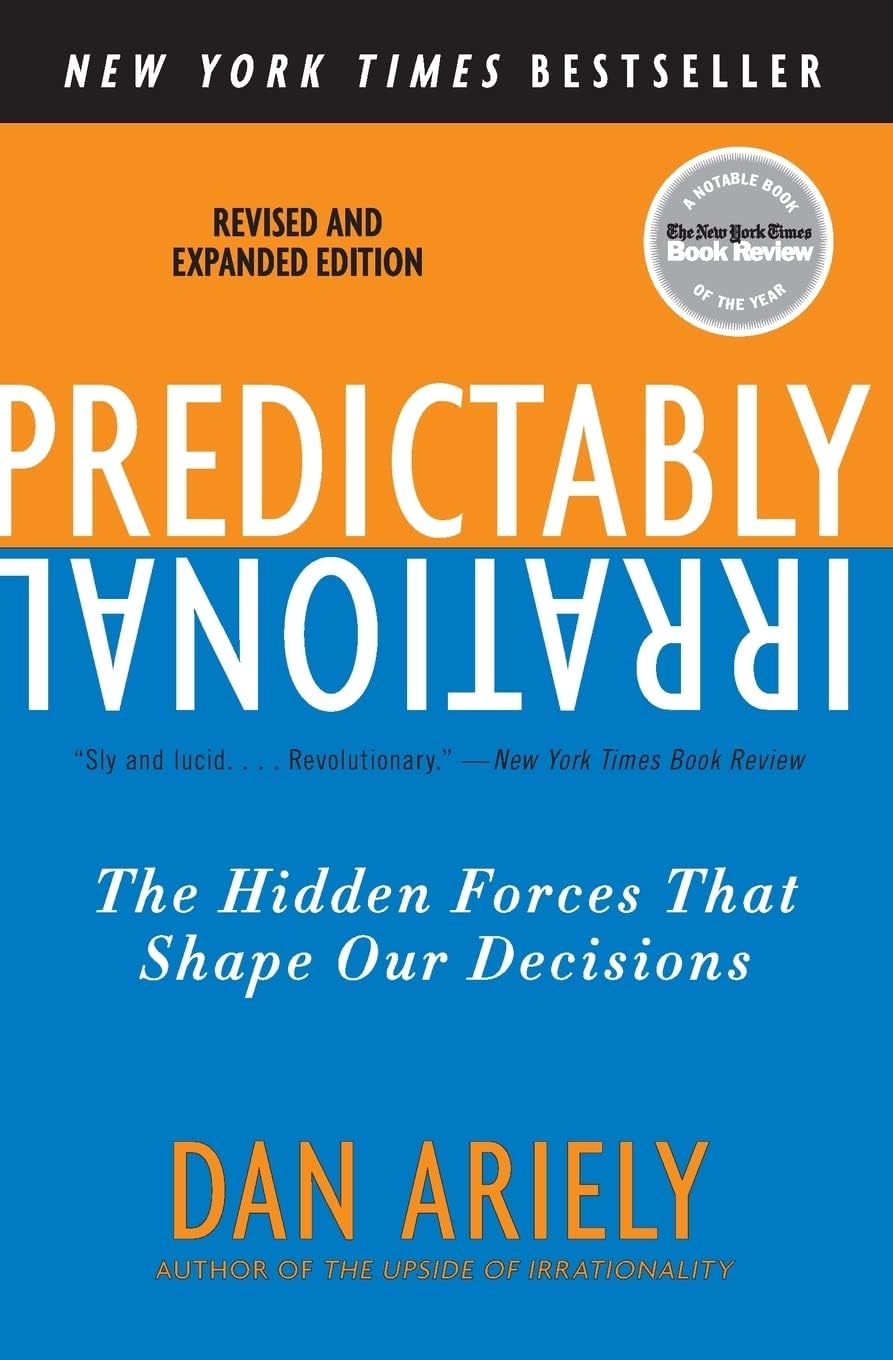

🧠 Decode your mind’s quirks before your competition does!
Predictably Irrational, Revised and Expanded Edition by Dan Ariely is a 380-page paperback that dives into 14 key cognitive biases shaping our decisions. Ranked in the top 50 for Cognitive Psychology books, it blends behavioral economics with engaging experiments to reveal why humans often act against their own best interests. This edition offers fresh insights and practical advice to improve decision-making in business, relationships, and everyday life, making it a must-read for professionals eager to outthink the crowd.


| Best Sellers Rank | #15,011 in Books ( See Top 100 in Books ) #40 in Cognitive Psychology (Books) #44 in Popular Social Psychology & Interactions #387 in Personal Transformation Self-Help |
| Customer Reviews | 4.5 out of 5 stars 11,377 Reviews |
C**.
Personal Irrational!
"Predictably Irrational: The Hidden Forces That Shape Our Decisions" by Ariely Ariely (PI), was an interesting read, and deserves to be looked at by economist, psychologist, marketer, or just people looking to improve their selves alike. It follows the trend, set by Freakonomics, by Steven Levitt and Stephen Dubner, in discussion of esoteric economic concepts, but without the academese that tends to keep casual readers away. I found myself personally engrossed while reading this novel due to the parallels of irrational behavior I discovered I also exhibited and will be actively correcting. The following three I believe have sentimental value to me and I feel are genuinely worth discussing. Zero cost irrationality as described by PI is the concept that reviews the large bias humans show towards "free." I put free in quotations as I am using the term loosely in this context as often the decision chosen is not without cost, and in relative terms, it is often not the option that held the most value per unit of the exchanging intermediary item. In fact, just a few hours before writing this brief review, I purchased three Publix cloth shopping bags that I had no intention of purchasing beforehand, but because they were buy three get one free. I can say in earnest, without that free offer, I would have completely shrugged off the Publix bag, to purchase at another time. A potential solution to this problem, derived from a specific example he mentions within the chapter, is to mentally give the "free" item a price, even one as low as one penny. This, surprisingly, nullifies the zero cost irrationality for most individuals, allowing for proper cost-benefit analysis of the additional item or offer. Procrastination, or the giving up of long-term goals for immediate gratification, this desire for immediate satisfaction permeates particularly strongly throughout American culture. The effect of this national procrastination can be seen by abhorrently low national saving rate, or more implicitly or healthcare system that is more reactive than proactive. Though I personally am not a pure procrastinator, in fact many would consider me an extrovert, I believe that there quite a bit I still put off that I do so exactly because I fail to properly evaluate the opportunity cost of the long term benefit of said action. For example, I did a quick back of an envelope calculation of me putting of my savings to next year, rather than not starting when I begun work two years ago. This three wait has cost me over half a million dollars (Assumptions: Roth IRA, with locked six percent APR, maturing in fifty years). I have begun taking Ariely's advice, and setting hard deadlines for many things, such as this particular book review which I gave myself exactly the day after completing the book to complete, no exceptions and no excuses. The final personal irrationality I've found plaguing my decision making has been that of `keeping doors open,' or not being able to stand the idea of closing our alternative options. My irrational in my context, has to do with maybe not a plethora of options, as emphasized within the book, but rather when I am down to two options that have to deal with something within the social sphere. Case in point, I would fret over the decision of whether I should continue to chase after a girl or letting her go, or going to a party where I would probably feel uncomfortable or not, though these examples may seem simple to an someone else, I struggled with these decisions constantly. Often than not, I found myself unable to take the choice that errs on the side of negative (deciding to stay home, or leave the girl alone) as I felt doing so eliminates a multitude of options without producing any new ones of benefit. I am curious to whether how much confidence has to do with the exact experiment presented within the book. I speculate if participants were required to self select as confident, or perhaps anchored to think of confidence, if such decisions become easier. I wonder this, since many my such decision-making gridlocks underlie a lack of self confidence, perhaps those with more of it at the time of the test may change results. In sum, Ariely's solution, as I interpret it, the cure for procrastination is really premised by self-confidence, where one sets long term goals and bravely commits to them. The book discussed around 14 irrationalities in total across 13 chapters, each holding a slight new scope of human cognizance to gain. The three above mentioned irrationalities after a deep introspective look, I felt held the most personal utility. I genuinely I have a new lens to the world. I genuinely believe that holds the potential to enrich the perspective of most readers as well, no matter their relative amount of academic background on the subject.
A**N
Interesting Stuff, but runs a little long
This was a fun book to read. It has been a while since I took any economics courses, and I forgot how much of economic theory is based on the assumption that humans are rational beings, always acting in their best interests. Dan Ariely does a marvelous job of shooting holes through that assumption. === The Good Stuff === * The book is really an overview of behavioral economics- the study of how supposedly rational people make decisions. Ariely recounts numerous experiments in which people are given a challenge and react in ways which would seem to be exactly opposite of their self-interest. As an example, if you allow people the chance to buy $1 chocolate bars for 10 cents, they will purchase quite a few. But if you offer then 90 cent chocolates for free, they will only take one or two. If experiments like this interest you, you will enjoy the book. * In each case, Ariely describes a simple experiment, and provides a theory as to what he thinks happened. I have no idea how many of his theories are considered valid, or would stand up to peer review. But for a quick read to just amuse yourself with human nature, the explanations suffice. * Ariely picks a nice assortment of topics-everything from placebos to "irrational" pricing and honestly and ethics. The experiments are clever and "fun", although I doubt they would stand up to serious scientific scrutiny. Still, they were fun to read, and I will probably try some of them on my friends. === The Not So Good Stuff === * While Ariely writes well, he is not the most engaging author you will read. The text comes across a little dry, and by the final chapters, I was ready for the book to end. * While the experiments, or at least their explanations were no doubt simplified for the book, in some cases they open more questions than they answer. Ariely offers one explanation and theory for the observed results, but makes no attempts to analyze deeper, or provide alternative explanations. * Without seeing more information, it is hard to tell if the experiments and their conclusions are statistically valid. In some cases it seems that they might not be, although given Ariely's background, it would seem he would know enough to assure the experiments validity. * Finally, there is no real theme or common thread through the work. Rather it is more like a series of short lab reports. The result is that the book can become tedious, and that it is tough to remember some of the results, as all the stories blur together. ===Summary=== While there were some problems, I did enjoy the book, and found the material fascinating. Some of the experiments product results that were quite unexpected, and with a little thinking you can use some of this information into whatever your business or trade you operate in. I'd recommend the book, with the caveat that the book has some flaws. Still, the positives outweigh the negatives.
J**T
Interesting and Insightful
This book ended up on my to-read list as a recommendation related to marketing. I read it expecting to learn more “tricks” for doing my job — and to better understand some of the influential triggers other marketers are trying to use on me. In that specific respect, I didn’t get a lot out of this book. The behavioral insights related to marketing were behavioral insights I’m already familiar with, though this did at least provide fresh takes that were entertaining to read. Now, OUTSIDE of that specific respect, I got a lot more out of this book than I expected. The behavioral insights in this book had me reevaluating multiple aspects of my life, from relationships to employment to retirement decisions and more. Not only was it insightful, but the writing was entertaining to read. It’s accessible and fun. Glad I read it and that I now have an even better understanding of just how nuts we all are.
M**N
Brilliantly Irrational!
I have not written any product reviews on Amazon, but I was forced into writing one because of my sincere admiration and new-found respect for Prof. Dan Ariely. I was introduced to the science of Behavioral Economics and the irrational decisions people make in their lives. The author, through his experiments, has an uncanny knack of explaining all the profound concepts in a simple and entertaining manner. The contents in this book will quite literally open your eyes and make you wonder how people are living in this so-called idealistic world of rational decision making. Some of the key ideas presented in this book are: -> How humans perceive value - "not in absolute terms, but one with respect to another," and this is how companies and marketers deceive people with "seemingly attractive" offers that you cannot resist. -> Market forces of supply and demand only apply to rational people - in the real world, companies exploit people's irrationality and influence prices and demand. -> The power of FREE - People are, in essence, losing some other resource in trying to procure FREE items. -> The wonderful distinction of market and social norms, and why and how they cannot coexist. He also explains how companies can motivate their employees using social benefits, which are cheaper and stronger than financial incentives. -> As long as money is not involved, we are caring social animals. -> Why people exhibit different behaviors when they are "normal" (cold state) and when they are "aroused" (hot state). Learning to bridge the gap between the two extreme states is very important and will help you avoid making errors or bad decisions that you will forever regret. -> The high price of ownership reveals three irrational quirks in human behavior - we are deeply attached to what we have; we often focus on what we may lose (also called Loss Aversion); we assume other people (or buyers of our goods) to also value the goods in the same manner as we do. -> People's expectations can cloud their thinking, and they use this as a marketing strategy to influence their friends' tastes and preferences. -> Price is so powerful that it can drive the Placebo Effect - the more the price, the more the utility you derive from the product. This phenomenon was explained with Aspirin - why a 50 cent Aspirin can do what a penny Aspirin can't. -> Trust is an important public resource and a necessary lubricant of the economy. A few bad players in the market can completely erode it. -> Why even the most morally upright person can be susceptible to making small crimes that hardly matter. However, a contemplation of moral behavior or a religious code of law before doing any action can greatly reduce the likelihood of people committing these petty crimes. -> The idea of FREE LUNCHES in behavior economics; the science of economics should be modified to account for how people actually behave instead of how they should behave in society. These are just some of the important principles explained in the book through experiments and startling revelations. It is easy to read and highly entertaining. However, there is one minor flaw in this book - the concepts and results described are all based on experiments performed on American college students or the western society, which may not be applicable to the more conservative societies in the world. BOTTOM LINE - Predictably Irrational is a wonderful book with new insights into irrational behavior in people. But for the one criticism, I believe this can change the way people think about economics, and can result in newer norms that account for our actual and not ideal behavior. PS: For people interested in reading more about behavior and cognitive sciences, I have the following book suggestions: 1. "The Power of Habit: Why We Do What We Do in Life and Business" by Charles Duhigg. 2. "Thinking, Fast and Slow" by Daniel Kahnem. 3. "The Upside of Irrationality" by Dan Ariely. 4. "The Signal and the Noise: Why So Many Predictions Fail -- but Some Don't" by Nate Silver
K**R
Great summary of research on human irrationality
The author provides a lucid and succinct summary of various aspects of human irrationality, based on solid and in depth research.
A**S
Good for the Anecdotes
Among the various books available that cover the topic of human behavior, Predictably Irrational is among the top ten (interested readers should also read Sway by Rom Brafman). It's not quite an economics book (for a much better analysis of the many failings of neoclassical economics, read Debunking Economics by Keen) and it's not quite a behavioral psychology book (read Sway) so it falls somewhere in the middle - and therein lies its main weakness. There are some very interesting anecdotes (for example, do you know why we think black pearls are valuable when originally no one wanted to buy them at any price?) and these are where most of the book's value lies. The principal weakness comes from Ariely's conclusions based on the work he's carried out. He acknowledges that we humans are "irrational" compared to the straw man of the "rational optimizer" beloved of neoclassical economic theory, but while some of his examples are interesting he fails to see the entire picture. Thus whereas Keen shows that the neoclassical model is computationally impossible, Ariely merely shows that we have different decision-making processes in two distinct contexts: interpersonal and financial. This is valid, but Ariely then goes on to show that he hasn't really explored the interpersonal context with any degree of rigor. A couple of examples will illustrate what I mean. In the first example Ariely talks about how companies strive to create a "social exchange" in the workplace because people generally work harder and more diligently in social exchange settings than in compensation-based settings. We can think of how we might keep on struggling to get a friend's piano up the stairs of a narrow apartment building long after we'd have given up if we were simply being paid $10 per hour by a stranger to perform the same task. So Ariely notes that companies try to exploit our social side in order to get more work out of us (he doesn't look at the ethics of this attempt, or even at its many infeasibilities). Then he suggests that in order to reinforce the social dynamic and avoid corrupting it with the financial dynamic (because it's not possible to combine the two) companies should not give bonuses but instead should send employees off on a paid-for vacation. The problem, of course, is that most employees don't want to be placed in a parent-child relationship. Most employees think of themselves as independent adults. Saying "here's a vacation we've arranged for you" violates an employee's independence. Worse still it assumes the employee's plans for their free time are irrelevant (the cost of leaving one's home, family, and friends for the duration of the enforced vacation are apparently zero where the company is concerned...). Obviously this recommendation would be disastrous under real-world conditions and one wonders how Ariely failed to think through his proposal. A second example of this failure to think things through comes with Ariely's analysis of cap-and-trade. Rightly he points out that when you set a price on something (in this case pollution) then people may elect to pay more in order to get more. Just as we might only take a single candy from a tray being passed around the group but might buy ten if the candies are being sold, so too might companies pollute less if pollution were a "social good" rather than a priced good. With cap-and-trade companies might simply elect to pay more in order to feel free to pollute more. So Ariely proposes making pollution a "social good." But again a moment's thought shows this to be absurd. Not only do we have far too many examples of companies being quite happy to pollute when it's a cost-free exercise, Ariely's own book shows that executives will ignore social factors when their focus in on financial rewards. As executives are almost exclusively motivated by fat financial rewards, the notion that they would take social norms into account when deciding whether or not (or how much) to pollute is like saying that investment bankers would put the needs of their clients and the financial system in general ahead of their own desire for the $100 million bonus they get from pushing CDOs onto unsuspecting dupes. So in the end the book is worth reading for its anecdotal value but not for Ariely's own conclusions or policy suggestions. He's not-quite an economist and not-quite a behavioral psychologist and ultimately that means he's not-quite useful as a guide to policy formulation on either the micro or the macro scales.
L**O
Read it, you won't regret it
I consider myself a very experienced reader, having read multiple hundred books in my 18 years. Usually that gives me a certain degree of knowledge; it gives me something to compare my experience against. Reading this book was something entirely new. Not only is it nonfiction, a genre which I seldom read, but it is also about Economics, Sociology, and Business, topics I have very little knowledge about. Although it sounded interesting, I was expecting it to be boring and dreary, but I am happy to say I was pleasantly surprised. I recommend this book to everyone. It is such an insight into our lives, exploring why we act the way we act instead of rationally. Ariely puts forward a theory, which he successfully—at least as far as I am concerned—backs up with experiments and observations throughout the book. He believes that everybody acts irrationally, but predictably so. Meaning that although our actions might not make sense in principle, they are still consistent and therefore to be expected. Predictably Irrational is such an eye opening book for this very reason. It calls to attention that we don't know ourselves quite as well as we believe. It deals with everything from the placebo effect to our ingrained need to keep all our options open at whichever cost, then teaches us how to overcome our absurd behavior. I recognized so many things about myself in this book, which made me very interested in finishing it. This, I think, makes Predictably Irrational a great introduction into this genre. I love connecting with the characters in the novels that I read, and this book has that to a certain extent. It also got me interested in reading more of his books, as well as other non-fiction, informative books. Perhaps, after reading what I wrote above, you are wondering why I did not give this book five stars. I am not entirely sure my rating is proper. I deducted one star because I didn't have any of my "I-love-this-book" symptoms: it took me a few days to finish, it sometimes made me sleepy, and I am not utterly obsessed with reading reviews and talking about it. This genre is entirely different from the ones I usually read, so I don't know if I have a good enough reason to take off one star, but until I get more experience in this genre, it will have to do. However, I acknowledge that perhaps it just isn't my type of book, and people that proactively seek this type of book might, in all likelihood, love it. Still, like I said before, I think everyone should give it a try. Ariely's writing might just win you over, and what he has to say is unquestionably worth the read.
T**G
Interesting Book
Very interesting book. Every marketer should have it.
Trustpilot
3 weeks ago
1 month ago