

The Art of Execution: How the world's best investors get it wrong and still make millions
Product ID: 32082107
Desertcart purchases this item on your behalf and handles shipping, customs, and support to Tunisia.
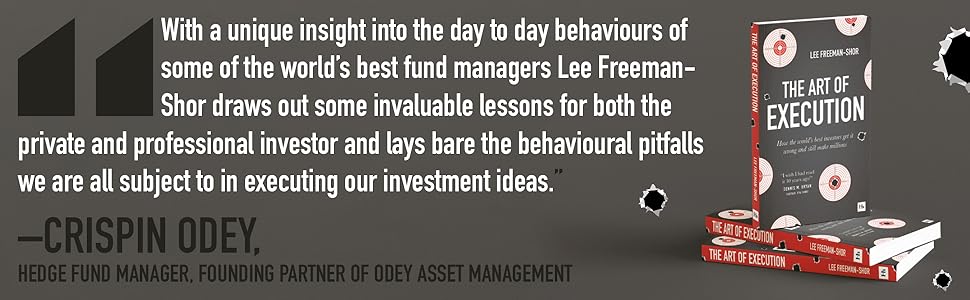
Over seven years, 45 of the world's top investors were given between $25m and $150m to invest by fund manager Lee Freeman-Shor. His instructions were simple. There was only one rule. They could only invest in their ten best ideas to make money. It seemed like a foolproof plan to make a lot of money. What could possibly go wrong? These were some of the greatest minds at work in the markets today – from top European hedge fund managers to Wall Street legends. But most of the investors' great ideas actually lost money. Shockingly, a toss of a coin would have been a better method of choosing whether or not to invest in a stock. Nevertheless, despite being wrong most of the time, many of these investors still ended up making a lot of money. How could they be wrong most of the time and still be profitable? The answer lay in their hidden habits of execution, which until now have only been guessed at from the outside world. This book lays bare those secret habits for the first time, explaining them with real-life data, case studies and stories taken from Freeman-Shor's unique position of managing these investors on a day-to-day basis. A riveting read for investors of every level, this book shows you exactly what to do and what not to do when your big idea is losing or winning – and demonstrates conclusively why the most important thing about investing is always the art of execution. Review: A must-read for serious investors - I’ve read countless investing books over the years, and after 20+ years in the markets I can say this one stands out. The Art of Execution distills hard-won lessons into practical wisdom that can save investors a decade of trial and error. Clear, direct, and extremely useful — highly recommended. Review: Very short but a good value - First about me b/c you can't understand an investor's book review without understanding the investor. I have been reading about investing for twenty years and I have probably been a retail market participant for twelve to fifteen years, mostly in strategic asset allocation. I see myself as an investor and not a trader. I have branched off recently into individual stock picking. I bought the book primarily b/c I was looking for information on how to improve my selling decisions. (As an asset allocation guy, I rarely sold anything.) This book certainly fit that bill and the information provided helped me in developing my checklist for quarterly monitoring of investments and clarifying when and why to sell. THe realization that even the pros are only right 50% of the time means they are wrong the other 50% literally blew my mind. As a novice retail investor, I need to always be aware that more than likely any single pick is wrong. This is tough pill to swallow, so I will be reading this book over and over. It is somewhat rare to find information on what works in selling in books on 'investing' for 'investors'. It may be more prevalent in the books for 'traders' on 'trading', but I don't know b/c that is not my style and not what I read. I am a value guy, as well, and I found that cost of the book to be a 'good value' for the info I gleaned from the book even though I read whole thing in three to four hours. Knowing what I know now, I'd still buy it again ;-) That said, if you haven't read What I Learned Losing a Million Dollars, you will want to read it as well.

| Best Sellers Rank | #154,806 in Books ( See Top 100 in Books ) #134 in Stock Market Investing (Books) #232 in Introduction to Investing |
| Customer Reviews | 4.3 out of 5 stars 982 Reviews |
T**L
A must-read for serious investors
I’ve read countless investing books over the years, and after 20+ years in the markets I can say this one stands out. The Art of Execution distills hard-won lessons into practical wisdom that can save investors a decade of trial and error. Clear, direct, and extremely useful — highly recommended.
A**R
Very short but a good value
First about me b/c you can't understand an investor's book review without understanding the investor. I have been reading about investing for twenty years and I have probably been a retail market participant for twelve to fifteen years, mostly in strategic asset allocation. I see myself as an investor and not a trader. I have branched off recently into individual stock picking. I bought the book primarily b/c I was looking for information on how to improve my selling decisions. (As an asset allocation guy, I rarely sold anything.) This book certainly fit that bill and the information provided helped me in developing my checklist for quarterly monitoring of investments and clarifying when and why to sell. THe realization that even the pros are only right 50% of the time means they are wrong the other 50% literally blew my mind. As a novice retail investor, I need to always be aware that more than likely any single pick is wrong. This is tough pill to swallow, so I will be reading this book over and over. It is somewhat rare to find information on what works in selling in books on 'investing' for 'investors'. It may be more prevalent in the books for 'traders' on 'trading', but I don't know b/c that is not my style and not what I read. I am a value guy, as well, and I found that cost of the book to be a 'good value' for the info I gleaned from the book even though I read whole thing in three to four hours. Knowing what I know now, I'd still buy it again ;-) That said, if you haven't read What I Learned Losing a Million Dollars, you will want to read it as well.
D**Y
i learned more about stock investing in this book than the last 3 years of research
The idea of execution with all its nuances really filled the gaps missing in my investing. Understanding the ways I was being a rabbit by taking quick profits, getting bored, or sticking with a losing position were transformative. I exited one position at a small profit recently by being a hunter. I added to positions to make them more meaningful. And I am developing written plans of how my thesis could break. I also had one big winner that pulled back 1/3rd and now I realize i made the right call by staying in it. I had a 3 bagger that dipped to a two bagger but my thesis is at least a ten bagger. This book is in my top 3 best stock investing books I’ve read
C**N
The binding is very loose!
Great book ; Good reads! However the binding for the book is terrible; the page is loose after you flip the page!
J**E
Empirics over opinon
The author provides us something unique; a behavioral analysis of actual trades for a reasonable cross section of professional traders over a five-year timespan, including bearish and bullish time periods. Thus, this book is not about what traders think they are doing via interviews, opinions, narrative, and other filtered understandings, but what they are actually doing. This is very useful, because even the best managers may be unable to articulate what they are actually doing, and why they are doing it. By evaluating the data, the author provides a taxonomy of the underlying patters of success and failure among this rich dataset of trades and traders. While we have to trust that the author "got it right" in terms of grouping the failure and success behavioral patterns, the final result is a very readable book whose taxonomy seem both reasonable and familiar. Moreover, he supports his observations by referencing developed theories of behavioral finance, thus leaving me with the impression that he did get it right.
W**?
Good Read
Found the ideas pretty simple and that gives me confidence in their soundness. If Only LTCM could have explained their investment rules this succinctly.
J**O
E.Z. read and very enlightening
I learned I got a few things right now, and it explained all my bad behaviors I have made changes to my investments because of this book, and will be doing some more changes . I know most people won't take the action needed, but that is on them. Thank You for sharing this information. Life changing.
J**N
Should absolutely be required reading for ALL new investors.
I've often struggled to have a valuable recommendation on hand for those asking me about reading material for beginners in the market. Sure, the 'Market Wizards', 'Intelligent Investor' etc. may come to mind, but I think at the most basic level, any new investor should be primed on risk management before hearing/learning anything else. This is now at the top of my recommendation list. Short, relatively easy read with data to back up the perspectives. And even if you're a 'veteran', this is a great value add that touches not just on methodology, but behavioral psychology as well.
D**K
Counterintuitive conclusions, worth reading and re-reading
This is a very good book about some of the behavioural aspects of investing. The author, Lee Freeman-Shor, oversaw a number of professional investment managers that managed portfolios of $25 to $150 million. He then analyzed the results and studied what behaviours led some to be more successful than others. The book is divided into two main sections, the first on what to do when you have a paper loss on an investment and the second on what to do when you have a paper gain. The losing and winning investment sections are further broken down into successful and unsuccessful behaviours in responding to each scenario. These behaviours are categorized into five distinct types, three types of behaviour when a stock is down (one unsuccessful type, and two successful types) and two types of behaviour when a stock is up (one unsuccessful and one successful). The author makes some interesting conclusions. Maybe I haven't read enough of these sorts of books yet, but I found all the recommendations to be counterintuitive yet logical. They will definitely be something I will apply to my own investing going forward (I found a few of the investing mistakes to be things I currently do or have done) Overall it is a short, easy to read book on investing behaviour, written in plain English (not much financial jargon). It covers its subject well and provides examples without overwhelming the reader. It might be too basic for people with advanced knowledge, but I nevertheless think there is still some value to be gained by a read through. I highly recommend it.
F**.
Very good read
It is one of the books I wish I had read earlier in my career as investor. This is one of the best books on behaviour of different styles of traders or investors on the market and also provides solutions on how to overcome the own mistakes. Congratulations on this work!
A**O
Worth the read
Important lessons for any money manager
M**.
An Under-rated Idea
Something all sharemarket buyers should consider.
G**U
Simple yet sustainable thought process
We all believe that people at top of their fields were born different or are god gifted. It may or may not be true, and we all have to live with what we got. Investing is one key part of managing one’s finances. This book provides simple yet effective habits that could help sustain a good investment profile. Definitely recommended
Trustpilot
3 days ago
2 months ago