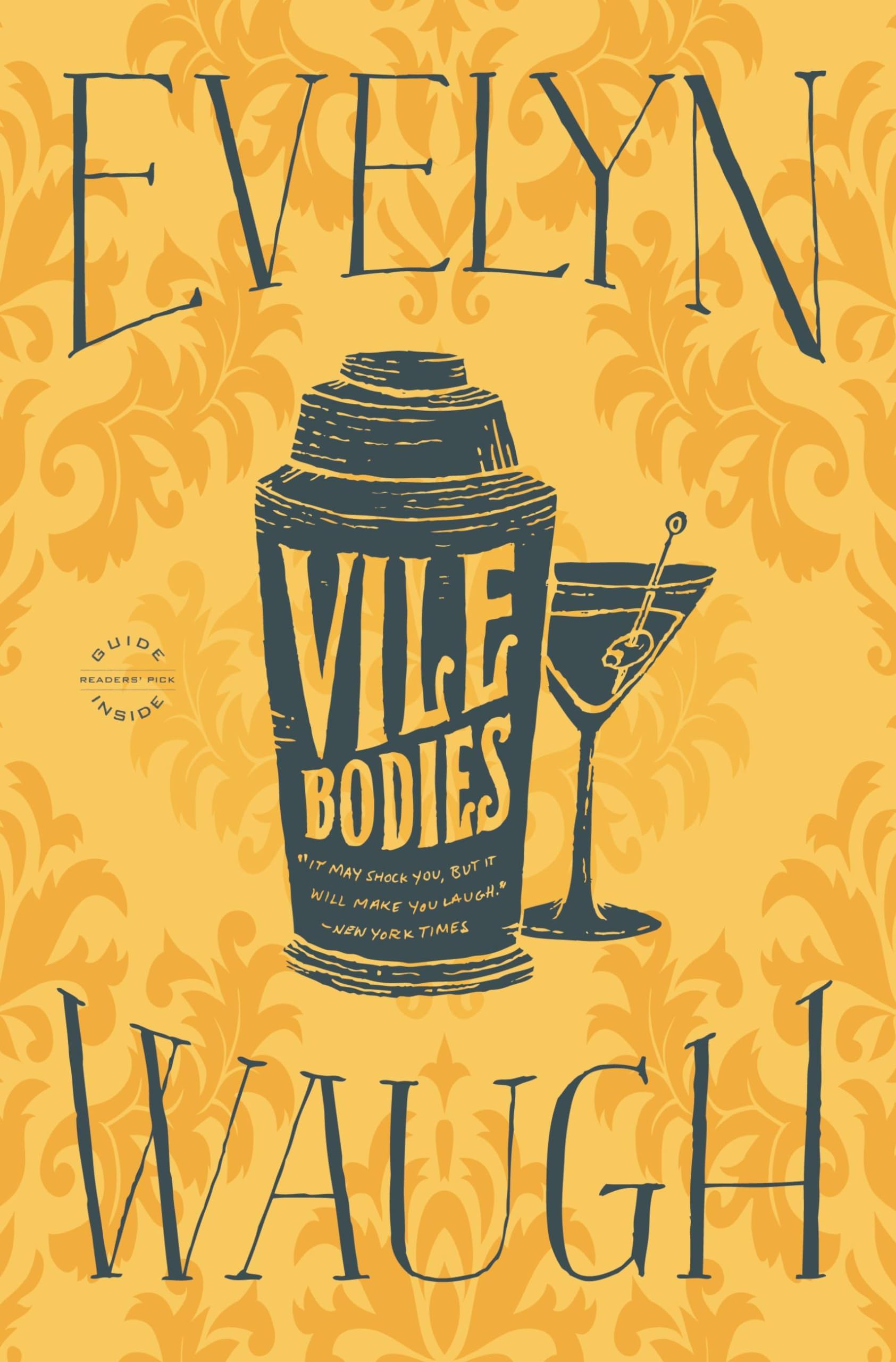

📖 Own a piece of literary satire history—don’t miss out on the cult classic everyone’s whispering about!
Vile Bodies is a 1930s satirical novel by Evelyn Waugh, lampooning the frivolous 'Bright Young Things' of post-WWI England. This used copy is in good condition and holds a solid 4-star rating from over 1,200 readers, making it a must-have for fans of classic literature and sharp social critique.
| Best Sellers Rank | #288,890 in Books ( See Top 100 in Books ) #1,066 in Fiction Satire #2,345 in Classic Literature & Fiction #7,392 in Literary Fiction (Books) |
| Customer Reviews | 4.0 out of 5 stars 1,231 Reviews |
L**.
"Glass Onion" in Great Gatsby Era
This book is: The "Glass Onion" movie character ensemble, trapped in a Great Gatsby era, with "O O O Shakespeherian Rag" dialect and Eton boys' vocabulary, dazzled by the satire of a professor emeritus with no-effs-given. And yes, after you read the book, this will make perfect sense. I highly recommend. Very funny.
T**H
A Bit Dated but Still Funny
Though I rarely review books by classic authors who have no need of my support (or lack of) to make their reputations, I sometimes bend my rule for books that might be lesser known in an author's oeuvre. So, admittedly as a fan of Waugh, I'm going to take the time to write a few lines about Vile Bodies. This is not one of my favorite Waugh novels. There is no plot to speak of. This book is really just a sequence of scenes that are meant to poke fun at the rich & foolish of post-WWI England; mainly, the "Bright Young Things". Though I'm sure this book was quite a riot in its day, I feel that it has aged less well than much of Waugh's work. This is also reflected in the use of what would be considered very un-PC language today. (Though, admittedly, the use of un-PC language doesn't really bother me personally.) That being said, there's no denying that Waugh is a very funny writer and that there are plenty of laughs still to be had here. Waugh's dialogue in this novel really pops with energy. There are set pieces that can still speak to us--the couple whose state of engagement changes on an hourly basis, the writer who makes up his articles wholesale, the religious proselytizers who don't practice what they preach. In fact, there are a whole slew of ridiculous characters here which each have a moment or two in the sun. Whatever its deficiencies, there's a reason some writers have their books still read over 80 years after they are first published: the worst book of a great author is better than most of the books out there. And I wouldn't say this is Waugh's worst. It's definitely worth a read.
B**M
Twit Parade
On the one hand, "Vile Bodies" has much of what makes Evelyn Waugh so admired so many years after its 1930 publication: Whip-smart dialogue, characters hoisted on their own petards, brutal plot twists, and a sense of cosmic, comic disengagement. On the other hand, well, let's just say this is one time Waugh doesn't employ his usual gimlet-eyed focus. Adam and Nina prepare to tie the knot, only he keeps falling out financially while she is distracted by a suitor who she used to play with when she was a girl and "his hair was a very pretty colour then." Their friend Agatha hasn't enough sense not to smoke in a race-car pit, but her being strip-searched at customs becomes national news. Evangelist Mrs. Ape and her all-girl wing-wearing retinue plies their trade to the aristocratic circle, while prime ministers rise and fall and the jeunesse dorée Waugh dubs the Bright Young Things seek ever-more exotic locales for their parties and shallow, self-serving games. Shallow selfishness is the theme of this, Waugh's satire of the class and culture he inhabited. Perhaps as an extension of this satire, Waugh is even more disengaged than usual in his characters and their goings-on, and as he jumps from one frothy distraction to another, it makes for a tough read. As Adam says at one point near the final stretch: "I've rather lost interest in this race." Adam is a particular difficult character in the novel, being the protagonist, so feckless he's hard to root for, whether he's giving a thousand pounds to a stranger to make a bet for him or selling his fiancée off to his rival to square a hotel bill. He does get one brief burst of energy when Waugh thrusts upon him the job of a gossip columnist, which Adam fills with unexpected verve and imagination, peopling his column with imaginary characters like a rare beauty, "very dark and slim, with large Laurencin eyes and the negligent grace of the trained athlete" of whom another celebrity of Adam's invention describes as "justifying the century." For a time, Adam's column sends London aflutter, and Waugh's satire soars, but then Waugh quickly switches gears and moves on to the next thing. He does this in all his novels, but he's normally such an inventive scenarist you don't mind. Here, so much of the divertissement is paper-thin, it really disappoints someone weaned on far better Waugh books set in the same place, like "Brideshead Revisited" (as deep and real a vision of London in the 1920s and 1930s as this is not) and "A Handful Of Dust" (where protagonist Tony Last merits a rooting interest.) Here you have what amounts to a clever Waugh short story that just goes on a bit too long. Even the humor feels forced at times. When Agatha finds herself in a strange house still dressed for a party from the night before, Waugh is compelled in parenthesis to tell us she's in a grass skirt, as if not trusting us to cotton onto the joke otherwise. Most people seem to regard this novel as one of Waugh's better ones, capturing the spirit of the time and its frivolity. It's frivolous, I grant you that, and you may find it more engaging. Certainly it is a Rosetta stone for understanding Waugh's complicated relationship with his surroundings, and his embrace of Catholicism as apparent satiety for the "almost fatal hunger for permanence" articulated in this novel by a wandering Jesuit. I just wish, for all the occasional moments of humor and Waugh's characteristically sharp pen, there was something of his more transcendent quality to be found here as well.
9**Y
Good service.
As advertised. Thank you.
R**N
Cheerio and All That
I have read a half dozen or so books by Evelyn Waugh. I enjoy his style of writing but I am occassionally left wondering what was the point of the book. For example, "Brideshead Revisited" read like a classic of literature but I still haven't figured out its' purpose 8 years later. Well, I enjoyed it so what's the big deal. Yet this is the same author who wrote "A Handful of Dust" which was quite a moving experience for me when I read it. Fortunately, one learns right away in "Vile Bodies" that this is a satire on the "Noble Society" in the decade or so after WWI. It may not have had a point but it was a lot of fun reading it. I laughed out loud several times during the book. Waugh seems to enjoy poking fun at the idle rich (and formerly rich) and his gift for writing clearly extends into humor. The ending caught me a bit off guard. Once again I think I failed to grasp a meaning where there might have been one. No regrets, though: I had fun getting there just the same.
M**Y
Easy but not trivial
The light touch, the airy language, the wit, humour, satire and deceptive sense of distance, along with passages of excruciating hilarity, make this an easy read. However, underlying this is an eerily prescient darkness.
C**Y
Vile Bodies
I had never read anything by Waugh and found the exaggerated personalities a bit too for my taste and credulity.
R**D
So clever
If you like Evelyn Waugh's writing, then you are likely to enjoy this view of a bygone lifestyle. This is the book that was made into the film "Bright Young Things". Full of Waugh's witty and rather arch observations of class and cultures, this book is a pleasure to read.
Trustpilot
2 weeks ago
3 weeks ago