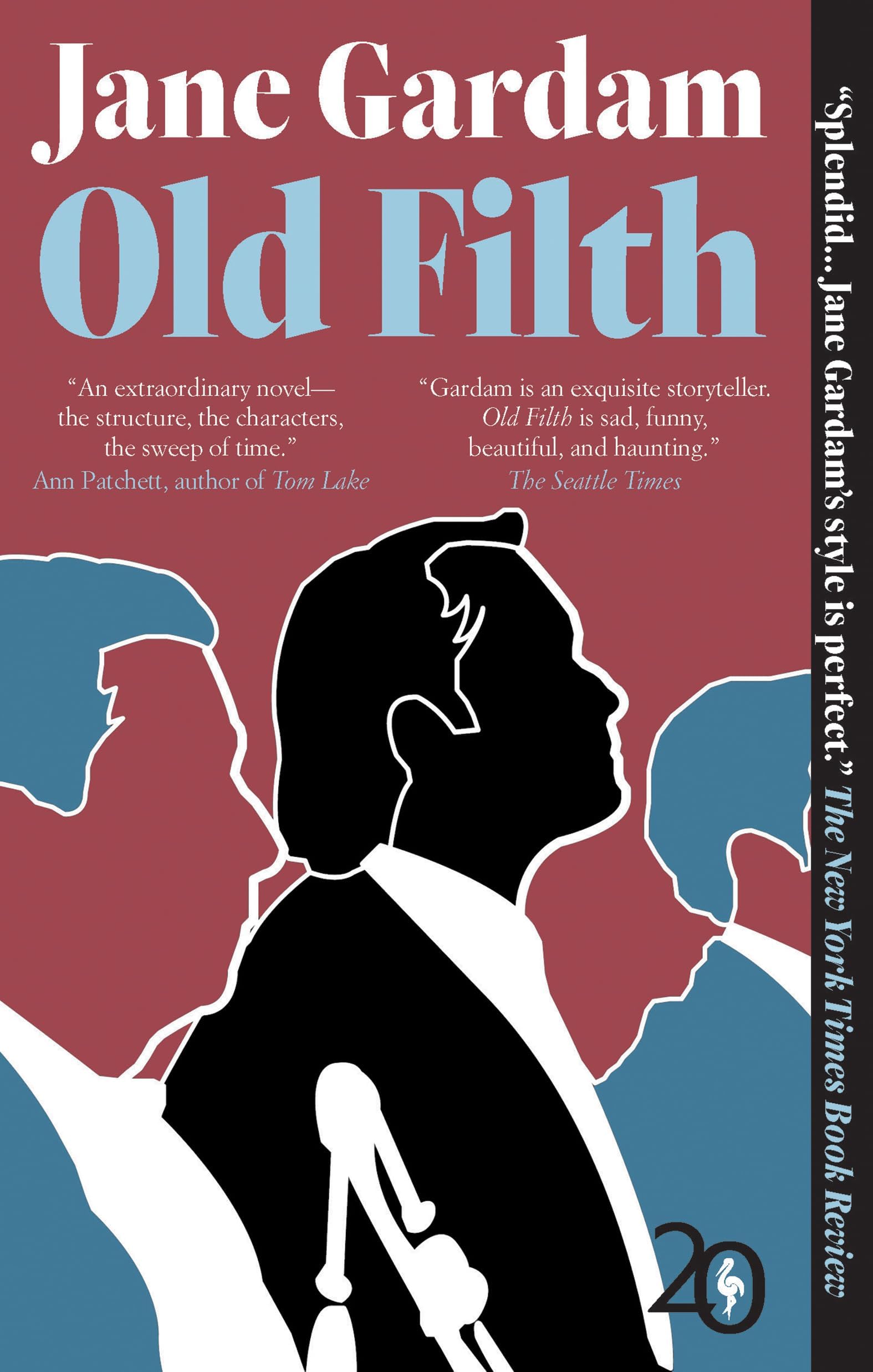
Old Filth
Product ID: 3879454
🌍Rich historical & cultural depth
🏆Whitbread & Orange Prize nominated
📚Award-winning literary classic
Desertcart purchases this item on your behalf and handles shipping, customs, and support to Tunisia.
📖 Unlock the hidden depths of history and humanity with Old Filth — where every page is a rare gem.
Old Filth is a used book in good condition featuring Jane Gardam’s masterful novel about Sir Edward Feathers, a distinguished retired judge whose life story spans colonial Malaya to post-war Britain. Nominated for the 2005 Orange Prize and winner of the Whitbread Novel Award, this literary gem offers a richly woven narrative celebrated for its subtlety, emotional resonance, and historical insight. Perfect for readers seeking a profound, character-driven exploration of legacy, love, and resilience.


| Best Sellers Rank | #157,093 in Books ( See Top 100 in Books ) #1,193 in Contemporary Literature & Fiction #1,406 in Historical British & Irish Literature #3,083 in Literary Fiction (Books) |
| Customer Reviews | 4.2 out of 5 stars 7,522 Reviews |
A**N
This is a subtle book and a wonderful one of two you must read
The book opens with the reader eavesdropping on a couple of young barristers commenting on the distant, handsome, elderly figure of "Old Filth," the rich lawyer cum judge who presided in Hong Kong before it returned to the Chinese. The barristers say that Old Filth had a quiet life, excepting that he made a pile of money, and is although distinguished, otherwise unremarkable. I have rarely loved a book so much and so quickly as this one. Eddie Feathers ("Old Filth") is reserved, well bred, well spoken, well dressed and one of the more remarkable survivors in literature. His youth would be a horror story in other hands. He is British from the day (post WWII, just as the Empire is failing) when to be a gentleman was to appear to be without passion, and to appear not to care about such ephemera as happiness. To be understated means that there is a statement to be made. Uunderstatement is in every sentence of his remarkable work, evidenced by the control Jane Gardam has of every sentence. Her craftsmanship builds character, story, plausibility and setting into a gently told, incredibly moving whole. Characters appear that deserve their own books, especially Mr. Ross and Sir,and perhaps Isobel. Every character breathes on his or her own and still tells us more of Eddie. How many authors can manage their populations with such skill, ease and fascination? But to see Eddie Feathers you must also meet his wife. Her story is in The Man in The Wooden Hat. "Old Filth" is a complete work and stands alone very well. But Gardam goes back and, through Betty's eyes, expands on what you know. Together,the books are the best exploration and most accurate insights I know of on how real relationships--especially long marriages--truly work. Their lives are entirely together, and separate. When I finished The Man in the Wooden Hat, I had to sit down and marvel. "Old Filth" was not originally intended to be "Part I of II" which makes the accomplishment of finishing a story that seemed perfectly complete even more astounding and incredibly satisfying. There is no point in telling you the plot because the plot is the vehicle for much more. Like Eddie and Betty Feathers, there is a lot more than meets the eye. If you love good,no, superb writing, read these books. If you enjoy the realization that there was more there than the immediate story made you consider, read these books. If you think that the 'marriage of true minds' leads to happiness ever after, you probably need this book to find a new definition of 'happiness'. This is an amazing writer who deserves a wide and appreciative audience.
A**T
Lawyers were children once
What a marvelously entertaining book! Next time you meet a charmimg, intelligent older person who seems to embody all that is seemingly prosaic, a person of some obvious merit, who having accumulated some wealth and station, but at first glance seems stuffy and unimpassioned, keep your mouth shut, and pay close attention. There are often such wonderful stories of character forged at an early age by the cruelest of circumstances. Old Filth seems to all the world a man who earned his reputation for being a good lawyer, a well respected judge, without breaking a sweat, as though he had more than a fair hand of luck.His peers reflect upon his life as somewhat unimginative, and though he was graceful and handsome, assured and friendly, they seem remember him chiefly as a modest man who never put a foot wrong. And yet, like all lawyers, he was a child once, and what a teeming childhood! I have never read Gardam's work before, but this feels like it is the product of a first rate observer who uses more than a bit of care in her styling and phrasing. It feels like she has spent a good deal of time researching her chronicle of events, and knew her subject intimately.Her descriptions of the Raj empire in Malay were lovely, her rendering of the scarred and often hardened children who were Raj orphans was handled without sentimentality, but with great tenderness nonetheless. The story itself is a page turner. It is impossible not to love Filth, but the writing is a prize too. The structure of the book, and the richness of the prose are so like the jade stones his wife, Betty, had a knack for finding in the Hong Kong markets after the war: Rare. Possessing great character and heft. They aren't easy to find anymore.
D**C
Probably the best novel I've read all year
“Old Filth” is the nickname of Sir Edward Feathers, Jane Gardam’s memorable protagonist, for reasons having nothing to do with his hygiene, habits, or reputation. Sir Edward is a “Raj orphan,”one of many English children who came of age during the closing days of the British Empire. Born to English families living in any of the far-flung colonies (in Sir Edward’s case, Malaysia) they were eventually exiled to foster homes or boarding schools in England. This would seem to make for a potentially traumatic, affection-starved childhood, and indeed it was for poor Sir Edward. His early years constitute a Dickensian series of dislocations, exploitations, and deprivations. And yet, circumstance enables him to emerge from these inauspicious beginnings with an Oxford education, a stable marriage, wealth, and a distinguished judicial career based mainly in Hong Kong. As the novel opens, we find Sir Edward at the threshold of old age. He is coming through a series of jolting transitions: retirement, resettlement in England, and the sudden death of his wife. Physical frailty and blunting of his mental acuity have begun to appear. Above all, Sir Edward is beset by loneliness. Events geopolitical and personal have left him with few surviving friends or relatives. He has difficulty establishing new connections, no doubt a result of his disrupted childhood. How will he proceed from here? Will he settle into quiet isolation, speaking only when he wishes to grouse about the shortcomings of those around around him and the devolution of society in general? Will he manage to adapt in a more fulfilling way? Or, to put it differently, can a Raj orphan break the shackles of his past and find happiness? Gardam unfolds this story by alternating between present narrative and flashbacks. She executes these shifts with incredible virtuosity, even making them work to the betterment of the story’s whole. In some spots, the sequencing enhances the ironic nature of specific events. In others, the shifting elucidates the temporal and locational disorientation to which the aged Sir Edward is occasionally prone. Gardam’s ability to develop her characters is spot on. Her dialogue is flawless. She offers humor and pathos generously but precisely. I must admit to disliking the current craze toward books appearing in series; sequels and trilogies tend to make me skeptical. However, I was delighted to find that Old Filth is only one of three books that Jane Gardam featuring her brilliant creation, Sir Edward Feathers. I won’t reveal how the nickname “Old Filth” came about, but if you read the book, you’ll find out at the very beginning. Old Filth may be the best novel I’ve read all year. Can’t wait to read the next two.
M**S
British Life
I read this book because it was recommended as one of the top 75 books one should read. I enjoyed the grammar throughout, but still found the book a bit disappointing. I intended to use it for a book club choice, but decided it was a bit too dull. I enjoyed the book, but I am not sure I would call it a classic as was suggested. It tells a story about one individuals life and all most all of his thoughts. I found it interesting, but not sure others would necessarily find it so. I learned some things from it and that I always appreciate.
R**E
Return to Youth
A wonderful novel! However, I should say right away that my enthusiasm for the book is probably enhanced by its personal resonances; more about that in a moment. Only the title is awkward. "Filth" stands for "Failed in London, try Hong Kong," which is a misleading soubriquet for the central character, Sir Edward Feathers, a distinguished advocate and judge, and a man of the utmost probity. Born in the Far East, he was educated in England, spent most of his brilliant professional career in Hong Kong, and has now as returned to England in retirement. He is shown as a lonely old man, unable to make close personal connections, even with his wife of over fifty years. One of the book's many beauties is the way in which Feathers reaches out in old age to repair at least a few of these missed connections. The book takes the central portion of Sir Edward's career mainly for granted, concentrating instead upon the way memories of his first quarter-century come back to haunt him as he enters his last. Born in Malaya of a mother who died in childbirth and a half-mad father who never spoke to him, he was shipped off to Britain as a young child, spending his formative years with an abusive foster-mother in Wales, and then at various boarding schools. The book describes his dysfunctional relationship with various distant relatives and close friendships with a family who are not relatives at all, his sexual education, and his wartime service guarding the Queen Mother -- all experiences that turn out to have shaped his life. The warmest contacts seem to be the most transient, and he almost entirely lacks the strong family structure that would have given him stability. As the story progresses, dodging backwards and forwards in time, the reader begins to understand how the man could have become so aloof and afraid of emotion. More importantly, Feathers begins to understand a little in himself also. Gardam uses a term that I had not heard before, "Raj Orphan." It refers to the children of British colonial administrators sent Home in early childhood, often not seeing their parents again for many years. My father had such a childhood, and I believe was seared by it; his two brothers, like Sir Edward Feathers, both went into the law; and all of us, including myself, underwent a similarly spartan education. At times, I felt I was reading a family biography! But I think it would work for other readers also, especially if they have an interest in a vanished past or of an age when it is more fascinating to look back than to peer forward. I am not convinced that it all quite hangs together as a unified narrative; there is an encounter with two distant cousins of the next generation that seems a little out of place, and I find myself wanting to know more about Old Filth's adult years than I do, but that would have made a much longer book. Gardam's style is lucid and sometimes luminous, her comparison of lives and attitudes over a sixty-year span rings entirely true, and -- even though writing about a man who cannot easily feel emotion -- her own power to evoke feeling is quite remarkable. I also want to say that the Europa paperback edition is a real joy: flexible yet solid, with distinguished typesetting on quality paper with lots of space.
L**Y
Exotic settings, unusual plot line, good read
Others have done a good job of reviewing "Old Filth." I would like to add several things: For those who relish learning, or learning more, about life in what for most of us are unusual, even exotic, locations and cultures, "Old Filth" is a very good read. For those who enjoy delving into not-so-obvious aspects of history, especially that of the British Empire, this is a very good read. I highly recommend this book to either kind of reader. In addition, however, "Old Filth" is not just any old story. This book, which tells so much about the experiences and inner lives of "Raj Orphans" - a topic I have never before read about - is strangely timely, I think. In this world of fast-increasing globalization, there are more and more "global nomads," many of them children of those who work worldwide for diplomatic, international business, military, religious, NGO, and education enterprises. The question of what to do about the children - to keep uprooting them and moving them from place to place? to send them "home" (wherever home might be) at some point? to send them to whom? at what cost? - is still a very real one for such families. The impacts - positive, negative, short-term, long-lasting, emotional, psychological, social, educational, familial - that international, multi-cultural living has on human beings (especially children) are interesting ones, and are increasingly important for all of us to understand. Look, for instance, at President Barack Obama's childhood history, at what seems to be his self-containment / aloofness / detachment, and at his broad world view. Such issues as these are well laid out in Gardam's book and, even though her novel is set in an era that might appear to be no longer relevant, I suggest that these are, in fact, altogether relevant issues in today's world. I give this book four, rather than five, stars, because there are some difficulties with Gardam's writing, as other reviewers have pointed out. These can be viewed as off-putting, subtly skillful, or a combination of both, but the reader does have to work a bit to stay engaged to the very end. Still, for my money, the effort is well worth the effort.
G**L
"Old Filth" and "The Man in the Wooden Hat"
I don't think you can review one book with out reviewing the other, just as I don't think you can read one and not the other. "Old Filth" was published in 2006. It is the story of Sir Edward Feathers, a noted jurist based in Hong Kong. His nickname - "Old Filth" - was at odds with his precise and personal probity. "Filth" stands for "Failed In London, Try HongKong". Sir Edward's life is written by Jane Gardam in not exactly a timely sequence; she starts when he is an old and distinguished judge, retired back in England, living life alone after the death of his wife, Betty. He meets an new neighbor who turns out to be an old enemy of his, a fellow jurist, also newly retired from duty in Hong Kong. The main story in "Old Filth" is about Edward Feather's childhood as a "Raj" orphan. He was born to an English doctor and his wife in the British East Indies. His mother dies in childbirth and his father, stricken by his wife's death and becoming an alcoholic, basically turns over baby Edward to the care of a native nurse. Edward is sent back to England at an early age, boarding with first a family near Wales, and then entering boarding schools. World War 2 begins when he's about 17 and is on his way back to the Indies to live with his father. He is forced to return to England, where he is further educated in the law, and, after the war, goes to live in Hong Kong, becoming first a noted lawyer and then a judge. He's met Betty along the way, and she, another orphan, born in China to British parents who are die under Japanese captivity, make a long, mostly happy but childless marriage. "The Man in the Wooden Hat", published in 2009, is neither the prequel or sequel to "Old Filth". Rather, it is the companion piece. If "Filth" told the story from Sir Edward's point, "Man" focuses on the story from Betty's. Gardam's writing in both books is exquisite, spare yet right to the point. Both main characters are given equal weight, along with the secondary ones, most of whom are drawn as well as Betty and Edward. Both books are just superb; if I could give six stars to both, I would.
H**R
a great read
It was a lovely read. It all hung together. It had humor, some tension. Loved the characters. Recommend it for a sweet read.
R**M
A brilliant thing
What a marvellous book this is, filled with vivid characters, humour, pathos, everything a novel ought to contain. And so beautifully, stylishly written.
C**E
Wonderful book
What a discovery this author. I started my acquaintance with Crusoe's daughter and wanted more of Jane Gardam. I was thrilled and immediately downloaded vols. 2 and 3. Can't wait!
M**I
India Inghilterra Scozia e le storie di vite
Una trilogia affascinante
A**I
An interesting read.
I really enjoyed this book. You got to know the characters well and you wanted to know how their lives entwined and what events shaped their early lives.
T**H
yes, it really is that good
Exquisite. The writing is lucid, the story is compelling, the characters and locations are engaging. I went ahead and read the second in the trilogy straightaway, but I have saved the third volume because I want to know that I have not finished it; it really is that good.
Trustpilot
1 month ago
3 days ago