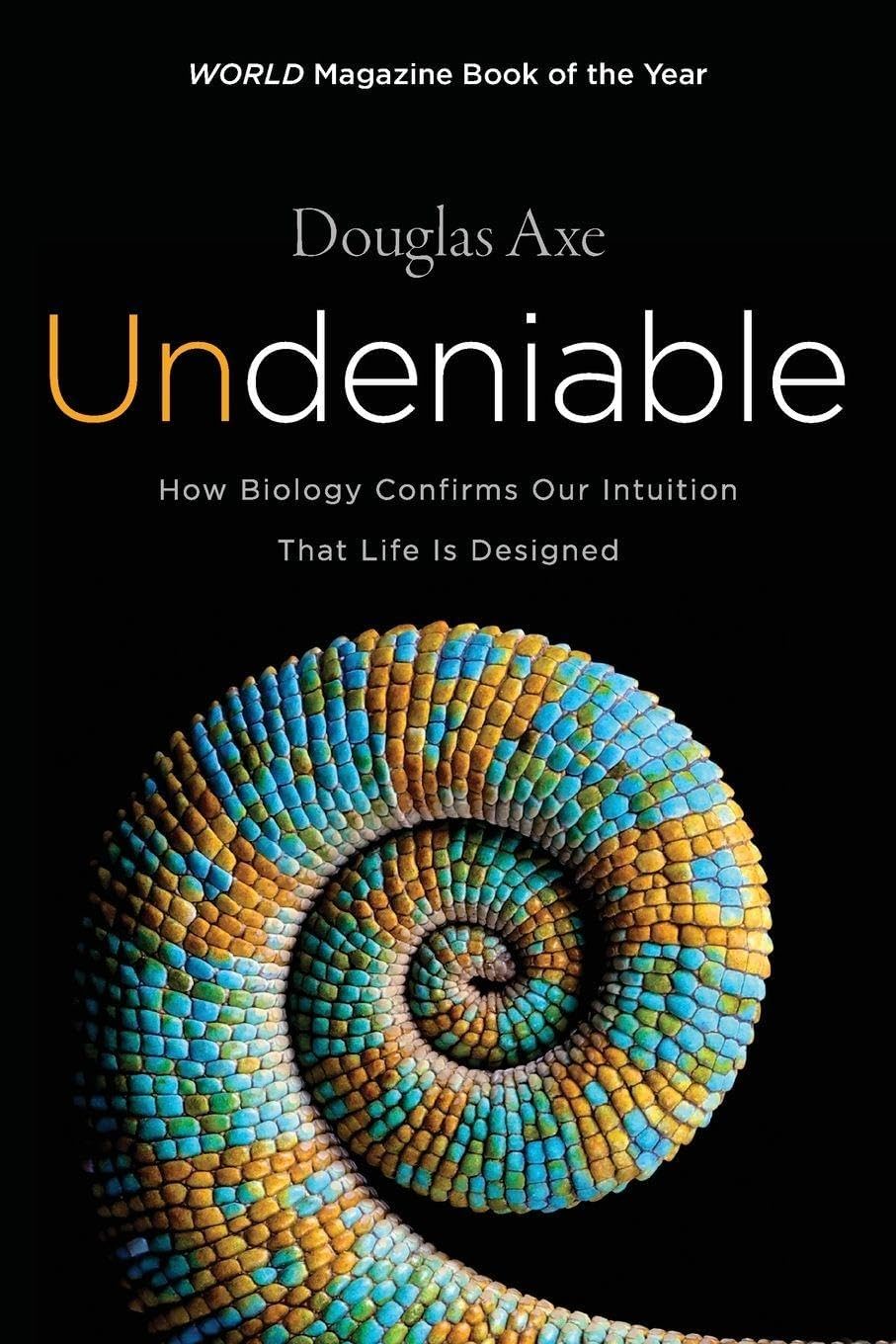
Undeniable: How Biology Confirms Our Intuition That Life Is Designed ― As Featured in the Film, The Story of Everything
Product ID: 45481786
Desertcart purchases this item on your behalf and handles shipping, customs, and support to Tunisia.
Named A Best Book of the Year by World Magazine Throughout his distinguished and unconventional career, engineer-turned-molecular-biologist Douglas Axe has been asking the questions that much of the scientific community would rather silence. Now, he presents his conclusions in this brave and pioneering book. Axe argues that the key to understanding our origin is the design intuitionthe innate belief held by all humans that tasks we would need knowledge to accomplish can only be accomplished by someone who has that knowledge. For the ingenious task of inventing life, this knower can only be God. Starting with the hallowed halls of academic science, Axe dismantles the widespread belief that Darwins theory of evolution is indisputably true, showing instead that a gaping hole has been at its center from the beginning. He then explains in plain English the science that proves our design intuition scientifically valid. Lastly, he uses everyday experience to empower ordinary people to defend their design intuition, giving them the confidence and courage to explain why it has to be true and the vision to imagine what biology will become when people stand up for this truth. Armed with that confidence, readers will affirm what once seemed obvious to all of usthat living creatures, from single-celled cyanobacteria to orca whales and human beings, are brilliantly conceived, utterly beyond the reach of accident. Our intuition was right all along. Review: A Fresh and Insightful Design Perspective - In Undeniable (2016), Douglas Axe sets out to answer one of life’s biggest questions: To what or to whom do we owe our existence? He is persuaded that the answer to this question is innately accessible to every person through a common, undeniable design intuition. In spite of its ubiquity, however, life’s circumstances can desensitize this design-sensing apparatus in a way that distorts conclusions about reality, not least of which being those regarding life’s biggest questions. Thus, Axe presents readers with a cogent argument that justifies this intuition in a manner that hopefully reawakens it. In a book-related interview, Axe explains that a key motivation for this project was the recognition that biological studies provide very clear and convincing technical arguments which show that life is designed; yet most people are untrained to follow such arguments in any technical detail and they certainly won’t be reading any scientific journals on the matter. Thus, he aims to present the basic rationale behind the design intuition in a manner that removes the necessity of specialized biological understanding so that everyone can follow the argument. Regarding the title, he credits his daughter who observed that, ultimately, we can’t deny our intuition that life is designed. Intrigued by her suggestion, he discovered that Bill Nye wrote a book by the same name, and so Axe reluctantly scratched the prospect. However, further reflection caused him to consider that using the same title might invite a comparison between Nye’s Undeniable and his own. With due respect to Bill Nye, Axe observes that his own substantial scientific research on the question of evolution surpasses Nye’s and thus provides readers with a perspective gleaned from 25 years of first-hand experience. Vocationally, Dr. Axe directs the Biologic Institute, where his work includes experiments and computer simulations to examine the functional and structural constraints on the evolution of proteins and protein systems. After earning his Ph.D. in molecular biology at Caltech, he held postdoctoral and research scientist positions at the University of Cambridge, the Cambridge Medical Research Council Centre, and the Babraham Institute in Cambridge. He has published in peer-reviewed periodicals such as the Journal of Molecular Biology, the Proceedings of the National Academy of Sciences and Nature. Summary: Undeniable’s opening chapter presents “The Big Question”: To what or to whom do we owe our existence? Axe explains that a theistic response to such ultimate inquiry generates awkwardness in the context of metaphysical materialism, an ideology that dominates contemporary science. In that regard, he cites Thomas Nagel’s candid analysis: “…this cosmic authority problem [associated with theistic implications]…is responsible for much of the scientism and reductionism of our time. One of the tendencies it supports is the ludicrous overuse of evolutionary biology to explain everything about life…” Given Nagel’s atheism and his courage to swim against its relentless materialistic currents, Axe recognizes him as “living proof that the awkwardness of bare-naked honesty doesn’t compare to the reward of engaging seriously the matters that concern us most.” In Chapter 2, The Conflict Within, Axe presents insights into his motivation for writing, specifically, his desire to resolve the conflict he experienced between “the voice of scientific consensus” and the “voice of his own intuition.” Even more, he wants to resolve this conflict for readers. Employing a clever thought experiment involving an oracular alphabet soup which spells complex assembly instructions when boiled, he demonstrates how our skeptical intuition about the implausibility of such a scenario is undeniably warranted; but he also observes that the certainty of such intuitions fall short of explaining how we know they’re correct. He further offers one plausible account of this, dubbed The Universal Design Intuition, wherein “tasks that we would need knowledge to accomplish can be accomplished only by someone who has that knowledge.” He caveats this by observing that descriptions of how intuition works are less significant than whether or not intuition can justify our conclusions—and, in particular, whether or not our intuitions that doubt Darwinism are sound. In sharing his pursuit toward resolving the internal conflict, chapter 3 recounts Axe’s experience as a post-doc at Cambridge University’s Laboratory of Molecular Biology (the LMB), where such notables as James Watson and Francis Crick conducted their famous Nobel-Prize-winning research on DNA. It was at the LMB where Axe’s own research unveiled more than just important scientific findings (cf. Journal of Molecular Biology, August 2000), it also raised his awareness of the prevailing science culture—specifically, the inevitable humanness of the enterprise. The utopian view of science—where researchers are driven solely by the quest for truth—began to crumble in Axe’s mind as he experienced first-hand how cultural considerations were as much a factor in peer consensus as solid research. Chapter 4 elaborates on this inescapable human dimension of science culture by observing that researchers are not mere automatons, but are very much driven by hopes and ambitions. Moreover, these qualities are necessary to the advancement of science and, therefore, principally good; however, as Axe emphasizes, harm comes to science when attempts are made to suppress actual results which threaten one’s hopes. Even more problematic for science is the institutionalization of agendas, where opposition to orthodoxy is tagged as anti-science to ensure compliance among the rank and file. Transitioning from human factors within science to a general human capacity abroad, chapter 5 introduces “common science,” a term Axe coins to package the idea that all humans are fundamentally scientists. In fact, common science is an inescapable part of living. Everyone makes observations of the world from which they develop mental notes and derive conceptual models that are continuously tested and refined through experience. Survival would be impossible in the absence of this remarkable ability. Furthermore, this notion of common science serves, in subsequent chapters, to address why tasks that require knowledge are never accomplished without knowledge; i.e., to explain why the universal design intuition is the case. In unpacking this intuition, Axe uses chapter six to address “busy wholes” and “whole projects,” where the former is something that accomplishes the latter. For example, a spider is a busy whole and its web is a whole project. Importantly, a spider differs from entities like rain, for example, since a spider’s web is an intended act for a purposeful end, whereas rain merely causes puddles incidentally. Moreover, we infer from completed projects that something did the work, even though the who and the how may lie beyond our apprehension. Chapter seven explores the inadequacy of natural selection in explaining such wonders as busy wholes. Moreover, in analyzing the viability of selection, Axe exposes “the gaping hole in evolutionary theory” by observing that selection is only capable of homing in on fitness signals that already exist; importantly, that is to say that selection does not invent anything. Amidst this critique, he also makes the fair point that selection functions well as a fiddler, but this capacity is far from inventive and even proves deleterious when beneficial signals are rivaled by harmful yet more-readily-selectable signals. Even in experiments where the conditions are rigged in selection’s favor, it merely homes in on immediate sources of higher fitness, regardless of harm caused within the larger context. Axe devotes chapter eight to demonstrating the challenges to successful blind searches posed by immense search spaces. He proceeds with precision in distinguishing between practical impossibility and conceptual impossibility, where the former lies outside the quantity of possible movements in the universe’s history (i.e., universal probability bound), while the latter is strictly zero. Ultimately, he wants to show that some things are so difficult to find by aimless wandering that their accidental discovery should be considered impossible. This is a critical step toward demonstrating the impracticality of Darwinism’s selection mechanism upon which the theory finally sinks or swims. Chapter eight also lays essential groundwork for appreciating the fantastic improbability of functional coherence, the subject of chapter nine. Here, Axe highlights the indispensable design element of coherence in light of the emergency assembly instructions used to rescue the Apollo 13 space mission. Ultimately, the point of the story and the chapter is to show that our firm intuition that such things can’t happen by accident is, in fact, correct. Furthermore, Axe summarizes the argument developed in chapters six through nine: “Functional coherence makes accidental invention fantastically improbable and therefore physically impossible.” Having used common science to justify the design intuition vis-à-vis the consensus view of biological origins, Axe devotes the book’s final four chapters to inquiry into the big question raised at its outset: to what or to whom do we owe our existence? To that end, chapter ten emphasizes that for all of humanity’s genius, we can’t escape the realization that someone has outdone us. As an example, Axe compares the man-made Tavros2 deep-submergence machine, outfitted with a virtually autonomous onboard computing system and solar-recharging cells, to that of a living machine, cyanobacteria (“high-tech pond scum”), which employs photosynthesis to create its energy. With little surprise, even a cursory comparison of the two remarkable systems demonstrates the surpassingly great complexity of the bacteria over Tavros2 (no offense to the engineers). In advancing the application component of his argument, Axe uses a baseball metaphor in advising common scientists to keep their eye on the ball as they move from the bleachers to the playing field, where jerseys are mostly emblazoned with “Darwin.” The proverbial ball is the argument cited above, that functional coherence makes accidental invention highly improbably and therefore physically impossible. Thus, to take one’s eye off the ball is to avert their attention to any account of origins which fails to answer that key argument. For example, Axe observes that physicist Jeremy England proposes that light + random atoms + time = a living plant, but this doesn’t answer the common science argument and therefore shouldn’t intimidate common scientists from engaging the science elite on this central consideration. Continuing with the application theme, Axe uses chapter twelve to enlist readers into a movement which stands up for the design intuition. Unlike a battle, everyone wins when a good movement prevails. To that end, readers are made aware of areas of retreat within the Darwinist/materialist context, not least of which being the retreat from critical dialogue. As Axe observes, questioning “the most central axiom of modern biology [i.e., evolution] was, and is, to excuse oneself from the company of modern biologists.” In that regard, he observes that when biology (or any other discipline) stifles open inquiry in the name of dogma, it acts more like bad religion than science. Chapter thirteen opens the aperture by shifting from a specific critique of evolution to a broader analysis of materialism and the mental world. Interacting with Thomas Nagel’s work, Axe explores issues in the philosophy of mind with respect to the inadequacy of a materialist accounting of reality—namely, the existence of consciousness and personhood. He observes that the uniqueness of personhood extends well beyond mere conscious thought and moral sense; in fact, persons are also friends, lovers, givers, takers, dreamers, visionaries, storytellers, philosophers, advocates, pleaders, sympathizers, sacrificers, poets, sculptors, dancers, reminiscers, and much more. Remarkably, the richness of this inner world also seems to compliment that of the outer world as if the two were made to go together. Undeniable’s closing chapter expounds on the nature of personhood while answering “the big question”: we owe our existence to a very personal God. While everyone had an innate grasp of this answer in childhood, it is all too often misplaced in later years, thus, providing impetus for the universal-design-intuition argument to resurface what we once already accepted as true. Reacquaintance with this reality will open avenues of inquiry that are presently closed within the materialist school of thought, such as asking why-questions with respect to function. Engineers develop indispensible insights in the problem-solving process by using such purpose-focused orientations, but biologists are implicitly forbidden by a paradigm where something like purpose is, at best, illusory. Evaluation: A great strength of Undeniable is its accessibility for a large audience. Achieving this without compromising the subject matter’s technical integrity is no easy task, but Axe accomplishes this with considerable success. Like many effective communicators, he does it by making ample use of stories, illustrations and analogies to clarify points of particular difficulty. For example, in answering the question of whether some things would be so hard to find by aimless wandering that we should consider their accidental discovery impossible, he uses the analogy of an Easter egg hunt to orient his readers by way of a familiar concept. Since such an analogy implies a goal-directed notion of searching (i.e., finding an egg), however, he helpfully distinguishes this colloquial sense of the term (search) by defining it as any process that can potentially find something, regardless of a goal. Thus, an egg hunt is a blind search inasmuch as the searcher lacks any special foresight or insight. This concrete analogy sets the stage for presenting an abstract notion of searching that most readers will find unfamiliar—specifically, searching nonphysical spaces. Unlike a physical egg hunt, nonphysical searches function in the realm of conceptual possibilities, such as a game of twenty questions, where the answer exists in the mind of a given player (as opposed to the corner of the backyard behind a rock, as in a physical egg hunt, for example). Thus, Axe connects the dots by explaining that a nonphysical, blind search is equivalent to a Darwinian search. This is significant because the true limitations of Darwinian explanations surface when searches are subjected to the immense conceptual search spaces that biological evolution entails. While expounding this important concept of searching vast spaces, Axe reverts to physical searches and invites readers to join him in conducting a virtual search of their own within the largest space one can mentally picture—the Earth’s surface. He picks the 2.5mm-diameter crosshair stamped upon a brass plaque at America’s Four Corners and dubs it the CUNA target (the intersection of Colorado, Utah, Nevada and Arizona). In terms of the Earth’s 510-million-square-kilometer surface area, the CUNA target covers 1 part in one hundred billion billion equal-sized parts. Readers can experience the difficulty of blindly hitting this target by dropping virtual pins at random to see just how close they can come to it on a world map (www.geomidpoint.com/random). This is a brilliant illustration on Axe’s part, as it vividly demonstrates the immense difficulty of hitting a target through blind searching within a vast space. Moreover, he does this in preparation for explaining evolutionary searches, which are much more difficult than hitting the CUNA target. In addition to cementing concepts and painting powerful imagery in the minds of readers, Axe uses these exercises to present key points of rationale, such as the coverage principle, where “if a pin is dropped blindly over a search space, the probability of it hitting any target within that space is equal to the fraction of the search space covered by the target.” In other words, the bigger the target, the better the chances of blindly hitting it. This is not only intuitive, but mathematically inescapable. Axe leverages this principle and the mental imagery gained by the CUNA experiment to test search spaces of “surreal size,” where the coverage principle applies with equal force. While this section on blind searches is masterfully presented, it might have been even more effective to explain the concept of physical impossibility in the text rather than as an endnote. In that regard, the endnote is well written and easily understood, but to the extent that readers treat them as nonessential, they will miss the technical grounding upon which Axe’s appeal to physical impossibility turns. Nevertheless, the general argument for impossible searches is soundly made regardless of technical amplification and readers will see that any accidental discovery which leads to functional coherence is highly improbable and therefore physically impossible. The general feature of accessibility throughout Undeniable is thematic, as its target audience is the biologically untrained (though biologists will benefit from its insights, too). Unfortunately, some reviewers considered the lack of technical arguments related directly to Axe’s research to be a liability. For example, “Tahir Nasser,” an desertcart reviewer, thinks this is an “excellent” book, though “slightly incomplete.” He points out that Stephen Meyer’s recent work, Darwin’s Doubt, cites more of Axe’s research than Undeniable. While this is the case, and while it may be disappointing for readers with similar expectations, the book is not meant to portray arguments for scientists by a scientist. Rather, its scope is mass appeal by way of justifying a capacity that people already possess: the design intuition. With respect to this intuition, other reviewers seem to miss the book’s aim altogether. For example, “Julias K.,” another desertcart reviewer, criticizes the validity of intuition as it relates to scientific inquiry, citing the once-universal acceptance of geocentrism as a failed example. A problem with this analysis as it relates to Undeniable, however, is that Axe devotes several chapters to justifying the design intuition. He doesn’t merely assert that one should assent to every sense experience, but rather argues for intuition in this particular case. From the book’s outset, Axe writes, “Specifically, we want to know whether the intuition that makes us doubt Darwin’s theory is sound … whether it [intuition] justifies our conclusions.” In other words, far from begging the question in favor of the design intuition, he argues (convincingly) for it. Another reviewer offers a critique that misses on a related point. He observes that “there is little interaction with other evolutionary scenarios … several different notions of how evolution may produce new life forms are proposed [by other scientists], and that most acknowledge some combination of several factors is probably right.” Unless the reviewer is referring to some sort of theistic version of evolution, which doesn’t seem to be the case, and which is equally rejected by the science establishment, then Axe’s argument still applies for the simple reason that insight and foresight are exempt from any naturalistic account of biological complexity. In other words, biological complexity displays functional coherence (which requires insight), and functional coherence is only achieved by top-down processes, but naturalistic accounts categorically preclude top-down processes; therefore, all naturalistic explanations fail to account for functional coherence. This is the point that Axe emphasizes with respect to Jeremy England’s evolutionary proposal (its Darwinian commitments notwithstanding) as was observed in the above summary. The same review levels another critique that seems to miss the main purpose of the book: “I understand this is a book for laity, but the movement from seeing some aspect of evolution as physically impossible to design is an inference that requires some explanation beyond assertion.” This is bewildering since Axe never merely asserts the legitimacy of a design inference in the absence of an argument. As is observed above, he develops an argument for the soundness of doubting Darwin’s theory on the basis of the design intuition, which he then extends to any naturalistic theory of evolution. This argument is even represented in an illustration (p. 162) which juxtaposes the various means by which design is concluded: “Instantly (by intuition),” and/or “Rigorously (by reasoning).” In that same illustration, he lays out the five premises for his argument and then synthesizes them into a single sentence. That the reviewer missed this key element of the book explains, perhaps, why he gave it a three-star rating. Contrary to these kinds of critiques, it is precisely because Axe argues so thoroughly and accessibly for the design intuition that Undeniable accomplishes its intent. Of course, many reviewers followed the arguments and grasped the book’s key points. Among such readers was a software developer who was inspired to create a program of his own to test the creative potential of mutation and selection. Similar to a theme rehearsed by Michael Behe in The Edge of Evolution, the reviewer pointed out that mutation and selection are better at breaking complex functional systems than making them (assuming it can make them in the first place): “My findings so far are that random mutation and selection have no creative power whatsoever and are highly destructive to code. The only way programs can survive being randomly mutated without being utterly destroyed is to have systems of functions that call each other and protect each other from single mutations. If they don't protect themselves from these mutations, they get completely destroyed.” Software analogies like these can be extended to include related mind-boggling factors, including the existence of the code itself, the complex computer system that process the code, the generation of the electricity which powers the computer that processes the code, etc. And again, this is Axe’s point. Just as one wouldn’t expect high-level functionality like this to result without insight and foresight, neither should one expect highly ordered biological systems to proceed from blind processes. In addition to its comprehensive and accessible argumentation, Undeniable also successfully leverages the power of story to provide rare and memorable insight into the pervasively naturalistic science culture as experienced by an insider. Readers already familiar with the resistance to design within biology won’t be surprised by these anecdotes, but they are likely to find that Axe’s first-person accounts will dispel any notion that the materialist bias within science enterprise is overplayed by design advocates. The power of these personal stories cannot be overstated, as they are among the few particulars that readers are likely to remember after they’ve finished the book. This is an important take-away since it showcases that scientists are human, too, and like every other human, they are subject to the pressures of their own biases as well as the biases of their peers—after all, who wants to be ridiculed and denied professional privilege for the sake of mere principle. Cynicism aside, a firm grasp of this phenomenon, vis-à-vis Axe’s own experience, will aid readers in understanding that the wide acceptance of naturalistic evolutionary tales reflects the imperfect human condition, not the detached objectivity of a Spock-like personality that many scientists would like to portray. In a similar regard, Undeniable also makes many significant existential connections, not least of which involves “the big question” that Axe interacts with throughout: To what or to whom do we owe our existence? Unlike many other ID texts, which tacitly distance design from its theological implications, Axe appeals to the handiwork of a personal God as the explanation of our existence. He doesn’t go so far as to argue for Christian theism, as that would launch the book into an entirely new direction; nevertheless, he does identify himself as a “Christian thinker,” thereby putting his personal theological commitments on display. This is a bold move since ID critics want to dismiss design as a religiously-motivated perspective vice a valid scientific inference; thus, to surface one’s religious view in the context of an ID argument would seem tantamount to conceding such a point. But regardless of the author’s perspective, the arguments stand on their own merit. Moreover, no thinking person is void of a theological perspective, so in that sense, Axe’s move is not only bold, but timely, as this fact seems lost on many engaging in the ID-evolution discourse; i.e., the atheist materialist has as much of a theological commitment as the Christian theist (disputes over the definition of atheism notwithstanding). As a representative of Christianity, Axe writes not only as a scientist, but as an ambassador for Christ—a role he should be commended for. His invitational, yet firm, presentation of the rationale for the universal design intuition is an exemplary model for others who plan to present this information to their family, friends, neighbors and co-workers. His engagement of Thomas Nagel’s perspective, for example, illustrates how one can critique an opposing view without assailing the person who holds it. In an age where brash exchanges and ad hominen attacks seem more common than ever, Axe’s respectful and courteous tone is refreshing indeed. Concerning possible improvements, there is really nothing the book itself is missing that would enhance its effectiveness. Given its target audience, it leverages an appropriate array of literary elements mentioned above (stories, illustrations, analogies) to clarify and reinforce its arguments and ideas. Given the importance of its subject, however, the production of a corresponding video presentation, along the lines of an Illustra Media project, would go a long way toward disseminating this message among a broader audience who have neither the time nor inclination to read it, but who would benefit from viewing an hour-long DVD. Recommendation: As has been mentioned, Undeniable’s accessibility lends itself to a broad audience, including high-school (and possibly middle-school) aged students. While the technical sophistication is tailored to accommodate readers untrained in biology, those with professional science backgrounds will also benefit from its philosophical insights and personal reflections. Given the novelty of the design-intuition argument itself, those acquainted with other ID projects should not approach this one as merely a repackaging of design arguments that they’ve encountered elsewhere. This book is particularly recommended for teachers who have the flexibility to incorporate it into their science and/or philosophy curricula. High school through graduate students will enjoy its readability and thought-provoking insights, and teachers may avail themselves of the engaging exercises presented within the book, such as attempting to hit the CUNA target with random drops of a virtual pin (as noted above). Students planning to enter the secular university will definitely benefit from this book’s ideas, as it will prepare them for the bombardment of materialist thinking that awaits and provide the confidence that comes from knowing that someone other than their youth pastor doubts the adequacy of a naturalistic worldview. After all, how many of their prospective teachers are likely to have been published in the Proceedings of the National Academy of Sciences, or the Journal of Molecular Biology? Finally, those who are not necessarily teachers but have a motivation for defending design will find Undeniable especially helpful as a template for developing both formal and impromptu presentations on the topic. Whether such an endeavor targets theists, agnostics, or atheists, reasoning along the lines that Axe provides will surely provoke thoughtful exchanges with anyone open minded enough to listen. Since the arguments themselves involve an innate human faculty (the design intuition), much of the heavy lifting is already done—it is merely a reawakening of the intuition that’s needed. After all, as Axe states in his closing sentences, “[the deepest questions] were never restricted to the most clever. Some things, of course, can only be seen by standing on the shoulders of giants, but the most crucial things have always been seen best by standing on the ground.” Review: Undeniable - Undeniable By Douglas Axe Published by Harper One A review by Jack Kettler Douglas Axe, a brief bio: Douglas Axe is a molecular biologist and Director of Biologic Institute. He completed his PhD at Caltech and held postdoctoral and research scientist positions at the University of Cambridge, the Cambridge Medical Research Council Centre, and the Babraham Institute in Cambridge. He worked as a postdoctoral fellow at the Centre for Protein Engineering under the supervision of Alan Fersht of the University of Cambridge. His current research examines the functional and structural constraints on the evolution of proteins and protein systems. His work has been published in the Journal of Molecular Biology. What others are saying: “From childhood everyone directly grasps that life is designed - until they’re talked out of it by a culture saturated with materialism. Using the latest science, molecular biologist Douglas Axe shows why you don’t have to be an expert to trust your firm knowledge of the wonderful design of life.” (Michael J. Behe, author of Darwin's Black Box) “Douglas Axe’s Undeniable is bold, insightful and world-changing. It’s also a joy to read. I recommend it highly!” (Phillip E. Johnson, Professor Emeritus of Law at U. C. Berkeley and author of Darwin on Trial) “Highly rigorous yet passionate, lyrical, forthright, refreshingly brief and accessible, Undeniable is an urgently needed addition to the library of books on intelligent design.” (Evolution News) “In Undeniable we are privy to a first-hand account of the evidence for intelligence and the painful professional cost of swimming against the flow of accepted but un-proven truth. A must-read.” (Gerald Schroeder, author of The Science of God and God According to God) “Probably the most engaging book I have read in the past ten years, because of Dr. Axe’s clear explanations and profound insights. This is an important book, perhaps the best one in existence, for anyone who takes origins questions seriously, whatever their perspective.” (Chuck Garner, Professor of Organic Chemistry at Baylor University) “Axe has carefully crafted a case that strongly favors our human intuition that life was designed, demonstrating why unguided evolution is improbable in the extreme. This book’s power to convince surpasses that of everything I’ve read on origins science in my sixty-five years as an engineer, biophysicist, and physiologist.” (Mark C. Biedebach, Ph.D., Professor Emeritus, Dept. of Biological Sciences, California State University, Long Beach) “Douglas Axe is one of the very few experimental scientists who has used his skills to test the validity of evolutionary mechanisms as a source of inventions. Here, he concludes that we can trust our common [universal] design intuition; it is supported by science, whereas evolutionary stories are anti-science.” (Matti Leisola, D.Sc. Professor Emeritus of Bioprocess Engineering, Aalto University, Finland) “Undeniable is a marvelous book, both engaging and convincing-a true masterpiece.” (Marcos Eberlin, Professor of Chemistry at University of Campinas, member of the Brazilian Academy of Sciences) About this book: Axe starts with a fascinating analogy. He asks us to imagine what can be found in “oracle soup.” The alphabet soup is boiled in a pot covered with a lid. When the lid is removed, a message appears in the soup. That message gives complete instructions for building something new like a machine with useful functions. If you actually saw such an oracle soup boiling, you could not possibly believe that random boiling produced those instructions. Nonetheless, evolution researchers want you to believe that the intricate instructions for building the first “simple” life form came from random interactions in some kind of “primordial soup.” “A three-letter word appearing in alphabet soup is worth mentioning, a five-letter word is worth photographing, and a seven-letter word is downright suspicious.” (Chapter 9, p.152.) Although Axe is dealing with very technical information, he writes in a style that can be followed by the layman. Some of the chapters that impressed me particularly were Chapter 3; Science in the Real World, Chapter 4; Outside the Box and Chapter 5; A Dose of Common Science. The book is a treatise, logically building a case that Darwinism has run its course and is out of gas. The more that is learned about the makeup and complexity of the simplest form of life, the knowledge screams, random mutations could never have responsible for the complexity of life as we know it. Axe makes the case that when there is too much information, there is no way random processes could have produced it. Axe goes on and discusses how an evolutionary process in one of his experiments took a protein that didn’t work well and converted it into a protein that did work well. Conversely, random processes could never have produced the original, poorly-working protein, because even a poorly-working protein represents significantly more information than could ever be produced by random chance mutations. Axe describes different systems that are analogous to how a biochemical system would “search” for a useful protein using random mutations acted on by natural selection. He then takes his own published scientific research on proteins and converts the numbers he got from that research into probabilities that are applicable to those analogous systems. In every case, the numbers tell you that it is not possible for the search to be successful considering the laws of probability. Axe’s Undeniable was World Magazine’s book of the year for good reasons. Axe exposes the folly of those who continue asserting the truthfulness of Darwinism in the face of the overwhelming complexity of the simplest single cell of life. Religiously held evolutionary theory is basically asserting: poof bang, all of this DNA, RNA, protein, amino acid, glycol-proteins (cellar communication) and gene sequencing complexity came from nothing. The most brilliant scientists can't make the simplest form of life in a test tube. And yet we are to believe that billions and billions of beneficial mutations and accidents brought us life as we know it today out of nothing. This is not science; it is blind faith, hell bent on keeping the God equation out of the picture. The fools making such extravagant claims about Darwinism usually hide behind a veneer of mathematical respectability. In other words, a smoke screen or like the curtain the Wizard of Oz hid behind. Douglas Axe has amply demonstrated that evolutionary scientists are not neutral in handling the facts of God’s creation; they suppress the knowledge of God for fables like unproven multi universes. (Romans 1:20-22) Douglas Axe is a scientist that shows us The Science That Undoes Darwinism and Vindicates Our Sense That Life Is Designed. Thus, the believer unlike the unbeliever no longer suppresses the knowledge of God. I highly recommend this book. It should be in every Christian’s library. Mr. Kettler is the owner of www.Undergroundnotes.com a conservative web hub and the author of the new book, The Religion That Started in a Hat: A Reference Manual for Christians who Witness to Mormons that is available at desertcart.


| Best Sellers Rank | #297,697 in Books ( See Top 100 in Books ) #15 in Developmental Biology (Books) #35 in Creationism #82 in Cell Biology (Books) |
| Customer Reviews | 4.6 out of 5 stars 985 Reviews |
P**D
A Fresh and Insightful Design Perspective
In Undeniable (2016), Douglas Axe sets out to answer one of life’s biggest questions: To what or to whom do we owe our existence? He is persuaded that the answer to this question is innately accessible to every person through a common, undeniable design intuition. In spite of its ubiquity, however, life’s circumstances can desensitize this design-sensing apparatus in a way that distorts conclusions about reality, not least of which being those regarding life’s biggest questions. Thus, Axe presents readers with a cogent argument that justifies this intuition in a manner that hopefully reawakens it. In a book-related interview, Axe explains that a key motivation for this project was the recognition that biological studies provide very clear and convincing technical arguments which show that life is designed; yet most people are untrained to follow such arguments in any technical detail and they certainly won’t be reading any scientific journals on the matter. Thus, he aims to present the basic rationale behind the design intuition in a manner that removes the necessity of specialized biological understanding so that everyone can follow the argument. Regarding the title, he credits his daughter who observed that, ultimately, we can’t deny our intuition that life is designed. Intrigued by her suggestion, he discovered that Bill Nye wrote a book by the same name, and so Axe reluctantly scratched the prospect. However, further reflection caused him to consider that using the same title might invite a comparison between Nye’s Undeniable and his own. With due respect to Bill Nye, Axe observes that his own substantial scientific research on the question of evolution surpasses Nye’s and thus provides readers with a perspective gleaned from 25 years of first-hand experience. Vocationally, Dr. Axe directs the Biologic Institute, where his work includes experiments and computer simulations to examine the functional and structural constraints on the evolution of proteins and protein systems. After earning his Ph.D. in molecular biology at Caltech, he held postdoctoral and research scientist positions at the University of Cambridge, the Cambridge Medical Research Council Centre, and the Babraham Institute in Cambridge. He has published in peer-reviewed periodicals such as the Journal of Molecular Biology, the Proceedings of the National Academy of Sciences and Nature. Summary: Undeniable’s opening chapter presents “The Big Question”: To what or to whom do we owe our existence? Axe explains that a theistic response to such ultimate inquiry generates awkwardness in the context of metaphysical materialism, an ideology that dominates contemporary science. In that regard, he cites Thomas Nagel’s candid analysis: “…this cosmic authority problem [associated with theistic implications]…is responsible for much of the scientism and reductionism of our time. One of the tendencies it supports is the ludicrous overuse of evolutionary biology to explain everything about life…” Given Nagel’s atheism and his courage to swim against its relentless materialistic currents, Axe recognizes him as “living proof that the awkwardness of bare-naked honesty doesn’t compare to the reward of engaging seriously the matters that concern us most.” In Chapter 2, The Conflict Within, Axe presents insights into his motivation for writing, specifically, his desire to resolve the conflict he experienced between “the voice of scientific consensus” and the “voice of his own intuition.” Even more, he wants to resolve this conflict for readers. Employing a clever thought experiment involving an oracular alphabet soup which spells complex assembly instructions when boiled, he demonstrates how our skeptical intuition about the implausibility of such a scenario is undeniably warranted; but he also observes that the certainty of such intuitions fall short of explaining how we know they’re correct. He further offers one plausible account of this, dubbed The Universal Design Intuition, wherein “tasks that we would need knowledge to accomplish can be accomplished only by someone who has that knowledge.” He caveats this by observing that descriptions of how intuition works are less significant than whether or not intuition can justify our conclusions—and, in particular, whether or not our intuitions that doubt Darwinism are sound. In sharing his pursuit toward resolving the internal conflict, chapter 3 recounts Axe’s experience as a post-doc at Cambridge University’s Laboratory of Molecular Biology (the LMB), where such notables as James Watson and Francis Crick conducted their famous Nobel-Prize-winning research on DNA. It was at the LMB where Axe’s own research unveiled more than just important scientific findings (cf. Journal of Molecular Biology, August 2000), it also raised his awareness of the prevailing science culture—specifically, the inevitable humanness of the enterprise. The utopian view of science—where researchers are driven solely by the quest for truth—began to crumble in Axe’s mind as he experienced first-hand how cultural considerations were as much a factor in peer consensus as solid research. Chapter 4 elaborates on this inescapable human dimension of science culture by observing that researchers are not mere automatons, but are very much driven by hopes and ambitions. Moreover, these qualities are necessary to the advancement of science and, therefore, principally good; however, as Axe emphasizes, harm comes to science when attempts are made to suppress actual results which threaten one’s hopes. Even more problematic for science is the institutionalization of agendas, where opposition to orthodoxy is tagged as anti-science to ensure compliance among the rank and file. Transitioning from human factors within science to a general human capacity abroad, chapter 5 introduces “common science,” a term Axe coins to package the idea that all humans are fundamentally scientists. In fact, common science is an inescapable part of living. Everyone makes observations of the world from which they develop mental notes and derive conceptual models that are continuously tested and refined through experience. Survival would be impossible in the absence of this remarkable ability. Furthermore, this notion of common science serves, in subsequent chapters, to address why tasks that require knowledge are never accomplished without knowledge; i.e., to explain why the universal design intuition is the case. In unpacking this intuition, Axe uses chapter six to address “busy wholes” and “whole projects,” where the former is something that accomplishes the latter. For example, a spider is a busy whole and its web is a whole project. Importantly, a spider differs from entities like rain, for example, since a spider’s web is an intended act for a purposeful end, whereas rain merely causes puddles incidentally. Moreover, we infer from completed projects that something did the work, even though the who and the how may lie beyond our apprehension. Chapter seven explores the inadequacy of natural selection in explaining such wonders as busy wholes. Moreover, in analyzing the viability of selection, Axe exposes “the gaping hole in evolutionary theory” by observing that selection is only capable of homing in on fitness signals that already exist; importantly, that is to say that selection does not invent anything. Amidst this critique, he also makes the fair point that selection functions well as a fiddler, but this capacity is far from inventive and even proves deleterious when beneficial signals are rivaled by harmful yet more-readily-selectable signals. Even in experiments where the conditions are rigged in selection’s favor, it merely homes in on immediate sources of higher fitness, regardless of harm caused within the larger context. Axe devotes chapter eight to demonstrating the challenges to successful blind searches posed by immense search spaces. He proceeds with precision in distinguishing between practical impossibility and conceptual impossibility, where the former lies outside the quantity of possible movements in the universe’s history (i.e., universal probability bound), while the latter is strictly zero. Ultimately, he wants to show that some things are so difficult to find by aimless wandering that their accidental discovery should be considered impossible. This is a critical step toward demonstrating the impracticality of Darwinism’s selection mechanism upon which the theory finally sinks or swims. Chapter eight also lays essential groundwork for appreciating the fantastic improbability of functional coherence, the subject of chapter nine. Here, Axe highlights the indispensable design element of coherence in light of the emergency assembly instructions used to rescue the Apollo 13 space mission. Ultimately, the point of the story and the chapter is to show that our firm intuition that such things can’t happen by accident is, in fact, correct. Furthermore, Axe summarizes the argument developed in chapters six through nine: “Functional coherence makes accidental invention fantastically improbable and therefore physically impossible.” Having used common science to justify the design intuition vis-à-vis the consensus view of biological origins, Axe devotes the book’s final four chapters to inquiry into the big question raised at its outset: to what or to whom do we owe our existence? To that end, chapter ten emphasizes that for all of humanity’s genius, we can’t escape the realization that someone has outdone us. As an example, Axe compares the man-made Tavros2 deep-submergence machine, outfitted with a virtually autonomous onboard computing system and solar-recharging cells, to that of a living machine, cyanobacteria (“high-tech pond scum”), which employs photosynthesis to create its energy. With little surprise, even a cursory comparison of the two remarkable systems demonstrates the surpassingly great complexity of the bacteria over Tavros2 (no offense to the engineers). In advancing the application component of his argument, Axe uses a baseball metaphor in advising common scientists to keep their eye on the ball as they move from the bleachers to the playing field, where jerseys are mostly emblazoned with “Darwin.” The proverbial ball is the argument cited above, that functional coherence makes accidental invention highly improbably and therefore physically impossible. Thus, to take one’s eye off the ball is to avert their attention to any account of origins which fails to answer that key argument. For example, Axe observes that physicist Jeremy England proposes that light + random atoms + time = a living plant, but this doesn’t answer the common science argument and therefore shouldn’t intimidate common scientists from engaging the science elite on this central consideration. Continuing with the application theme, Axe uses chapter twelve to enlist readers into a movement which stands up for the design intuition. Unlike a battle, everyone wins when a good movement prevails. To that end, readers are made aware of areas of retreat within the Darwinist/materialist context, not least of which being the retreat from critical dialogue. As Axe observes, questioning “the most central axiom of modern biology [i.e., evolution] was, and is, to excuse oneself from the company of modern biologists.” In that regard, he observes that when biology (or any other discipline) stifles open inquiry in the name of dogma, it acts more like bad religion than science. Chapter thirteen opens the aperture by shifting from a specific critique of evolution to a broader analysis of materialism and the mental world. Interacting with Thomas Nagel’s work, Axe explores issues in the philosophy of mind with respect to the inadequacy of a materialist accounting of reality—namely, the existence of consciousness and personhood. He observes that the uniqueness of personhood extends well beyond mere conscious thought and moral sense; in fact, persons are also friends, lovers, givers, takers, dreamers, visionaries, storytellers, philosophers, advocates, pleaders, sympathizers, sacrificers, poets, sculptors, dancers, reminiscers, and much more. Remarkably, the richness of this inner world also seems to compliment that of the outer world as if the two were made to go together. Undeniable’s closing chapter expounds on the nature of personhood while answering “the big question”: we owe our existence to a very personal God. While everyone had an innate grasp of this answer in childhood, it is all too often misplaced in later years, thus, providing impetus for the universal-design-intuition argument to resurface what we once already accepted as true. Reacquaintance with this reality will open avenues of inquiry that are presently closed within the materialist school of thought, such as asking why-questions with respect to function. Engineers develop indispensible insights in the problem-solving process by using such purpose-focused orientations, but biologists are implicitly forbidden by a paradigm where something like purpose is, at best, illusory. Evaluation: A great strength of Undeniable is its accessibility for a large audience. Achieving this without compromising the subject matter’s technical integrity is no easy task, but Axe accomplishes this with considerable success. Like many effective communicators, he does it by making ample use of stories, illustrations and analogies to clarify points of particular difficulty. For example, in answering the question of whether some things would be so hard to find by aimless wandering that we should consider their accidental discovery impossible, he uses the analogy of an Easter egg hunt to orient his readers by way of a familiar concept. Since such an analogy implies a goal-directed notion of searching (i.e., finding an egg), however, he helpfully distinguishes this colloquial sense of the term (search) by defining it as any process that can potentially find something, regardless of a goal. Thus, an egg hunt is a blind search inasmuch as the searcher lacks any special foresight or insight. This concrete analogy sets the stage for presenting an abstract notion of searching that most readers will find unfamiliar—specifically, searching nonphysical spaces. Unlike a physical egg hunt, nonphysical searches function in the realm of conceptual possibilities, such as a game of twenty questions, where the answer exists in the mind of a given player (as opposed to the corner of the backyard behind a rock, as in a physical egg hunt, for example). Thus, Axe connects the dots by explaining that a nonphysical, blind search is equivalent to a Darwinian search. This is significant because the true limitations of Darwinian explanations surface when searches are subjected to the immense conceptual search spaces that biological evolution entails. While expounding this important concept of searching vast spaces, Axe reverts to physical searches and invites readers to join him in conducting a virtual search of their own within the largest space one can mentally picture—the Earth’s surface. He picks the 2.5mm-diameter crosshair stamped upon a brass plaque at America’s Four Corners and dubs it the CUNA target (the intersection of Colorado, Utah, Nevada and Arizona). In terms of the Earth’s 510-million-square-kilometer surface area, the CUNA target covers 1 part in one hundred billion billion equal-sized parts. Readers can experience the difficulty of blindly hitting this target by dropping virtual pins at random to see just how close they can come to it on a world map (www.geomidpoint.com/random). This is a brilliant illustration on Axe’s part, as it vividly demonstrates the immense difficulty of hitting a target through blind searching within a vast space. Moreover, he does this in preparation for explaining evolutionary searches, which are much more difficult than hitting the CUNA target. In addition to cementing concepts and painting powerful imagery in the minds of readers, Axe uses these exercises to present key points of rationale, such as the coverage principle, where “if a pin is dropped blindly over a search space, the probability of it hitting any target within that space is equal to the fraction of the search space covered by the target.” In other words, the bigger the target, the better the chances of blindly hitting it. This is not only intuitive, but mathematically inescapable. Axe leverages this principle and the mental imagery gained by the CUNA experiment to test search spaces of “surreal size,” where the coverage principle applies with equal force. While this section on blind searches is masterfully presented, it might have been even more effective to explain the concept of physical impossibility in the text rather than as an endnote. In that regard, the endnote is well written and easily understood, but to the extent that readers treat them as nonessential, they will miss the technical grounding upon which Axe’s appeal to physical impossibility turns. Nevertheless, the general argument for impossible searches is soundly made regardless of technical amplification and readers will see that any accidental discovery which leads to functional coherence is highly improbable and therefore physically impossible. The general feature of accessibility throughout Undeniable is thematic, as its target audience is the biologically untrained (though biologists will benefit from its insights, too). Unfortunately, some reviewers considered the lack of technical arguments related directly to Axe’s research to be a liability. For example, “Tahir Nasser,” an Amazon reviewer, thinks this is an “excellent” book, though “slightly incomplete.” He points out that Stephen Meyer’s recent work, Darwin’s Doubt, cites more of Axe’s research than Undeniable. While this is the case, and while it may be disappointing for readers with similar expectations, the book is not meant to portray arguments for scientists by a scientist. Rather, its scope is mass appeal by way of justifying a capacity that people already possess: the design intuition. With respect to this intuition, other reviewers seem to miss the book’s aim altogether. For example, “Julias K.,” another Amazon reviewer, criticizes the validity of intuition as it relates to scientific inquiry, citing the once-universal acceptance of geocentrism as a failed example. A problem with this analysis as it relates to Undeniable, however, is that Axe devotes several chapters to justifying the design intuition. He doesn’t merely assert that one should assent to every sense experience, but rather argues for intuition in this particular case. From the book’s outset, Axe writes, “Specifically, we want to know whether the intuition that makes us doubt Darwin’s theory is sound … whether it [intuition] justifies our conclusions.” In other words, far from begging the question in favor of the design intuition, he argues (convincingly) for it. Another reviewer offers a critique that misses on a related point. He observes that “there is little interaction with other evolutionary scenarios … several different notions of how evolution may produce new life forms are proposed [by other scientists], and that most acknowledge some combination of several factors is probably right.” Unless the reviewer is referring to some sort of theistic version of evolution, which doesn’t seem to be the case, and which is equally rejected by the science establishment, then Axe’s argument still applies for the simple reason that insight and foresight are exempt from any naturalistic account of biological complexity. In other words, biological complexity displays functional coherence (which requires insight), and functional coherence is only achieved by top-down processes, but naturalistic accounts categorically preclude top-down processes; therefore, all naturalistic explanations fail to account for functional coherence. This is the point that Axe emphasizes with respect to Jeremy England’s evolutionary proposal (its Darwinian commitments notwithstanding) as was observed in the above summary. The same review levels another critique that seems to miss the main purpose of the book: “I understand this is a book for laity, but the movement from seeing some aspect of evolution as physically impossible to design is an inference that requires some explanation beyond assertion.” This is bewildering since Axe never merely asserts the legitimacy of a design inference in the absence of an argument. As is observed above, he develops an argument for the soundness of doubting Darwin’s theory on the basis of the design intuition, which he then extends to any naturalistic theory of evolution. This argument is even represented in an illustration (p. 162) which juxtaposes the various means by which design is concluded: “Instantly (by intuition),” and/or “Rigorously (by reasoning).” In that same illustration, he lays out the five premises for his argument and then synthesizes them into a single sentence. That the reviewer missed this key element of the book explains, perhaps, why he gave it a three-star rating. Contrary to these kinds of critiques, it is precisely because Axe argues so thoroughly and accessibly for the design intuition that Undeniable accomplishes its intent. Of course, many reviewers followed the arguments and grasped the book’s key points. Among such readers was a software developer who was inspired to create a program of his own to test the creative potential of mutation and selection. Similar to a theme rehearsed by Michael Behe in The Edge of Evolution, the reviewer pointed out that mutation and selection are better at breaking complex functional systems than making them (assuming it can make them in the first place): “My findings so far are that random mutation and selection have no creative power whatsoever and are highly destructive to code. The only way programs can survive being randomly mutated without being utterly destroyed is to have systems of functions that call each other and protect each other from single mutations. If they don't protect themselves from these mutations, they get completely destroyed.” Software analogies like these can be extended to include related mind-boggling factors, including the existence of the code itself, the complex computer system that process the code, the generation of the electricity which powers the computer that processes the code, etc. And again, this is Axe’s point. Just as one wouldn’t expect high-level functionality like this to result without insight and foresight, neither should one expect highly ordered biological systems to proceed from blind processes. In addition to its comprehensive and accessible argumentation, Undeniable also successfully leverages the power of story to provide rare and memorable insight into the pervasively naturalistic science culture as experienced by an insider. Readers already familiar with the resistance to design within biology won’t be surprised by these anecdotes, but they are likely to find that Axe’s first-person accounts will dispel any notion that the materialist bias within science enterprise is overplayed by design advocates. The power of these personal stories cannot be overstated, as they are among the few particulars that readers are likely to remember after they’ve finished the book. This is an important take-away since it showcases that scientists are human, too, and like every other human, they are subject to the pressures of their own biases as well as the biases of their peers—after all, who wants to be ridiculed and denied professional privilege for the sake of mere principle. Cynicism aside, a firm grasp of this phenomenon, vis-à-vis Axe’s own experience, will aid readers in understanding that the wide acceptance of naturalistic evolutionary tales reflects the imperfect human condition, not the detached objectivity of a Spock-like personality that many scientists would like to portray. In a similar regard, Undeniable also makes many significant existential connections, not least of which involves “the big question” that Axe interacts with throughout: To what or to whom do we owe our existence? Unlike many other ID texts, which tacitly distance design from its theological implications, Axe appeals to the handiwork of a personal God as the explanation of our existence. He doesn’t go so far as to argue for Christian theism, as that would launch the book into an entirely new direction; nevertheless, he does identify himself as a “Christian thinker,” thereby putting his personal theological commitments on display. This is a bold move since ID critics want to dismiss design as a religiously-motivated perspective vice a valid scientific inference; thus, to surface one’s religious view in the context of an ID argument would seem tantamount to conceding such a point. But regardless of the author’s perspective, the arguments stand on their own merit. Moreover, no thinking person is void of a theological perspective, so in that sense, Axe’s move is not only bold, but timely, as this fact seems lost on many engaging in the ID-evolution discourse; i.e., the atheist materialist has as much of a theological commitment as the Christian theist (disputes over the definition of atheism notwithstanding). As a representative of Christianity, Axe writes not only as a scientist, but as an ambassador for Christ—a role he should be commended for. His invitational, yet firm, presentation of the rationale for the universal design intuition is an exemplary model for others who plan to present this information to their family, friends, neighbors and co-workers. His engagement of Thomas Nagel’s perspective, for example, illustrates how one can critique an opposing view without assailing the person who holds it. In an age where brash exchanges and ad hominen attacks seem more common than ever, Axe’s respectful and courteous tone is refreshing indeed. Concerning possible improvements, there is really nothing the book itself is missing that would enhance its effectiveness. Given its target audience, it leverages an appropriate array of literary elements mentioned above (stories, illustrations, analogies) to clarify and reinforce its arguments and ideas. Given the importance of its subject, however, the production of a corresponding video presentation, along the lines of an Illustra Media project, would go a long way toward disseminating this message among a broader audience who have neither the time nor inclination to read it, but who would benefit from viewing an hour-long DVD. Recommendation: As has been mentioned, Undeniable’s accessibility lends itself to a broad audience, including high-school (and possibly middle-school) aged students. While the technical sophistication is tailored to accommodate readers untrained in biology, those with professional science backgrounds will also benefit from its philosophical insights and personal reflections. Given the novelty of the design-intuition argument itself, those acquainted with other ID projects should not approach this one as merely a repackaging of design arguments that they’ve encountered elsewhere. This book is particularly recommended for teachers who have the flexibility to incorporate it into their science and/or philosophy curricula. High school through graduate students will enjoy its readability and thought-provoking insights, and teachers may avail themselves of the engaging exercises presented within the book, such as attempting to hit the CUNA target with random drops of a virtual pin (as noted above). Students planning to enter the secular university will definitely benefit from this book’s ideas, as it will prepare them for the bombardment of materialist thinking that awaits and provide the confidence that comes from knowing that someone other than their youth pastor doubts the adequacy of a naturalistic worldview. After all, how many of their prospective teachers are likely to have been published in the Proceedings of the National Academy of Sciences, or the Journal of Molecular Biology? Finally, those who are not necessarily teachers but have a motivation for defending design will find Undeniable especially helpful as a template for developing both formal and impromptu presentations on the topic. Whether such an endeavor targets theists, agnostics, or atheists, reasoning along the lines that Axe provides will surely provoke thoughtful exchanges with anyone open minded enough to listen. Since the arguments themselves involve an innate human faculty (the design intuition), much of the heavy lifting is already done—it is merely a reawakening of the intuition that’s needed. After all, as Axe states in his closing sentences, “[the deepest questions] were never restricted to the most clever. Some things, of course, can only be seen by standing on the shoulders of giants, but the most crucial things have always been seen best by standing on the ground.”
J**R
Undeniable
Undeniable By Douglas Axe Published by Harper One A review by Jack Kettler Douglas Axe, a brief bio: Douglas Axe is a molecular biologist and Director of Biologic Institute. He completed his PhD at Caltech and held postdoctoral and research scientist positions at the University of Cambridge, the Cambridge Medical Research Council Centre, and the Babraham Institute in Cambridge. He worked as a postdoctoral fellow at the Centre for Protein Engineering under the supervision of Alan Fersht of the University of Cambridge. His current research examines the functional and structural constraints on the evolution of proteins and protein systems. His work has been published in the Journal of Molecular Biology. What others are saying: “From childhood everyone directly grasps that life is designed - until they’re talked out of it by a culture saturated with materialism. Using the latest science, molecular biologist Douglas Axe shows why you don’t have to be an expert to trust your firm knowledge of the wonderful design of life.” (Michael J. Behe, author of Darwin's Black Box) “Douglas Axe’s Undeniable is bold, insightful and world-changing. It’s also a joy to read. I recommend it highly!” (Phillip E. Johnson, Professor Emeritus of Law at U. C. Berkeley and author of Darwin on Trial) “Highly rigorous yet passionate, lyrical, forthright, refreshingly brief and accessible, Undeniable is an urgently needed addition to the library of books on intelligent design.” (Evolution News) “In Undeniable we are privy to a first-hand account of the evidence for intelligence and the painful professional cost of swimming against the flow of accepted but un-proven truth. A must-read.” (Gerald Schroeder, author of The Science of God and God According to God) “Probably the most engaging book I have read in the past ten years, because of Dr. Axe’s clear explanations and profound insights. This is an important book, perhaps the best one in existence, for anyone who takes origins questions seriously, whatever their perspective.” (Chuck Garner, Professor of Organic Chemistry at Baylor University) “Axe has carefully crafted a case that strongly favors our human intuition that life was designed, demonstrating why unguided evolution is improbable in the extreme. This book’s power to convince surpasses that of everything I’ve read on origins science in my sixty-five years as an engineer, biophysicist, and physiologist.” (Mark C. Biedebach, Ph.D., Professor Emeritus, Dept. of Biological Sciences, California State University, Long Beach) “Douglas Axe is one of the very few experimental scientists who has used his skills to test the validity of evolutionary mechanisms as a source of inventions. Here, he concludes that we can trust our common [universal] design intuition; it is supported by science, whereas evolutionary stories are anti-science.” (Matti Leisola, D.Sc. Professor Emeritus of Bioprocess Engineering, Aalto University, Finland) “Undeniable is a marvelous book, both engaging and convincing-a true masterpiece.” (Marcos Eberlin, Professor of Chemistry at University of Campinas, member of the Brazilian Academy of Sciences) About this book: Axe starts with a fascinating analogy. He asks us to imagine what can be found in “oracle soup.” The alphabet soup is boiled in a pot covered with a lid. When the lid is removed, a message appears in the soup. That message gives complete instructions for building something new like a machine with useful functions. If you actually saw such an oracle soup boiling, you could not possibly believe that random boiling produced those instructions. Nonetheless, evolution researchers want you to believe that the intricate instructions for building the first “simple” life form came from random interactions in some kind of “primordial soup.” “A three-letter word appearing in alphabet soup is worth mentioning, a five-letter word is worth photographing, and a seven-letter word is downright suspicious.” (Chapter 9, p.152.) Although Axe is dealing with very technical information, he writes in a style that can be followed by the layman. Some of the chapters that impressed me particularly were Chapter 3; Science in the Real World, Chapter 4; Outside the Box and Chapter 5; A Dose of Common Science. The book is a treatise, logically building a case that Darwinism has run its course and is out of gas. The more that is learned about the makeup and complexity of the simplest form of life, the knowledge screams, random mutations could never have responsible for the complexity of life as we know it. Axe makes the case that when there is too much information, there is no way random processes could have produced it. Axe goes on and discusses how an evolutionary process in one of his experiments took a protein that didn’t work well and converted it into a protein that did work well. Conversely, random processes could never have produced the original, poorly-working protein, because even a poorly-working protein represents significantly more information than could ever be produced by random chance mutations. Axe describes different systems that are analogous to how a biochemical system would “search” for a useful protein using random mutations acted on by natural selection. He then takes his own published scientific research on proteins and converts the numbers he got from that research into probabilities that are applicable to those analogous systems. In every case, the numbers tell you that it is not possible for the search to be successful considering the laws of probability. Axe’s Undeniable was World Magazine’s book of the year for good reasons. Axe exposes the folly of those who continue asserting the truthfulness of Darwinism in the face of the overwhelming complexity of the simplest single cell of life. Religiously held evolutionary theory is basically asserting: poof bang, all of this DNA, RNA, protein, amino acid, glycol-proteins (cellar communication) and gene sequencing complexity came from nothing. The most brilliant scientists can't make the simplest form of life in a test tube. And yet we are to believe that billions and billions of beneficial mutations and accidents brought us life as we know it today out of nothing. This is not science; it is blind faith, hell bent on keeping the God equation out of the picture. The fools making such extravagant claims about Darwinism usually hide behind a veneer of mathematical respectability. In other words, a smoke screen or like the curtain the Wizard of Oz hid behind. Douglas Axe has amply demonstrated that evolutionary scientists are not neutral in handling the facts of God’s creation; they suppress the knowledge of God for fables like unproven multi universes. (Romans 1:20-22) Douglas Axe is a scientist that shows us The Science That Undoes Darwinism and Vindicates Our Sense That Life Is Designed. Thus, the believer unlike the unbeliever no longer suppresses the knowledge of God. I highly recommend this book. It should be in every Christian’s library. Mr. Kettler is the owner of www.Undergroundnotes.com a conservative web hub and the author of the new book, The Religion That Started in a Hat: A Reference Manual for Christians who Witness to Mormons that is available at Amazon.
T**Y
Doug Axe puts the challenges facing Neo-Darwinian Evolution into words most people can understand.
I am thoroughly enjoying this book so far and it is unnecessary for me to read the rest to give it this review. The crux of what Axe gets at and really is the crux of the entire dissension against Neo-Darwinian evolution is that information never happens naturally. The genetic code is information. Highly complex information, more complex than the best computer code humans have yet designed. The central theme of Undeniable is the "Universal Design Intuition" which is how we process a great deal of information on a daily basis and observe and draw conclusions quickly. For instance, we can look at one of those toy dog robots and immediately understand an intelligent individual designed that robot. Yet when we look at a dog, which is many orders of magnitude more complex than a toy robot dog we are supposed to "understand" that a real dog came about by purely natural causes over a long period of time. Our intuition would immediately dismiss such a notion. This problem of the origin of genetic information is a very valid challenge to naturalist origin. Axe spends a whole chapter on probability and I must admit it was pretty dry. Essentially the probability of even the simplest sequence forming is astronomical and really should lead most people to question if evolution is viable, but the main problem with probability is that no matter how small it is, even being in the realm of statistically impossible, there is "always" a chance that the stars will align and life will appear. Both Creation Science and the ID movement need a better argument in my opinion. While massive numbers may infer impossibility, without absolute certainty it is unlikely that many will drop their faith in evolution. The information argument is much better in my opinion because it is intuitive. Axe gets at this with his "oracle soup" analogy and I find it very compelling with or without the probabilities. When someone tells me a dog evolved ultimately from some ooze billions of years ago I am immediately incredulous and want proof. My intuition says that cannot be. The more I learn about the origins debate, the more incredulous I become that evolution can present a reasonable answer. The other side of the debate will say I am the one acting without reason, but the onus is than on them to prove their position. As we learn more about our world the complexity of nature grows not simplifies. A whole new system of pathways was just discovered in the brain, DNA now has additional levels of programming that enable it to function, and the ENCODE project is close to showing that all of the genome is functional. When I read books supporting evolution or discuss with different individuals I feel like there is a lot that is taken for granted with evolution. For instance the primordial soup where life first emerged. This haven with just the right conditions. So many things would have had to be just right for such a place to exist if even it is possible for such a place to exist in the chaotic early earth. I read a lot that "evolution just did it!", no one knows how or why, but here we are so obviously it did. I find that explanation to be severely lacking in rationality and places it squarely in the realm of faith. There are no examples of one species evolving into another on earth. Finches remain finches with varying beak size, moths remain moths with different colors, lizards remain lizards, and bacteria remain bacteria. All the animals in the fossil record are already "fully evolved". They are complete creatures and the sheer catastrophic genetic change that would be required for even the smallest advancement along the evolutionary timeline should be visible everywhere. To close, Axe expresses a very critical piece of understanding in the argument in Chapter 8, where he shows that natural selection cannot invent new features, it only finds new features. This means that a process OTHER than natural selection is responsible for inventing the new features. Mutations perhaps, but what that means is that natural selection IS NOT what drives evolution, something else has to come up with new features and functions and the natural selection has to find them. All of it seems pretty fantastic and reads more like science fiction than reality.
R**K
Excellent presentation of a ground-shifting idea
I just finished reading this book. The author has done a great job of bringing this message to the layperson. He gives several examples of the difficulty of beneficial mutations in the real world. He also gives a lot of good analogies bringing common sense and logic into the argument. It's refreshing to see a scientist follow the data where it leads rather than being scared by the status quo into twisting the data into something it isn't. I'm a software engineer and I've always been fascinated by the idea that random mutation and selection could have any level of creative power or designing power. Intuitively I know that that cannot be true. It's hard enough for actual human beings to design elegant inventions and implement them in ways that are functional. How much more difficult would it be for random mutations to design something elegant especially multiple things that work together in elegant ways? This book outlines with detail what my intuition already knew: only minds invent elegant systems. Inspired by this book, I have actually started a project of code mutation and selection to see if the same intuition that I have can apply to code and be proven. My findings so far are that random mutation and selection have no creative power whatsoever and are highly destructive to code. The only way programs can survive being randomly mutated without being utterly destroyed is to have systems of functions that call each other that protect each other from single mutations. If they don't protect themselves from these mutations, they get completely destroyed. The author did an excellent job of putting this all together in a way that makes sense and inspires people to pursue more research in these areas with a different point of view. Just take a quick look through the reviews of the book to see what level of mentality is at work giving it one star. From those reviews, I see people who haven't even read the book and who are engaging in ad hominem attacks. Unfortunately, this kind of behavior isn't limited to book reviews online. I've been disappointed to see scientists engage in the same logically fallacious behavior during debates and in their own books in an attempt to silence any opposing views. I thought one of the key parts of the scientific method was skepticism. Without skepticism, science gets lost in the weeds. Let's have logical open discussions. Let's add more voices to the discussion rather than silencing the ones we disagree with. Thanks to the author for writing this book and for the open minded who read, share, and learn from it.
G**T
Powerful, Clear, Courageous Extension of the Design Argument
This is an incredibly thoughtful, courageous, and well written book. A timely appropriate extension of the compelling evidence and reason pressing forth the need to abandon the unscientific dogma of Darwinism and recognize the reality of design with all its implications. Douglas Axe had the courage to demonstrate in clearly stated terms the research, evidence, and logical reason establishing the inability of purely materialistic natural causes to create or invent anything we intuitively recognize as being designed, especially and specifically the tremendously complex designs manifest in all living things. He takes the argument further and affirms through thoughtful reasonable argument that the designers of complex things include human persons and that the designer of persons and other living things necessarily shares this personhood but at an incredibly higher level of intelligence than humans and is in fact the being we recognize and refer to as God. The book exceeded my expectation in terms of clarity, firmness, and logical flow of his arguments and the extent to which he extends his conclusions. I was impressed with the readability, power, and relative simplicity of his arguments. I believe it is an exceedingly significant fresh contribution and approach to the fundamentals of the design argument. I strongly encourage the lay reader and professional alike to read and study this book. And join the invitation to travel on a new road of understanding and research that promises to produce many exciting discoveries!
C**R
Vindicating Our Design Intuition
Biologist Douglas Axe, Ph.D., delivers some much-needed fresh thinking on the nature of living things. It is highly recommended for its perceptive insights into the design we intuitively perceive in biological systems. What I love about this book is the way it does justice to our perception of intentionality and purpose in nature. Truly, we need come to terms with our everyday intuition that living creatures – as intricate hierarchical composites of intricate organs, body parts, and biological nanotechnology – are designed. In this respect, Axe’s book lays an important foundation for approaching theory of intelligent design (ID) – the idea that certain aspects of living things are best explained by an intelligent cause. Axe’s book doesn’t zero in on the theory of ID so much as it puts ID in common-sense context. He also explores a few implications that follow from life being designed. And along the way he relates the story of his own intellectual engagement with these profound ideas about living things, purposeful invention, and the limits of undirected mechanistic processes. In effect, the modern version of Darwin’s theory of (blind) evolution by natural selection tells us our most basic intuitions about life being designed are wrong. But Axe demonstrates neo-Darwinian evolution’s shortcomings as an explanation for all of life by blending common sense thinking with cutting-edge scientific findings – including some of Axe’s own laboratory research. It's not that natural selection has no place in nature; rather, Axe persuasively describes how its limited powers have been repeatedly oversold. Axe writes to a general audience but with steady sophistication. The result is both original and intriguing. It would be a treat to hear a panel of scientists and philosophers offer reflect on and respond to this book. One should hope for future published works from this sharp scientist.
A**N
Common Sense coupled with humility; good read
Not intended for those seeking deep technical answers to highly technical questions concerning biology, this book and author speak to those of us who are not constrained by academia, colleges and publishers who purposefully exert control over whomever disagrees with their agenda. We live in a culture in the U.S. and Europe of God haters, who will be over ruled. This author makes an appeal to those who are humble and who choose to stand up for the Truth, which requires guts!!! He simply asks questions that a child would ask who is seeking the truth and who refuses to believe in simp,e answers that simply do not all add up: how can anyone believe that the complex and be built up from simple parts?? Irreducible Complexity exists and, yes, it's an actual branch of mathematics. Even wont that, why do so many people choose to believe that complex systems can all be broken down into simply parts and voila, we have the complete explanation of how a thing works. Is personhood a thing that can be grasped with one's hand? Really? This scientist has recognized the limits of science and recognizes a fact: which is an idea, a concept, that there is more to life than what can be grasped with ones hand. Common sense tells us this, BUT, Materialists WANT and DEMAND that that Truth NOT be so, because then they area countable for their actions and the consequences of those actions. No, no, they want to be god and EVERY ONE else's God and have NO responsibility for their own actions,words,lifestyle as long as they keep getting to drink their wine, no matter how they obtained it. NO society has ever survived moral relativism and the bastardized version of Darwin's macro-evolution HAS up-held this moral shift. This is a fact and it's time for it to end. This humble scientist is appealing to those of us who seek the Truth and accept our responsibilities as adults, as men and women, who accept our accountability for what we pass on. The greatest gift to pay-it-forward: humility quickly followed by courage to grow up, be an adult and be responsible. The scientists he is challenging are none other than the very ones who feed off the universities -OUR TAX DOLLARS- who publish lies, backstab their colleges and curse the God of Abraham, Isaac and Jacob. Real, authentic, humble and adult scientists pursue the Truth and accept the responsibility of their actions as well as their thoughts. Truly, this concept I'd novel in the so called first world countries...please pray for our nation and our future. Thank you Douglas for this book
S**.
Clear, concise, and at a level anyone can understand
This book is a pleasure to read. I can't really speak to how convincing the arguments are to people who believe in the materialistic worldview, but for someone who already believes in Intelligent Design, this book has given me a clear and precise way to present my side of the case when the topic of evolution arises. Intelligent Design is painted by modern science as religion in disguise, but Doug Axe proves beyond a shadow of a doubt that the bias lies mostly on the science side of this argument. If you are tired of being told you are nothing more than a cosmic accident and wonder if your life really has purpose, you should give this book a read. We are created for a purpose by an intelligent creator. Axe's design intuition is a wonderful way to bring science down to a level for everyone while not losing the technical argument. As Axe points out, most of our early intuition is built upon to help us understand the world around us, however, the intuition that we all have at a young age, that the world was created, we are told to ignore no matter the evidence. Why? Not because of the science, but because of the scientism.
A**I
undeniably Unmissable !!
A must-read masterclass for anyone seeking science-backed truth. If you are tired of guesswork and want evidence-based clarity, this book is an absolute game-changer. The author strips away hype, relies strictly on peer-reviewed research, and presents complex topics in a clear, highly actionable way. It equips you with facts, counters common myths, and gives you a grounded foundation built entirely on solid scientific evidence. An essential read for critical thinkers who value objective truth over popular opinion!
A**ー
Exactly what I expected, very good book!
The book is in delivered in good condition. Very interesting and honest book, gives you deeper understanding of reality.
R**N
Antonio Cruz
Muy buena reflexión. Invita a replantearse muchas cosas que desde la cosmovisión evolucionista imperante se daban por supuestas. Vale la pena leerlo.
C**D
Spends the whole time talking about what it will talk about
While I'm a believer that evolution isn't a satisfactory answer to life this book does little to nothing to support that. The author spends the majority of the book talking about what he is going to talk about or what he has already talked about. There is very little substance. Just incredibly lengthy hypothetical examples over and over again primarily illustrating odds. He does next to nothing to address the arguments used by evolutionists and certainly doesn't use biology as the title misrepresented. Astronauts solving space problems, robots, pixels in pictures are some of the examples used. There must be far more useful books out there that can point to actual biological examples. I suggest looking elsewhere if you are looking for some compelling evidence against evolution.
N**C
A Breakthrough! Axe Shows How Our Design Intuition Was Correct All Along
This breakthrough book has been a great read. It explores how our design intuition when applied to nature is valid and how everyone can feel confident that those intuitions (having been sharpened you the points enumerated in the book) are correct. He shows us examples of design in nature and helps us to understand why. Can alphabet soup, when the lid is removed from the pot, reveal complete instructions for building something new and useful? Clearly no. Well that illustrates the problem of the Neo-Darwinian explanation for the emergence of life from a primordial soup (or really any proposal of how the first life could've come about). This brings Axe to the principle of the Universal Design Intuition: "Tasks that we would need knowledge to accomplish can be accomplished only by someone who has that knowledge." This, he asserts, "...[is] the common human faculty by which we intuit design." His purpose thenceforth is to show that this intuition is reliable and provides a solid refutation to Darwinian explanations for life. Axe shows us that the are many more possibilities than are likely to play out in reality. Why? Because our universe is bound by finite probabilistic resources. Darwinism appeals to blind searches to achieve certain outcomes. But he shows that appeals to chance severely downplay the likelihood of such a outcome taking place in reality. Living things are exquisite wholes - an intricate interplay of overlapping levels of function - they are functionally coherent. Axe uses this fact to show why blind processes (required by Darwinism) fail in achieving the level of complexity present in living systems. "What enables human inventions to perform so seamlessly?" Axe asks. It is a thing called "functional coherence" - which, as Axe writes, is "the hierarchical arrangement of parts needed for anything to produce a high-level function - each part contributing in a coordinated way to the whole." He then goes on to show how this functional coherence "makes accidental invention fantastically improbable and therefore physically impossible." He provides fascinating examples of biological systems, such as the Cyanobacteria & the Mammalian eye and shows us a basic overview (to go much deeper would require a book length treatments) of their intricate functional hierarchy. Axe writes, "unlike human inventions, living inventions are all-or-nothing wholes. Every cell in every body sustains both the body and is sustained by the body. Life is never anything but whole." Truly, this is mind boggling complexity. This point I loved, to quote Axe, "each new form of life amounts to a new high-level invention, the origin of the thousandth new life form is no more explicable in Darwinian terms as the origin of the first." As an example, even if we were to suppose the first insect has been formed by chance, all the countless insects that differ substantially from the first would still be new top-level inventions - a great many of these components would have to be reworked to suit each new insect. This would have to be a "staggering feat of re-engineering in itself, to say nothing of that great new variety of new components that would have to be invented by scratch." A point downplayed by Darwinists. Axe also shows us how we can use a practical tool, a "magicians hat" for analysing some of the fantastic claims made by Darwinists. He shows how we can attribute this complexity, our design intuition, to an intelligent designer! In all, a great book! Highly recommended!
Trustpilot
5 days ago
3 weeks ago