Desertcart purchases this item on your behalf and handles shipping, customs, and support to Tunisia.
🔭 Unlock the Universe: See More, Discover Faster, Belong to the Stars
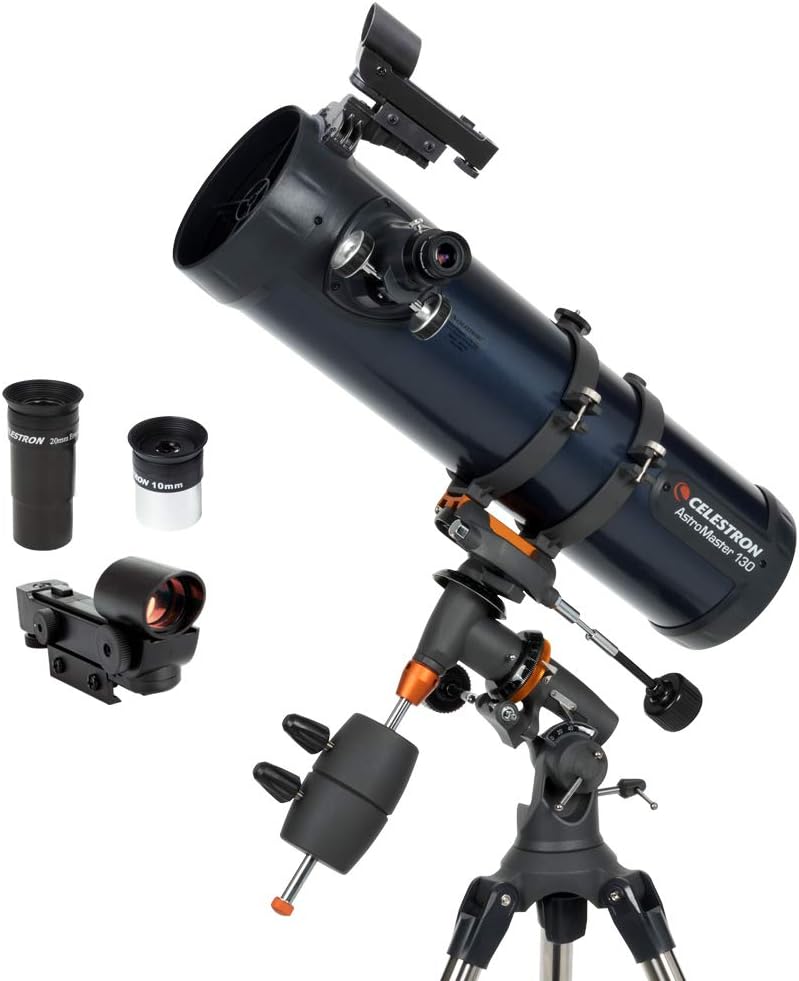
The Celestron AstroMaster 130EQ is a powerful Newtonian reflector telescope featuring a 130mm fully-coated primary mirror and a German Equatorial mount with slow-motion controls for precise celestial tracking. Lightweight and tool-free to set up, it comes with two eyepieces, a StarPointer red dot finderscope, tripod, and free astronomy software, making it ideal for both beginners and seasoned stargazers. Supported by a 2-year warranty from the world’s leading telescope brand, it’s your gateway to stunning night sky exploration.


| Asin | B000MLL6RS |
| Best Sellers Rank | 7,844 in Electronics & Photo (See Top 100 in Electronics & Photo) 15 in Telescopes |
| Box Contents | 20mm eyepiece with built-in erect image corrector, Manual, Optical tube, Red-dot finderscope, Standard 10mm eyepiece, Tripod and mount (preassembled) |
| Brand Name | Celestron |
| Coating | Fully coated lenses |
| Compatible Devices | iPhone, iPad, Android devices |
| Country Of Origin | China |
| Customer Reviews | 4.4 4.4 out of 5 stars (3,439) 4.4 out of 5 stars |
| Dawes Limit | 0.89 Arc Sec |
| Exit Pupil Diameter | 1.44 Millimeters |
| Eye Piece Lens Description | Plossl |
| Field Of View | 0.67 Degrees |
| Finderscope | Straight-Through |
| Focal Length Description | 610 millimeters |
| Focus Type | Manual Focus |
| Global Trade Identification Number | 00050234310451 |
| Item Dimensions D X W X H | 88.9D x 48.3W x 30.5H centimetres |
| Item Weight | 17 Pounds |
| Manufacturer | Celestron |
| Manufacturer Part Number | 31045 |
| Model Name | AstroMaster 130EQ |
| Model Number | 31045 |
| Mount | Equatorial Mount |
| Number Of Batteries | 1 Lithium Metal batteries required. (included) |
| Number Of Items | 1 |
| Number Of Packs | 1 |
| Objective Lens Diameter | 130 Millimetres |
| Optical Tube Length | 552 Millimetres |
| Power Source | Manual |
| Product Features | German Equatorial Mount with Slow-Motion Control Knobs, Permanently Mounted StarPointer, TheSkyX - First Light Edition Astronomy Software |
| Unit Count | 1.0 count |
| Upc | 050234310451 |
| Zoom Ratio | 33x a 65x |
User
Great for first time users
After much searching and investigating I picked this telescope as it had the largest aperture for my price range.It is very well built and was easy to setup and build. The guide is useful, but ended up searching YouTube for a video guide - this also included how to balance the telescope [...]).The telescope itself was supplied with 2 lenses, a 20mm and a 10mm. The 20mm is plastic and I only use it as a starting lens to position the telescope first to what I want to see. The 10mm is a good little lens and give nice view of the stars and moon. I also purchased the 'Celestron AstroMaster Accessory Kit' at the same time - this included lens filters and additional 5mm, 15mm and 2x lenses. This gives more range of magnifications to use with the telescope.Viewing with the telescope is very good. The moon is amazing, but you will NEED a moon filter - it is very bright. You can clearly see the moons of Jupiter and with my additional 5mm lens I can just about make out the markings of Jupiter. As for the other planets they have not been visible in the evenings yet - but can't wait until Saturn appears!The only fault is the StarPointer. It's not that good, but you can work around/with it.I have even had my 4 year old daughter looking at the moon - which she found fascinating as she could see the craters very clearly.Since buying this, I have also contacted Celestron support (issue with the additional lens). They were quick and put me in touch with their local distributor (Hama) in the UK. Hama were also very helpful.All-in-all this is very good for the price it costs. I wanted a good telescope that would allow me to get started in Astronomy, without using it for a short while and having to replace it when I want more. This is a good start and with the right lenses will do for what I want it for. Good quality lenses are not cheap (it's the price of the telescope itself for a set), but I can now slowly upgrade this over time now that I have a decent telescope.
User
Great for a first timer
I think it's always good to give some background info on myself first so if you're in a similar position you know what to think. I'm 18, finishing my A-Levels, about to start an Astrophysics course at Uni and i've not personally used a telescope before.I'd been toying with the idea of buying a telescope for a while, and after Christmas had some spare cash so set out to find one for >£250. I spent weeks researching and contacted friends, teachers and professors about what would be best for my situation. the feedback i essentially got was to buy a Newtonian reflector of minimum this diameter aperture.Being 18 and not wanting to overspend i bought this one. And after a combined usage of about 6 hours i think i can come up with a good review. On the upside: It's easy to assemble regardless of the instructions. I didn't look once and had it together in 20 minutes; it produces a VERY clear image and have seen brilliant detail of objects like the moon, the bands of jupiter and it's moons and more recently the Milky Way; it comes with some good extras such as the two eyepieces. On the downside; it's hard to use at first, the dot finder for example was useless (infact i took it off completely and instead screwed on my point and shoot camera and used the zoom on that to locate what i wanted to see, reduced the time to find, for example, jupiter from 30 minutes to 30 seconds) making it hard to use for beginners although with a few hours practice you'll be fine; it's not particularly transportable, to move all the bits and pieces single handed (i.e. the telescope, the counterweights and the tripod) it takes 3 trips and you need those three trips unless you want to mark every wall in your house and develop a back injury as the combined thing weighs a lot; it's also quite hard to control, the "precision" controls are pretty flimsy and i feel like i'm going to break them, not to mention the fact that you get roughly 4 seconds of visual time on any object before you have to re-align it as the object's drifted away.On the whole i gave it 4 *'s because for it's price it does the job nicely. It's not super expensive (especially here on amazon) which means you get a lot for your money, the concepts are easy to pick up and it gives you the single greatest feeling ever. The first time i saw jupiter for example it made it worth every single penny. So, if you're in the same boat as me. You want something to mess around with a couple of hours a week. And to see something really cool. Look no further, or rather not too much further (see below). For the price this was brilliant and arrived quickly all in one piece (figure of speech).HOWEVER!!!!!There are two MASSIVE things to keep in mind.Firstly, if you are like me, a beginner. You MUST!!!!!!!:1) Buy a light filter too, otherwise you'll see for example the moon for 3 seconds and you'll come away nearly blind. I wouldn't opt for the celstron one amazon recommends, it's ok, but not great. Instead spend the extra pound and get this "Light Blue 1.25" Telescope Filter - (73% transmission)" type it into amazon and you can't miss it2) Don't get this one. The is the 130 EQ, get the 130 EQ-MD, the MD stands for motor drive. Which means that it'll track whatever you're looking at. This means you'll be able to actually look at stuff rather than glimpse it then re-align. This also comes in EXTREMELY handy with astrophotography (see below) as it means you can have longer exposure times. It's worth paying the extra £20 for a better quality stand3) If you're interested in taking pictures using this scope you need to buy a 1" / 1/4" adapter and a T-Ring of your particular brand DSLR camera. This is the easiest way for doing it, as in my experience afocal imaging is hard to do. Although if ALL you want to do is take pictures of stuff, don't bother with a telescope, buy a DSLR camera, a telescopic lense, a stand and an automatic shutter release. It's so much easier to do, and produces just as good pictures as the telescope a lot more easily.And secondlyIf you're not a beginner. Don't buy this telescope at all. This is a good scope, but having seen the quality of a picture taken on a £7000 telescope the price really does matter even at a smaller scale. pay as much as you can afford and i promise you'll be happier with it. Although i can't really advise you much on what to get.
User
Outstanding Customer Service
Firstly, it is very rare I leave a review for anything. However, I just felt I had to give a shout out to Celestron for their outstanding customer service.I have used my Astromaster 130EQ for 9 months or so now and have always been extremely pleased with it. Yes, the provided lenses aren't the best but the telescope is excellent for a beginner. It may be a little too complex for a child but I managed to set it up and use it without any trouble! The barrel is well made and easy to attach to the mount. The tripod is OK but can be a bit shaky if there is some wind. On the whole though. I am more than happy with the tripod for now.I recently had a major problem with the mount however. I went out to use the telescope and the mount completely broke with the telescope on it! Fortunately, I managed to catch the scope before it hit the ground. Obviously, I was a little upset about this as there was no way to fix it. So, I emailed Celestron in the USA and they responded in seconds (and I do mean seconds); unfortunately, they were unable to help due to shear geography. They provided me with the email for the UK branch of the company and I emailed them first thing. Within minutes they had replied, arranged a replacement and shipped it. This was yesterday morning (28/03/22). The new mount was in my hands at lunchtime today!Celestron have been outstanding. They have definitely made a loyal customer out of me and I can't thank them enough for the speed of their response and delivery of the replacement part. A lot of companies could learn a thing or two from them. Awesome company and a decent product for a beginner.
User
Great beginner telescope
This is a great beginner telescope. I only used the kit included (except for a 3x Barlow lens which I bought separately for about £20), nothing else, and got views of Saturn similar to the image attached (which I pulled from the internet to give readers an idea of what you’ll see through the scope). You can faintly make out the cloud stripes of Jupiter (couldn’t see big red spot unfortunately) and the Galilean moons were also visible. On my first try, having never used a telescope before, it took me about 30-40 minutes to find Saturn through the scope. The second night, I found Saturn and Jupiter in 5 minutes.Set up was pretty simple for an adult and took about 20 minutes.If there was anything I could fault at all (and this is small) is that it doesn’t have easily collapsible legs, there is a static plastic tray that must be twisted off before the legs will collapse and putting the tray back on in darkness would be a bit of a pain. It’s not really a problem, but I just wish it was a quick lever to collapse the legs for quick moving, so I can get it through my door or into my car without having to fiddle with a tray. A flexible nylon tray would have done the same job and made transport easier.Other than that, the telescope is perfect for beginners, you won’t be disappointed.EDIT: I bought the Celesteon 2.3mm lens and, without using a Barlow lens, I was able to snap my own picture (the one of Saturn horizontal, not slanted). It still looks better in person as there’s no shakiness blurring the image (the picture was taken on an iPhone 12 by hand, no mount to keep it still)
User
fantastic value for money
I was amazed at the size of this telescope when it arrived, very impressive. One thing to remember, and I have to keep reminding myself is, the price of this telescope. When I grumble at the flimsiness of a couple of the things on it I remind myself how much it cost. As one reviewer has quite rightly pointed out, it can cost this much to buy a tripod. So the five stars is for the value for money. If you want a professional telescope start looking at a couple of thousand plus, not hundred and fifty or so. The quality of the visuals (for the price) are excellent. You get two lenses, a 20mm and a 10mm. Perfectly adequate for starters. I then acquired Orbinar Plossl 30mm eyepiece 31.7mm (1.25")which gives a larger field of view. Great for finding the planet then use one of the others to zoom in on it. The main downside of this level of scope is the ease of use. It is not brilliant for following the orbits, the two cables you use to make the minor adjustments are to be honest, rubbish! They are really flimsy and soon come off (but remember what it cost!). Probably not a good idea to go below 8mm lense on this telescope due to the limitations of this scope. I did buy Celestron AstroMaster Accessory Kit which does seem to fluctuate in price. At the moment it is fifteen pounds more than I paid a couple of weeks ago. In this box you have the filters, a 15mm and 6mm lense plus a 2x power lens. The 6mm lens probably won't get used much but the collection is worth it because to buy the items individually would cost a lot more. I now feel after an outlay of just over two hundred notes that I have all I need to be a novice astronomer!
User
Great price, great starter scope
Like many people, I have a casual interest in the night sky and have often thought about buying a telescope. Last time I checked they cost upwards of £300, so I was very surprised to see one for £130 getting such good reviews.Spurred on by last years series of Stargazing Live, and thanks to the positive reviews on Amazon I took the plunge and purchase this telescope.It arrived well packed in a large box and the tripod feels very solidly constructed. Like many others I had trouble following the printed setup instructions, I would recommend building it near your PC/YouTube enabled TV/with a tablet near by so you can follow the setup video. Once built the tripod is a really good weight and the scope can be attached or removed, it's not permanently fixed. This has been brilliant for the many months I've been unable to use the `scope and have had it stored away ready for clear dark nights.In use I've had hit and miss results. I still need to practice locating objects in the sky, again like others the actual sights seem to be fairly useless when trying to line up objects for viewing. This can be hugely frustrating to begin with and you must be prepared to be very patient in the beginning.However...then you finally manage to lock on to the moon and what an amazing sight it is. OK we've all seen photos on the TV or on PCs, but to look at the moon with the naked eye, then look again through the telescope is a fantastic experience.I'm very much in the early stages of using this telescope, but for the price I would recommend it to anyone thinking of buying one.Keep in mind you may quickly want to purchase some extra lens/filters to maximise your experience. I ended up quickly purchasing Celestron 94303 Telescope Eye Piece and Filter Kit which added an extra £150 to the overall cost, so in the end I spent just over £300. However, you can easily find individual additions if you don't want the full kit.Just remember to wrap up warm, it can be very addictive leading to hours spent out in the cold night time weather.
User
Excellence!
This telescope is magnificent! Im so happy with it that I practically want to use it every night (when nights are clear). It is tough to put the product together at first - my partner helped me which made the job a lot easier. Also, it is not very portable as it is freaking heavy! If you plan on taking it around with you id recommend you go for something smaller. We live in the countryside meaning we often have a beautiful sky during clear nights. If you live bang in the middle of a city, then obviously you will have a lot more difficulty!The images are very sharp and the moon looks stunning. Looking at other stars is great fun although I do recommend you buy a book on stargazing for beginners and a moon filter (note: the moon filter just dims the bright light of the moon - it does not enhance it in any way!).Overall, a superb product that delivers quality. It is intended for use by beginners (which I am) and the stargazing booklet has given me enough information to stargaze for the whole year! it is a great product if you admire the night skies the way they are - do not expect to see planets, alien ships or meteorites everynight as the telescope simply is not suited to see those things!!! :) I hope anyone who buys this product is as happy as I am.Good luck!
User
New to Astronomy
Celestron Astromaster 130EQI purchased the Celestron Astromaster 130EQ as a starter telescope aimed at 'newbie' astronomers. For the price it is an impressive piece of kit. It comes well packaged and is easy to assemble using the picture guide that comes with it. If you get stuck there is a YouTube video to help you.Of course you get what you pay for and the 130EQ has limitations. It is best suited to observing the Moon and planets. Don't expect closeups of deep space objects. Using the telescope takes practise, but on the first evening out we got some great views of the moon.Included in the package is TheSkyX - First Light Edition software. This is a great tool. Input your latitude and longtitude (available from Google World) and TheSkyX will deliver a view of the night sky at any time you choose. It recommends some targets complete with RA and DEC. Great for planning your observing sessions.The two lenses supplied with the 130EQ are just adequate to get you started, but you will soon want to add to them, for example you should purchase a 2x Barlow lens.On the downside there is a major problem with the 130EQ associated with aligning the telescope and finding objects. The problem is the starfinder that comes fitted to the telescope. It contains two concentric rings and a central dot. The dot is illuminated red for use at night. The concentric rings worked well in daylight, but at night they are impossible to see and aligning the red dot with a star is near impossible. For novice users this finder is a source of frustration and would put off all but the most dogged new astronomer. I wonder how many people have given up on the hobby because of this cheap piece of optical engineering. Celestron should ditch it and do better. However, there is a simple and cheap solution - the Telrad Refex Finder. An oversized, odd looking device (costing around £35) that works superbly well. It has three illuminated target rings. Point the Telrad at a star and bingo it appears in the center of your eyepiece. I love the Telrad. It makes the 130EQ usable.In summary the 130EQ is a mixed bag. I would recommend this telescope to those people with a budding interest in astronomy or those with a casual interest in the near objects of the solar system. If the interest survives a year or so of using the 130EQ there are plenty of motorised and computerised Goto telescopes (costing many times more than the 130EQ) to take you forward. The Celestron Astromaster 130EQ does little to solve the two biggest challenges for inexperienced astronomers - aligning the telescope and finding objects. The poor finder means that I can only give it 3 Stars. Fit a Telrad and get some better quality eyepieces and it becomes a 4 Star telescope.
User
Alın ve uzay macerası yaşayın.
Çok iyi bir teleskop. Başlangıç için 50AZ modelini almıştım ama arasında çok fark var. Andromeda, jüpiter, saturn ve niceleri telefonumda var ama "AMAZON TÜRKİYEDE RESİMLERİ AÇSA GÖSTERECEM!" Eğer çok üst segment alıp para basmayacam diyorsanız ideal. Çok ekmeğini de yedim ürünün ;) 2 eksisi var el ile taşınmaz çok ağır. Ekstra lens alıp geliştirmek lazım. Jüpiterin 2 büyük çizgisi ve büyük kırmızı gözü lens yardımı ile gözüküyor. Ayrıca fotozeynep ile 1 günde kapınızda.
User
An out of the world experience
Amazing is just not enough to describe what you see and feel looking through the eyepiece.Venus was my first stop, "wow" was the word that came out when the image got focussed for the first time. I could see the phases of venus with just the 20mm eyepiece. 10mm made the image a bigger one and astonishing.Moon was playing hide and seek with the clouds but when it was well above the horizon and shining brightly, I was spell bound with its beauty. Honestly you could spend hours just looking at the moon. 10mm eyepiece gave an even closer look at the Carter's, the shadows casted by the craters and the mountain ranges on the moon.Jupiter looks like a 2mm ball with very faint bands of methane distinguishable if observed for longer durations. The four moons of Jupiter are just a very minute dots if observed very minutely. But I felty it requires more magnification power to observe Jupiter with it's methane bands and the giant red spot. (May be collimation issue is there)Couldnot see the most beautiful planet Saturn as clouds came in hope to see it when conditions are perfect.These were my first experience of amature astronomy with my first telescope.I don't write reviews at all but this Celestron Astromaster 130eq is such amazing piece that it made me to write such a review. Though there are some points which I would like to list to get the most out of the telescope.1. Lots of patience is required to be able to see what you actually want to see, trust me patience will give you all that you want from this telescope.2. Try to see the videos and go through the instructions manual before beginning assembly of the telescope as it's quite critical for one who has no idea of any such kind before.3. Lot of things has to go right to get the perfect views, if not getting the perfect view wait for the perfect condition to occur.4. The equatorial mount is very heavy and of solid built quality but the pointers are just not right and you can't be sure which degree u are setting on it.5. The tripod is also of heavy construction but if expanded fully it feels more shakey so I don't expand it.6. The secondary mirror was dangling loose when I first unpacked the telescope which totally dishearted me but I did manual collimation as per the instructions manual provided and it was fairly accurate but will eventually require a lazer collimation which again costs around Rs 6000/- to get more sharper images.7. The telescope is very heavy (around 16kgs) and very difficult to move it around in assembled condition. It gave me body pains the next morning after my first setup and observations.8. There are no cromatic abbrations as it is relfector telescope and the optics are of very good qualityThose who are still reading this review and disheartened because I didn't post any pictures of moon or Jupiter for them I just want to tell that pictures just don't do justice to what you can actually see with your naked eye because human eye has 1000 times better dynamic range than any camera. Even I have gone through all the pictures posted in the other reviews. Trust me you are going to see 1000 times better with your naked eye that any of those pictures.If you want to go for this telescope go for it without any hesitation as it will finally give you and out of the world experience.
User
Excelente qualidade - Vale cada centavo
É bem preciso na busca de planetas quando se regula bem a buscadora. As lentes que vem nele é de altíssima qualidade e só fica "devendo" uma barlow para aumentar o zoom.- Antes de comprar, é importante saber a latitude e longitude da sua localidade.- Se vai comprar, compre uma barlow também. Respeitando a capacidade do telescópio- Zoom real máximo é de 260x (sem aberrações nas imagens)- Para ver a lua, fica muito bom com o filtro lunar e as lentes de 10mm e 20mm dão e sobram- A regulagem precisa é muito boa- Se for fazer imagens/vídeos, recomendo um suporte para celular ou câmera DSL
User
unable to see any thing
not usable
User
Worth the extra cost over the Powerseeker 127EQ
Tried the Powerseeker 127EQ first and was only acceptable. Then I bought the Astromaster 130EQ and found it to be a fine quality sharp image excellent Reflector Telescope. You should be prepared to learn a bunch before feeling accustomed to this Reflector but you will be rewarded for your efforts. A laser collimator is a must to check, and if necessary, realign the mirrors, known as Collimating. I spent some time learning how to collimate this Scope, or align the mirrors and I devised an additional step in the beginning as I am a former technical writer.First, making sure the laser Collimator is NOT in the focuser tube and is definitely OFF, stand a few feet in front of the opening or aperture of the telescope and look into the opening where you will see the cross frame in front, the mirror in the back, and the reflection of the front cross frame in the back mirror. Then slowly and carefully concentrate on what you see and move your view slowly so the mirror and reflection of the cross frame appear centered within each other and the telescope tube. The point is to confirm that the main mirror is perpendicular to the axis of the tube such that all parts viewed appear to be all centered or concentric with each other. If looking straight down the tube center, you see the reflection of the secondary mirror frame up front off center and offset from the actual frame up front, then carefully adjust the primary mirror in back so everything looks aligned. That means the back mirror reflection of the front cross frame should be aligned behind the frame when looking absolutely down the center of the tube and the mirrors appear correctly centered. After you have assured a nearly aligned primary mirror when viewed from the front, then you can proceed to install the laser collimator into the eyepiece focuser with the indicator target pointing forward as the telescope does. Turn on the laser and DO NOT LOOK into the front of the telescope until you are done and the laser is out and OFF. Slowly adjust the secondary mirror up front carefully and slowly loosening and tightening very delicately each of the three screws until the laser dot is centered on the target. Remember to very delicately loosen and tighten the screws slowly and in steps between the three until you become accustomed to how the adjustments affect the laser dot on the target.Once you have centered the dot on the target adjusting the secondary mirror up front, then TURN OFF the laser and rotate the laser Collimator in the focuser tube such that the target opening is facing the back of the Telescope where the primary mirror is. Turn on the laser and observe the laser dot on or near the target. The dot should be centered in the target and likely will be close or off towards the outer part of the target. Very carefully loosen the locking phillip screws of the back large primary mirror to allow further adjustment with the larger knurled knobs that adjust the mirror. Very slowly adjust one knob at a time while you become accustomed to the results of each adjustment as they affect the movement of the laser light dot on the target of the collimator. Do this all slowly until you gradually learn the tricks to collimate. Do not make big adjustments to the primary mirror unless you have to. When done, turn OFF the laser collimator and remove it from the focusing tube. Once again, DO NOT look at the laser beam or the front of the telescope while the laser is in use.Now that the eyepiece focuser tube is open, look in the tube and you should see a reflection of your eye's pupil in the center of the small secondary mirror and mirrors and cross frame should all look centered upon each other or concentric.NEVER LOOK AT THE LASER BEAM END, ONLY THE DOT ON THE TARGET WHEN IT IS INSTALLED IN THE TELESCOPE.A laser collimator really is a must for easy collimation testing before each use of the telescope and especially after transporting the telescope as vibrations may change mirror alignment or collimation.I highly recommend pointing the telescope horizontal during mirror collimation outdoors as the laser light may be considered offensive by planes with resulting complaints and possible law actions. I collimate indoors.DANGER; never look at the laser beam as eye damage can result. Only look at the light dot on the target when the collimator is installed in the telescope. The laser collimators are very low power but safety practices should always be a way of life.In actual use, I just barely saw the cluster of galaxies between Virgo and Leo on a dark night near the new moon and gladly told myself it was worth the money and effort to have seen the dim but visible galaxies with the fuzzy center nuclei of stars. Dark conditions and eyes adjusted to the dark are necessary.I also viewed Jupiter and five of it's moons in very good detail on a marginal seeing night. The planet was actually too bright and required a filter to lower the the brightness and improve contrast. For the price, it is an excellent light gatherer. I also have a Powerseeker 80EQ Refractor that exhibits very clear images.The Telescope paid for itself when I could see deep space distant galaxies. That is a result of the larger light gathering ability of the Reflector.I recommend Dean Fuller's video on YOU TUBE on how to operate an equatorial mount and polar align for beginners. It was faster and easier to understand than the written instructions.
Trustpilot
3 weeks ago
5 days ago