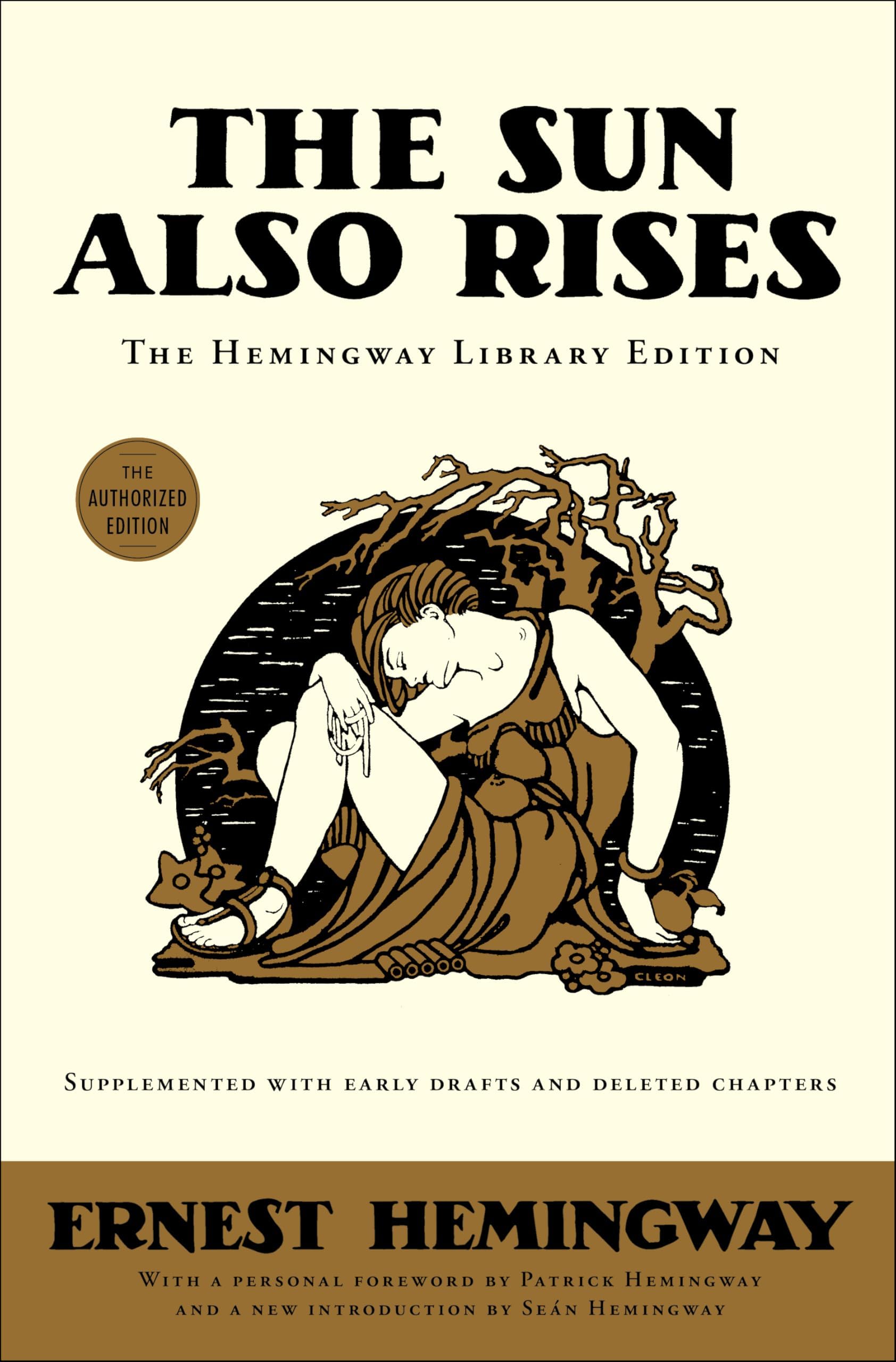
The Sun Also Rises
Product ID: 502599228
Desertcart purchases this item on your behalf and handles shipping, customs, and support to Tunisia.
Buy The Sun Also Rises by Hemingway, Ernest online on desertcart.ae at best prices. ✓ Fast and free shipping ✓ free returns ✓ cash on delivery available on eligible purchase. Review: Good - Great classic ood Review: وصلني الكتاب في الوقت لكن تفاجئت بأن غلاف الكتاب وصل ممزقًا. عليه فإنني اطالب بتعويضي عن الضرر الذي لحق بالكتاب نسخة اخرى
| Best Sellers Rank | #204 in War Fiction #378 in Historical Fiction #567 in Classic Literature & Fiction |
| Customer reviews | 4.4 4.4 out of 5 stars (1,966) |
| Dimensions | 15.56 x 2.79 x 23.5 cm |
| Edition | Hemingway Library ed. |
| ISBN-10 | 1476739951 |
| ISBN-13 | 978-1476739953 |
| Item weight | 612 g |
| Language | English |
| Print length | 320 pages |
| Publication date | 15 July 2014 |
| Publisher | Scribner |
S**L
Good
Great classic ood
F**A
وصلني الكتاب في الوقت لكن تفاجئت بأن غلاف الكتاب وصل ممزقًا. عليه فإنني اطالب بتعويضي عن الضرر الذي لحق بالكتاب نسخة اخرى
C**D
There is no point to reading Hemingway, particularly The Sun Also Rises, if you are looking merely for entertainment. The entire book is a denouncement of people who seek only entertainment and purposefully tries to exclude you from enjoying the book. Just don't read it if you read only for entertainment - you're already part of the Lost Generation, if that's what you're doing because, while you can deny it, that's you he is trying to capture in those dissolute spectators of the bullfight. They don't fight, they drink. In your case, reading is the same as drinking - a way to escape and be entertained. Hemingway and the proprietor of the bullfighter's hotel don't want you there. Go home. You're ruining it, he says. Hemingway saw that people were not, as he had been taught as a child, becoming more and more capable of enjoying and producing peace and beauty. This was only true if you kept your head in the sand and tried to live in the suburbs. Hemingway's father had not yet shot himself, but his wife's father had - and he knew that, even in Midwestern America, the truth of life's very harsh realities could creep in. He adores the Spanish for maintaining a culture that permits the age old practice of tauromachia, bullfighting. It keeps people's heads on straight. It does not allow them to be ostriches. It is only natural that young Americans, raised to believe that the world is mostly entertainment and mostly constructed for their own enjoyment, would be drawn to a grittier cultural event - even if only briefly. The truly alive, though, become aficionados (in the Spanish sense) of the fights. They open their eyes to everything, particularly the specter of their own death. Is it possible to enjoy contemplating death? One's own death? If you don't think it's possible, then this book is probably not for you. It is nothing like a horror story, it is not fake death made momentarily into an adrenalin rush, from which you can hide your face (you can hide your face while at the bullfights; you cannot hide from death itself). Hemingway was born in 1899, just 4 years after certain historians had proclaimed the Closing of the American West (meaning: subduing of the last of the hunter-gatherer tribes and the complete expansion of "traditional American values" into the entire North American continent. He was raised with notions similar to what parents seem to want for their kids today, ideas about family life going well, everyone being happy, no drinking problems, no one acting out sexually, everyone gender-normal, and so on. Yet, he knew it wasn't so. He knew that humans are humans and there was nothing new under the sun. Only men were sent into combat, young men with ideals in the case of World War I. Hemingway wants to capture the "Riau Riau" mindset that allows men, in a trancelike state, to rise up out of the trenches and charge forward while either being blown to bits or having other people's bits end up on your body (as happened to him). We are not going to live forever, are we? So why die as cowards? Die as a hero! We don't push the heroism meme as much as it was pushed prior to World War I or World War II. We sort of gave up on that - perhaps in the 60's. Hemingway was part of the extinction of this kind of hero. Oh, people still invent games for themselves in which they travel, play sports, climb mountains, run marathons and so on, to still be "heroes" but without killing anything. We don't want heroism associated with killing or dying for a cause and yet, in all of human history, there it is still. People in Kiev (right or wrong) deciding to advance against the police and getting themselves shot - with others watching. People finding that even a shot to the leg isn't a good thing, and doesn't feel as heroic as it felt just a few minutes earlier, while preparing to advance on the enemy. People love having enemies, but the fact that for most 21st century American (and other Anglophone) readers, the "enemies" are now either things like evil corporations or the other people's rugby team, makes the world rather different. In Hemingway's time, a huge war had just been fought, with people (much like oneself, by the way) as the real and true enemy. Germans had been part of the European community, just across the border from France, and now they were the enemy. Russia, once an ally, got itself a separate peace (and saved a bunch of Russians from being killed). Real people were killing real people with greater efficiency than ever before. But why? Because people, men in particular, are designed this way. They get into groups, worked up into various frenzies, and stuff happens. Cultures that can channel the "stuff" into the bullring, well, perhaps that's a partial solution. Perhaps not (Hemingway will consider that in For Whom the Bell Tolls). Perhaps the bullring is merely a way of keeping people perpetually ready to rise up in violence and die for a cause. Maybe that's what all sports do (the ones that are true sports, Hemingway might say - he hated tennis). If you are reading this book cold, you will probably have the reactions of many others (see the 3 star and lower reviews). I strongly suggest you read two volumes of Michael Reynolds's biography of Hemingway (the first two: Young Hemingway and the Paris Years). Read Paul Fussell's The Great War in Modern Memory before reading The Sun Also Rises. Don't just watch war movies, you will turn yourself into the very kind of reader that Hemingway is scathingly trying to insult. Remember, Hemingway was trying to needle and agitate people who may be just like you or me, people who sit at home reading and have not been in the trenches, people who don't go to bullfights. How would he feel about modern audiences, with all the vegans and vegetarians and animal rights people within them? I think he would say that while the ambition is noble, that the understanding of the killing is more important than ever. If you are going to save animals (including people), you must understand human nature and human history. Human nature, on the ground, in all its somewhat eccentric and boring detail, must be at least noticed, and if possible, understood. Even changed. When I first read The Sun, I deplored what I thought was the glorification of bullfighting and the cult of machismo. I was quite young and did not know much about the world then. I thought I would never read it again. When I read it the second time, I knew a lot more about Hemingway and I had read some of the 5 star reviews here. I realized I'd missed the whole point (and it isn't just about the symbolism - I got that part). Now, reading it again, slowly, a third time (because I am interested in understanding the craft of writing - so much is known about Hemingway's processes, reading it again with that information in mind is quite a new read), I realize that the intense literary criticism brought to bear on Hemingway, as well as his public persona, make this book completely amazing. It is a touchstone for not just one generation, but for almost a century's worth of modern readers. It changed how movies were made, it changed how people talked about reality. Because once upon a time, people simply ignored the "black sheep" in every family, until they were piled up so high that someone had to notice that there were more black sheep than white sheep. The entire symbology of this black sheep/white sheep business had to be thrown over. Well brought up and well-to-do people were behaving outside of the standards of puritanical Christendom. Oh no. What to do? What to say? There were gay people! And women who liked sex! And people who had affairs! And prostitutes! And alcohol! (Even during prohibition!!!) Did the puritanical beliefs fail to take hold because the people were flawed? Or were the beliefs flawed? Or had anyone ever really believed them? I think Hemingway leads us down many trails in answering these questions. He keeps his own cards close to his chest (he loved pictures of poker players and throwing dice; he spent money he didn't have on a painting of dice throwing by Masson). He knows that his parents seem to be "true believers" in the middle class, Midwestern ethos (he knows they will disapprove of the characters in the book, as so many readers here still do). He doesn't know, yet, that his father will shoot himself (and that two of his siblings will also be suicides). But he knows there's something amiss with the whole thing and in the end, prefers to slip back in time, and to another culture, to the corridas and the ancient dance with the bull. He knows that near Pamplona, some of the earliest art in the world depicts a human conception of a bull as powerful - but also the entire point of the Hunt. Even Hemingway, though, cannot make the actual bullfighter the protagonist of the novel, even if he intended him to be the Hero. Hemingway is too modern, himself, too much of a spectator to be a bullfighter - or, as he seems to say in The Sun, even a true aficionado. Without true love for something, we are lost. The entire generation was lost, it had lost the possibility of true love. He thought he loved Hadley, during the period depicted in The Sun and in the period when he was writing it, he became painfully aware that he no longer loved Hadley in the same way - he had another "true love." He did not want to admit, ever, that he had lost the capability of loving truly, which is why he tried to capture the minutiae of how love is born and how it dies. By becoming expert on this subject of love (Lady Brett is certainly loved in many different ways, all of them "true"), Hemingway hopes not to be lost. Many of his other themes are lost on today's readers, though, because we have all but given up on the notions of masculinity and femininity that Hemingway was steeped in (as was the next generation after him, and the one after that - the ones who fought in World War II; they still had those same notions); we have given up on the touchstone of extreme competition as an inherent value (we give ribbons and trophies to all the kids who "compete" in our suburban children's leagues). Showing people drunk or otherwise intoxicated is a commonplace (Jersey Shores, anyone?) and no one is shocked - in fact, they are apparently amused and entertained. Perhaps that's why that aspect of the book seems relatively boring. Finally, Hemingway doesn't want you to spectate. He purposefully took out interior monologues, bits about what people were thinking, many of the "explanations" of the action. He had this perverse idea that you, the reader, are supposed to be actively engaged - using your imagination. He was showing you exactly what happened. What did it mean? You are supposed to stop and think about it, imagine it. This book is a great one to read aloud with a significant other or older kids. We don't know a single family, anywhere, who doesn't have some of these people in them. In our neighborhood, there are drug addicts, 12 steppers, homeless people who apparently have wandered away from any sort of family - all kinds of "lost" people. Is your world really that different? If so, it will be changing soon. There is no where on the planet where a thinking person can live and not encounter the problems of death, destruction, unrequited loves and all that Hemingway scrupulously describes. But it is a literary description, not a self-help book. He provides no answers and he didn't intend to be uplifting.
G**I
I have some problems to find a cheaper edition of this masterpiece. This novel is art, life and passion. ITA: Non riuscivo a trovare l'edizione in lingua originale di questo capolavoro, ma finalmente ce l'ho fatto. Il libro non credo necessiti spiegazioni: se non l'avete letto, compratelo. Soprattutto se avete fatto viaggi recenti tra Parigi e Pamplona
S**A
Truly Hemingway. A very good read.
M**S
de la vida europea de la posguerra. Hemingway tiene una manera muy propia para involucrarte con sus protagonistas que convierte esta lectura en algo bastante entretenido y ligero a pesar de la temática. Si no has tenido la oportunidad de acercarte a su obra, esta es una buena introducción.
I**S
I finished this novel for the second time last night and felt compelled to write my first Hemingway review. I’ve been reading Hemingway for over 20 years, starting with For Whom The Bell Tolls in the mid-nineties, followed by the Old Man and the Sea on a trip to Cuba in 2001, where I visited the hotel that Hemingway stayed at before he bought his own place, and the two famous bars where he spent his days, the Floridita and the Bodegita del Medio. I’ve also read A Farewell to Arms and the complete short stories. Enough of that. The problem with Hemingway is he began his writing career in the 1920s when anti-Semitism and the use of the N word were acceptable, if not respectable. To be fair to Hemingway, in this novel the N word is only used when a character recounts a sympathetic anecdote about an African American boxer in dire straits in Vienna. However, the anti-Semitism is rife among several characters, and although the narrator is friends with Robert Cohn, the Jew in the novel, and is not overtly anti-Semitic himself, he doesn’t challenge the anti-Semitism of the other characters, which is a way of implying that it’s “OK”. This problem isn’t unique to Hemingway, and if we burned all the books that contain offensive references to women, Jews, gay people, Black people, an Amazon warehouseful of literature would go up in smoke. Yes, there are bits of this novel that make me wince, but I’ve found that’s the case with a great many books from this era, particularly American books. I read The Big Sleep and The Maltese Falcon a couple of years ago, after seeing both films a dozen times, and the novels both came out as surprisingly homophobic. Only after reading the novels did I detect traces of homophobia in the films (it had all gone over my head previously). The novel is about a group of American, English and Scottish ex-pats living in Paris in the 1920s. They are the “lost generation” who survived the Great War and are trying to rebuild their lives in exile with copious amounts of alcohol. It’s summer and they all decide to go down to Pamplona, Spain, for the fiesta. The narrator Jake Barnes and his mate Bill go first. They’re mad on fishing and bullfighting, so they go down to Spain and fish for trout for a few days and organise tickets for the bullfights that form the main attraction of the fiesta. The others come down later: the aristocratic Englishwoman, Lady Brett Ashley, and her Scottish fiancé, Mike Campbell, and the misfit, Robert Cohn, who has ditched his partner because he’s fallen for Brett. The fiesta presents opportunities for more drinking even than Paris, followed by conflict and violence as the group disintegrates. For me, there are two things that save Hemingway from the pyre: first, that over time his politics improved and he was on the right side of history in the Spanish Civil War and the Cuban Revolution. The second is the quality of his writing. All the stuff about hunting, fishing and bullfighting might seem overly macho and distasteful today, but it’s the way Hemingway writes about these things. His style seems so simple and direct – sometimes “manly” in the worst sense of the word – but underneath there is pounding emotion. This passage refers to a bull goring a bystander as it’s taken to the bullring. Later, a matador kills it in the ring and presents its ear to the novel’s heroine, Brett Ashley, who slept with him the previous night and the night after the bullfight: “The bull who killed Vicente Girones was named Bocanegra, was Number 118 of the bull-breeding establishment of Sanchez Taberno, and was killed by Pedro Romero as the third bull of that same afternoon. His ear was cut by popular acclamation and given to Pedro Romero, who, in turn, gave it to Brett, who wrapped it in a handkerchief belonging to myself, and left both ear and handkerchief, along with a number of Muratti cigarette-stubs, shoved far back in the drawer of the bed-table that stood beside her bed in the Hotel Montoya, in Pamplona.” One of the most remarkable things about this novel is that we have an impotent male narrator (result of a war wound) and a heroine who sleeps with three different men in the novel (one is her fiancé, the other two aren’t). Sexual power transferred from male to female. Difficult to explain for a writer who’s often dismissed as a misogynist. There’s no condemnation of Brett and you’re left with the feeling that she’s going to go on doing what she enjoys, whereas in too many novels by men women who like sex come to a bad end. Here’s another example where the narrator and his companions are watching a dance at a fiesta: “In front of us on a clear part of the street a company of boys were dancing. The steps were very intricate and their faces were intent and concentrated. They all looked down while they danced. Their rope-soled shoes tapped and spatted on the pavement. The toes touched. The balls of the feet touched. Then the music broke wildly and the step was finished and they were all dancing up the street.” The artistry here is in what’s not said. We don’t have a detailed description of what they were wearing or the moves of the dance. Hemingway focuses on their faces and feet, and even with my limited imagination I can see those dancers in front of me now. So, despite my misgivings about the N word and the anti-Semitism, I’m giving this book five stars. If you think you’ll be offended, don’t buy it; but if you want to see what made Hemingway such a brilliant story teller, take a punt.
Trustpilot
2 weeks ago
2 days ago