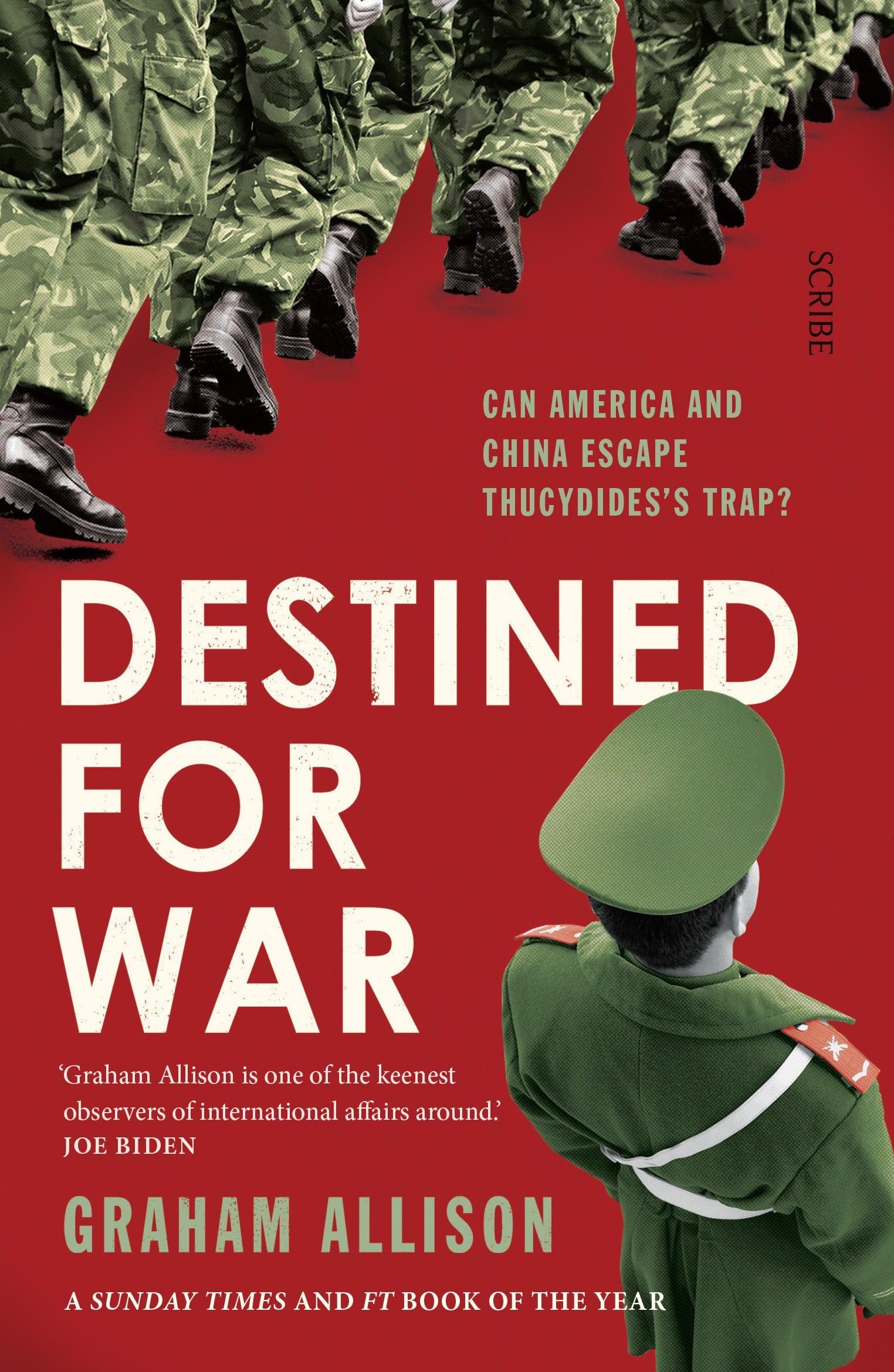
Scribe Publications Destined for War: can America and China escape Thucydides’ Trap?
Desertcart purchases this item on your behalf and handles shipping, customs, and support to Tunisia.
Description
A Sunday Times and FT Book of the Year When a rising power threatens to displace a ruling one, the most likely outcome is war. In this razor-sharp analysis, Harvard scholar Graham Allison examines the phenomenon known as Thucydides’s Trap, which is currently playing out between the world’s two biggest superpowers: the US and China. Through uncanny historical parallels, Destined for War shows how close we are to the unthinkable. Yet, stressing that war is not inevitable, Allison also reveals how clashing powers have kept the peace in the past ― and what painful steps international leaders can and must take to avoid disaster.
Specifications
| Dimensions | 12.9 x 2.3 x 19.8 cm |
| Edition | B format |
| Isbn 10 | 1911617303 |
| Isbn 13 | 978-1911617303 |
| Item Weight | 1.05 Kilograms |
| Language | English |
| Print Length | 384 pages |
| Publication Date | 13 September 2018 |
| Publisher | Scribe Publications |
Reviews
User
うん
Great
User
Must read for all to understand the present predicament.
For all the 'liberals' and so called 'global citizens'. It will make them understand why ethnic nationalism has triumphed civic nationalism and will also in the future.
User
Used but great
I have just recieved the book. It's used but in a very good condition.
User
Great book on big conflicts throughout history
Graham Allison vividly tells us not only about the US/Chinese Rivalvry, but also about the ones which have greatly influenced our modern day world. Using Thucydides Trap to explain "great power conflict" in the past but also the present is an interesting perspective worth keeping in mind, when looking at the conflicts of any century... and the ones to come.
User
Makes an interesting and valuable contribution
Back in 2014, in Strategic Reassurance and Resolve, which also examined the relationship between the US and China, authors Steinberg and O’Hanlon cited Thucydides’s assertion, in his History Of The Peloponnesian War, that as Athens grew and challenged the power of Sparta, war between the two was “inevitable”. Graham Allison, in Destined For War, examines the same relationship through the prism of the same assertion, but here gives the phenomenon a name, Thucydides’s Trap. (Steinberg and O’Hanlon, incidentally, do not get a mention.)Allison, like Steinberg and O’Hanlon, does not, in fact, consider war between China and the US as anything like inevitable. Indeed, his opinion is that Thucydides himself did not believe war between the Greek superpowers two-and-a-half millennia ago was inevitable either. War between such incumbent and rising superpowers is, however, a distinct possibility, particularly, as he and the other authors point out, given the possibility of misunderstandings related to each other’s actions. Both books, taking slightly different routes, conclude that, provided both sides clearly signal their intentions, all should be well, at least in terms of avoiding nuclear conflagration. They also need to make every effort to understand each other’s diverse philosophical grounding. I found the earlier book more satisfactory in the way it arrived at this conclusion, avoiding getting stuck in the mire of Huntington’s Clash of Civilisations and instead getting to the point that China’s and the US’s tacit strategies are both based on rationality and a desire to prolong humanity’s existence on the planet, albeit possibly under different political systems. Allison, unfortunately, falls into Huntington’s Trap, with the result that he gives the appearance at least of “othering” the Chinese, always a formula for disaster, and he never, from my point of view, really wriggles out.Others of his chosen bedfellows I similarly disagree with. As I hinted in my review of his 2014 opus World Order, I find Kissinger, whom Allison cites with reverence, a less than credible source of advice. He’s just the gorilla in the room that can’t be ignored. Ditto, though to a lesser extent, Paul Kennedy who, a quarter century ago, made the same mistake with Japan as some are making with China in extrapolating a period of meteoric growth to infinity, overtaking the US economically along the way, without fully taking into account the many potential pitfalls along the way. It is not that I don’t believe in the possibility of the continuation of Chinese growth – find it, indeed, desirable given, as Allison points out, that the country has raised more than half a billion people out of poverty since 1981 - just that I consider it to be as “inevitable” as nuclear war. In fairness, though, Allison himself acknowledges the perils of extrapolation in citing a prediction in 1964 by none other than Paul Samuelson that by the mid-1980s Soviet GNP would have overtaken that of the US. The future certainly ain’t what it used to be.Nevertheless, in the majority his analysis is generally useful, and a few things stand out as particularly valuable.First, he provides an account of instances of Thucydides’s Trap over the past half millennium, analysing why they qualify and why some resulted in war and some, fortunately, did not; though the avoidance of war applies only to four of the sixteen cases, one of those involved the rivalry between the US and USSR, which could have resulted in destruction for us all, and the examination of why war was avoided in this case probably has the most potential worth. Secondly, he outlines some of the conditions under which war could break out, most notably those instances in which there are miscalculations or misunderstandings. Topically, he mentions Korea in this context. (If Trump were to follow through with his threats to North Korea, China would without doubt see that as a provocation and threat, with currently unknown consequences.) Additionally, though by no means lastly, Allison gives an overview of Thucydides’s history that is a worthy contender as an Introduction to a future edition of the book. (The Intro to the current Penguin edition, for example, is nowhere near as good or relevant.)The Appendix of case studies, in which are given brief overviews of the sixteen examples of Thucydides’s Trap over the past 500 years, is worth particular mention, as I suspect many readers will find these enlightening in their own right. One of the startling features of this is the characterisation of Britain’s “Glorious Revolution” as unequivocally a Dutch invasion; I’ve only ever seen this as a tentative suggestion once before, by Simon Schama, and it’s a definite challenge to the British 1066 mentality. Perhaps most thought-provoking, however, is the notion of a Trap involving Britain and France on one side and Germany on the other, stretching back to the 1990s. Though Allison does not say so himself, the outcome of this particular rivalry, it appears, is that the British electorate has abandoned the fight through its vote to leave the EU, whilst France, through Macron, has allied more closely with Germany in the face of uncertainty over not only the outcome of Brexit but also that of Trump’s often capricious statements.Trump’s presidency itself raises a big question mark over the whole enterprise of avoiding war and maintaining US hegemony, and here I think Allison gives him way too soft a ride. As he withdraws from agreements such as TTP and the Paris Accord on climate, Trump is also losing the US an awful lot of good will. Flawed as it was, TTP represented a means by which the US could gain influence in East Asia. The vacuum is now likely to be filled by China. Similarly, with Xi Jinping continuing China’s commitment to the Paris Accord, the US as a nation has been absented from the process, which on a national-diplomatic level at least (many US enterprises and a number of individual states have pledged to continue to use the Accord as a benchmark) will only serve to isolate it. Joseph Nye, who is mentioned twice – one of those in a footnote - would have been worth a third reference for his concept of soft power in this context. (Incidentally, I did find it somewhat laughable that Allison, apparently without irony, could claim that all Americans were proud that anyone can become an American citizen. Some of them sure have a strange way of showing that.)Ultimately, although to some extent the two books are complementary, not in competition, I found Steinberg and O’Hanlon’s more useful. However, Allison’s is without doubt worth a look, for the case studies if nothing else, but also for his Intro to Thucydides’s History.
Common Questions
Trustpilot