Description
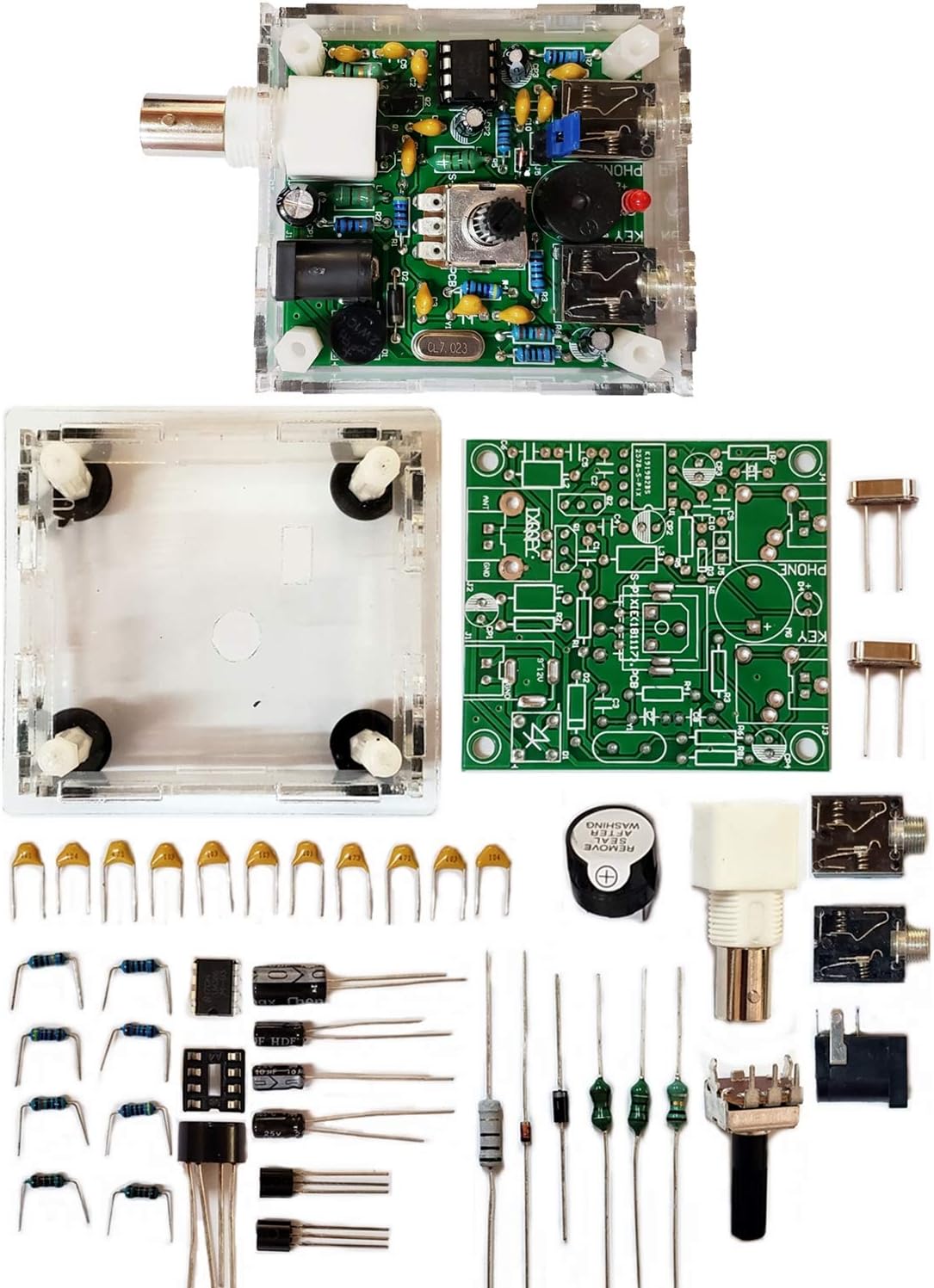
- "Pixie" is mini of the 40 metre band simple micro-power amplitude telegraph transceiver, 9 ~ 13.8V DC power supply
- Resistance to change is a horizontal packaging vertical packaging, easy to solve the short circuit resistance has long been a problem.
- Power input does not distinguish between positive and negative, and to improve the power supply area, the user can easily use 13.8V communication power supply, and do not worry about the positive and negative reverse losses.
- Raise the transmitter side when the buzzer sound prompts (using a shielding noise of the jumper cap), an increase in the LED lights as a transmitter prompt.
- You will receive the balun kits with the instructions (English language not guaranteed). Or please contact the seller for the PDF instructions. Enjoy.Thx
Power supply: DC9~13.8V (recommended linear power supply or battery), does not distinguish between positive and negative Antenna: 50 Ohm, 7 MHz, VSWR 2.0 or less. Reception standby current: 20 mA. Emission current: 120 mA. Transmission power: 1.2 W. Frequency: the oscillator frequency emission; reception of local oscillator frequency. Mode: CW. Button: manual button. Automatic transmitter: not supported. Sidetone: none. The circuit principle: See wiring diagrams: with the surrounding elements forming a typical Colpitts-oscillator and remaining oscillating (it has about 1mW when receiving an oscillating signal leak), the LO signal is directly coupled to the capacitor 8050. In the transmitting state (keystroke), 8050 as the C-class amplifier, the signal is amplified by capacitive 100nF coupling to the type 3 low-bass filter, and then send the antenna; in the receiving state (key release), and around 9018 elements forming the beat oscillator (BFO), 1. N40001 Plus high voltage, DC with capacitive pressure is increased. At both ends decreases, the natural frequency can be increased to about 0-3 kHz, can easily receive signals of 7.023 MHz clock. 8050 is biased in the nonlinear range (the transistor is then two diodes back to back), and the signal received by the antenna BFO signal for mixing, mixing the audio signals obtained by coupling to the 0.1uF capacitor form LM386 audio power amplifier, audio signal amplified by LM386 1.5 m 1.5m 0uF capacitor blocking evacuation headphones key not only control the LM386 power on off switch is also pre-loaded Varactor D2, so that volume changes in different states.
Review: A right of passage for Amateur Radio afficianados ! - Fun, inexpensive little kit that anyone who is interested in radio communications should build and enjoy. Although there is very little included in the way of instruction, there is enough documentation online to complete it easily. All the parts were of decent quality and the Lexan box gives it a bit more of a finished looked.
Review: Great little CW Transceiver for training. - This is a fun little project to build a 1 watt QRP CW transceiver. The kit is well designed and the build instructions are easy to follow. The case is well made and fits like a glove. It comes with two crystals so you can choose which frequency you would like to transmit on. I now have an inexpensive unit to practice my CW skills. It is surely a low cost tool to help you learn morse code. 73 W4WQC.