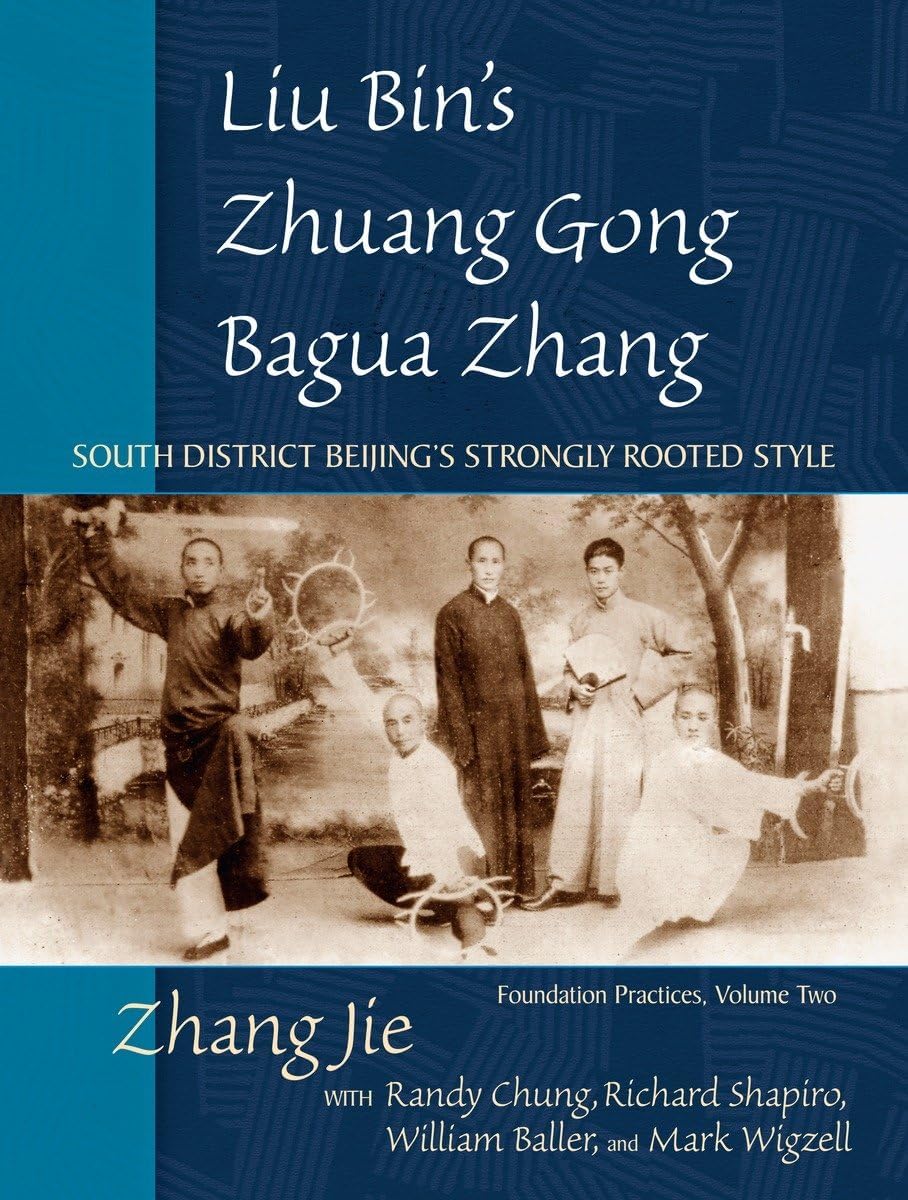
Liu Bin's Zhuang Gong Bagua Zhang, Volume Two: South District Beijing's Strongly Rooted Style
Product ID: 7670154
In volume 2 of Liu Bin's Zhuang Gong Bagua Zhang , Professor Zhang Jie documents the style of Bagua Zhang developed by Liu Bin, one of Cheng Ting Hua's top students. Professor Zhang became a disciple in this tradition in 1979, apprenticing under the well-known expert Liu Xing Han in Beijing. He was carefully trained for many years, practicing Bagua's circle-walking techniques under the trees of Temple of Heaven park—the same place where Dong Hai Quan, Cheng Ting Hua, and many other masters used to train. A two-volume series, Liu Bin's Zhuang Gong Bagua Zhang gives equal attention to Bagua Zhang's history, its practice, and the culture from which it arose; Professor Zhang presents Bagua Zhang as a guide for everyday living, stressing the Chinese concept of balance in all things. While volume one instructed students in the fundamentals of Bagua practice (stances and footwork, the circle walk, and the single palm change), volume two teaches variations on the single palm change; the eight mother palms; the twenty-four movements of five elements, three levels form; and the twenty-four movements of eight palms, eight fists, and eight elbows form. Professor Zhang also introduces readers to weapons training with the continous sword form and the coiling dragon long staff form. Step-by-step photos and descriptions document the forms, while never-before-published historical photographs and first-hand accounts of the development of the art provide a rich background for the practical instruction. Volume two also goes further into the history of Liu Bin's lineage, including profiles of many notable Bagua masters. The author's personal contact with many of these masters, including ones that risked their lives to carry on the tradition through the Cultural Revolution, allows him to record their stories in vivid detail. Review: Five Stars - Good stuff Review: After a good first book this volume is just OK - I was looking forward to this book after the first volume was so good . The two books are good source material for those studying Chinese martial arts, especially Baguazhang. However I found that this volume had too many fabulous stories of the practitioners from past generations without much serious information. I found that only the story of Tie En Fang to be of value because he had examples of Tie's poetry, in which his insights into bagua after 40 years are expressed and analyzed. I did like the eight variations for the Single Palm Change. The second volume is lacking in several ways. It maybe that I like the bagua system that I study more, but I thought that Zhang Jie' s movements were too big and without subtlety. In both the open hand and weapon forms the movements were all large extended arm circles. The photography of this volume seems to make Zhang Jie small and sometimes difficult to see. It looks like the photo shots were focused on the background instead of filling the photo with Zhang's image. So while the written directions are concise, the sequence of photos show few details.
| Best Sellers Rank | #1,811,511 in Books ( See Top 100 in Books ) #4,001 in Martial Arts (Books) #19,148 in Exercise & Fitness (Books) |
| Customer Reviews | 4.5 out of 5 stars 13 Reviews |
N**S
Five Stars
Good stuff
D**I
After a good first book this volume is just OK
I was looking forward to this book after the first volume was so good . The two books are good source material for those studying Chinese martial arts, especially Baguazhang. However I found that this volume had too many fabulous stories of the practitioners from past generations without much serious information. I found that only the story of Tie En Fang to be of value because he had examples of Tie's poetry, in which his insights into bagua after 40 years are expressed and analyzed. I did like the eight variations for the Single Palm Change. The second volume is lacking in several ways. It maybe that I like the bagua system that I study more, but I thought that Zhang Jie' s movements were too big and without subtlety. In both the open hand and weapon forms the movements were all large extended arm circles. The photography of this volume seems to make Zhang Jie small and sometimes difficult to see. It looks like the photo shots were focused on the background instead of filling the photo with Zhang's image. So while the written directions are concise, the sequence of photos show few details.
C**R
Nice reference for people interested in Liu Bin's baguazhang, but lacking depth
Lots of history regarding Beijing baguazhang practitioners in the later half of the 20th century. My biggest complaint is that the author neither uses Chinese characters nor proper Pinyin tone markers. So some of the names of the sequences are impossible to explore the root meaning in Chinese. For example, he describes the movements for "Yao Shen Zhang (Rooster Palm)." Yao does not mean rooster in Chinese. But depending on the tone, there are 28 different characters associated with "yao." But Mr. Zhang does not describe what "Yao" means or what the name of the sequence refers to.
A**R
Amazing work
Nice!
C**R
BaGua
Für Fans der Kampfkunst und Interessierte sehr zu empfehlen, die Übungen und das Hintergrundwissen ist gut gewählt und interessant dargestellt.
T**M
.....
dieses buch ist einfach sehr gut geschrieben und ich bin sehr zufrieden , ich kann es sehr empfehlen und würde es immer wieder kaufen.
Trustpilot
2 weeks ago
4 days ago