

Buy anything from 5,000+ international stores. One checkout price. No surprise fees. Join 2M+ shoppers on Desertcart.
Desertcart purchases this item on your behalf and handles shipping, customs, and support to Tunisia.
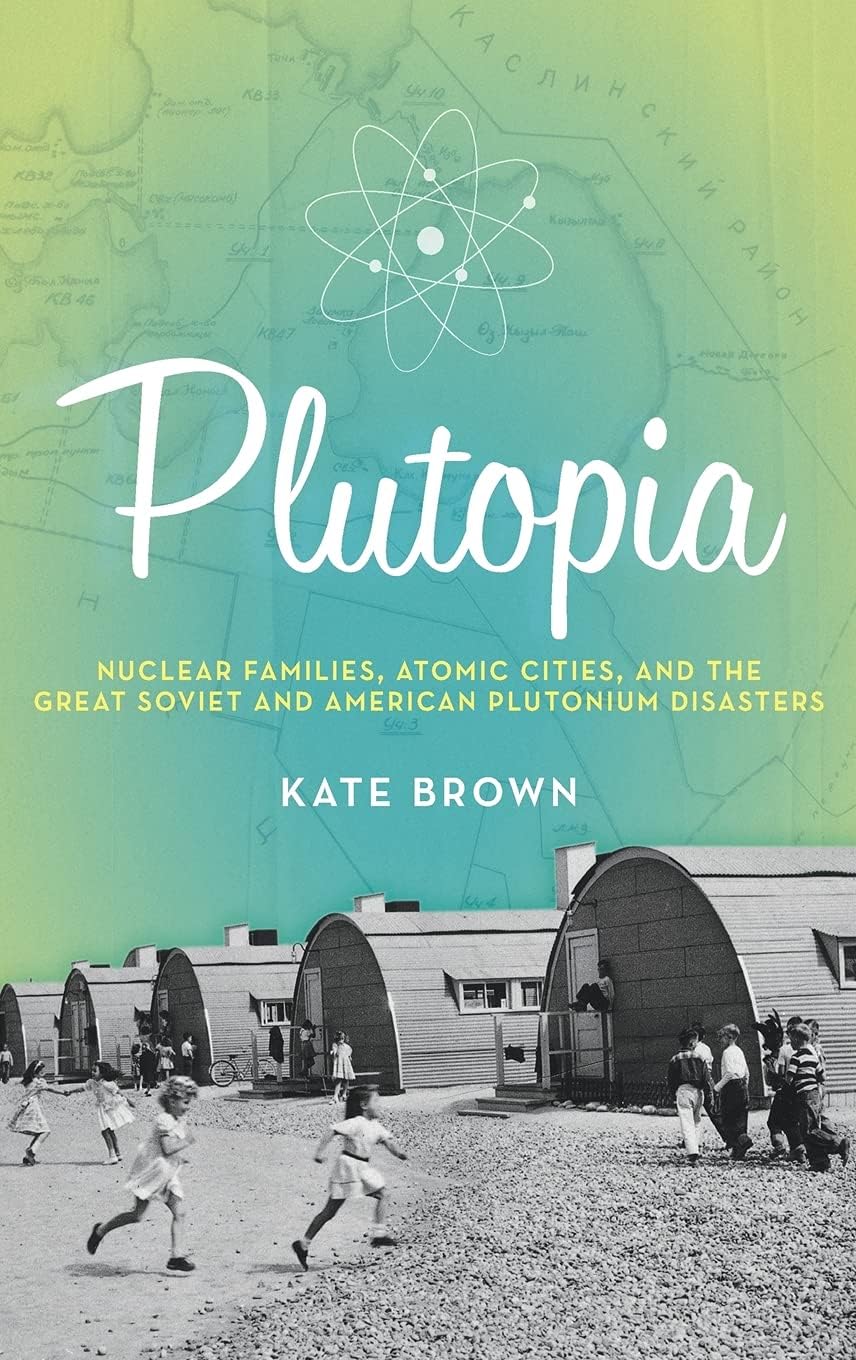
While many transnational histories of the nuclear arms race have been written, Kate Brown provides the first definitive account of the great plutonium disasters of the United States and the Soviet Union. In Plutopia, Brown draws on official records and dozens of interviews to tell the extraordinary stories of Richland, Washington and Ozersk, Russia-the first two cities in the world to produce plutonium. To contain secrets, American and Soviet leaders created plutopias--communities of nuclear families living in highly-subsidized, limited-access atomic cities. Fully employed and medically monitored, the residents of Richland and Ozersk enjoyed all the pleasures of consumer society, while nearby, migrants, prisoners, and soldiers were banned from plutopia--they lived in temporary "staging grounds" and often performed the most dangerous work at the plant. Brown shows that the plants' segregation of permanent and temporary workers and of nuclear and non-nuclear zones created a bubble of immunity, where dumps and accidents were glossed over and plant managers freely embezzled and polluted. In four decades, the Hanford plant near Richland and the Maiak plant near Ozersk each issued at least 200 million curies of radioactive isotopes into the surrounding environment--equaling four Chernobyls--laying waste to hundreds of square miles and contaminating rivers, fields, forests, and food supplies. Because of the decades of secrecy, downwind and downriver neighbors of the plutonium plants had difficulty proving what they suspected, that the rash of illnesses, cancers, and birth defects in their communities were caused by the plants' radioactive emissions. Plutopia was successful because in its zoned-off isolation it appeared to deliver the promises of the American dream and Soviet communism; in reality, it concealed disasters that remain highly unstable and threatening today. An untold and profoundly important piece of Cold War history, Plutopia invites readers to consider the nuclear footprint left by the arms race and the enormous price of paying for it. Review: Great Transnational History of the Costs of the Nuclear Arms Race! - In “Plutopia: Nuclear Families, Atomic Cities, and the Great Soviet and American Plutonium Disasters”, Kate Brown writes, “To entice workers to agree to the risks and sacrifices involved in plutonium production, American and Soviet nuclear leaders created something new – plutopia. Plutopia’s unique, limited-access, aspirational communities satisfied most desires of American and Soviet postwar societies. The orderly prosperity of plutopia led most eyewitnesses to overlook the radioactive waste mounting around them” (pg. 4). She continues, “As the Cold War promises of affluence, upward mobility, and the freedom to consume materialized in plutopia, anxious residents gradually came to trust their leaders, the safety of their plants, and the rightness of their national cause. As plutopia matured, residents gave up their civil and biological rights for consumer rights” (pg. 5). Brown takes a transnational approach in her examination, writing, “I place the plutonium communities alongside each other to show how plutonium bound lives together across the Cold War divide. I suggest that the world’s first plutonium cities shared common features, which transcended political ideology and national culture and were derived from nuclear security, atomic intelligence, and radioactive hazards” (pg. 8). Describing the founding of the American plutopia, Brown writes, “New Deal social welfare went against the grain of DuPont corporate ideology, but government spending that promoted business, generated profits for deserving parties, and preserved unspoken class divisions – that was the desired future, and in planning the city of Richland DuPont executives sought forcefully to push this vision along” (pg. 39). Further, “In insisting on middle-class housing, DuPont executives argued that only a community united in middle-class abundance would deliver plutonium safely and securely. Yet to run the vast plant they had to stock Richland with working people. So they simply called the proletariat ‘middle-class’ and in that way co-opted it. The scheme worked. Although Richland was a city with a working-class majority until the 1960s, it was seen and is remembered as a middle-class town of scientists and engineers, a homogeneous, monoclass society” (pg. 51). To this end, “The desire to keep the government-stimulated communities alive led residents to blithely exchange the possible dangers of radioactive contamination for the certainties of growing prosperity, bankrolled by an expanding federal government, which, as they grew more dependent on it, they politically derided” (pg. 132). In this culture, “The expanding industrial wealth of the West alongside the personally increasing prosperity of the American working class joined at a point where science, technology, and culture bolstered one another to send a message of competence, expertise, and trust” (pg. 221). Brown writes of the Soviet plutopia, “Like their American counterparts, Soviet leaders also created a community of select plutonium workers secured both physically and financially, which was orbited by lesser communities of workers, prisoners, and soldiers, servicing both plutopia and the spreading radioactive contamination flowing from the plant. The Stalinist regime may seem like it was ready-made for the kind of surveillance, submission, and obedience demanded by the nuclear security state. But that was not the case. Due to sheer poverty and disorganization, it took more than a decade to build the first Soviet plutopia, and it cost the nation dearly” (pg. 75). Addressing popular misconceptions, Brown writes, “There are two problems with the equation of the mature, closed nuclear city with the Gulag. First, Soviet leaders and construction managers like General Rapoport were so taken up in the first two years with organizing a colossal nuclear infrastructure amidst the postwar ruin that they largely forgot about security and secrecy. Second, despite the popular image of a Soviet labor camp as a place of totalitarian order and control, where prisoners meekly submitted to the power of guards and wardens, that reputation is grandly mythical” (pg. 92). In this way, “Party leaders agreed that the best way to keep employees was to tempt them with urban magnificence” (pg. 214). This led to a situation where residents living under advanced socialism were no longer socialist and demanded ever more opulence. Brown writes, “Peace, contentment, and tranquility reigned in Ozersk, this major front of the Cold War, as if it had slipped the collective mind that the city existed to produce plutonium, not the other way round – that plutonium’s existence was there to ensure the city’s prosperity” (pg. 267). Turning to disasters and the example of Chernobyl, Brown writes, “Most liquidators in Ukraine had no idea that Chernobyl was not the nation’s first disaster or that, from a scientific perspective, there was little that was new in the Chernobyl cleanup. The emergency actions in Ukraine had all played out before in 1951, 1953, 1955, 1957, and 1967 in the Urals” (pg. 284). The difference was that, “as nuclear catastrophe laid waste to the assurances that Soviet leaders and Soviet science would protect and defend its citizens, [Head of the Soviet Committee for Atomic Energy A.M.] Petrosiants failed to see that Chernobyl’s greatest victim would be the Soviet state” (pg. 286). Brown concludes, “The effects of radiation on health remain highly controversial, as the continuing debate about the effects of Chernobyl demonstrates; estimates of deaths from the accident range from thirty-seven to a quarter of a million. The controversy is not surprising. I have argued in this history that highly controlled medical research on the effects of radioactive isotopes on human bodies manufactured knowledge, doubt, and dissent in a way that created a gulf of opinions. But there also existed a strange lack of curiosity” (pg. 332). Further, “Plutopia’s spatial compartmentalization appeared natural because it mirrored divisions in Soviet and American society between free and unfree labor, between majority white and minority nonwhite populations, and often between those people thought to be safe and those left in the path of radiation” (pg. 334). Review: pretty good - interesting read. bought it for a history class
| Best Sellers Rank | #1,903,524 in Books ( See Top 100 in Books ) #209 in Nuclear Weapons & Warfare History (Books) #408 in Russian History (Books) #1,623 in History of Technology |
| Customer Reviews | 4.5 out of 5 stars 322 Reviews |
R**D
Great Transnational History of the Costs of the Nuclear Arms Race!
In “Plutopia: Nuclear Families, Atomic Cities, and the Great Soviet and American Plutonium Disasters”, Kate Brown writes, “To entice workers to agree to the risks and sacrifices involved in plutonium production, American and Soviet nuclear leaders created something new – plutopia. Plutopia’s unique, limited-access, aspirational communities satisfied most desires of American and Soviet postwar societies. The orderly prosperity of plutopia led most eyewitnesses to overlook the radioactive waste mounting around them” (pg. 4). She continues, “As the Cold War promises of affluence, upward mobility, and the freedom to consume materialized in plutopia, anxious residents gradually came to trust their leaders, the safety of their plants, and the rightness of their national cause. As plutopia matured, residents gave up their civil and biological rights for consumer rights” (pg. 5). Brown takes a transnational approach in her examination, writing, “I place the plutonium communities alongside each other to show how plutonium bound lives together across the Cold War divide. I suggest that the world’s first plutonium cities shared common features, which transcended political ideology and national culture and were derived from nuclear security, atomic intelligence, and radioactive hazards” (pg. 8). Describing the founding of the American plutopia, Brown writes, “New Deal social welfare went against the grain of DuPont corporate ideology, but government spending that promoted business, generated profits for deserving parties, and preserved unspoken class divisions – that was the desired future, and in planning the city of Richland DuPont executives sought forcefully to push this vision along” (pg. 39). Further, “In insisting on middle-class housing, DuPont executives argued that only a community united in middle-class abundance would deliver plutonium safely and securely. Yet to run the vast plant they had to stock Richland with working people. So they simply called the proletariat ‘middle-class’ and in that way co-opted it. The scheme worked. Although Richland was a city with a working-class majority until the 1960s, it was seen and is remembered as a middle-class town of scientists and engineers, a homogeneous, monoclass society” (pg. 51). To this end, “The desire to keep the government-stimulated communities alive led residents to blithely exchange the possible dangers of radioactive contamination for the certainties of growing prosperity, bankrolled by an expanding federal government, which, as they grew more dependent on it, they politically derided” (pg. 132). In this culture, “The expanding industrial wealth of the West alongside the personally increasing prosperity of the American working class joined at a point where science, technology, and culture bolstered one another to send a message of competence, expertise, and trust” (pg. 221). Brown writes of the Soviet plutopia, “Like their American counterparts, Soviet leaders also created a community of select plutonium workers secured both physically and financially, which was orbited by lesser communities of workers, prisoners, and soldiers, servicing both plutopia and the spreading radioactive contamination flowing from the plant. The Stalinist regime may seem like it was ready-made for the kind of surveillance, submission, and obedience demanded by the nuclear security state. But that was not the case. Due to sheer poverty and disorganization, it took more than a decade to build the first Soviet plutopia, and it cost the nation dearly” (pg. 75). Addressing popular misconceptions, Brown writes, “There are two problems with the equation of the mature, closed nuclear city with the Gulag. First, Soviet leaders and construction managers like General Rapoport were so taken up in the first two years with organizing a colossal nuclear infrastructure amidst the postwar ruin that they largely forgot about security and secrecy. Second, despite the popular image of a Soviet labor camp as a place of totalitarian order and control, where prisoners meekly submitted to the power of guards and wardens, that reputation is grandly mythical” (pg. 92). In this way, “Party leaders agreed that the best way to keep employees was to tempt them with urban magnificence” (pg. 214). This led to a situation where residents living under advanced socialism were no longer socialist and demanded ever more opulence. Brown writes, “Peace, contentment, and tranquility reigned in Ozersk, this major front of the Cold War, as if it had slipped the collective mind that the city existed to produce plutonium, not the other way round – that plutonium’s existence was there to ensure the city’s prosperity” (pg. 267). Turning to disasters and the example of Chernobyl, Brown writes, “Most liquidators in Ukraine had no idea that Chernobyl was not the nation’s first disaster or that, from a scientific perspective, there was little that was new in the Chernobyl cleanup. The emergency actions in Ukraine had all played out before in 1951, 1953, 1955, 1957, and 1967 in the Urals” (pg. 284). The difference was that, “as nuclear catastrophe laid waste to the assurances that Soviet leaders and Soviet science would protect and defend its citizens, [Head of the Soviet Committee for Atomic Energy A.M.] Petrosiants failed to see that Chernobyl’s greatest victim would be the Soviet state” (pg. 286). Brown concludes, “The effects of radiation on health remain highly controversial, as the continuing debate about the effects of Chernobyl demonstrates; estimates of deaths from the accident range from thirty-seven to a quarter of a million. The controversy is not surprising. I have argued in this history that highly controlled medical research on the effects of radioactive isotopes on human bodies manufactured knowledge, doubt, and dissent in a way that created a gulf of opinions. But there also existed a strange lack of curiosity” (pg. 332). Further, “Plutopia’s spatial compartmentalization appeared natural because it mirrored divisions in Soviet and American society between free and unfree labor, between majority white and minority nonwhite populations, and often between those people thought to be safe and those left in the path of radiation” (pg. 334).
C**E
pretty good
interesting read. bought it for a history class
M**N
Interesting atomic age info from a pompous college professor
As has been mentioned this is a book comparing the Atomic cities of the two nuclear powers, which the author documents fairly well. However, my beef with this book is the author's superior, 21st century attitude about the whole thing. She seems to forget the seriousness of the country in total war and desiring to get it over with. For instance, she castigates the construction of Hanford for not including blacks and hispanics. She conveniently forgets that we had serious race problems in many places in this country where war construction was going on; we just couldn't wave a magic wand and solve the problem (as she does). While the sites in the US and USSR (at that time) had numerous similarities (since the Russians stole all our secrets), she tries to paint the use of prison lab at Hanford as similar to Ozersk. Ha! The prisoners in Hanford picked fruit; the gulag unfortunates broke their backs and souls hand mixing concrete and lived in squalor. Hardly a comparison. Another complaint I have is the misuse of citations. I see this as the result of a social studies professor tackling a scientific subject. She doesn't seem to know what is important or properly representative at times. In the introduction, she says we don't understand how radiation works in the body and cites a 1945 document. Well, in 1945 we didn't understand it, but we certainly do now. She certainly has a lot of citations, which I found helpful for further reading. Outside of these concerns, if you you're discerning, you can still get a lot from this book. I appreciated the info on what happened in Ozersk and outlying areas. Gosh, if we did it bad, the pollution there was incredibly worse. I've visited Hanford and saw the vast spaces around it. Unfortunately at the time, scientists thought that would be means of absorbing the pollution. Too bad they were wrong. This is all a great example about trusting science to cure everything for us and trusting our government to make right decisions. Scientist often don't fully understand the problem, and the government just wants the job done. We have better tools today to at least find out about these things, but I doubt we have the wisdom to know how to handle them. (as evidenced by the massively expensive and questionable treatment facility being built at Hanford right now).
K**F
Plutopia: Nuclear Families, Atomic Cities, and the Great Soviet and American Plutonium Disasters
Kate Brown’s Plutopia is an exploration of the nuclear industry in the United States and the Soviet Union, and explores the profound human and environmental cost that arises from the processing of nuclear materials. Telling the parallel story of Richland, Washington, and Ozersk, in the Russian Urals, Brown showcases the startling similarities and tragedies that can be found in both the American and Soviet nuclear programs. Brown used government documents and interviews with the residents of the towns to explore both the bureaucracy that ran these nuclear cities and the people who lived under the policies that the bureaucrats espoused. The memories of the people who lived in these cities and the surrounding areas are a curious mix of middle-class prosperity and those of nuclear disaster. The government reports, when they could be found, were rife with omissions and cover-ups that, in hindsight, cast an ominous pall over the futures of Richland and Ozersk, and of the families who lived there. Brown explores the dichotomy between communities with “memories of safety and security” while “security agents and doctors watched residents anxiously” and “they polluted the surrounding landscape freely, liberally, and disastrously” (3). Her detailed accounting of the environmental disasters in Richland and Ozersk, which have polluted the environment and poisoned its people beyond almost all hope of recovery, gives light to the enormous cost that the nuclear arms races of the Cold War had. Using interviews, anecdotal evidence, governmental reports, and private documents, Brown is able to successfully argue that the governments of the United States and the Soviet Union willfully ignored the costs that plutonium production had on the environment and the workers in the cities of Richland and Ozersk, who were kept in the dark about the consequences or who preferred not to know. Brown makes it very clear that the officials in Richland and Ozersk were very aware of the damage they were wreaking on the environment and the dangers to the inhabitants of the cities, as evidenced by the surreptitious doctor check-ups that often deliberately concealed problems from patients. Using the benefit of hindsight and a heightened awareness of the costs of plutonium production, Brown is able to incorporate contemporary knowledge with the historical record to present of compelling case for a massive cover-up by the United States and Soviet governments. Her use of interviews and anecdotal evidence also presents a human side to a story that could have quickly become bogged down by dry government documents. She recounts the stories of those like Arthur Purser, who “had a tumor on his thyroid,” a woman who “counted up ten cousins, five aunts, nine friends, and a mother suffering with cancer,” another who “had lost an infant” and whose “doctor removed tumors from the throat of her kindergarten-age daughter. The rest of the family had thyroid disease.” By incorporating poignant stories of human loss and environmental destruction, Brown also makes an emotional, as well as a logical, appeal to convince the reader of the gravity of her accusations. Stories of dead forests, mass die-offs of fauna, and generation of exotic cancers tell the story of nuclear devastation under the auspices of the Cold War: Kate Brown puts into words what the environment and genetics were already saying. Meddling with science at the edge of human understanding, and ignoring the warnings it gave, led to a culture in which cover-up was normal, and a pretty, pastoral facade, that, when pulled back, revealed the tumors at the heart of American and Soviet plutonium production. Plutopia is relevant today because it brings to light issues that still have bearing in the present time. The environmental destruction left behind by plutonium production is an issue that will be generations in repairing, and there are no shortcuts, no miracle cure, that will fix the problem of nuclear waste in Richland and Ozersk. While various activists have tried to draw attention to the environmental devastation, Brown’s book may be the fullest accounting yet, and one that draw parallels between the Soviet Union. It suggests that, by their very nature, plutonium production facilities cannot avoid, or maybe choose not to avoid, extreme forms of environmental fallout. In this age of alternative energy, nuclear power is one of the forms of energy that are coming under consideration to replace fossil fuels such as coal, oil, and gas. It is often described as a form of “clean” energy, on par with solar and wind power. However, the waste product that comes from processing the material to run nuclear plants is anything but “clean.” In light the recent disaster at Fukushima, Brown’s book may start a conversation on the costs of nuclear energy, and the price future generations may have to pay.
J**N
Fascinating
Great in-depth read
K**Y
Miners' canaries in the USA
Kate Brown writes that radioactive material "migrated from industrial to residential zones, from soils into food, from air to lungs to bloodstream, bone marrow, and finally DNA, so bodies themselves now serve as nuclear waste repositories." The medical section of the U.S. Army's Manhattan Project, the top-secret World War II machine that built the first atomic bomb, conducted human experiments that remained classified for 50 years. E.I. DuPont de Nemours & Co. played a major role in the Manhattan Project in 1943, designing, building and operating the massive U.S. plutonium-production complex on 780 square miles of land along the Columbia River at Hanford, Washington. Like miners' canaries, workers in the chemical industry are often the first line of exposure to environmental toxins. "In the early thirties," writes Brown, "a DuPont chemical dye plant had an outbreak of bladder cancer among its workers. DuPont officials hired Wilhelm Hueper, a German scientist specializing in toxins, to figure out what was giving the workers cancer. Hueper isolated a new chemical agent, beta-napthylamine, used in dye production, which, he said, caused bladder cancer in rats. Rather than pull the chemical from the line, DuPont officials took Hueper off the research project, and when he refused to drop the issue, they fired him. Fearful that Hueper would broadcast his findings, they assigned another scientist, Robert Kehoe, at the company's Kettering Lab, to carry out research that would discredit Hueper's findings. For the next twenty years, DuPont workers continued to use beta-napthylamine, which caused bladder cancer in nine out of ten employees exposed to it. For the subsequent two decades, DuPont officials harassed and censored Hueper in his work as director of the environmental cancer program of the National Cancer Institute." Robert A. Kehoe, M.D. and his Kettering Laboratory in Cincinnati, Ohio, conducted research, carefully crafted to benefit powerful sponsors - Ethyl, DuPont, Standard Oil, Pennsalt - but not the health of our nation; medico-legal data was produced to protect industrialists from potential worker injury lawsuits. At the end of World War II, Kehoe teamed up with the Manhattan Project because the U.S. government did not want workers in the uranium mines and bomb factories to learn they were being poisoned. "Manhattan Project workers were subject to regular 'medical surveillance.' Doctors had permission to inform employees of medical abnormalities only if the maladies were not related to radiation. To contain this knowledge within the trusted group of plant doctors, DuPont managers built up a full-service, low-cost clinic" writes Kate Brown. "This kind of New Deal-style medical program directly contradicted DuPont's conservative philosophy, but in this case DuPont managers argued that a subsidized medical program for Hanford employees and their families would be advisable both to maintain control over the plant medical staff and to cover up the distinction between occupational and regular illnesses. The service plan would pay for both and thus 'avoid embarrassing situations' and patients' 'undue alarm.' Writing with that knowing wink of Manhattan Project officialdom, a DuPont manager concluded, 'The important value of this feature can be readily understood.'" The Manhattan Project became the civilian-run Atomic Energy Commission (AEC) January 1, 1947. Two years later, AEC researchers harvested organs of plutonium workers and secretly gathered bones of children worldwide to measure radioactive fallout. In order to reduce the release of nuclear fallout into the planet's atmosphere, President Kennedy signed the Limited Nuclear Test Ban Treaty October 7, 1963, prohibiting all test detonations of nuclear weapons except underground. "In the United States from 1950 to 2001, the overall age-adjusted incidence of cancer increased by 85 percent. Childhood cancer, once a medical rarity, has become the most common disease killer of American children. Cancer rates are just the end of a continuum of American health problems that include diabetes, heart disease, asthma, and obesity. These social-cultural-economic problems written on the body are also etched across American communities, one-quarter of which are within four miles of a Superfund site filled with plastics, chemical solvents, pesticides, nuclear waste, and all the unwanted detritus of consuming societies."
T**N
Well-researched and written
Kate Brown has done the almost impossible, using vast files of information long classified in America and the former USSR to plumb the depths of the secrecy and the cover-ups involved in the pursuit of plutonium for weapons production. While some Americans as well as Russians dispute the accidents and cover-ups, one can only surmise that they were so patriotically blinded by their participation as to deny anything which besmirched their remembrances of the programs and their lives in the secret cities. Some of the evidence, to be sure, is anecdotal, however Brown has managed to document her assertions and is to be commended as a brave historian for attacking an investigation into a part of history that many would wish to remain unknown. Having spent a good part of the past 20 years traveling in Russia and seeing the fear of contemporary Russians that the walls still "have ears" demonstrates the degree of difficulty Brown must have had to gain the confidence of people there in telling this story, not to mention similar challenges in the U.S., particularly among people still residing in and near Hanford.
K**R
It was interesting
An interesting book . It bounced between topics a lot and repeated itself too many times. I still found it a well researched and gave me lots of additional info about things my history classes of the pacific NW never addressed. Make sure you read Findlay's book Atomic Days first, then read about the first atomic plant accident in Idaho.
D**S
Excellent but very technical
This is excellent account of the US and USSR's quest to harness the atom and the cities they created to do so. Be aware that it gets quite technical and what is missing is a better accounting of those who lived in these cities. You get a high-level account of the residents but little on how the survived the isolation etc.
A**E
great book
I am interested in nuclear history and nuclear biology, although they are completely unrelated to my field of study and work. This book by a historian is very informative, well researched, objective, but reads easier than your regular history book. Kate Brown shows in beautiful writing an interwoven world of history, politics, physics, chemistry, biology and the communities they created; sacrifices that were made knowingly or unknowingly, wittingly or unwittingly in the name of social security, management of nuclear crises, the human drama of communities tied to and dependent on contaminated landscapes in the Soviet Union and the USA. Ultimately I think this book should be read by progenies of both sides of the Cold War if they really want to understand their past.
S**O
Really interesting book
I agree with the rewiew saying this book repeats itself quite a lot, yet it still brings us a really interesting perspective and "behind the scenes" from both USA and USSR while developing the Plutonium facilities, and like all scientific good work, brings us tons of sources. I've been studying radioactive accidents and I found in this book plenty of good information
コ**ン
原子力の理想郷の近未来の参事
米国ハンフォードとソ連マヤク再処理工場を対比させ,大河川に放射能を直接放流し,住民が多大な健康被害を受けたことに,丁寧にインタビューし,まとめた.現在の武漢生物研究所が長江にウィルスを直接放流し,世界中に感染被害をもたらしている状況を予言している.核とウィルスがリスクでは等価であり,周辺住民のみならず世界的な健康被害が及ぶ点,軍事技術である点で全く同じである.奇形や障害児が現れている点で,コロナの近未来を示唆している.
P**E
Interesting but repeats itself a lot
The same story could have been told with half the pages without losing anything.
Trustpilot
4 days ago
2 days ago