
Buy anything from 5,000+ international stores. One checkout price. No surprise fees. Join 2M+ shoppers on Desertcart.
Desertcart purchases this item on your behalf and handles shipping, customs, and support to Tunisia.
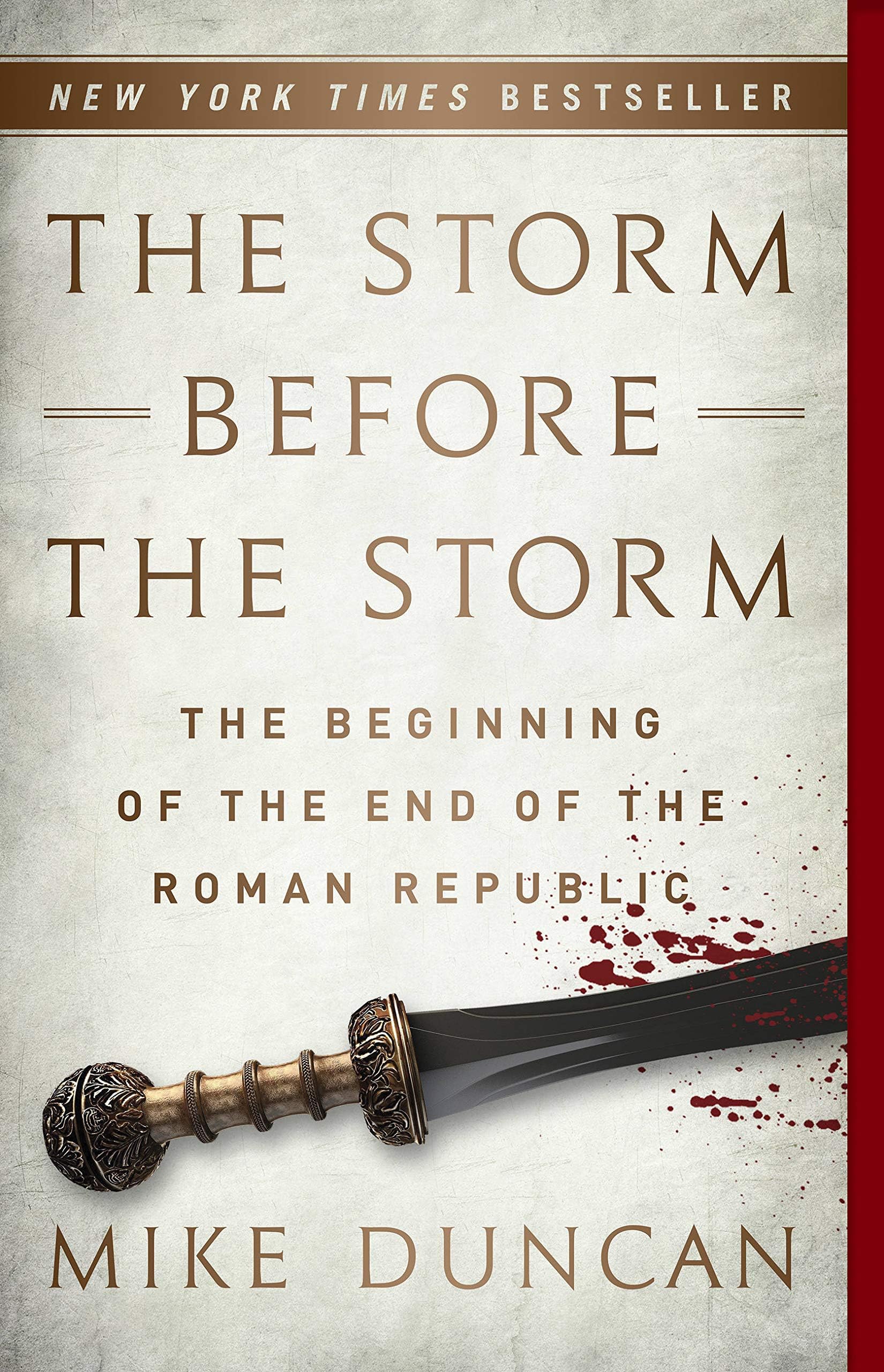
From the creator of the award-winning podcast series The History of Rome and Revolutions comes the fascinating history of the bloody battles, political machinations, and human drama that set the stage for the fall of the Roman Republic. "Remarkably engaging." ― Washington Post The Roman Republic was one of the most remarkable achievements in the history of civilization. Beginning as a small city-state in central Italy, Rome gradually expanded into a wider world filled with petty tyrants, barbarian chieftains, and despotic kings. Through the centuries, Rome's model of cooperative and participatory government remained remarkably durable and unmatched in the history of the ancient world. In 146 BC, Rome finally emerged as the strongest power in the Mediterranean. But the very success of the Republic proved to be its undoing. The republican system was unable to cope with the vast empire Rome now ruled: rising economic inequality disrupted traditional ways of life, endemic social and ethnic prejudice led to clashes over citizenship and voting rights, and rampant corruption and ruthless ambition sparked violent political clashes that cracked the once indestructible foundations of the Republic. Chronicling the years 146-78 BC, The Storm Before the Storm dives headlong into the first generation to face this treacherous new political environment. Abandoning the ancient principles of their forbearers, men like Marius, Sulla, and the Gracchi brothers set dangerous new precedents that would start the Republic on the road to destruction and provide a stark warning about what can happen to a civilization that has lost its way. Review: A Captivating and Insightful Journey into the Fall of the Roman Republic - The Storm Before the Storm: The Beginning of the End of the Roman Republic by Mike Duncan is an absolute masterpiece that brilliantly captures the tumultuous period leading up to the fall of the Roman Republic. As a history enthusiast, I found this book to be both enlightening and captivating from start to finish. Duncan's meticulous research and engaging writing style make complex historical events accessible and fascinating. He has a remarkable ability to weave together the political, social, and economic threads of the era, providing a comprehensive understanding of the factors that contributed to the Republic's decline. The book delves into the lives and actions of key figures with vivid detail, making them come alive on the pages. One of the standout aspects of this book is Duncan's narrative flair. He balances scholarly rigor with a storytelling approach that keeps the reader hooked. Each chapter is structured to build suspense and intrigue, making it hard to put the book down. The way he connects historical events to contemporary parallels adds an extra layer of relevance and insight. The Storm Before the Storm also excels in its ability to provide context and clarity. Duncan explains the significance of each event and decision, making it easy to follow the complex political machinations and power struggles. His analysis is sharp and thought-provoking, shedding light on the consequences of corruption, ambition, and social unrest. Overall, The Storm Before the Storm is an outstanding work of historical non-fiction. It is a must-read for anyone interested in Roman history or the dynamics of political power. Mike Duncan has created a compelling and informative narrative that will stay with readers long after they have turned the last page. I highly recommend this book to history buffs and general readers alike. Five stars! Review: Well written account of the events that lead to the end of the Roman Republic. - The author proves in this book that the beginning of the end of the Roman Republic should be traced to the period between 146 and 78 BC, rather than the events of the First and Second Triumvirate. During that time, too many ambitious men rose to power one after the other breaking the unwritten rules of Rome's Republic (mos maiorum). Each time those rules were broken set a precedent for the next populist demagogue to repeat the feat and go an extra step in breaking the law and destroying the pillars of the Republic. This story is told in a fast-paced way, with enough detail to learn about the key events of the era, but without dwelling too long in them. When ancient sources are contradictory, Duncan tries to present both views, but telling us which one he believes and why. In a time period full of political developments and wars, the author manages to retell the events that keeps the reader's attention. Also, it must be noted this book seems to be really balanced and without bias towards the main characters. It's easy to find authors that try to present conflicting characters like Marius or Sulla in either a good or bad light, depending in their own views. Duncan seems to have no trouble in presenting the good and the bad of each character, without taking sides. He does (understandably) seem to lose this balanced approach when talking about other characters who seem interested in burning the world down, like Saturninus. Overall, very good book, highly recommended for readers interested in this period before the last years of the Roman Republic. It provides context that helps understand how is it that a few years later we see characters like Julius Caesar, Mark Anthony, Pompey and Octavian.


| Best Sellers Rank | #8,309 in Books ( See Top 100 in Books ) #3 in Ancient Roman History (Books) #4 in Political Corruption & Misconduct #22 in Political Commentary & Opinion |
| Customer Reviews | 4.6 out of 5 stars 4,378 Reviews |
M**L
A Captivating and Insightful Journey into the Fall of the Roman Republic
The Storm Before the Storm: The Beginning of the End of the Roman Republic by Mike Duncan is an absolute masterpiece that brilliantly captures the tumultuous period leading up to the fall of the Roman Republic. As a history enthusiast, I found this book to be both enlightening and captivating from start to finish. Duncan's meticulous research and engaging writing style make complex historical events accessible and fascinating. He has a remarkable ability to weave together the political, social, and economic threads of the era, providing a comprehensive understanding of the factors that contributed to the Republic's decline. The book delves into the lives and actions of key figures with vivid detail, making them come alive on the pages. One of the standout aspects of this book is Duncan's narrative flair. He balances scholarly rigor with a storytelling approach that keeps the reader hooked. Each chapter is structured to build suspense and intrigue, making it hard to put the book down. The way he connects historical events to contemporary parallels adds an extra layer of relevance and insight. The Storm Before the Storm also excels in its ability to provide context and clarity. Duncan explains the significance of each event and decision, making it easy to follow the complex political machinations and power struggles. His analysis is sharp and thought-provoking, shedding light on the consequences of corruption, ambition, and social unrest. Overall, The Storm Before the Storm is an outstanding work of historical non-fiction. It is a must-read for anyone interested in Roman history or the dynamics of political power. Mike Duncan has created a compelling and informative narrative that will stay with readers long after they have turned the last page. I highly recommend this book to history buffs and general readers alike. Five stars!
G**O
Well written account of the events that lead to the end of the Roman Republic.
The author proves in this book that the beginning of the end of the Roman Republic should be traced to the period between 146 and 78 BC, rather than the events of the First and Second Triumvirate. During that time, too many ambitious men rose to power one after the other breaking the unwritten rules of Rome's Republic (mos maiorum). Each time those rules were broken set a precedent for the next populist demagogue to repeat the feat and go an extra step in breaking the law and destroying the pillars of the Republic. This story is told in a fast-paced way, with enough detail to learn about the key events of the era, but without dwelling too long in them. When ancient sources are contradictory, Duncan tries to present both views, but telling us which one he believes and why. In a time period full of political developments and wars, the author manages to retell the events that keeps the reader's attention. Also, it must be noted this book seems to be really balanced and without bias towards the main characters. It's easy to find authors that try to present conflicting characters like Marius or Sulla in either a good or bad light, depending in their own views. Duncan seems to have no trouble in presenting the good and the bad of each character, without taking sides. He does (understandably) seem to lose this balanced approach when talking about other characters who seem interested in burning the world down, like Saturninus. Overall, very good book, highly recommended for readers interested in this period before the last years of the Roman Republic. It provides context that helps understand how is it that a few years later we see characters like Julius Caesar, Mark Anthony, Pompey and Octavian.
S**.
Educational but a bit dry
This is a good book because: 1. It is informative and has a fair amount of details, but not an overwhelming amount. 2. At times, the writing has some wit and humor. It isn't 5 stars because: 1. The aforementioned wit and humor is not that often. The book generally is pretty dry. I felt the writing was lacking, and I was reading a college term paper. That probably comes across as a bit harsher than my intent. 2. It is hard to keep track of all the different positions and their roles. As another reviewer mentioned, a diagram or chart in the front of the book serving as a reference guide would have been helpful. 3. The maps were not very useful either. There were countless places the author mentioned that were not on the map, while with maybe 1-2 exceptions, the places that WERE marked on the map of Italy did not come up at all in the writing. It was a bit frustrating. Overall, a solid read that educated me quite a bit on the late Roman Republic, but it was far from flawless.
D**D
Well-Written Story of Decline and Dissolution
I became interested in the Roman Republic after reading about the Roman emperors. None of their dynasties were formed with public participation. Then I learned that previously the Romans were governed as a republic. The Roman Republic originated in 509 BC with the overthrow of the Roman monarchy. In some ways, their new government was not unlike America’s: they had a constitution and three branches of government. They had an executive branch with fixed terms of office. They had two legislative groups. And a judiciary. Although their system wasn’t perfect, it was rational. I was curious why the Romans gave up that form of government. And not unrelated, I wondered what lessons the history of the Roman Republic could teach America. Author Duncan presents a coherent progression of how the Republic developed and what went wrong. The story is supplemented with a timeline and maps. Ample notes and sources are provided. The author’s occasional colloquialisms made events easier to understand. It was difficult to keep track of the characters, many with similar names (some were related). I needed to reread several sections. But a story covering so much history is bound to have many players. Overall, this book satisfied my objectives and was enjoyable to read. WHAT HAPPENED In the provinces, Rome’s warlike culture led it into battle after battle. Wars became an anticipated part of Roman life. This led to a mixing of military experience and governmental politics producing essentially “private armies.” In Rome, politicians amassed power by developing cohorts of thugs and “hit men” who would do their dirty work. Predictably, in 133 BC, this escalation reached politically-instigated murder. The situation reached its inevitable climax in 82 BC when Lucius Cornelius Sulla marched his army into Rome and posted “proscriptions” that ordered Sulla’s listed enemies killed on sight by anyone. The Republic’s justice had consolidated under one man. From then, events unwound in a blinding sequence of alliances, triumvirates, wars, and murders until only one was left standing. The reign of Octavian (now called Augustus Caesar) began in 27 BC. Given unprecedented powers as the first Roman emperor, Augustus Caesar transformed the Republic into the Roman Empire. The government of the Republic was never fully restored.
R**K
An important and often overlooked part of history
The collapse of the Roman Empire and the fall of Rome have been dealt with in more books, movies, and articles, purely factual and fictionalized, than I can guess at. However, just as Rome wasn’t built in a day, it didn’t fall in one. In THE STORM BEFORE THE STORM Mike Duncan starts with events taking place long before Rome actually falls. He carefully covers many of the factors leading to the collapse of Rome. Naturally, as with any work of ancient history, some of the ideas Duncan brings up are debatable, but THE STORM BEFORE THE STORM is well researched and documented. It is also completely readable. Readable, but to some extent disturbing. To paraphrase, the old saw “Those who don’t know history are doomed to repeat it” comes to mind. I’m not sure it was Duncan’s intention, but some of the parallels between the events in THE STORM BEFORE THE STORM and the much more recent history of the United States struck me as unpleasantly obvious.
M**K
Engaging tale of the times leading up to the fall of the Roman republic
Feels like sitting and listening to the author tell you stories. Easy to digest and follow what is happening. Great read and a lot of history that isn't typically covered in studies.
R**N
A good read. Mos Maiorum FTW.
Love the podcast, it was a great introduction to the histories of Rome; this book is an extension of that, But far more focused on the rise of the populares prior to Caesar. An engrossing and easy read, not always something easy to say about texts covering late antiquity. It has always been a hallmark of his work. My obvious suspicion is that the elevator pitch was done with the modern era in mind. I do recall Mr. Duncan once saying that if one were to compare Rome to America, we would be in this moment right now; the Gracchi movement was compared superficially to the Tea Party. That late republican period was also a favorite of his. Parallels abound. Which makes Donald Trump....which Roman senator openly flouting Mos Maiorum ? Hard not to take this comparison as damning. Either way, he would not have been a favorite of Cicero.
A**.
Very good, reads well.
Fits in well with other books I own that deal with the Roman Empire. Gone through roughly half the book so far, and it’s very informative.
R**N
Recommended
Reads like a novel, finished this in two sittings. And very thought provoking.
S**E
Cadeau
Cadeau
相**郎
Great book
This is an excellent book for people wanting a riveting introduction to the fall of republican Rome. It's got all the info, and none of the boring prose typical of history books.
D**L
Helpful and fascinating
Excellent! Mike Duncan writes with humor and passion about an important and less-highlighted time in ancient Rome's history--the beginnings of the end of the Roman Republic. I found this book helped expand my own knowledge of this era as well as learning more details about the men and women who helped shape the end of the world's first republic.
F**Z
Simplemente fascinante
El período entre las guerras púnicas y la guerra de las Galias no es lo suficientemente tratado, o al menos, no es divulgado con la misma celeridad que estos grandes eventos. Leer cómo poco a poco las tradiciones y tabúes que mantuvieron la República durante 500 años colapsaban cual piezas de dominó, y las diferencias entre los optimates y los populares se acrecentaban más y más, no podía parar. Lo terminé en un mes. Un excelente trabajo de divulgación.
Trustpilot
1 month ago
2 months ago