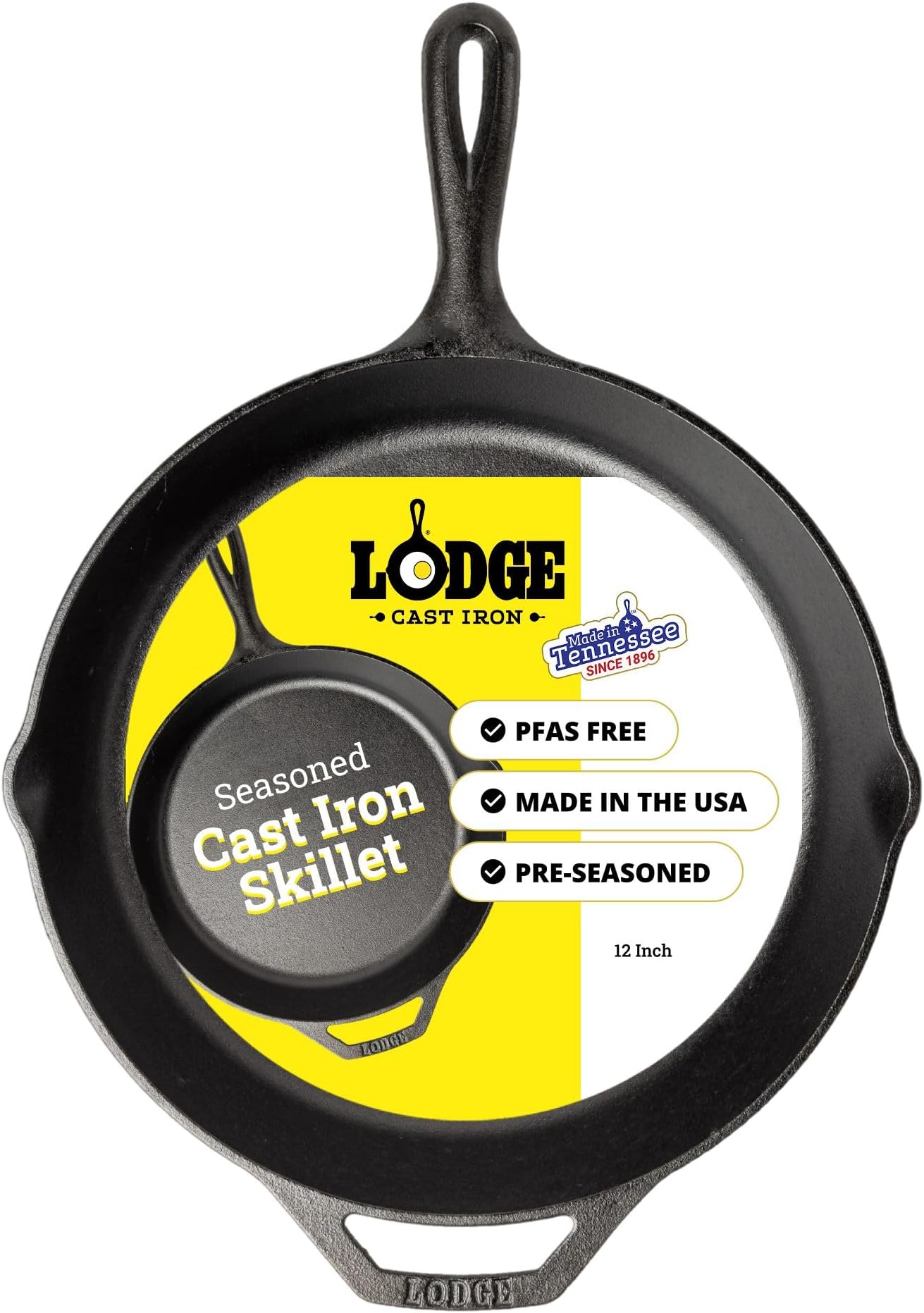

Pre-Seasoned Cast Iron Skillet, PFAS-Free, 12 Inches
Product ID: 1160999
Details
- BrandLodge
- Capacity5 ml
- ColorBlack
- Materialcast-iron
- Special FeatureMade without
🔥Superior heat retention
♻️PFAS-free, non-toxic
🛠️Durable cast iron build
Desertcart purchases this item on your behalf and handles shipping, customs, and support to Tunisia.
🔥 Elevate your kitchen game with the skillet that’s as tough as your hustle!
The Lodge Pre-Seasoned 12-inch Cast Iron Skillet is a premium, PFAS-free cookware piece designed for professional-grade heat retention and durability. Pre-seasoned with natural oils, it offers a smooth, non-stick surface that improves with use. Oven-safe up to 500°F and compatible with all heat sources including grills and campfires, this skillet is a versatile essential made in the USA to last a lifetime.


| ASIN | B00006JSUB |
| Additional Features | Made without PFOA or PTFE |
| Best Sellers Rank | #113 in Kitchen & Dining ( See Top 100 in Kitchen & Dining ) #2 in Skillets |
| Brand | Lodge |
| Brand Name | Lodge |
| Capacity | 5 ml |
| Coating Description | Cast Iron |
| Color | Black |
| Compatible Devices | Gas |
| Customer Reviews | 4.6 out of 5 stars 132,074 Reviews |
| Global Trade Identification Number | 00075536301006, 04517751708179, 30075536301007 |
| Handle Material | Cast Iron |
| Included Components | Skillet |
| Item Highlight | Non-Toxic & Naturally Non-Stick Cast Iron Pan, Compatible with Oven, Stove, Grill & Campfire, Made in USA |
| Item Type Name | Miniature Skillet |
| Item Weight | 3.58 kg |
| Manufacturer | Lodge |
| Manufacturer Part Number | FBA_1033502000010 |
| Manufacturer Warranty Description | Lifetime |
| Material | cast-iron |
| Material Type | cast-iron |
| Maximum Temperature | 500 °F |
| Metal Type | cast iron |
| Model Name | Cast Iron Skillet |
| Model Number | Miniature Skillet |
| Number of Items | 1 |
| Number of Packs | 1 |
| Product Care Instructions | Hand Wash Only, Oven Safe |
| Recommended Uses For Product | cooking, frying, baking, serving a variety of dishes |
| Shape | Round |
| Special Feature | Made without PFOA or PTFE |
| Specific Uses For Product | versatile cooking, family meals, camping, grilling, and oven use |
| UPC | 720698828624 085404391671 075536301006 075536014005 077344751271 075536301198 844819016254 |
| Unit Count | 1 Feet |
A**1
Lodge 10.25 Inch Cast Iron Skillet
TL;DR: I have one and I love it. But it works different than a regular pan. I picked one of these up about four years ago during the COVID lockdown. It's a solid workhorse that I have been using for almost all personal cooking. I believe these are still proudly made in the USA, and they are still affordable compared to other cookware. The skillet is especially good for making steaks, burgers, omelettes, bacon, and seared onions. I've been using it a lot to cook marinated beef, pork, and chicken from Hmart (the Korean supermarket). Another favorite dish is roasted sweet potatoes. I've been using avocado oil as a healthier cooking oil. I have only used it on the stovetop, but it can also cook inside the oven. The 10.25" size has worked well for me. I usually fire it up to cook a week's worth of meals. At this point, it would be worth having a second one for parallel processing. If you haven't used a cast iron skillet before, there are some special considerations. Especially around cleaning and seasoning, which are related. Seasoning is like a chemical treatment of the cast iron to keep food from sticking too much to the cooking surface. There will be some sticking though, and it is important to clean after each use. Although these are less non-stick than "non-stick pans", cast iron also does not contain synthetic chemicals like PFAS that have been used in non-stick cookware. PFAS are apparently harmful to ingest and start getting into food as the cooking surface degrades. Cast iron cookware is from an era before these chemicals became so widespread. Here is some cast iron guidance from my experience. Do not run it through the dishwasher. Do not leave it in the sink, especially in contact with water (to avoid rust). Preferably avoid cleaning it with soap and water altogether. Do not pour cold water into a hot skillet since the temperature shock might cause it to crack. Avoid setting the heat too high on the stovetop; this burns off your hard-earned seasoning and may set off the fire alarm. I usually set the burner to 3-4 out of 10. Before using the skillet, I followed a suggestion on the internet about sanding down to the bare metal and starting over with my own seasoning. Lodge's casting process apparently results in the rough texture, and I think their factory seasoning also contributes. Other brands offer skillets with much smoother surfaces, but they seem to cost substantially more, and I don't mind a little DIY for something like this that should last a very long time. I didn't have power sanding tools so I sanded by hand, removing the factory seasoning and smoothing down the metal. To kickstart the new seasoning, I applied an imperceptibly thin layer of oil and baked the skillet in the oven. I repeated that several times. Then, for the first cook, I fried some potatoes, onions, and butter. I did another round with bacon. The bacon was delicious, but I just realized that I still have the grease saved from it in the back of the fridge... After that I just used the skillet normally. I didn't note down my exact process like the sandpaper grits, and the number of oven seasoning rounds, and the type of oil I used, but there is plenty of detailed guidance on the internet if you need it. After each use, I clean it and then finish off by applying the thinnest possible coat of grapeseed oil (which is less expensive than avocado oil) while the skillet is cooling down on the stovetop. I apply the oil to the entire skillet including the handle and the underside. I used a paper towel or napkin to wipe off any excess oil - if you don't do this, it becomes a layer of crust rather than seasoning. Not a big deal though, it can be scraped off. For my cleaning process, I keep the skillet heated. I boil a pot of water and pour it on the skillet to burn off most of the residue. I use a wooden spoon to scrape off anything that's still stuck on. Sometimes a metal spatula helps if the spoon isn't scrapey enough. I pour the greasy run off into disposable cups and let them cool before taking them out to the dumpster. I would say to avoid pouring this stuff down the drain. One of my most useful resources has been the YouTube channel "Cowboy Kent Rollins". Definitely check him out if you're new to cast iron cooking and want to get advice from a cowboy guy. There are some Lodge accessories (or similar from third parties) that might be worth checking out: this includes scrapers, chain mail scrubbers, silicone handles, and lids. One more thing to mention is that there are a variety of Lodge skillets with special designs on the back. I got a basic one with the logo. A special design might be cool if you have multiple skillets (to tell them apart) or if you are giving one as a gift.
D**.
Great and the weight is a good thing see below
After I learned to season it quick like 7 times, and started using a bush and cup with a dap of oil on the side I kept around to wipe with oil when done, and learned to due to size I needed to have rag on edge of sink when dumping out water, and then I often but not always heat up water in electric kettle to pour in when done cooking in order to not shock it. I find after all this that I actually do basically no scrubbing, just a bit of scraping with the metal spatula while the hot water is in it. And then I use a silicone handle on one side I had gotten and I want to get the other side for the silicone side to hold but I just use a pot holder for the other side, thicker one. But I find now that this is an ideal pan to cook everything and anything and many things. I just leave it on top of my stove for daily use. And the weight, for the same reason a mechanics arms are big while not lifting, their muscles are big purely due to making the same motion every day repetitively with the wrench. It’s called a hermetic stressor, the same way weight session (more stressful obviously) and a hot sauna, cold plunge, run, etc, are all good forms of stress that cause adaptation, So to does this just cause you to lift a heavier pot a few times a day as you cook. For vast majority of us it’s nothing. But I told my mom for instance that she should use it and she complained how heavy it was, and my brutal honest response was “that’s exactly why you need to be using it because it’s not like you are working out”. It won’t make you buff, just a bit heavier than a similiar size pan, but for the older crowd who find it important to get their exercises in at the pool and such, this is no different. Plus, once I learned to clean efficiently and season a couple times, it’s a god send of a pan. I love it. I just want to put that “it’s too heavy” criticisism that comes with cast iron in a new light. Your body adapts, allow it too gradually. I will at some point be adding a top to this, I just haven’t decided if I need to get the lodge glass one which would be nice or a silicone one for this, or just a cast iron one to keep the theme and look and durability forever. (Glass and silicone could both break in different ways). I do love this pan as I will admit, one of the reason I got this pan, being some one who can be hard on things by temperment, after knowing roughly how to care for this pan, I also have a lisence to absolutely abuse it and can’t scratch it or anything. Because once you have researched a couple of ways to take rust off and to totally reseason and recondition an old used on for instance, you have the confidence to own this the rest of your life and not ever feel like your going to rune it. I’m also strategically lazy, I call efficient, my mom thinks different, lol, but anyway, the fastest way to clean any pan is with hot water right when done cooking as it burns and melts stuff right off, I can do that with this without worrying how it affects coatings or anything and I can do that to kingdom come. I just try to throw water from kettle on it ideally but not always. Again, the point of these pans is the amazing non stick coating that develops after use and learning to season a few more times your self, but that you can absolutely abuse these pans and know they will last. There is a certain security that’s nice to feel with knowing that. The fact that it has a great non stick that develops after some use and is durable Af, I’m in love. Plus ever seen those videos on YouTube about how baking/pizza steel beats baking/pizza stones every time because of how the metal works vs the ceramic of the stone. It just hit me that this pan is also big enough to make a 15 inch pizza, and when making one for one to a few people depending how thick it is, that’s a good size to use as a pizza steel in the oven. I do even ti ally want a baking steel as I even learned you can leave those in your oven as it helps regulate the temperature in oven by functioning as a ballast in your oven. Don’t even have to clean those. Just let the oven burn stuff off. None the less, till then this will work as a great pizza steel surface too. ++. I don’t have much sense of smell, a bit impulsive so I tottally would put it on “HIGH” on the stove every time. Might turn it down at times but it always creates smoke which didn’t matter to me, but got my mom has the higher disgust sensitivity (these two traits in the house do not get along well) anyway, I out of impatience realized I had a habit of heating it up quickly on high, Then I realized I tested how long it takes to smoke with the oil I was using to season it after each cook. I timed how long on high, waited till room temp, tested how long on medium, etc. Did this for any cast iron and carbon steel pans I have too. And in this one I can get away on our gas burner stove on high: High Canola 400°-450° 4m 34s Medium Canola 400°-450° 6m 43s 400°-450°=smoke point at which smoke appears as the oil is actually starting to burn (note health wise causing this isn’t healthy so avoid normally by following these instructions). You can do the same test on your stove with your seasoning pans. And now I just run it for 3mins on high but then turn to medium or lower. Could probably get away with 3:30 duration on high. But this way you can cook at medium or a tad lower after.
J**B
Timeless classic for the modern kitchen
Sorry for the long review - for the short review, count the stars! I'm a bit of a purist. I always season my cast iron - new, or used (hey, I don't know WHAT someone else used that old piece of cast iron for - maybe cleaning auto parts). I sand it down to bare metal, starting with about an 80 grit and finishing with 200. Then I season. The end result is a glossy black mirror that puts Teflon to shame. There are two mistakes people make when seasoning - not hot enough, not long enough. These mistakes give the same result - a sticky brown coating that is definitely not non-stick, and the first time they bring any real heat to the pan, clouds of smoke that they neither expected or wanted. I see several complaints here that are completely due to not knowing this. But there were a few pieces I needed (yes, needed, cast iron isn't about want, it's a need), and this was one of them, so I thought I'd give the Lodge pre-seasoning a try. Ordered last Friday, received this Friday - free shipping, yay! The first thing I noticed was the bumpy coating. The inside is actually rougher than the outside, and my hand was itching for the sandpaper, but that would have defeated the experiment. This time, I was going to give the Lodge pre-seasoning a chance before I broke out the sandpaper. So I scrubbed the pan out with a plastic brush and a little soapy water, rinsed well, put it on a medium burner, and waited. Cast iron tip number one - give it a little time. Then give it a little more time. Cast iron conducts heat much more slowly than aluminum, so you have to have a little patience. Then I threw in a pat of butter, and brought out the natural enemy of badly seasoned cast iron - the egg. And, sure enough, it stuck - but not badly, just in the middle. A bit of spatula work and I actually got a passable over-medium egg. Hmmm. But still not good enough. So I cleaned up the pan, and broke out the lard. I have only one justification for using lard. I don't remember Grandma using refined hand-pressed organic flax oil, or purified extra-virgin olive oil made by real virgins. Nope, it was pretty much animal fat in her iron. A scoop of bacon grease from the mason jar beside the stove and she was ready to cook anything. Grandaddy wouldn't eat a piece of meat that had less than a half-inch of fat around it. "Tastes like a dry old shoe.", he'd declare if it was too lean. In the end, I'm sure their diet killed them, but they ate well in the meantime. Grandaddy was cut down at the tender age of 96, and Grandma lasted till 98. Eat what you want folks - in the end, it's pretty much up to your genetics. So I warmed up my new pieces, and smeared a very thin layer of lard all over them - use your fingers. Towels, especially paper towels, will shed lint, and lint in your seasoning coat doesn't help things at all. Besides, it's kinda fun. Here's cast iron tip number two - season at the highest temp you think you'll ever cook at - or higher. If you don't, you won't get the full non-stick thing, and the first time you bring it up to that temp you'll get clouds of smoke from the unfinished seasoning. I put my pieces in a cold oven, and set the temp for an hour at 500 degrees (F, not C). Yeah, I know, Lodge says 350. Lodge doesn't want panicked support calls from people whose house is full of smoke. Crank the heat up. You have two choices here. You can put a fan in the kitchen window and blow smoke out of your house like the battleship Bismarck under attack by the Royal Navy, or invest in an oxygen mask. You will get smoke. You will get lots of smoke, especially if you're doing several pieces at once, like I just did. This is a good thing - that's smoke that won't be jumping out to surprise you the first time you try to cook with any real heat. The goal is to heat until you don't get smoke, and in my experience, 500 degrees for an hour does that pretty well. Let the pieces cool in the closed oven. Then re-grease and repeat. And repeat again. And don't glop the fat on. Just enough to coat. More thin layers are better than fewer gloppy layers. I managed four layers last night without my neighbors calling the fire department. Seems like a lot of work? Look at it this way. It's a lifetime commitment. Treat your iron well, and it will love you right back like you've never been loved before. And this is pretty much a one-time deal, unless you do something silly. The end result of my all-night smoking up the kitchen exercise? Dry, absolutely no stickiness, black as a coal mine at midnight and shiny - but still bumpy - could it possibly work with that rough surface? I put the skillet back on a medium burner, put a pat of butter on and tossed in a couple of eggs. After the whites had set a little, I nudged them with a spatula, and they scooted across the pan. I'll be... it works. My wife came back from the store and wanted scrambled eggs. If there's anything that cast iron likes less than fried eggs, it's scrambled. But it was the same thing all over again. No stick. No cleanup. Just a quick hot water rinse with a brush in case something got left on the pan (I couldn't see anything, but hey), then I put it on a med-hi burner till dry, put a thin coat of lard on the pan and waited until I saw smoke for a minute. Let cool and hang up. Done. So. do I like the bumpy texture of the Lodge pre-season? Nope. Does it work? Yes, and contrary to my misgivings, it works very well. My wife pointed out that even some Teflon cookware has textured patterns in it. The Lodge pre-season isn't a perfect surface out of the box - but it does give you a big head-start. After a night's work, my iron is ready to face anything, and you just can't beat that. Lodge makes a great product. For the quality, durability, and versatility, you can't beat Lodge cast iron. Plus, it's made in America. I like that. If you've never experienced cast iron cooking, you've just been cheating yourself. Plus, the price, for a piece of lifetime cookware, is insanely cheap. And my sandpaper is still on the tool shelf.
K**E
Lodge 12-Inch Cast Iron Skillet: PFAS-Free, Durable, and Built for a Lifetime of Cooking
The Lodge 12-Inch Pre-Seasoned Cast Iron Skillet is a kitchen workhorse that delivers exceptional performance, durability, and versatility at an affordable price. Whether you're searing steaks, frying eggs, baking cornbread, or cooking over a campfire, this skillet handles it all with ease. The pre-seasoned surface arrives ready to use and only gets better over time, developing a naturally non-stick finish with regular cooking. Unlike many modern cookware options, it's completely PFAS-free and free from synthetic coatings, providing peace of mind for anyone looking to avoid potentially harmful chemicals in the kitchen. One of its biggest strengths is heat retention. The skillet heats evenly and stays hot, making it ideal for achieving restaurant-quality sears and golden-brown crusts. It also transitions seamlessly from stovetop to oven, adding even more versatility to meal preparation. While cast iron is heavier than traditional cookware and requires simple maintenance like drying thoroughly and occasional seasoning, the benefits far outweigh the extra effort. Its rugged construction is built to last for generations, making it a long-term investment rather than a disposable kitchen tool. Pros: -Naturally non-stick with continued use -PFAS-free and non-toxic cooking surface -Outstanding heat retention and even cooking -Oven-safe and compatible with all cooktops, including induction -Extremely durable and built to last for decades Cons: -Heavy compared to aluminum or stainless steel pans -Requires basic maintenance to prevent rust -Handle can get very hot during cooking Overall If you're looking for a dependable, chemical-free skillet that can handle virtually any cooking task, the Lodge 12-Inch Cast Iron Skillet is an excellent choice. Its durability, cooking performance, and value make it one of the best cast iron pans available for both beginners and experienced home cooks.
S**G
Great cast iron skillet
TL;DR version - The skillet is awesome, it cooks everything from dutch babies to searing meat without any sticking or hot spots. No kitchen is complete without a cast iron skillet. ------ Now that's out of the way, if you haven't cooked with cast iron you're missing out, and you've also got a lot to learn, so here's a crash course to help figure out if this skillet is right for you. Advantages of cast iron: * cast iron has a high density, thus is retains heat extremely well * it's great at distributing even heat * properly seasoned cast iron can perform with the best non-stick pans * they are built to last longer than you, many are passed down generation to generation * you could rearrange a home intruder's face with a good swing of a cast iron pan Disadvantages of cast iron: * unseasoned cast iron will rust quicker than you imagine * takes longer to heat up than your nonstick or steel * will probably crack if thermally shocked or dropped * they are heavier than any other type of cooking vessel A lot of the disadvantages of cast iron are easily addressable with a bit of common sense. First and foremost, cast iron has to be completely seasoned. This means the cooking surface, the bottom, the handle, everything. The good news is, this is pretty easy to do and the more you use the pan the better your seasoning gets. Seasoning your cookware: There are many discussions as to how to properly season cast iron. A recent post on lifehacker sums them up best. Basically what everyone agrees on is the vessel is covered in a layer of fat, and is put under high heat until the fat polymerizes. You let the pan cool, and repeat until you have multiple thin layers of polymerized fat. The discrepancies are what type of fat to use, the baking temp/time, and the best practices to maintain your seasoning. Traditionalists will argue that lard is best, because that's the way it always has been done. I've seasoned with bacon fat, and I'm a big fan of it. It satisfies the inner animal in me and makes me feel I'm cooking in the manliest way possible without putting a whole animal into a fire - not that I'm insecure about such things. I've also seasoned with vegetable oil, and found that it produces almost identical performance that lard does. The food science crowd suggests using flax seed oil, because it polymerizes easiest. I haven't had a chance to try seasoning with flax seed oil, but it's what I plan on doing after my next move in a few months. Another point to bring up, is that cast iron used to be offered polished and unpolished. The Lodge skillet comes unpolished, meaning it has a textured surface. I think before I do the flax seed oil seasoning, I will likely use a dremel/sandpaper to smooth the cooking surface purely for aesthetic purposes to flaunt that I take care of my cookware. Polished cast iron does offer the benefit of more exposed internal pores, so the seasoning sticks better, but I've never had an issue seasoning so this point is moot. I've done both high heat and medium heat for seasoning, and I find that the hotter the oven the better the seasoning. If you fail to season above 350f, you will likely end up with a browned pan that is slightly sticky because the fat didn't form a polymer, and will make you leave an unnecessary low star Amazon review and never know the benefits of cast iron. My suggestion is scrub the skillet with steel wool and soap until the water runs clear and you're sure there's no soap remaining on the cast iron. Dry the skillet completely, and cover with oil; make sure you get the handles, bottom, and top. Place a cookie sheet below the oven rack to catch any drips so you don't burn the house down. Heat the oven to 400f to 500f and put the skillet in there and bake for an hour - not including the preheating time. Putting it in a cold oven may be unnecessary, however this is the thermal shock downfall I mentioned earlier. It's better to get into the habit of avoiding massive temperature changes so you can pass the skillet down to your children's children. After the hour, shut off the oven and allow the skillet to cook down. This initial seasoning layer isn't quite ready for primetime, if you were to cook something with tomatoes, lemons, vinegar you could very well screw it all up because of the low PH reacting to the thin layer of fat polymer and possibly penetrating all the way to the cast iron. Too much science for me, so to be on the safe side if I'm going to be using the oven with temperatures in excess of 375f I make sure the cast iron gets another layer of fat and gets re-seasoned. Usually after about 3 or 4 trips to the oven, it could withstand just about anything. Now that you're seasoned, how do you not screw this up? First and foremost, I use metal utensils on it because it inevitably makes it easier to clean if stuff isn't stuck to it for very long. Providing you're not trying drill for oil through the pan, the polymer should be hard enough to not flake off and ruin your day. Next, make sure you invest in a large thing of salt. I don't think it's anything chemical about salt that allows it to clean the pan, but it's an edible scouring powder. I've read that because we generally don't use dish soaps that contain lye, they should be gentle enough to use on cast iron. I cannot confirm or deny this, because I find just using salt and a bit of oil to make a paste works just as well. Get a paper towel and polish down the dried bits of food until it resembles how it started. It may not have the same shine, but you should be completely drying the skillet and applying a real thin coat of oil to it. There's your shine. It's important to continuously use the skillet to maintain the coat. This doesn't mean every night, but treat yourself to a steak for dinner or pannekoeken for breakfast once a week - your skillet and taste buds will thank you.
L**E
LOVE it
I read the negative reviews before I bought, and they made nervous. Now that I've used mine, though, I don't understand how anyone could have a problem with this pan. As you can see from my photo, it is nonstick for frying chicken and then glazing it right in the pan. Even better, it makes food taste so good. Fried, baked, seared, whatever you do with it. And, face it, you are eating what you cook in, so best make it something your body needs anyway. This is a large pan, and it is heavy. If you have weakness in your arms for some reasons, get a smaller iron skillet. But I'm an old lady and I have no problem with it. It does have two handles, after all. I reseasoned the pan before use by rubbing shortening on the entire thing and turning it upside down (baking sheet on rack below) in a 450° oven for four hours, then letting it gradually cool as the oven cooled. Beautiful black finish. No sticking. I usually use wood utensils, though my pic shows an old leftover silicone one, but you can use metal. A couple of words to the wise: the handles will get as hot as the pan itself. Use potholders or oven mitts. Don't soak it or let it air dry. Heat it on your burner until it is dry. Don't wipe it with a towel or rag. You will get bits of lint that will burn and stick. Reseason if the bottom gets scratched or scraped or the shine wears off. The bottom is not flat and smooth, nor does it need to be. A little bit of texture from a sand casting gives somewhere for oil to bubble beneath your food so that you get nicely browned oven- or stovetop-fried food or crispy pizza crusts. (Cut back the oil for cornbread or brownies.) I've used cast iron all of my life, and a lot of it was Lodge.
S**D
Nice large skillet
Great Lodge quality. The 15" skillet has 60% more cooking area than a Lodge 12". I bought it because I was tired of cooking in batches. It's heavy but manageable and it fits ok in the sink. I wouldn't go any larger than this for home use though. I use it on a gas range and heat distribution is pretty good.
S**W
Excellent
Excellent quality and not expensive for what you get. Works on all stoves and especially on the new induction top perfectly. Ready out of the box I made an egg on it and it didn't stick. Very nicely seasoned and perfectly flat. I highly recommend this brand.
A**X
Calidad
Excelente sarten,muy buena calidad,es para toda la vida,llego todo perfecto,muy recomendable,gracias.
S**O
The only one
Will never buy anything else. Simply the best.
F**.
Un marchio affidabile.
Sono pesanti e da pulire con attenzione ma il cibo viene buono e sicuro. I lati positivi battono nettamente quelli negativi.
R**E
Very nice product
Big size for big family, able to cook easily 1.5kgs of meat. Heavy, slightly sticks at the bottom but overall good.
R**T
A lovely traditional cooking implement that offers life-long build quality and potential health benefits.
These pre-seasoned Lodge cast iron pans - if cared for properly - are a life-long purchase, or possibly longer, if you decide to hand them down to the next generation! They are beautifully made, with a clean, consistent cast, and a considerable heft, even in the smaller sizes. The iron has a tight, fine grain which produces smooth curves and crisp details on the pan, and provides a visible sense of quality. Equipping your kitchen with a set of these would be ideal if you appreciate traditional, quality items that can be passed down from generation to generation - they are genuinely 'Modern Retro'. Unchanged in design over hundreds of years, there is a sense when cooking with these that a great-great-grandmother has done the same somewhere back in the distant past. In this manner, they are eminently suitable for cooking traditional and slow-cooked dishes. Pros: Solid, long-lasting, high quality construction that saves on energy (as less heat is needed) and may improve the taste of your foods. A slower approach on a lower setting will infuse the pan with an even heat all over. The cast iron may not actually add anything taste-wise to the food being cooked, but - possibly by not taking anything away either - it definitely does help food taste better! Meats sear really well, sealing in more flavour. There is absolutely no chance of any contamination from non-stick chemicals or coatings as the pans are entirely naturally coated (cooking oil). Cons: Need slightly more maintenance than a modern non-stick pan, and the considerable weight can make them a bit of a handful! Pre-seasoning (cooked-on oil) ensures less hassle when the pan is new, and as you add to the seasoning through time, the non-stick qualities of the pan increase. Unlike normal non-stick pans, you can use metal kitchen implements with impunity, as the surface is practically bulletproof. However, you must wash the pan in a gentle soap solution after each use, and re-coat the pan with oil before storing it away. In practice, this only takes a couple of minutes and leaves the pan with a satisfying black lustre. Not doing it, or leaving the pan damp, can result in rust quickly forming on the raw iron. However, even this is not a disaster as a gentle scrub and re-oiling will get rid of the rust (although leaving rust on for longer could result in physical damage to the surface of the pan). Due to their robust construction and the nature of cast iron, these pans tend to weigh heavily, even in the smaller sizes. This helps the pan spread and retain heat evenly, but can make them a bit of a handful when moving them around the stove. As an integral part of the pan, the handles heat up at the same rate, so be careful with them! The positive side of this is that the pan can go from stove top to oven to table top (and even BBQ!) without alteration, or risk of a plastic handle melting. Buy a pair of good quality silicone mitts or oven gloves and always lift them using both handles. Lodge do silicone covers for the handles and tempered, oven-proof glass lids in sizes to fit the main pans. For general use, the 8" and 10" sizes should be adequate, with 12" for larger meals or extended family cooking. They are also available in deep versions that can be used as a casserole. We store ours on the gas stove top as we like the look of them so much!
Trustpilot
1 week ago
2 weeks ago