
Desertcart purchases this item on your behalf and handles shipping, customs, and support to Tunisia.
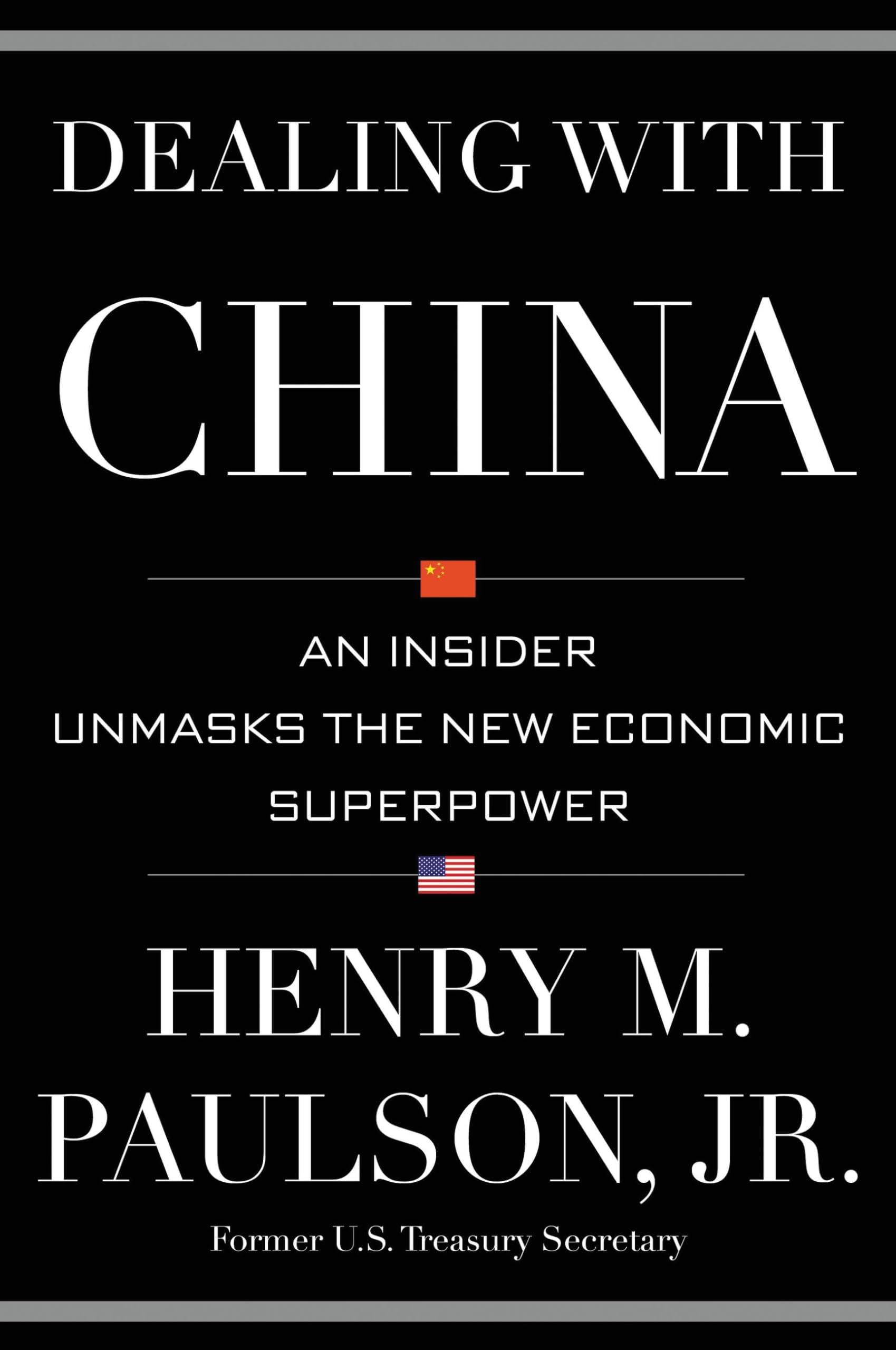
The New York Times bestselling author of Dealing with China takes the reader behind closed doors to witness the creation and evolution and future of China's state-controlled capitalism. Hank Paulson has dealt with China unlike any other foreigner. As head of Goldman Sachs, Paulson had a pivotal role in opening up China to private enterprise. Then, as Treasury secretary, he created the Strategic Economic Dialogue with what is now the world's second-largest economy. He negotiated with China on needed economic reforms, while safeguarding the teetering U.S. financial system. Over his career, Paulson has worked with scores of top Chinese leaders, including Xi Jinping, China's most powerful man in decades. In Dealing with China , Paulson draws on his unprecedented access to modern China's political and business elite, including its three most recent heads of state, to answer several key questions: How did China become an economic superpower so quickly? How does business really get done there? What are the best ways for Western business and political leaders to work with, compete with, and benefit from China? How can the U.S. negotiate with and influence China given its authoritarian rule, its massive environmental concerns, and its huge population's unrelenting demands for economic growth and security? Written in the same anecdote-rich, page-turning style as Paulson's bestselling memoir, On the Brink, Dealing with China is certain to become the classic and definitive examination of how to engage China's leaders as they build their economic superpower. Review: I'm so glad I read this book - I'm so glad I read this book. It has helped me understand the U.S.'s relationship with China a lot better. I especially appreciate the ecological work the Paulson Institute is doing in China and Hank Paulson's years of hard work opening good lines of communication with Chinese leaders. It will be interesting to see if the U.S. and China can create a balanced, perhaps symbiotic, relationship in the future. Although China is a country of "massives" - massive population, massive physical size, massive government influence, massive ambition, massive economy, massive military, and massive deceit, I don't feel as threatened by China after reading this book. The public may not be privy to all that goes on between China and the rest of the world, but the little we do find out about will be fascinating. Review: China, the Economic Power - Henry (Hank) Paulson has written another very significant and interesting book. Dealing with China:... is not nearly as exciting as On the Brink:... which treated the financial crisis. After all the United States economy was then in danger of entering another Great Depression. But Paulson has too much worthwhile experience with post 1978 China to ignore. Henry Paulson is a master salesman of financial instruments. He sold those instruments as a partner and CEO of Goldman Sachs. China was a major focus over the years. Paulson knows his customers, and the Chinese People definitely were not those customers. Instead, his sessions and many trips were directed successfully at powerful members of the Chinese Communist Party. I reluctantly awarded four rather than five stars for readability. Keeping track can be tedious. I spent about a month of spare time reading the Kindle version. There really are not many amusing moments to serve as respites. One is an incident with the US Navy that threatens to interfere with critical negotiations. The incident involves disrespecting a US aircraft carrier and DOD plans for retaliation. A mere ordinary Treasury Secretary might have trouble dealing with that situation. There are some parts of this book that I especially noted. Paulson almost talks the Chinese leadership into accepting the elements of financial capitalism. But the financial crisis, with Paulson as Treasury Secretary, creates some second thoughts. Goldman Sachs generated much of the structure for the crisis. Paulson is a conservative Republican, but he wants the Chinese to have a Government safety net as in the US. Why? Without the safety net, the Chinese save too much money and don't buy their products or foreign products. Also, unlike many of the politicians in his party, Paulson is an authentic environmentalist. He recognizes that the fantastically rapid economic growth of China creates a real pollution hazard and demand for resources. His own foundation now focuses on those problems. I understand that for family reasons Paulson was reluctant to write this book and probably will not write another. But if he does, I will read it.
| Best Sellers Rank | #2,325,033 in Books ( See Top 100 in Books ) #68 in Government & Business #130 in Chinese History (Books) #306 in Business Education & Reference (Books) |
| Customer Reviews | 4.4 out of 5 stars 420 Reviews |
D**K
I'm so glad I read this book
I'm so glad I read this book. It has helped me understand the U.S.'s relationship with China a lot better. I especially appreciate the ecological work the Paulson Institute is doing in China and Hank Paulson's years of hard work opening good lines of communication with Chinese leaders. It will be interesting to see if the U.S. and China can create a balanced, perhaps symbiotic, relationship in the future. Although China is a country of "massives" - massive population, massive physical size, massive government influence, massive ambition, massive economy, massive military, and massive deceit, I don't feel as threatened by China after reading this book. The public may not be privy to all that goes on between China and the rest of the world, but the little we do find out about will be fascinating.
A**K
China, the Economic Power
Henry (Hank) Paulson has written another very significant and interesting book. Dealing with China:... is not nearly as exciting as On the Brink:... which treated the financial crisis. After all the United States economy was then in danger of entering another Great Depression. But Paulson has too much worthwhile experience with post 1978 China to ignore. Henry Paulson is a master salesman of financial instruments. He sold those instruments as a partner and CEO of Goldman Sachs. China was a major focus over the years. Paulson knows his customers, and the Chinese People definitely were not those customers. Instead, his sessions and many trips were directed successfully at powerful members of the Chinese Communist Party. I reluctantly awarded four rather than five stars for readability. Keeping track can be tedious. I spent about a month of spare time reading the Kindle version. There really are not many amusing moments to serve as respites. One is an incident with the US Navy that threatens to interfere with critical negotiations. The incident involves disrespecting a US aircraft carrier and DOD plans for retaliation. A mere ordinary Treasury Secretary might have trouble dealing with that situation. There are some parts of this book that I especially noted. Paulson almost talks the Chinese leadership into accepting the elements of financial capitalism. But the financial crisis, with Paulson as Treasury Secretary, creates some second thoughts. Goldman Sachs generated much of the structure for the crisis. Paulson is a conservative Republican, but he wants the Chinese to have a Government safety net as in the US. Why? Without the safety net, the Chinese save too much money and don't buy their products or foreign products. Also, unlike many of the politicians in his party, Paulson is an authentic environmentalist. He recognizes that the fantastically rapid economic growth of China creates a real pollution hazard and demand for resources. His own foundation now focuses on those problems. I understand that for family reasons Paulson was reluctant to write this book and probably will not write another. But if he does, I will read it.
K**Z
Paulson's work shows in great detail what has been achieved by continuing American engagement ...
I would strongly suggest reading this book in tandem with Michael Pillsbury's 100 Year Marathon. Paulson's work shows in great detail what has been achieved by continuing American engagement with China. Pillsbury's contends that the economic reforms that Paulson anticipates are unrealistic and that a good deal of the economy will remain under state ownership and control. Both positions have their strengths and weaknesses. Paulson's account does demonstrate reasons to be optimistic because it contains a great many details about businessmen, state officials, and business schools trying to foster best practices. There are also those working with Paulson and his wife on environmental issues. Most importantly Paulson notes that China refused Russian pressure to sell American investments during the 2008 financial crisis in order to undermine the American economy and give Russia and China an advantage. He's also quite candid and critical about the endless subsidies to some state owned industries that continue to run up debts. I really enjoyed the details of the personnel and deals described and analyzed in this book, but I could easily imagine that other readers might find the mini resumes provided about nearly everyone in the book to be tedious. Paulson's editors should consider producing an abridged version to provide the book to a broader readership. One comes away from Paulson's book impressed by the innovative instincts that allowed Goldman Sachs to help large state owned companies raise capital through the kind of IPOs usually reserved for publicly owned private companies. Clearly such actions have helped produce the Chinese economic miracle. However if one reads Pillsbury after reading Paulson one comes away thinking that the real reformers that could liberalize the economic and political order have been out of power since the Tiananmen Square protests in 1987 He contends that the leadership depended upon both economic growth and state control to prevent future mass movements. More importantly they've chosen to misrepresent and demonize American history to fuel nationalist competition with a supposedly anti-China America. All of this does not suggest that the reforms that Paulson thinks can be realized with engagement is realistic. The reader can decide which side to believe but Paulson's book is a "must read" for anyone who wants to be part of the discussion about what to do about China's rise.
B**L
Refreshingly Positive Portrayal of Alarmists Favored Target
Really great read and very refreshing take on China's transformation over the past 30 years. Paulson very clearly admires and respects China's leaders. With few exceptions they are portrayed as very smart human beings who care deeply about their country. In contrast to many writers, Paulson found the Chinese to be honest and forthright. It is noted that change comes slowly while consensus is built with large groups of decision makers. Frequent mention is made of the Communist Party's ongoing struggles to root out bureaucratic corruption and fradulent business practices in a country with three times the population of the United States.
C**O
A book to be taken very seriously - but it has its flaws.......
Henry Paulson is a figure that must be taken seriously, especially on matters related to China. His private sector experience, coupled with his time as Treasury Secretary offers readers a very special opportunity......to hear and understand from someone who created opportunities but also had to deal with some of the largest risks of our generation. His experiences in China are valuable to both Democrats and Republicans, and he offers a lot of pragmatic examples of how the West can deal with a re-emerging, powerful China. Such an opportunity should be understood and read, by many; including those who are both for and against deepening relationships with China. Why I did not choose to give this 4 or 5 stars is the inherent contradictions at times, or lack of broadening his arguments and examples beyond those of Goldman Sachs. The first third of the books is fascinating, learning how Paulson and his team 'built' the GS business in China. No easy task, and certainly one that provided a 'game changer' in many regards to their respective business. I personally enjoy reading these 'case studies' as they offer valuable insight on how deals did or did not happen. But was GS the only 'smart people in the room'? That is what you are left with thinking. Perhaps some greater humility and expansion on the other great generations of American entrepreneurs, and not just in the finance world, would have also been valuable for Mr. Paulson to add. He also details key personal relationships with some of the most senior leaders in China; again, very helpful and where Mr. Paulson's book has great value. This personalization hopefully allows those not so familiar with China to better understand that not everyone in the senior leadership in China is an ideologue or evil person. They are quite often, shrewd, pragmatic, strong leaders aiming to help their country develop and reform. However, some of these details of relationships includes officials who have found themselves on the other sides of the law. And granted, in China, this is a very complicated item to predict ---- which officials will or will not be swept up in the anti-corruption campaign given its depth and breadth. But I want to focus on Paulson's descriptions on the now-disgraced Zhou Yongkang, who is sitting awaiting a public trial on corruption charges. The passages I was waiting for Mr Paulson to include near the end of the book.............was an attempt at distancing himself from Mr. Zhou or reinforcing his strong commitment (as captured in other chapters) about how corruption really detracts from the Chinese reform agenda. This didn't happen as I hoped, when Mr. Paulson merely skims over this with regards to Zhou; I find this very strange given the corruption allegations and that this is one of the most senior officials in Chinese history to be accused of corruption and kicked out of the Party. Why Mr. Paulson did not choose to add this facts or an addendum before publication seems baffling. Perhaps he and the publishers should reconsider this; otherwise, those who strongly know and follow China, will be left with how Mr. Paulson came to know Zhou in his days as the Chairman of CNPC only, tarnishing Mr. Paulson's often, impeccable sense of judgement. This is a reason for 3 stars. Lastly, I want to applaud Mr. Paulson's commitment to the natural environment and for linking environment with economic issues. The two are very heavily linked, and I have a new found respect about his commitment to forwarding the environmental causes that the world has, and that China needs to solve in a very critical sense. I recommend this book to all of those interested in US-China relations, as well as those interested in people who played a great role in our current history ---- Mr. Paulson is someone very credible in both regards and I look forward to seeing what his Institute can further accomplish.
W**R
A Bankerโs Banker
Henry Paulsonโs subtitle โA Insider Unmask โฆ.โ Is the strong point of this work. As the president of Goldman Sachs, Pres. G. W. Bushโs Secretary of the Treasury and now head of the Paulson Foundation , Paulson has had an open door to intimate discussions with the top leaders of the Peoples Republic of China, an opportunity afforded few others from the American Establishment. As he mentions in passing their existence very well guarded their operations very opaque. What he reveals in his rambling but insightful observations is perhaps the best available account of the difficulties the system faces in its existing structure, the reforms that have been called for and the problematic paths to carrying them out, both for the Economy and for the controlling Communist Party. He is sympathetic for China finding a way forward for a healthier world economy but also for the opening of greater profitable opportunities of Goldman Sachs and othersโ investments in China and Chinaโs investments in the American Economy. I found answers to many questions I had regarding the tax structures of the PRC and other issues of interest, but also perhaps the most insightful discussion of the driving force behind the desires of President and General Party Secretary Xi Jinping and Prime Minister Li Keqiang. What ever your interest in China this is likely a revealing story, if sometimes ambling and highly personal. He ends on a high note: โAt the risk of sounding utterly simplistic, once we have dealt with our own problems, we will find it far easier to deal with China.โ How timely.
R**Y
Insightful.
My son had a video of the book, which I enjoyed. I bough the book for my other son, who is a very avid reader. There is absolutely no question that Paulson is a very intelligent man, and was a great leader at Goldman Sachs. They sorely miss his leadership now, with little or no integrity left at the firm. I do question if Mr. Paulson had the Financial Industry, rather than the great American, taxpaying, middle class at heart when he called for the bailout of his Industry while he was Secretary of the Treasury. I think his career influenced his thinking.
J**J
A must read! Shocking details.
Great book to read. This book will give you an understanding of how China became the number two economy in the world. Hank Paulson Jr. taught the Chinese government how the banking system works and so much more. China didn't become a powerful economy on their own. The U.S. made them powerful in so many ways. This book explains the most vital way. The Chinese government were smart to keep their mouths shut, observe and take notes.
M**E
ARTICOLATO, MA PESANTE
Interessante, ma un vero mattone...
A**R
Great read
In-depth topics discussed
B**D
How to Develop a Relationship with a Different People, China Rising.
Paulson has demonstrated a much better logical understanding of China and how they do things. Their progress has been remarkable. They are people of hopes and great progress. Their government system is effective and improving. This book should be mandatory reading for Congress, Senatae and President. Instead of mistrust and demands, cooperation with China could serve as a model of how to get along with the different peoples of the world. The chinese approach to change serves as a good model for the rest of the world. This book will have longivity.
M**D
Positive and Constructive Opinion on US-China Relations.
China: The new international economic monolith. A nation whose future is written in the stars as a world leader, or so we've been led to believe. Henry Paulson delivers here both a clear and concise history of doing business in, and with, China and also provides a blueprint on how to improve business relations with the Asian giant in the future. Paulson himself is an expert in his field and I found 'Dealing With China' to be both hugely informative and very entertaining, especially as I have minimal knowledge and understanding of business practices in general. The author presents his work in clear and understandable language and I was greatly impressed both by the change that has taken place in China over the past twenty years but also the very positive and productive co-operation that has taken place between the United States and the Chinese. Mr. Paulson's book makes for a refreshing change. Mr. Paulson has spent nearly twenty years doing business with the Chinese. Whilst working for Goldman Sachs since the late nineties, through to his time as Treasury Secretary in Bush Jnr's government and his work beyond, the author provides a fascinating account on how he and his colleagues worked with China's leaders to assist them in building up and re-organising their burgeoning economic might. The gargantuan state operated enterprises (SOE) that characterised China's economy were unproductive and noncompetitive, making losses so huge that the true amount could not be ascertained. Paulson and Goldman Sachs provided much advise and expertise on where to make the correct alterations in order to achieve success. The first half of the book documents Paulson's time at Goldman Sachs and the processes employed to assist the Chinese including the re-organising of their industries, the changing of business practices and also the training of executive managers who are skilled enough to make the decisions required to succeed. The author became Treasury Secretary in 2006 and was to play a huge role in the creation of the Strategic Economic Dialogue (SED) between the United States and China. The SED, and it's successor under the Obama administration; the S&ED, has since become a major pillar in bilateral relations between the two nations. Indeed, the author highlights and re-emphasises just how co-operation is essential to future bilateral success and this constitutes a running theme throughout the book; the many positive benefits that come from constructive dealings with China and it's leaders. This is also assisted by the author's personal relationships with China's leaders. A huge amount has been achieved over the previous two decades, however, much more needs to be accomplished. Mr. Paulson is above all a realist and gives significant attention to issues and problems that China still faces in it's battle to achieve greatness. Much reform still needs to be made by China both socially and economically. SOE are still very noncompetitive and sluggish. These same SOE provide many non-profitable services and facilities to their workers who still need to be provided for in a post SOE environment. China still relies too much on it's exports to power its economy and needs to develop an internal market for commodities and services which is still some way from being achieved. There is great inequality in wealth, crippling corruption is rife and there are huge environmental issues which need to be dealt with thanks to Chinese cities rates of industrial production, something the author takes a personal interest in. Mr. Paulson also states that, in his expert opinion, a certain amount of political reform may need to occur in order for China to develop a truly competitive free-market economy; constructive criticism from an expert in his field. I have always been of the opinion that China's 'rise' is not inevitable and much needs to be done in order for the country to become the world power its been slated to be and Mr. Paulson's work confirms this view to an extent. China has come a very long way in the past twenty years, yet more needs to be done in order for that growth to continue, and the author acknowledges exactly this. This is an excellent work and is both a history of dealing with China and also a guide to future success as well. Above all, I was impressed by how much both US and Chinese officials were willing, and indeed are willing, to work together and build a secure world order.
S**Y
Probably a 3.5 out of 5 but worth a read
Henry Paulson has had a long and distinguished career both as an investment banker at Goldman Sachs and then as US Treasury Secretary. This book details accounts of his visits to China in many different roles. As investment banker he talks about structuring deals various Chinese SOEs, as Treasury secretary his dealings with the Chinese top leadership and then as founder of the Paulson initiative the efforts he took to bring the two countries together. As a matter of fact the book is equally divided into three parts to account for the three different roles he played. The first two parts where he talks about his Goldman stint and his role as secretary are filled with amazing experiences and stories which really take you up close with what it was like dealing with China right from the 80s to the late 2000s. However as the book enters into the third part it becomes less interesting as the anecdotes and personal accounts are replaced by general ideas and observations of the author which become very repetitive. This book is still definitely worth a read as it is written by Henry Paulson and gives you a brief account of the way he dealt and did business with the Chinese. The book has its moments but it is probably about a 3.5 out of 5 but since that wasn't an option I'm going to go with a four.
Trustpilot
2 months ago
3 weeks ago