


Blood Meridian: Or the Evening Redness in the West (Vintage International)
Desertcart purchases this item on your behalf and handles shipping, customs, and support to Tunisia.
Description
📖 Own the brutal beauty of the West’s darkest legend — don’t just read history, live it.
- TOP RANKED BESTSELLER - Join thousands of discerning readers—ranked #2 in Westerns and #25 in Literary Fiction, with over 21,700 reviews averaging 4.3 stars.
- TIMELESS VINTAGE EDITION - Own a pristine 56th printing of the iconic May 1992 Vintage International edition—unread, unmarked, and ready to impress your collection.
- LITERARY MASTERPIECE WITH DEPTH - Dive into one of the greatest American novels of the past century, praised for its complex prose and unforgettable characters.
- EXCLUSIVE FOREWORD BY MARLON JAMES - Gain fresh perspectives with a new foreword by acclaimed author Marlon James, adding contemporary relevance to this classic.
- INTELLECTUALLY CHALLENGING REWARDING - Experience a narrative that demands your full attention and rewards with profound insights on violence, history, and human nature.
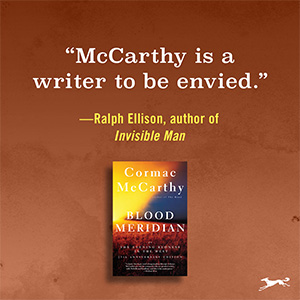
Blood Meridian: Or the Evening Redness in the West (Vintage International) is a 56th printing of the May 1992 first international Vintage edition, a trade softcover that remains unread and unmarked. Celebrated as one of the greatest American novels of the last century, it offers a harrowing, poetic exploration of violence and morality during America’s westward expansion. With a new foreword by Marlon James, this edition is a must-have for literary connoisseurs and fans of complex, challenging narratives.


Specifications
| Dimensions | 5.2 x 0.74 x 7.94 inches |
| Isbn 10 | 0679728759 |
| Isbn 13 | 978-0679728757 |
| Item Weight | 2.31 pounds |
| Language | English |
| Print Length | 368 pages |
| Publication Date | May 5, 1992 |
| Publisher | Vintage |
Reviews
User
A worthwhile, violent challenge
Blood Meridian is not for the faint of heart or for relaxing entertainment. It was for me, immensely challenging in parts, and there is no lack of horrific gore throughout the book. I guess that's why I have such praise for it. I just finished about 30 minutes ago, and I know a book has affected me when I have to sit for a while and let my mind digest what I've read, as best as it can. It's been a long time since I've felt the need to re-read a book, but I suspect in a year or so I will go back to it because the density and complexity of the prose is such that I'm sure that I will be able to glean more from it with at least a second reading.I'm embarrassed, as a reader, to say that this is the first Cormac McCarthy book I have read, and it's taken me so long to finally get to it (I am 44 years old). In some ways, it brought back the feeling I had the first time I read A Clockwork Orange when I was 12, and I loved it, even though at the time much of the language confounded me since Burgess just made up his own slang, so I had to read it again. It's really a good feeling, oddly. Also, this is a much "easier" read on Kindle because McCarthy refuses to translate when conversations occur in Spanish, at times uses archaic vocabulary, which may or may not include old west American or Spanish slang. You won't find every word or phrase in the Kindle dictionary, translation, or Wikipeida, but it helps often.There are parts of this book, especially towards the end, that definitely feel like scenes from "No Country for Old Men" even though No Country is a modern setting, and Blood Meridian is old west. They are very different stories, but they share a theme of a man against unstoppable forces (crazy guy/nature/the universe/fate/luck).In Blood Meridian, many of the characters are not even given names. The book begins with a character simply referred to as the kid. No quotes or capitalization, just the kid. The other primary protagonist is the judge. These are two of the most significant characters in the book, while other, lesser characters are named unceremoniously and with little or no background, and go away just as quickly. McCarthy forgoes standard pronunciation during conversations, so sometimes it is difficult to discern who is actually speaking. But, it's all part of the demonstration of how this band of mercenaries meld into a single, violent organism.The book begins with the kid, but his "character" disappears throughout much of the book as he is absorbed into the group. He's mentioned occasionally, and when he is it is significant, but rare until the latter part of the book when he emerges again as a primary in the action. The judge, on the other hand, remains a primary figure throughout the book once he is introduced, and he's a fascinating, hulk of a man, hyper-intelligent, talented, despicable, and insane. He is not the official leader of these mercenaries, but drives this group of mercenaries to become what the do.The prose oscillates between long descriptive passages as they ride through the southwest and Mexico and back up to the west, bloody massacres that include truly brutal acts that made me wince (and I'm not squeamish), and scenes of debauchery. Once these men begin to meld, much of the descriptions are of the land that they ride through and endure, and there are many long paragraphs and run-on sentences that weave the descriptions with primary theme in the book, which is, I think, the nature of violence in man and nature, and what it means to dominate, kill, and destroy. This is not just manifested in man but in all facets of living and dead and things that never lived.It's not an easy book. It is up there with the most complex works by Dostoevsky or Joyce but it is intellectually, spiritually, and emotionally challenging that I feel is very rewarding.
User
Comparisons to Faulkner and Melville valid, but a laborious read
Let’s start with the most common complaint about this book. Yes, almost all the characters are violent, but that word doesn’t convey the sheer cruelty inflicted in this story. Certainly all the main characters are violent including the protaganist, “the kid”. The few minor characters who are not are generally brutalized. I quit reading for a few month less than halfway through. When I picked it back up I finished the last two hundred pages in a long day. I guess I was better prepared for the violence and the lack of morality in all the characters, but I also felt I was becoming densensitized during my second attempt. If you read the backcover or a critical summary you should be aware violence is at the core of Blood Meridian, it shouldn’t be a suprise. But the depth of it might.Now this is the type of read that for the average reader, like myself, can be laborious. I do not have the skill to be a book critic and struggled as an English major to understand the intracacies of some masterful writers, compared to my professors and some fellow students who quickly identified subtext and points of style. McCarthy is one of those writers, certainly Blood Meridian is one of those works. This novel is often compared to Moby Dick or Faulkner’s top writing, and the comparison is spot on for me. I struggled to understand the subtext of what is being said, re-reading McCarthy’s frequent long descriptive sentences which are amazing to behold. They can be longer than a typical paragraph but are smooth and flow perfectly. I could never pull that off, it would either be a disjointed run-on sentence or it would take me ten maybe twenty sentences to convey what McCarthy does in one. What is amazing is these are common throughout the book, every page is filled with them. I can only imagine how much work went into each page, this is clearly the result of many years of focused effort.Similarly, I hear complaints from others or see complaints in reveiws regarding McCarthy not using quotation marks to highlight dialogue. This is a hallmark of his work, and he is not the first nor last to choose such a style. I think too much is made of this by people who really just didn’t want to put in the effort to read the book. Which is fine, this is not a traditional Western in any way, its not a tradtional mindless entertaining story. That’s one reason I am just reading this at age fifty and I am a fan of McCarthy. I have had the book for ten years and just read it. I knew going in it was the type of book you need to prepare for. But I don’t believe most people who claimed they couldn’t tell when a character was speaking are being honest. More likely they are just annoyed as it takes more effort to follow who is speaking, to re-read to understand, and if you want to skip the long descriptive sections to jump to the next scene of dialogue it is hard to do without quotation marks. This is just not an issue. Is it a gimick by McCarthy and those who pull it off? Maybe, I don’t know what they have said about the style but I suspect its more about flow and keeping the text clean. The pages do look beautiful and that affects your mood when reading. Also, quotation marks and other punctuation does in fact effect the cadence of you reading. Regardless of all that, I don’t believe it will effect most readers and is a weak complaint.As I mentioned, there are many long descriptive sentences. Sometimes there are pages of this with minimal action occuring, but you tend not to notice unless you are really analyzing the style. Very vivid, I could visualize almost every scene, and appreciated McCarthy’s ability to be so descritpive while simultaneously leaving specifics of how we visualize up to us individually. I suspect how I see each character is different than everyone else, but we all enjoy vivid scenes. For this reason I hope they don’t make a film version of this. For one, I think it would be a failure, especially in today’s hypersensitive PC climate, and two, I just think it would be impossible and an antithesis to what McCarthy’s writing accomplished.I did struggle with the last twenty pages, because, as I’ve said this is not a book where the story is solely at the heart of things. Symbolism and style are equally as important. And the judge as a character is the most complex. The final encounter and how things were left was at first baffling to me, but after re-reading the last few pages I loved it. Won’t ruin things but there is of course room for interpretation. Sometimes I hate that, sometimes it works. For me at least, this time it worked. The epilogue was however completely unnecesary and a distraction. I get what its saying but its like hitting me over the head. I almost feel like ripping that page out it seems so out of place, like a teacher told him, now put this in so it will all be tied together and the stupid people will “get it”. I might be one of those stupid people and I just found it annoying.Overall, I enjoyed the novel once I came to accept the inclusion of so much violence, and am glad I set aside mental space to read it and time to chew on what it was saying. If you want to read a real western, stick with Zane Grey, Elmore Leonard, even Louis L’Amour if you want the heart of the genre. If you want a taste of the true history of the west in the mid 19th century, framed with an exploration on man’s capacity for violence and cruelty, pick up a copy of Blood Meridian. Just allow more time for the read and you’ll likely get more out of it.
User
McCarthy’s post-modern Western is both sprawling and meticulous
McCarthy’s post-modern Western is both sprawling and meticulous. Throughout Blood Meridian, the narrative is, at times, deeply immersive, plunging you into the tactile horrors of a lawless world inhabited by idiosyncratic characters. At other times, the prose is caught in a torrent, a rapid succession of sentences that impatiently hasten the reader as the narrative traverses a vast sweep of events with incredible velocity. As a result, much of the detail can feel inconsequential, but the delivery, lean as it is, is almost akin to Hemingway. It might be easy to mistake these seemingly fleeting moments as banal, unaware of the detailed composition being laid out. When McCarthy decides to pull focus, we are gifted with straightforward and captivating storytelling.McCarthy challenges the traditional understanding of Western storytelling as we follow a band of miscreants, devoid of anything resembling Roy Rogers, and make no mistake: Blood Meridian is brutal and raw. However, McCarthy’s use of violence is not gratuitous; it signifies a separation from benevolence—that we are bearing witness to nature’s most primal indulgences.The introduction of our titular character, The Kid, wastes no time, and much of this urgency carries throughout the book with The Kid serving as our protagonist, if one is to be found. The minimalistic narrative is reflected though sparse dialogue, but when McCarthy does indulge us, he delivers with provocative monologues and sharp wit. With his verbose dialogue, figures like The Judge directly challenge your philosophical assumptions and many of the personalities we encounter, each possess a distinct appeal, existing within that space beyond the reach of morality and virtue.At around 350 pages, Blood Meridian is a moderate read through a violent and savage world, whose vivid scenes will linger long after. It is a modern take on the Western—a focus on brutality and human nature unbound by the restrictions of society, and a profound deconstruction of the tropes commonly found within the genre. Blood Meridian has more in common with McCarthy’s post-apocalyptic novel, The Road, than you might expect from a typical Western.
User
A challenging and worthwhile read
Rarely, okay, never have I read a book which is so simultaneously abhorrent and appealing. Blood Meridian is a book that treats violence as a commonplace occurrence, and offers little respite in its continual assault on all (or anything, please anything) that is good in the world. The prose is stark, direct, and often undefinable (perhaps somewhere, but I often found words for which no definition can be found). The novel immerses you in a world of evil and violence far more terrifying than any post-apocalyptic book can create. And this, indeed, is how I came to this “masterwork” by Cormac McCarthy (bio). I’ve read a few of his novels, and consider “The Road” (blogged about here) one of my all time favorite novels.This novel centers around “the kid” in the 1850s as he travels from his home state of Tennessee and joins up with the Glanton Gang, a real-life group of killers (there are probably more appropriate terms, but I’m calling them what they are) led by John Joel Glanton. Hired by the Mexican government to fight off attacking Native Americans, they killed any Native American they could since they were paid by the scalp. Women, children, unarmed men — it makes no difference. Even non-Native Americans were not exempt for their depravity as all of humanity appears to be at their disposal. What makes McCarthy’s descriptions so unnerving is the calmness and detachment used in describing the killings. You can almost read through some of them before the horror of what is happening dawns on you. I’m reminded of Tim O’Brien’s writing about the My Lai massacre during the American war in Vietnam. In the Lake of the Woods is a novel about a politician later found to have been involved in the massacre. But the most disturbing part of the book is not the fiction, but a chapter of excerpts from the actual court-martial records. What you see is this same dispassionate account of brutal abuse and killing. As if the event itself is not horrific enough, the presenting of it as a normal occurrence makes it even worse.McCarthy’s prose is powerful. It can edge on the dramatic, and at times tips into the over-dramatic category, but its power is clear."Under a gibbous moon horse and rider spanceled to their shadows on the snowblue ground and in each flare of lightning as the storm advanced those selfsame forms rearing with a terrible redundancy behind them like some third aspect of their presence hammered out black and wild upon the naked grounds. They rode on."The phrase, “they rode on,” is the perfect balance to that long, intricate preceding sentence. Language like his can be hard to follow in our quick read society, but a slow and thoughtful read pays off. Plus, he reminds you of the beauty of words (and perhaps I just tipped into the over-dramatic category).While “the kid” is the anti-hero of this anti-western, it is the Judge who stands out as the most memorable character. A large, hairless, white man, he is often naked and always calm. He appears to be waiting for others as they come to him, and his intellect puts him ahead of both enemies and his fellow travelers. He makes observations in his notebook in order to understand and thus control the world, and is given to long, fascinating discourses on a variety of topics. He is both God-like and devil-like, omniscient and monstrous, and terrifying in his outreach.Toward the end of the book “the kid” faces off with judge, the culmination of a relationship in which they dance around one another throughout the book."The judge smiled. He spoke softly into the dim mud cubicle. You came forward, he said, to take part in a work. But you were a witness against yourself. You sat in judgement on your own deeds. You put your own allowances before the judgments of history and you broke with the body of which you were pledge a part and poisoned it in all its enterprise. Hear me, man. I spoke in the desert for you and you only and you turned a deaf ear to me. If war is not holy man is nothing but antic clay."It is as if “the kid” recognizes his role in evil, and by the recognition (for there is no repentance) he has broken the fabric of their community. He recognizes the judge as the one behind the evil, but he cannot separate himself. As the judge says, “What joins men together is not the sharing of bread but sharing of enemies.”Clearly, this is a disturbing novel. The fact that McCarthy bases this on historical occurrences does not allow us to write this off as some post-apocalyptic fantasy. Instead, we have to face the judge and his comments about our own culpability in human affairs."You can find meanness in the least of creatures, but when God made man the devil was at his elbow".
User
A Great Writer Unfortunately Defined by What He Left Out
McCarthy is not for everyone. The violence of Blood Meridien is graphic and pervasive, but is also cold and emotionless, and it dehumanizes many of the characters. I found no dark humor here, only darkness, but not evil. Of course there are evil acts perpetrated by nearly everyone McCarthy chose to include as a character and those who don't are either killed before they have a chance, or shown as fools to juxtapose the reality of western expansion of the United States. So the question that arises is "why?"McCarthy based this book on real events, the participation of the eradication of the indigenous population of North America by scalp hunters paid by the Mexican government to track down and kill Indians, the scalps serving as receipts to prove that Indians had been killed. When caught by Indians, the scalphunters suffered the same fate and worse at the hands of their intended prey, which left a river of blood in the wake of these marauding bands. McCarthy's point here is to destroy the romanticism of how the West was won that has supplanted the reality of genocide and ruthless destruction. The West was won by an almost unimaginable amount of killing, Indian and buffalo alike, by our ancestors, and McCarthy wanted to write a book about how and why people ended up doing this, and wipe out the hideous mythology of sentimental and delusional western hacks like Louis L'Amour. At this he succeeds brilliantly. No one who reads this book should ever think of the American West of the 19th Century in the same way again.Part of what drives the book and its characters is the love of war by some, and the acceptance of war by others. The relevance to our current foreign policy situation is even more startling than when McCarthy wrote the book in the 80s.McCarthy's wordcraft is everything it's hyped to be. There aren't many writers working today who can craft descriptions of the landscape with as much compelling wonder and detail. One section early in the book, a long, unpunctuated description of a band of men attacked by Commanches, stands as far as I'm concerned with some of the greatest literary achievements in history, Hamlet's soliloquy, the last few pages of One Hundred Years of Solitude, the opening scenes of The Sound and the Fury, the death of Joe Christmas in Light in August, chapter 4 of V, Joyce's The Dead, just to name a few off the top of my head.Yet there was something missing from this book that weakened it for me. It is a great book, but not a perfect book, and that is because McCarthy has no use for women. Even in scenes with women, they are tossed aside as unimportant. This is a book about men, he leaves no doubt, but he never even for a moment speaks of sensuality, need, and desire, and despite his wilingness to describe violence in lurid detail, his view of the human experince remains myopic. He barely mentions sex, and refuses to detail it despite his chances to. Graphic violence is everywhere, these are men passionate about their killing, yet their sex lives are so glossed over or ignored they stop seeming like men. One could imagine a band of robots sitting in for the men in this book because it is bereft of the most human of desires. This huge absence left me sad because I wanted to really love this book, and love this writer, but he is so ensconced in masculinity and unable to even approach the female side of his male characters, let alone the females characters, and the mens' needs for them, that ultimately I was put off. Blood Meridien could have stood as an example of the great American novel, but instead it stands as a brilliant near-miss, a great book that missed its chance to be the greatest, letting itself be defined by this failure. As an example of being able to encompass violence and sensuality, I feel I know what I'm talking about, thusly: Mad God
User
A book unlike anything ever written
The central character in Cormac McCarthy’s “Blood Meridian” says at one point, “Whatever exists in creation without my knowledge exists without my consent”. The book that details his journey surely seems like it could not have existed without his knowledge and consent.There are a few universals that fill a McCarthy novel: the crudity and Neo-Biblical, fire-and-brimstone bleakness of human sagas with no respite in sight, the almost complete absence of women, the haunting, bone-chilling, lyrical physical descriptions of nature and devastated landscapes, the metaphors literally dripping from every sentence, and – ubiquitously so – the brutal violence and desperation. But “Blood Meridian” stretches each one of these plot devices to the breaking point. Critics have universally praised it as one of the best American novels of the past 25 years and heavyweights like Harold Bloom have said it’s the most significant encapsulation of all of human frailty and triumph since ‘Moby Dick’. Yet it remains one of the most complex, challenging and exhausting works of fiction I have ever read, and this feeling seems to be widespread.It’s certainly the most extraordinarily violent. The violence here is mind-numbing, routine-as-rain and runs on every page like fresh blood pulsing through a healthy artery. For several days when I was reading and re-reading the book, the story was lodged like a splinter in my brain, not letting go even when I was away from it; as one reviewer of the volume put it, there is no safe space (not in the contemporary sense of the term) from which you can watch what unfolds. But it was the kind of splinter whose pain and beauty you want to feel before you finally dislodge it in a final act of defiance. And even though I read it as carefully as I could, there are parts I will have to read again so that I can fully digest their mystical properties. When I finished I was glad to be done with it and just felt like sleeping, and yet I will re-read it at some point in time; it's a bone-rattling wine that makes you sick but ages with time and contains mysteries that are still waiting to be plumbed.The book is challenging and exhausting for several reasons. The plot is set in 1840s Texas, Mexico and the American Southwest, and the language is often a bastardized mix of English and Spanish from that era; if you understand Spanish you will have a leg up. But that’s the least of the obstacles. Anyone who has read McCarthy knows how a single one of his sentences routinely fills an entire paragraph or even entire pages. Not just this, but these sentences can consist of garbled verbs and nouns and sometimes words that are pure inventions: there was more than one occasion when I looked up a word in a dictionary, only to find that just like McCarthy’s fevered creations, it’s a phantasmagorical thing that only exists in the heaven and hell of his characters. There is plenty of free association in the book, but somehow, this free association often congeals into a kind of mesmerizing, rhythmic meter.The basic story centers on a boy of 14 years who joins a gang of bounty hunters who are hungry for Indian scalps. They ride on through the American southwest, regularly encountering various tribes of Indians and massacring them, scalping them, and parading these bloodied trophies around. In the process they also kill, maim and mow down hundreds of innocent men, women and children who have done them no harm. After each of these “missions” they ride back into town, collect their bounty and revel in a night of drunken excess and destruction before setting off on their next bloodthirsty trip through bleak and cruel lands. Like many other McCarthy stories, this begins in mid-stride, seemingly without a beginning and a background, wrenched from the orderly march of destiny. Who is the kid? Where does he come from? What is the historical context in which he lives in his life? None of this really matters. His actions simply are.Although the story centers on the kid, the main character is a man called the Judge who has to be one of the most fascinating characters in all of fiction. He is a terrifying, large, sweaty, bald, crude hulk of a violent creature, capable of crushing heads simply by squeezing them. Blood and guts permeate his entire being, his naked body often providing the backdrop to some of the most gratuitous scenes in the narrative. And yet like Whitman he contains multitudinous contradictions. He engages in extended, complex disquisitions on every topic from evolution to astronomy, from philosophy to religion, from morality to agency and the Bible. He dances little jigs when in the mood. This murderous psychopath is, almost violently disgustingly, a kind of gentle Darwin, constantly sketching scenes, fossils, flowers and other natural objects in a little notebook around the fire and holding forth on the timeless beauties of the rocks and stars to young recruits. His extended monologues comprise some of the most interesting, deep-seated and shocking parts of the book, and ones that will almost certainly take more than one reading to fully digest.Here’s one excerpt, one of the more comprehensible ones:“The universe is no narrow thing and the order within it is not constrained by any latitude in its conception to repeat what exists in one part in any other part. Even in this world more things exist without our knowledge than with it and the order in creation which you see is that which you have put there, like a string in a maze, so that you shall not lose your way. For existence has its own order and that no man’s mind can compass, that mind itself being but a fact among others.”For the Judge and the other men, violence is not something to be done, something to be inflicted on friends or foes; it’s simply their natural state of being. Just when you think the killing in these pages is conveniently making you numb, there is a fresh instance of it that delivers a blow in a wholly novel manner. There is no swashbuckling cowboy and Indian story here, although there’s certainly plenty of the lawlessness and the casual, break-bottle-on-head kind of violence which was prevalent on the frontier in those times. But that’s just the beginning. When someone is not being scalped, they are being pierced by arrows; when they are not being pierced by arrows their brains are being smattered on the walls. If it’s not bodies of babies strung out on a clothesline, it’s pet dogs being bound to their owners and cast alive into a fire. And all this happens relentlessly, often without rhyme and reason, at the drop of a hat. Violence and war here simply exist, infused into every emotion and cell and fiber of the world.But the violence in the narrative is not just physical; it extends to the violent descriptions of pretty much everything. Man in this book is reduced to his primal state, wallowing in his own blood and filth. Random characters who seem to serve no further purpose are depicted as naked, bound in chains, with a leash around their neck if alive; split open, their entrails spilling out and being eaten by wild animals if dead. The animals in the story are desperate and wretched; wolves constantly trail the party and subsist on human and animal bones, lizards crawl out of the rocks and drink the men’s spittle and horses routinely buckle under in a heap of broken bones and spurting blood when they are shot. And not just the living organisms but the rocks and trees and weather and stones and lightning and arroyos and rivers and sand and houses and stirrups and food and whiskey and guns and nooses and feathers; all of these seem to cry out with crudity and conflict. And sometimes they evoke great beauty.At least half of the narrative is devoted to descriptions of the gang just riding through landscapes of wind and rain and fire and sunsets and sand and storms and snow and heat whose descriptions drip with high metaphor, often mesmerizing; sometimes these streams of consciousness go on for pages. Here’s a typical - although atypically short - example:“They rode on and the sun in the east flushed pale streaks of light and then a deeper run of color like blood seeping up in sudden reaches flaring planewise and where the earth drained up into the sky at the edge of creation the top of the sun rose out of nothing like the head of a great red phallus until it cleared the unseen rim and sat squat and pulsing and malevolent behind them.”And a stunning, poetic one-sentence description of a war party of Indians on the horizon, defying any I have seen before:“A legion of horribles, hundreds in number, half naked or clad in costumes attic or biblical or wardrobed out of a fevered dream with the skins of animals and silk finery and pieces of uniform still tracked with the blood of prior owners, coats of slain dragoons, frogged and braided cavalry jackets, one in a stovepipe hat and one with an umbrella and one in white stockings and a bloodstained wedding veil and some in headgear or cranefeathers or rawhide helmets that bore the horns of bull or buffalo and one in a pigeontailed coat worn backwards and otherwise naked and one in the armor of a Spanish conquistador, the breastplate and pauldrons deeply dented with old blows of mace or sabre done in another country by men whose very bones were dust and many with their braids spliced up with the hair of other beasts until they trailed upon the ground and their horses' ears and tails worked with bits of brightly colored cloth and one whose horse's whole head was painted crimson red and all the horsemen's faces gaudy and grotesque with daubings like a company of mounted clowns, death hilarious, all howling in a barbarous tongue and riding down upon them like a horde from a hell more horrible yet than the brimstone land of Christian reckoning, screeching and yammering and clothed in smoke like those vaporous beings in regions beyond right knowing where the eye wanders and the lip jerks and drools.”One scene that deals with the horrible massacre of Indians like these is another single sentence one that goes on for several pages. You can of course tear away your eyes, but the only recourse for doing that would be to stop reading and step away. Once you are committed to the narrative however, it has contaminated your soul, so it would seem pointless to not trudge on.Taking a ride with the Judge and his fellow scalpers feels like taking a ride through Sodom and Gomorrah with Lot, except that these men are the malevolent God of the Old Testament who are committed to raining fire and misery on the world. McCarthy’s predilection for Neo-Biblical, apocalyptic tellings is well-known; “The Road” featured some of these doleful ingredients at their most effective. And yet the central core of “The Road” was the tender relationship between father and son. There is no such redeeming relationship in “Blood Meridian” except the occasional fleeting bonds between men engaged in casual murder. In fact there is no redemption in the book at all, and that’s what makes it so wholly unique.What is the rationale behind this kind of murderous, nihilistic writing, a vision for the end of time that never ends and keeps sucking the marrow from our bones, albeit in its own lyrical manner? Cormac McCarthy is a very private person who has granted maybe three or four interviews over the past twenty-five years. But a clue comes from his interview with – of all people, Oprah – which takes place at the Institute for Complexity Studies in Santa Fe, a scientific organization at the forefront of interdisciplinary research. In it McCarthy confesses that he has always liked hanging around scientists much better than around artists and writers. In fact he seems to have almost shunned contemporary writers. His scientific eye is evident in the often excruciatingly graphic details of physical landscapes and human anatomy that he provides.And it is this love for describing things as they are in all their gory detail that I believe provides a window into McCarthy’s writing. McCarthy’s men seem to engage in a kind of inexorable, stark Darwinian extravaganza; just like the cruel laws of nature which are made bright through tooth and claw, the wanton killing and maiming here seems to be part of a Darwinian cycle of rebirth through murder. Just like mutations and nucleosynthesis and entropy and life and death, the violence in these pages just is.There is still a key difference, however: unlike Darwinian evolution which somehow also manages to produce butterflies and tulips and kindness and altruism, there seems no redemption at the end of “Blood Meridian”. And that’s perhaps the best way to read it, as a story that can only be described, not explained.
User
He says that he will never die.
Well that's three for three for Cormac McCarthy. Three books read, three books on my 'favorites' shelf. To say that I am impressed is an understatement, and to say that I am glad to have found him is the same.It is impossible--or at least was for me--to begin reading Blood Meridian without having heard anything about it. And what one hears generally surrounds a theme. "Blood Meridian is the most violent book I've ever read." That is the typical utterance. So naturally I began the book with some form of an expectation. Is it the most violent book I've ever read? Well, yes, it probably is. I've read other violent books, but this one seems to have more... purpose than those others. It seems to cut deeper, to scream louder. Death permeates these pagesNow, readiness for violence was not my sole expectation upon starting the book. One comes to expect greatness when it comes to McCarthy's prose, and he always delivers. His dialogue the same. I think he is undoubtedly one of the best authors I've ever read. He has that natural storyteller's mystique, presented in some outlandish form of dark poetry and long run-on sentences that somehow not only works but may approach genius. Truly I cannot say enough good things.Blood Meridian is largely about a kid who joins up with a group of scalphunters (the Glanton gang) on contract along the Texas/Mexico border in the year 1849. This may set the scene for you on the kind of depravity and madness that lies herein. The observation of violence and villainy in these men is--while hard to stomach--an interesting one, and leaves you to wonder what it has to say about human nature in its most stripped down and bare manifestations. It's often shocking to witness, and so you must wonder, how could it be? Or, alternatively, how did it come to be? It is as if these men, each of them individually, took one wrong step on some path of darkness in their pasts and could never revert. One step in the wrong direction and now they find themselves sprinting down this road with no way to leave it. The nature of the violence itself is interesting too though because though there is no shortage from the very beginning, as you read it seems to increase in an almost calculable exponential curve--as if the book contains its own dark inertia. So much so that you can find yourself caught up in it, hoping for a reprieve. And what you come to realize is that in the minds of these lunatics it's just survival. It's survival. Anything else is death.Now, I would be remiss if I did not here comment about the judge. Just as a reader of No Country for Old Men would be remiss to not mention Anton Chigurh. McCarthy is a master at writing these... I hesitate to use the world "villains". He writes these characters that are so larger than life as to be almost a force of nature, or a passing ghost, while somehow also being so tightly woven into the fabric of life as to never be removed. The judge is one such. And by the end of this story, due to this mastery I am referring to, I felt rather empty. Desolate might be a better word. I felt hollowed out and in awe of the dark mysteries of this world, of those beings so devoid of compassion as to be capable of the true horrors that lurk within the mind of man. If indeed a man the judge is. If he is not some bizarre necessity of nature, or prophet of destruction. A force of evil sitting in judgment and balancing out any shred of good that may still inhabit this harsh and unforgiving land. And frankly, anyone that can make me feel that way deserves five stars and more.
User
Ambitious Effort that Just Misses the Mark
Blood Meridien is one of the most violent, and brutal novels I have yet read. McCarthy's prose is impressive, but after a while it loses its majesty and became, for me, somewhat turgid and overwrought. It is a novel with grand philosophical ambitions, and to its credit, it comes close to achieving its lofty goals. However, without giving away any spoilers, the ending was heavy handed and overdone, and while the architecture of the novel definitely lends itself to interesting discussions, as a work of fiction, it is not a great novel.
User
Not for everyone...but if it is, it's 5 stars
Brutal, relentless, no redemption arc. The prose is insane, biblical almost. Not a fun read, but one of the best books I've ever read. Know what you're getting into.
User
Reçu en temps et en heure.
Reçu en temps et en heure.Colis en excellent état.Bravo et merci.
User
Edizione ben fatta, libro senza eguali.
Niente a che vedere con le edizioni economiche picador. Questa è un'edizione di classe, con una formattazione impeccabile, ben impaginata e rilegata. Sulla qualità del libro non mi esprimo, dato che si tratta di uno dei più grandi capolavori della letteratura americana. Vale davvero la pena di spendere qualche soldo in più e prendere questa versione, perché è destinata a durare nel tempo ed esser tramandata alle generazioni che verranno. Anche la carta è piacevole al tatto, con una porosità calda e raffinata. Diciamoci la verità: alcuni libri meritano una rilegatura all'altezza, come in questo caso. In america è possibile trovare delle edizioni molto più prestigiose, ma questo è quanto di meglio sia possibile reperire in Italia. Sono entusiasta, ed il servizio amazon è stato impeccabile. Fatti questo regalo.Valuterò solo l'edizione e non il contenuto del testo, che è INGIUDICABILE tanta è la sua grandezza.Rilegatura: 8/10Carta: 9/10Impaginazione: 9/10 (c'è lo spazio per scrivere appunti)Dimensioni del testo: 9/10 (non affatica la lettura)Copertina rigida: 8/10Sovra-copertina: 5/10 (brutta, ma il suo scopo è solo protettivo).
User
Classic
a must have in any personal library
User
Condition of the book.
A few dents here and there but not too bad.I bought this based on reviews on tiktok and I am really excited to start reading.
Common Questions
Trustpilot