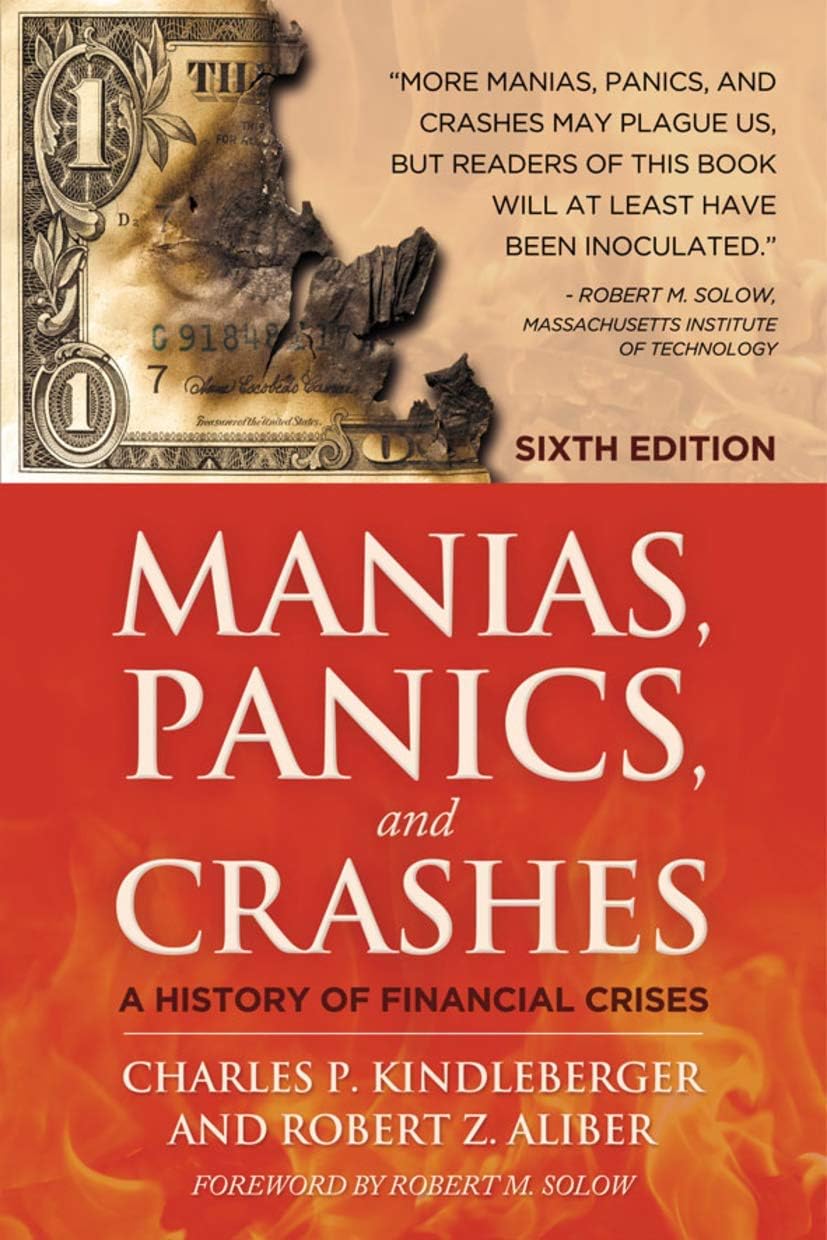
Manias, Panics and Crashes: A History of Financial Crises, Sixth Edition
Product ID: 1556193
Desertcart purchases this item on your behalf and handles shipping, customs, and support to Tunisia.
This highly anticipated sixth edition has been revised to include an in-depth analysis of the first global crisis of the twenty-first century. Providing a scholarly and entertaining account of such topics as the history of crises, speculative manias and Lehman Brothers, this book has been hailed as 'a true classic...both timely and timeless.' Review: Forgotten Econ History - This is an exhaustive review of the exciting episodes in financial history beginning with the 1770's South Pacific Bubble and the Tulip Bubble, and moving to close to the publication date. This is history we should all know to intelligently discuss modern financial issues. We forget that in the 1890's the USA went through a decade of recession and depression. We forget that before the "Great Depression" there were cycles of mania and depression from post our Civil War to 1937. We forget that Argentina and Sweden went through recessions in the 1990's. How they came out of their recessions is instructive. As we forget, we are denied the lessons history can teach us. The "game" between government and bankers, with the bankers racing to devise new systems, plans, deals, and the government moving a little slower, but close behind keeping things legal and fair, and protecting the public, actually started in the Western World about 1300. With the removal of "interest" or as then called "increase" from the list of sins, came investments and borrowing and eventually the rise of the Middle Class. Also came banking systems. And the "game" or "race" was on. This book lays out the history of this game clearly and in detail. Neither side will like how that are portrayed in this book. But history is not always pretty. The book is a bit of a long read, and at times, redundant and tedious. But the lessons are important. Excellent book, well worth the effort to read. Review: Another "Inconvenient Truth"? - Now in its sixth edition, "Mania, Panics, and Crashes: A History of Financial Crises" was first published by Charles Kindleberger in 1978. How times have changed over those thirty plus years -- at least that is the striking conclusion from this latest iteration of the enduring classic, which argues that the world of financial crises began to take a very different shape just as the first volume was being written. Consider this: according to the latest lead author, Robert Aliber (Kindleberge died in 2003), nearly all of the 10 greatest financial crises of all-time have occurred since 1978; the only ones that fall outside are the Dutch tulipmania of 1640, the South Sea and Mississippi bubbles of 1720, and the Latin American sovereign debt defaults of the 1970s, which fell right on the demarcation line. The original theme of this book was that all financial crises throughout history are the same and that they are a "hardy perennial." While the basic contours of a crisis (exogenous shock, euphoria, mania, distress, collapse, a pattern first laid out by Hyman Minsky) and the critical enabling element (loose credit) remain the same, the velocity, frequency and magnitude of these events is increasing. Reading this book in 2012 is the financial equivalent to watching "An Inconvenient Truth" - with the frightening overhang that the worse is likely yet to come. The authors argue that things really began to change in the late 1960s and early 1970s. First, the US began to experience a sustained high rate of inflation (6% plus) for the first time ever in peacetime. Next came the breakdown of the Bretton Woods system, when the dollar went off the gold standard and free floating exchange rates were introduced, which dramatically increased the spread and volatility of world currencies. Then, large and persistent budget and trade deficits, especially that of the United States, along with dramatic economic growth and oil wealth in Asia and the Middle East, led to payments imbalances that created an enormous mountain of money looking for a higher rate of return. Finally, the liberalization of the world's capital market and the opening of off-shore banks made the international transfer of money fast and easy. In my mind, I see this huge and easily moveable pile of capital as an enormous tidal wave that is drawn, as if by the gravitational pull of higher returns, to the most attractive opportunity of the moment. Aliber writes that over the past 30 years there have been four major cycles of opportunity, over investment, collapse, and then flight to the next future boom and collapse. The first was Mexico (and Latin America in general) in the 1970s. External money was attracted by the high GDP growth rates, high demand for capital, and the belief that "countries don't go bankrupt." When Paul Volker made the decision to squeeze inflation out of the US economy it was the growth economies in Latin America that were really crushed, as the ability of these countries to finance trade and current account deficits declined sharply. The money that had been invested in Mexico and elsewhere needed a place to go - and it moved rapidly across the Pacific to Tokyo. Japan had been growing at a breakneck rate for decades, mainly fueled by export focused industries, such as automotives and high tech/electronics. As the surge of profit seeking dollars flooded into Japan central banking authorities were faced with a challenge. The success of the Japanese economy depended on exports. The success of exports depended on a relatively weak yen in the international currency market. The rapid inflow of international investment dollars would appreciate the yen. The Bank of Japan made the decision to prevent the yen from appreciating, which meant buying US treasuries to appreciate the dollar. The end state was that Japanese banks held the enormous investment surge and had to find an outlet that wouldn't appreciate the yen. The answer was loosening the regulations around investment in domestic real estate - which resulted in a skyrocketing of Japanese real estate that makes the recent US experience look like child's play. The Japanese real estate and stock markets (Nikkei) rose to dizzying heights in what the authors call a "financial perpetual motion machine": 1) increases in real estate prices led to an increase in stock prices; 2) increases in both led to increases in bank capital; 3) as bank capital increased they were able to lend more; and 4) because those that invested in real estate were making great profits, they took on as much loans as they could get. So how did it end? Like every other bubble, according to Kindleberger and Aliber. Once the bubble was punctured - in Japan's case by the seemingly benign policy pronouncement by the incoming head of the Bank of Japan in 1989 that future real estate loans should grow no faster than other loans - those that were most aggressive were caught with their pants down. They had been paying their interest payments with new extensions of credit, which suddenly weren't coming, so they desperately needed to sell, which caused the perpetual motion machine to sputter, then stall, and then nose dive, as high risk investors became distressed sellers and the prices collapsed. In 1989 the Nikkei was at 40,000. A full generation later, in 2012, it stands at 9,700. One word: WOW. The tidal surge of global capital quickly receded from Japan and flooded into the emerging economies next door in Asia, the so-called dragons that were the darling of the development community in the early 1990s, countries like Thailand, South Korea, and Indonesia, which offered a compelling combination of high growth, low labor costs, and market oriented monetary policies. Once again the familiar pattern reappeared: foreign capital raced in, much of it into real estate; the local currency appreciated, pushing up the book value of the original investments; allowing local banks to make new and riskier loans; real estate and equity prices skyrocketed as investors flipped properties and poured money into the new and popular "emerging market asset class" of equities; that is, until a few hyper-aggressive and/or risky debtors defaulted, and then the whole house of cards suddenly collapsed, with many countries experiencing a currency devaluation of up to 50%. Fortunes recently and quickly won were just as quickly and easily lost. The speculative money gathered itself up with due haste and bolted back across the Pacific to the next best bet for a quick buck: American mortgages. The hypothesis that drove the US (and Irish, South African, Spanish, etc.) real estate boom of the early 2000s was that the securitization of mortgages made them more liquid and thus less risky. Global money couldn't get enough of American mortgages fast enough. When the bubble burst US investment banks had a six month backlog of mortgage securities awaiting actual mortgages to fill them with. The central hypothesis of this sixth edition makes a lot of sense and it's sobering. In a global capital market that facilitates "hot money" flowing rapidly and nearly without obstruction to the greatest opportunity for return, where that flow feeds a feedback loop that encourages further and often reckless investment, usually driven as much by currency appreciation and the real estate/equity market link rather than any rational driver of growth, these markets are almost guaranteed to experience a tragic storyline of surreal expansion followed by horrifying collapse. All of this raises the obvious question: where has the tidal surge of money fled after the US subprime collapse? Unfortunately, disappointingly, almost shockingly, Aliber says nothing at on this critical point, although my sense is that China, and to a lesser extent India, must be absorbing the lion's share of those assets. In closing, this is a good book, but by no means a great or essential one, despite its "classic" mantle. I can't help but feel that the latest iteration is somehow hampered by being tethered to the original. If things have really changed that much so fast, then perhaps the authors need to wipe the slate clean and write something new.
| Best Sellers Rank | #1,174,658 in Books ( See Top 100 in Books ) #307 in Microeconomics (Books) #579 in Macroeconomics (Books) #614 in Banks & Banking (Books) |
| Customer Reviews | 4.0 out of 5 stars 135 Reviews |
G**R
Forgotten Econ History
This is an exhaustive review of the exciting episodes in financial history beginning with the 1770's South Pacific Bubble and the Tulip Bubble, and moving to close to the publication date. This is history we should all know to intelligently discuss modern financial issues. We forget that in the 1890's the USA went through a decade of recession and depression. We forget that before the "Great Depression" there were cycles of mania and depression from post our Civil War to 1937. We forget that Argentina and Sweden went through recessions in the 1990's. How they came out of their recessions is instructive. As we forget, we are denied the lessons history can teach us. The "game" between government and bankers, with the bankers racing to devise new systems, plans, deals, and the government moving a little slower, but close behind keeping things legal and fair, and protecting the public, actually started in the Western World about 1300. With the removal of "interest" or as then called "increase" from the list of sins, came investments and borrowing and eventually the rise of the Middle Class. Also came banking systems. And the "game" or "race" was on. This book lays out the history of this game clearly and in detail. Neither side will like how that are portrayed in this book. But history is not always pretty. The book is a bit of a long read, and at times, redundant and tedious. But the lessons are important. Excellent book, well worth the effort to read.
T**I
Another "Inconvenient Truth"?
Now in its sixth edition, "Mania, Panics, and Crashes: A History of Financial Crises" was first published by Charles Kindleberger in 1978. How times have changed over those thirty plus years -- at least that is the striking conclusion from this latest iteration of the enduring classic, which argues that the world of financial crises began to take a very different shape just as the first volume was being written. Consider this: according to the latest lead author, Robert Aliber (Kindleberge died in 2003), nearly all of the 10 greatest financial crises of all-time have occurred since 1978; the only ones that fall outside are the Dutch tulipmania of 1640, the South Sea and Mississippi bubbles of 1720, and the Latin American sovereign debt defaults of the 1970s, which fell right on the demarcation line. The original theme of this book was that all financial crises throughout history are the same and that they are a "hardy perennial." While the basic contours of a crisis (exogenous shock, euphoria, mania, distress, collapse, a pattern first laid out by Hyman Minsky) and the critical enabling element (loose credit) remain the same, the velocity, frequency and magnitude of these events is increasing. Reading this book in 2012 is the financial equivalent to watching "An Inconvenient Truth" - with the frightening overhang that the worse is likely yet to come. The authors argue that things really began to change in the late 1960s and early 1970s. First, the US began to experience a sustained high rate of inflation (6% plus) for the first time ever in peacetime. Next came the breakdown of the Bretton Woods system, when the dollar went off the gold standard and free floating exchange rates were introduced, which dramatically increased the spread and volatility of world currencies. Then, large and persistent budget and trade deficits, especially that of the United States, along with dramatic economic growth and oil wealth in Asia and the Middle East, led to payments imbalances that created an enormous mountain of money looking for a higher rate of return. Finally, the liberalization of the world's capital market and the opening of off-shore banks made the international transfer of money fast and easy. In my mind, I see this huge and easily moveable pile of capital as an enormous tidal wave that is drawn, as if by the gravitational pull of higher returns, to the most attractive opportunity of the moment. Aliber writes that over the past 30 years there have been four major cycles of opportunity, over investment, collapse, and then flight to the next future boom and collapse. The first was Mexico (and Latin America in general) in the 1970s. External money was attracted by the high GDP growth rates, high demand for capital, and the belief that "countries don't go bankrupt." When Paul Volker made the decision to squeeze inflation out of the US economy it was the growth economies in Latin America that were really crushed, as the ability of these countries to finance trade and current account deficits declined sharply. The money that had been invested in Mexico and elsewhere needed a place to go - and it moved rapidly across the Pacific to Tokyo. Japan had been growing at a breakneck rate for decades, mainly fueled by export focused industries, such as automotives and high tech/electronics. As the surge of profit seeking dollars flooded into Japan central banking authorities were faced with a challenge. The success of the Japanese economy depended on exports. The success of exports depended on a relatively weak yen in the international currency market. The rapid inflow of international investment dollars would appreciate the yen. The Bank of Japan made the decision to prevent the yen from appreciating, which meant buying US treasuries to appreciate the dollar. The end state was that Japanese banks held the enormous investment surge and had to find an outlet that wouldn't appreciate the yen. The answer was loosening the regulations around investment in domestic real estate - which resulted in a skyrocketing of Japanese real estate that makes the recent US experience look like child's play. The Japanese real estate and stock markets (Nikkei) rose to dizzying heights in what the authors call a "financial perpetual motion machine": 1) increases in real estate prices led to an increase in stock prices; 2) increases in both led to increases in bank capital; 3) as bank capital increased they were able to lend more; and 4) because those that invested in real estate were making great profits, they took on as much loans as they could get. So how did it end? Like every other bubble, according to Kindleberger and Aliber. Once the bubble was punctured - in Japan's case by the seemingly benign policy pronouncement by the incoming head of the Bank of Japan in 1989 that future real estate loans should grow no faster than other loans - those that were most aggressive were caught with their pants down. They had been paying their interest payments with new extensions of credit, which suddenly weren't coming, so they desperately needed to sell, which caused the perpetual motion machine to sputter, then stall, and then nose dive, as high risk investors became distressed sellers and the prices collapsed. In 1989 the Nikkei was at 40,000. A full generation later, in 2012, it stands at 9,700. One word: WOW. The tidal surge of global capital quickly receded from Japan and flooded into the emerging economies next door in Asia, the so-called dragons that were the darling of the development community in the early 1990s, countries like Thailand, South Korea, and Indonesia, which offered a compelling combination of high growth, low labor costs, and market oriented monetary policies. Once again the familiar pattern reappeared: foreign capital raced in, much of it into real estate; the local currency appreciated, pushing up the book value of the original investments; allowing local banks to make new and riskier loans; real estate and equity prices skyrocketed as investors flipped properties and poured money into the new and popular "emerging market asset class" of equities; that is, until a few hyper-aggressive and/or risky debtors defaulted, and then the whole house of cards suddenly collapsed, with many countries experiencing a currency devaluation of up to 50%. Fortunes recently and quickly won were just as quickly and easily lost. The speculative money gathered itself up with due haste and bolted back across the Pacific to the next best bet for a quick buck: American mortgages. The hypothesis that drove the US (and Irish, South African, Spanish, etc.) real estate boom of the early 2000s was that the securitization of mortgages made them more liquid and thus less risky. Global money couldn't get enough of American mortgages fast enough. When the bubble burst US investment banks had a six month backlog of mortgage securities awaiting actual mortgages to fill them with. The central hypothesis of this sixth edition makes a lot of sense and it's sobering. In a global capital market that facilitates "hot money" flowing rapidly and nearly without obstruction to the greatest opportunity for return, where that flow feeds a feedback loop that encourages further and often reckless investment, usually driven as much by currency appreciation and the real estate/equity market link rather than any rational driver of growth, these markets are almost guaranteed to experience a tragic storyline of surreal expansion followed by horrifying collapse. All of this raises the obvious question: where has the tidal surge of money fled after the US subprime collapse? Unfortunately, disappointingly, almost shockingly, Aliber says nothing at on this critical point, although my sense is that China, and to a lesser extent India, must be absorbing the lion's share of those assets. In closing, this is a good book, but by no means a great or essential one, despite its "classic" mantle. I can't help but feel that the latest iteration is somehow hampered by being tethered to the original. If things have really changed that much so fast, then perhaps the authors need to wipe the slate clean and write something new.
M**.
Very dense book with some great insights. Not an easy read on the beach ...
Very dense book with some great insights. Not an easy read on the beach but worth the effort. Mine is filled with notes/thoughts etc...
T**H
Clumsy Writing Should be Completely Re-Written but Ideas Good.
This book is hard on the eyes and brain because so much is meaningless as though a stuffy professor is droning on in front of bored students. Could be condensed into less than half the pages. Far too many books are like this. Good stucture and perspective. Essential reading but do not expect to be entertained.
A**S
The single best introduction to the subject
A fantastic introduction and easily readable guide to the subject. What is less than clear from the introduction is that this is to a great extent based upon 30 years of research by Charles Kindleberger and his legions of graduate students who wrote term papers on bits and pieces of this.
M**W
Well written economics book
This is well written though, given my two stars, I have to say I disagree with his synopsis. I have been reading a lot of Austrian perspective in the last years and I like how the logic can be followed. This book seems a treatise on possible ideas without taking a definite stand on what actually caused what. I find any economic reasoning that doesn't acknowledge the importance of the value of money (the Fed picking an interest rate for the economy) and thus the value of everything else not being determined by the market players but by an arbitrary political group of self interested bankers to be empty of a sound basis. Just sayin...
J**R
Lessons Learned
I bough this sixth edition right after it came out and then read a but and then put it back on my shelf for some reason. I though when I bought it would be more a sequential history and not a larger arc looking at crashes and their causes, but I was rewarded coming back to it. I'm just glad that we have the problem of crashes solved after 2008 and there's no worry or possibility of another one (unless crashes are inherent in the economic system, and as explored here even more likely in the current incarnation of capitalism).
T**Y
excellent choice
an excellent trek through the financial history of the modern world. not a fast read but if you have a desire to understand the causes and results of the past troubles in finance leading to and including current problems, this is the book for you! i read it on a kindle, which was cool except for the table summarizing the breadth of the crises was a little difficult to manage.
J**J
Good economic history book
Charles P. Kindleberger after having predicted the dot-com crash of 2000 was interviewed by the WSJ in a 2002 article titled "A 91-Year-Old Who Foresaw Selloff Is 'Dubious' of Stock-Market Rally." Like an observant owl, Kindleberger already started to see the signs of a bubble in the American housing market (way ahead of the pack). He viewed the two GSEs (Fannie & Freddie) as major providers of liquidity to the mortgage market and feared that their "nationwide presence in the market [was] fueling a speculative fire." Kindleberger was an economic historian and he viewed the financial cycle through the theories of Hyman Minsky. The book goes through a number of historical financial cycles and links them with excess liquidity as the culprit that creates the boom and the sudden stop in liquidity that creates the bust. Unlike some economists that view excess liquidity/money as a byproduct of bad government policies, Kindleberger shows that there are endogenous ways markets could create excesses all by themselves, such as the blurry line between highly liquid securities that have high "moneyness" and government created money itself. Or the market excesses could come about accidentally with a large discovery of gold. This is a good book to start in the search for alternative views of the business cycle.
M**I
Contenu riche mais construction de l'exposé confuse
Ce livre est connu pour être un classique de l'histoire des crises financières et a fait l'objet de plusieurs mises à jour. Je n'ai lu que la dernière et sixième version écrite par R. Aliber et non plus par Ch. Kindleberger décédé en 2010. L'auteur s'attache à identifier les causes qui sont à l'origine des crises financières depuis des siècles et les facteurs déclencheurs de ces crises, en montrant le caractère répétitif de ces causes et facteurs, tels que, par exemple, une politique monétaire laxiste, un comportement spéculatif moutonnier jusqu'à l'arrivée d'un choc extérieur ou la défaillance d'un ou plusieurs spéculateurs ou un changement de politique monétaire. En somme dans ce livre, on trouve d'une part les causes et facteurs des crises financières au cours des siècles qui est le résultat des analyses conduites par les auteurs et d'autre part la liste des nombreuses crises qu'ils évoquent pour illustrer leur thèses. Pour chaque cause ou facteur identifié, Aliber puise dans sa très riche connaissance de l'histoire des crises pour confirmer ses thèses. Le résultat pour un lecteur qui n'est pas DÉJÀ un expert d'histoire économique est un exposé confus. Pour illustrer un facteur générateur de crise, on passe d'une crise à une autre au travers des siècles sans ordre chronologique et sans que le contexte historique de crises évoquées soit rappelés. Donc si le lecteur ne connait pas les épisodes cités, il sera vite perdu et ne verra pas forcément la pertinence des exemples utilisés.
M**N
... history of economic crashes with the view to being better able to recognise the patterns that precede of tough ...
I was hoping for a history of economic crashes with the view to being better able to recognise the patterns that precede of tough times ahead. Instead it reads like a fairly arbitrary list of panics with little tying them together. It's rare for me to not finish a book but I didn't feel like I was getting any value out of it.
P**.
This book should not be the only one to read about financial crises
Very early information about the financial crisis 2007/2008 triggered my interest in this subject followed by the study of 16 books covering this and former financial crises. In “This Time Is Different” the authors Reinhart and Rogoff mentioned Kindleberger’s book on page XXVII: “Many important books have been written about the history of international financial crises, perhaps the most famous of which is Kindleberger’’s 1989 book Manias, Panics and Crashes. By and large, however, these earlier works take an essentially narrative approach, fortified by relatively sparse data.” This reference made me buy the book in its sixth edition published in 2011 – authors: Charles P. Kindleberger (1910-2003) and Robert Z. Aliber (born 1930). Kindleberger published the first edition in 1978. Obviously the book is a long-seller, and I would recommend it to anybody interested in a better understanding of financial crises. Below you will find some original quotes which should inspire you to read the book end-to-end: The look-inside function provides you with the contents allowing you to relate my quotes to the specific chapters. My comments, if any, are marked MC. “The years since the early 1970s are unprecedented in terms of the volatility in the prices of commodities, currencies, real estate, and stocks. There have been four waves of financial crises … the economic slowdown that began in 2008 was the most severe and the most global since the Great Depression of the 1930s.” (P.1). MC: Ben Bernanke wrote in his excellent book “The Courage to Act” published in 2015: “In public I described what was happening as the ‘worst financial crisis since the great Depression,’ but privately I thought that … it was almost certainly the worst in human history. (Chapter 16 A Cold Wind P.336). "On pages 9ff. of this book under review, Aliber provides a comprehensive list of “Books on the 2008 financial crisis” and “The big ten financial bubbles”. “Manias are dramatic but they have been infrequent; only two have occurred in US stocks in two hundred years. (P.12) Ponzi finance, chain-letters, pyramid schemes, manias, and bubbles." (P.14) The discussion in Chapter 9 highlights the four waves of credit bubbles since the mid-1970, and the relationships among the successive waves. "The likelihood that these four waves are independent and unrelated seems low." (P.21). MC: “There is a committee called the National Bureau of Economic Research, which officially designates the beginning and end dates of recessions. … And they determined that this recession began in December 2007 and ended in June 2009, so it was a long recession. … So we have been growing nor for almost three years, averaging about 2.5 percent a year. But as I described, we are still some distance from being back to normal.” (Ben Bernanke: The Federal Reserve and the Financial Crisis, published in 2013, P. 109. Excellent book). Europe is still struggling with the financial crisis 2007/2008; should the next crisis appear before this one is behind us, troubles would pile up tremendously. “Long Term Capital Management borrowed more than $125 billion; its capital was $5 billion. Its leverage ratio of 25 to 1 was much higher than the ratios of most other hedge funds, which generally were less than 10 to 1. Lehmann Brothers had capital of three percent in the several years prior to its collapse – and it tended to transfer some of its assets to affiliates at the end of each month to reduce its leverage ratios. (P.74). Securitization contributed to the bubble in US real estate between 2002 and 2006; the investment banks created new Asset Backed Securities (ABSs) which were claims to the interest and principal of securities with similar attributes trusts. Mortgages, credit card debt, and student loans were securitized. Mortgage Backed Securities (MBSs) were one type of ABS; they were much more liquid than the individual mortgages that were in the trust. Moreover they provided a way for firms to diversify the credit risks attached to individual mortgages. Because of these advantages, the supply of credit for mortgages was much larger." (P.74). MC: Greenspan wrote in “Age of Turbulence” (2007): Even after the smoke cleared, no one ever knew for sure how highly leveraged LTCM was when things started to go wrong. The best estimates were that it had invested well over $35 for every $1 it actually owned. (P.194). In his 2008 edition extended by a new chapter called Epilogue Greenspan wrote: “I started this epilogue by observing that if securitized U.S. subprimes had not emerged as the weak link in the global financial system, some other financial product or market would have.” (Pj.522). In my view the term products insinuates a certain quality which you find in real products – cars, pharmaceuticals etc. However, every player can invent a financial product without reliable qualities and guarantees. This makes this industry dubious when Wall Street meets Main Street and vice versa. Maybe the term product should not be used or certain qualities and guarantees should be attached in a transparent way. Rating Agencies with conflicting interests failed in this context. “If central bankers were omniscient and omnipotent, they might be able to manage interest rates and reserve requirements to stabilize the credit system; they could then correct the instability in the supply implicit in the infinite expansibility of credit. But ‘there are no positive limitations to the expansion of individual credit.’” (P.83) MC: as omniscient and omnipotent central bankers do not exist, knowledge about the financial sector with its uncertainties and risks as well as means to protect oneself should be provided in an understandable way to all kinds of policy and decision makers – in government, business and private sectors. FED speech and the language of economists are rather obscuring instead of clarifying. “One of the first signs of adjustment in the United States to the extraordinary increase in home prices and the large excess supply of homes that began in 2002 was a surge in the bankruptcies of mortgage brokers that started the last few months of 2006; these firms were ‘middlemen’ and wholesalers who acquired mortgages from home buyers, after having indicated the terms of the mortgages they would acquire. Then they sold the mortgages to the investment banks, which would place mortgages with similar terms in a trust that they would use as collateral for issuing mortgage backs securities (MBS). The investment banks retained the right to ‘put’ these loans back to the mortgage brokers if the borrowers stopped making their monthly payments within 12 or 18 months. As the borrowers fell behind in their payments, the investment banks returned these mortgage loans to the brokers and asked for the return of their money, and the firms that were unable to repay went bankrupt. The investment banks were stuck with tens of billions of dollars of failed mortgages after the brokers went bankrupt. The combination of the default by those who had recently borrowed to buy homes and the failures of the mortgage banking firms let to a sharp decline in the supply of credit available for mortgages. The pace of home purchases slackened. The property developers that had built homes in anticipation of future sales experienced a surge in their inventories of unsold properties as home prices declined. House prices in some of the regional markets peaked toward the end of 2005, and at the national level at the end of 2006. The decline in 2007 of nearly 15 percent led to a dramatic decline in new housing starts. The first major casualty was Bear Stearns [March 2007]; two of leveraged hedge funds that it managed tanked, and the investors in these funds lost most of their money. Then there was a run on Countrywide Financial, the largest US mortgage lender, in mid-August 2007. At the same time, there was a run on Northern Rock [September 14, 2007], which was the largest mortgage lender in Britain. … Countrywide Financial was rescued by the Bank of America, … Northern Rock was rescued by the bank of England, …” (P.86) MC: the process described above has been called “securitization”. “Securitization was a central feature of the bubble in US real estate between 2002 and 2007” (P.149). What followed was described by Greenspan in his “Age of Turbulence” – “On August 9, 2007, the French bank BNP Paribas suspended trading in three of its mutual funds, saying it could no longer value the funds’ assets because the market for them had evaporated. Within hours, short-term credit markets around the world had virtually seized.” (P. 507) – and Bernanke – “On September 7, 2008, Fannie and Freddie clearly were insolvent; On September 15, 2008, Lehman Brothers filed for bankruptcy; On September 15, 2008, Merrill Lynch, another big broker-dealer, was acquired by the Bank of America, basically saving the firm from potential collapse; On September 16, 2008, AIG, the largest multidimensional insurance company in the world, came under enormous attack from people demanding cash; On September 25, 2008, Washington Mutual, one of the biggest thrift companies, was closed; On October 3, 2008, Wachovia, one of the five biggest banks in the U.S. came under serious pressure and was acquired by Wells Fargo, another large mortgage provider. … All the firms I am talking about were among the top ten or fifteen financial firms in the United States, and similar things were happening in Europe.” (Quoted from “The Federal Reserve and the Financial Crisis” by Ben Bernanke, published in 2013, P.72ff.). “The credit panic in the last several months of 2008 led to a sharp decline in automobile sales, and both General Motors and Chrysler became bankrupt. (P.90) The debacle of Long-Term Capital Management in the summer of 1998 occurred at the same time as the collapse of the Russian Banking system and the ruble. The prospect of the impending disaster in Russia induced changes in interest rate and yield relationships that contributed significantly to the collapse of LTCM. … LTCM was considered a ‘very smart’ financial institution; two Nobel laureates in in finance were among its top officers.” (P.95) MC: in a box on page 96 readers find the answers to recurring questions “Where did the money come from before it disappeared” and “Where does the money go?”. “The crash or panic that follows financial distress may do so immediately, in a matter of weeks, or with a delay of several years. (P.96) A crash is a collapse of the prices of assets, or perhaps the failure of an important firm or bank. A panic, ‘a sudden fright without cause’ (from god Pan, known for causing terror), may occur in assets markets or involve a rush from less liquid securities to money or government securities – in the belief that governments to not go bankrupt because they can always print more money. A financial crisis may involve one or both and in either order. (P.104) Consider the birthdates of some of the tallest buildings in the world. The Empire State Building in New York City – 1250 feet tall – was started in 1929, at the peak of a bubble. …In the late 1980s … Tokyo. By the mid-1990s many of these cranes had migrated to Shanghai and Beijing, and then they moved to the Persia Gulf. Not the tallest building is the Burj Dubai in the United Arab Emirates, completed in 2010. (P. 107) These towers of eighty, ninety, or one hundred stories are a visual manifestation of assert price bubbles … A ‘mine is bitter’ syndrome. (P.108) Madoff had run the scheme for twenty years, so he may hold the world’s record for both the largest and the most long-lived Ponzi scheme. Every Ponzi scheme has a ‘story’. (P. 117) Corruption is discovered when money becomes tight and credit is less readily available, and when asset prices decline. Corruption increases in a pro-cyclical way, much like the supply of credit. Much fraudulent behavior is illegal, but some hovers on a fuzzy legal bordering. Consider Enron, MCI WorldCom, Adelphia, Tyco, Health south, Global Crossing – the stars of some of the financial excesses of the 19902 stock price bubble. Much of the fraudulent behavior initially occurred in the mania phase as stock prices were increasing but was obscured in the froth of the bubble; the high-risk borrowers were able to refinance their maturing loans because the lenders were eager to increase their total loans.” (P.119) The collapse of Enron led to the demise of Arthur Andersen, formerly the most respected of the large US accounting firms. (P.131) MC: maybe, these events are the motivation behind Greenspan’s kind of disclaimer in his book: “August 9, 1995, will go down in history as the day the dot-com boom was born. (P.164) We generally did not talk about the stock market very much at the Fed.” (P.165) “A lot of the fraud in the mortgage market in the housing boom between 2003 and 2007 occurred at the ‘retail level’ – borrowers lied about their homes and their credit histories, and the mortgage brokers knew that the borrowers were lying, but hey, ‘It’s business.’ (P.121) The 1920s in the United States has been called ‘the greatest era of crooked high finance the world has ever known.’ – but that was before the 1990s. (P.148) What Gibbons said in 1859 is still true. The tendency is to believe that the banks and the bankers are ‘paragons of integrity’ and perhaps some of them are.” (P.150). “Chapter 9 Bubble Contagion: Mexico City to Tokyo to Bangkok to New York, London, and Reykjavik Four waves of credit bubbles in 30 years plus a bubble in US stocks in the late 19902 are unique in financial history. Either this succession of waves in a relatively short period was a coincidence, or there was a systematic relationship among several of them. Four waves of bubbles in 30 years suggest that the reversal in the direction of cross-border money flows that follows the implosion of one bubble may contribute to the next wave. (P.170) The Fed under Greenspan provided liquidity to cope with the Asian Financial Crisis in 1997, the debacle in Russian finances and the collapse of Long-Term Capital Management in the summer of 1998, in anticipation of the Y2K crisis in the last few months of 1999, and in response to the sharp decline in stock prices in 2000 and 2001. The Federal Reserve under the chairmanship of Ben Bernanke was slow to recognize the sharpness of the housing bubble and impacts of the implosion of real estate values on the banks and financial markets and the economy. Only after the panic triggered by the failure of Lehman Brothers in mid.-September 2008 did the Fed open ‘all of its windows’.” (P.223) MC: with reference to my customer reviews of the books written by Alan Greenspan and Ben Bernanke I do not agree with this simplified view. “Chapter 13 The Lehman Panic – An Avoidable Crash” (P.257-272). MC: I prefer Ben Bernanke’s view about Lehman in his book “The Courage to Act”. “Many have argued that Lehman could have been saved, as Bear Stearns had been and as AIG would be, and that letting Lehman go represented a major policy error. Yet the Fed and the Treasury did not choose to let Lehman fail. Lehman was not saved because the methods we used in other rescues weren’t available. We had no buyer for Lehman, as we’d for Best Stearns … The Treasury had no congressionally approved funds to inject, as they’d had in the case of Fannie and Freddie. Unlike AIG, which had sufficient collateral to back a large loan from the Fed, Lehman had neither a plausible plan to stabilize itself nor sufficient collateral to back a loan of the size needed to prevent its collapse. And Lehman’s condition was probably worse than reported at the time, according to the bankruptcy examiner’s report in 2010. (P.287f.) “The last four hundred years have been replete with financial crises, which often followed increases in the supplies of credit, greater investor optimism, and more rapid economic growth. (P.273) MC: I recommend reading this book, the books quoted above and the excellent book “This Time Is Different – Eight centuries of Financial Folly” by Carmen M. Reinhard & Kenneth S. Rogoff, published in 2009. It was on the Financial Times’ Long List of the best business books 2009 when the very interesting book “Lords of Finance” by Liaquat Ahamed was the winner.
W**I
incoherent, chaotic and exceptionally badly written
I purchased the book because it was referenced in Bethany McLean's "all the devils are here", and I'm willing to try anything Bethany deems interesting, but boy, what a complete and utter disappointment it was. "Manias, panics and crashes" is the 6th edition of a book written decades ago, and it painfully shows. In terms of structure, the book resembles a selection of randomly selected paragraphs, with no reference to each other. Even though the subject is naturally poised for simple and elegant chronological, crisis-after-crisis continuity starting with South Sea bubble and ending with present day, the authors and editors clearly deemed this idea too simplistic, and instead went for incoherent mix of dates, facts and ideas. That in itself might not fully discredit the book, but the little there was left to ruin, was ruined by the narrative. "Manias, panics and crashes" redefines boring, I doubt anyone actually proof-read this edition before publishing. I didn't manage to get all the way through the book, despite enormouse interest in the topic, I simply gave up. I would advise everyone considering a purchase of this book to choose something else on the topic in order to a void a boring and costly disappointment.
Trustpilot
2 weeks ago
2 months ago