
Desertcart purchases this item on your behalf and handles shipping, customs, and support to Tunisia.
📚 Dare to question everything — join the intellectual revolution with Sam Harris!
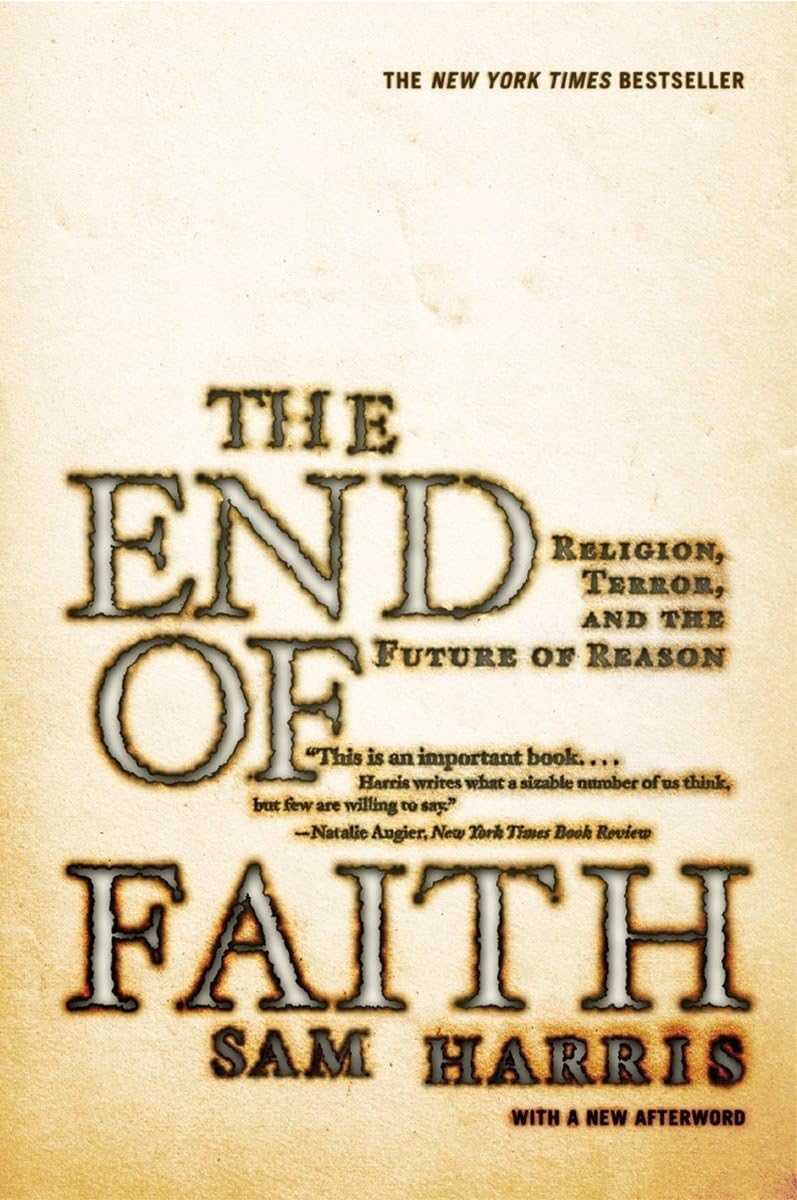
The End of Faith is a groundbreaking nonfiction work by Sam Harris that critically examines the clash between religion and reason in the modern world. Winner of the 2005 PEN/Martha Albrand Award, it blends neuroscience, philosophy, and mysticism to challenge religious dogma and advocate for a secular, science-based foundation for ethics and spirituality. Highly ranked in Comparative Religion and Rationalist Philosophy, this book is essential for those seeking a fearless, intellectual critique of faith’s impact on society and politics.
| Best Sellers Rank | #74,164 in Books ( See Top 100 in Books ) #3 in Comparative Religion (Books) #14 in Rationalist Philosophy #36 in Philosophy of Good & Evil |
| Customer Reviews | 4.5 out of 5 stars 3,440 Reviews |
J**K
Beyond Atheism
I like this book a lot. I think I should first give all the reasons I like it. 1. There has never been a book like this. It is one of the most original I have come across. I don't believe anyone has ever written a book attacking monotheism before that wasn't written from an apologetic point of view. If I had to compare it to something, it would be "Why I am not a Christian" by Bertrand Russell, or even "Meditations" by Descartes. The book is extremely well ordered. You can't tell this from the table of contents because the chapter titles are poetic, but it can be broken down as follows with his titles in parenthesis. Chapter 1. Political position regarding monotheism (Reason in Exile) Chapter 2. Philosophical position (The Nature of Belief) Chapter 3. Problematic of Christian History (In the Shadow of God) Chapter 4. (The Problem with Islam) Chapter 5. Christianity and U.S. Politics (West of Eden) Chapter 6. Ethics (A Science of Good and Evil) Chapter 7. Mysticism (Experiments in Consciousness) Harris avoids the kind of Christian discourse known as Apologetics, preferring to get right down to the truth about what religions claim and what that means to the rest of us in light of the dictums of the books cited as infallible by their adherents, especially the Bible and the Koran. Philosophically, the focus of his attack is on religious moderates and the idea that Religions are actually good, and ultimately even help us get along together. It is this focus that makes this book immortal in my estimation. It will be on "Need to Read" lists for many years. Besides being enchanted with the freshness, intelligence and originality of the book, let me mention a couple of omissions which I consider significant. First, there is no discussion of life and death, or a philosophy of life and death. This will have to come from other sources. Since this book is meant to be primarily a wake-up call to atheists, I guess he didn't feel that it was necessary. I'm not talking about proselytization, which this book isn't, anyone shedding the religion of their ancestors will need to confront this question, and a little help may not hurt. Second, he goes light on Judaism. Whether this is due to "Holocaust Guilt" or with being too close to his own background, it does not coincide with the facts. In my own analysis of religion it has been quite clear that the moral turpitude so obvious in the Christian churches (and the reasons why the Christian ideas gained hegemony in Rome so easily, for example) cuts deep into Jewish history and culture as well, and it seems strange that Judaism has been so completely spared by his knife as to be almost beyond mentioning. The second strangeness is his call for a science of mysticism. He's not concerned with New Age mysticism in general as one reader has claimed, he's interested in Tibetan Buddhism, which he feels is the best popular exposition available on "Scientific" Phenomenology. I admit that this idea is not foreign to me. I've often thought of low Buddhism and Zen Buddhism as enlightened philosophies that get to the point a lot faster than most western philosophers, while avoiding dogma. So I naturally feel very comfortable for his call to explore alternatives to religion, what he calls "Scientific Mysticism". Thirdly, after criticizing the Torquemada with all the appropriate harshness you would expect, he goes on to present an argument for reviving torture in order to deal with the contingency of Terroristic Religion. His justification comes from "Collateral Damage", how you would weigh the destructiveness of torturing an innocent person against the destruction caused by firebombing a city, for example. This reasoning is not easy to agree with. Finally, with Samuel Huntington, he is against Islamic Civilization. He buys Huntington's whole argument and sincerely believes we are locked in a fight to the death with Islamicists and the "Islamic Civilization" that nutures them. How this is any any different from an Islamic person viewing Western soldiers as Crusaders nurtured by our "Christian" civilization somehow escapes me. In what way is this any different from the "fight to the death" we just completed with "Godless Communism"? To some of us, it seems a little too convenient that the weapons ovens are now blazing up again just after the Cold War is finally over. His attacks on Relativism and modern Pragmaticism in Chapter 6 are very well reasoned. Personally, I was pleasantly surprised to see that he calls himself a "Realist", since this is how I present myself. So all of this isn't for everyone, and some of this is for someone, etc. Each will have something to dislike, but it will be very hard to find a book as spiritually uplifting as this, which also has been banned at church.
J**R
Beyond Religion
It is ironic that Sam Harris begins his book with a description of a young man bombing a bus in the heart of a city. Though published in 2004, the description appears to fit very well the recent London transit bombings. And this is precisely why this book demands our attention in this time of growing radical, religious fundamentalism of whatever variety. Sam Harris presents as a quiet, thoughtful, reflective person in television interviews and public presentations. His background is in philosophy and he is now completing his doctorate in neuro-science. He presents his analysis of religion in a deliberate, careful, rational manner. Yet the result is powerful. The book his two major themes. The first part is comprised of a critique of the irrational basis of religious faith and the often terrible consequences of these beliefs. This is not a tentative or hesitating criticism. At a time when the negative effects of religion and religious thinking are becoming increasingly visible, this book serves notice that making accommodations to religious thinking serves only to allow it to perpetuate its destructive influence. A belief that killing innocent people is responding to the will of one's God is not an idea to be given credence. And yet it flows directly from religious ideology and scripture. After surveying the current effects of religious beliefs, Harris then explores the nature of belief and how it relates to reason by providing an excellent review of the criteria and process of determining truth--or what in philosophy is called epistemology. Building on this analysis, he then reviews the effect of irrational belief in the history of Christianity with the Inquisition, the Cathar persecution, the witch hunts and finally the Holocaust. His point is that the moderation and toleration that is generally accepted today is not a result of the religious belief itself, but the modulating influence of the Enlightenment and the political separation of church and state that followed. This is followed by a detailed chapter analyzing the rise of radical and violent Islam. But lest we think we are immune from the effect of religious fundamentalism, he points out its current effect over issues such as the Ten Commandments controversy, the role of "faith-based" legislative efforts, the attempt to legislate what had previously been areas of private freedom, the movement to control embryonic stem cell research, and, of course, the abortion debate. Harris is particularly critical of what he calls the "myth of moderation" which flows from the postmodern viewpoint that all ideas are relative and none can be held truer or better than others. Moderates do not want to kill anyone in the name of God, but they want us to keep using the word "God" as though we know what we were talking about. And they do not want anything too critical said about people who really believe in the God of their fathers, because tolerance, perhaps above all else, is sacred. To speak plainly and truthfully about the state of the world--to say, for instance, that the Bible and Koran both contain mountains of life-destroying gibberish--is antithetical to tolerance as moderates currently conceive it. But we can no longer afford the luxury of such political correctness. We must finally recognize the price we are paying to maintain the iconography of our ignorance. The second part of the book is what makes it so significant This is not just another attack on the irrationality of religious faith. Harris acknowledges the legitimacy of the issues that religion attempts to address. What makes one person happier than another? Why is love more conducive to happiness than hate? Why do we generally prefer beauty to ugliness and order to chaos? Why does it feel so good to smile and laugh, and why do these shared experiences generally bring people closer together? Is the ego and illusion, and, if so, what implications does this have for human life? Is there life after death? These are ultimately questions for a mature science of the mind. If we ever develop such a science, most of our religious texts will be no more useful to mystics than they are now to astronomers. First he addresses ethics. What kind of ethics is possible without a faith in a supernatural God? One based in reason and that incorporates our growing knowledge of ourselves at the level of the brain. Where currently there is little consensus on moral issues, a sustained inquiry will force the convergence of various belief systems as it has done in other sciences. Moral relativism will no longer make sense ("we can't really judge the suicide bomber") because we will have developed verifiable criteria for moral and ethical behavior. Harris explores a number of contemporary issues from this perspective including terrorism, torture and pacifism. Furthermore, ethics is intimately connected with spirituality. In the next chapter he reframes the entire arena of spirituality from the religious to the scientific in the newly emerging field of consciousness studies. He is hesitant to use the words spirituality or mysticism because "neither word captures the reasonableness and profundity of the possibility that we must now consider: that there is a form of well-being that supersedes all others, indeed, that transcends the vagaries of experience itself". Specifically he refers to those traditions that identify spirituality with consciousness itself--with the observer of content rather than the content itself, which frees us from the vicissitudes of experience. Our spiritual traditions suggest that we have considerable room here to change our relationship to the contents of consciousness, and thereby to transform our experience of the world. Indeed, a vast literature on human spirituality attests to this. It is also clear that nothing need be believed on insufficient evidence for us to look in this possibility with an open mind. It is tempting to quote whole sections of this final chapter in which Harris rescues spirituality from religion. He explores the nature of consciousness and the various efforts within traditional religions to change the nature of consciousness through sustained introspection and the refinement of attention. He applies this to an analysis of the nature of the self--how it arises, what sustains it and how it can be transcended. He compares Eastern to Western philosophy and religion and questions why the Eastern analysis appears to be so much more sophisticated. And finally he describes meditation as a form of introspection in a section which can serve as a primer to meditative practice. All of this is done from an empirical perspective informed by modern studies of consciousness rather than from religious doctrine. The only lack in this book is the omission of the psychodynamic explanation for faith as originally proposed by Freud and more recently in the book The Psychological Roots of Religious Belief by M.D. Faber. Harris takes a more cultural and societal perspective. Few books describe more clearly the transition to a post-religious era and establish so clearly why it is of such importance. The days of our religious identities are clearly numbered. Whether the days of our civilization itself are numbered would seem to depend, rather too much, on how soon we realize this.
J**S
A well-focused thesis with slightly blurry edges
By page 22 of "The End of Faith," the reader is aware that Sam Harris does not feel the least bit conciliatory toward religious worldviews. Moreover, he knows just how and where to insert an intellectual stiletto: "Whatever is true now should be discoverable now....By this measure, the entire project of religion seems perfectly backward." Indeed, religious thinking does seem to have an uncanny knack for being not just wrong, but exactly wrong. For example, it credits the Old Testament god with being merciful, patient, forgiving and wise, although even a cursory reading of Genesis through Numbers shows him to be cruel, petty, vengeful, selfish and embarrassingly ignorant of the cosmos he supposedly designed and constructed. While highlighting this and many other faith-based nonsequiturs, Harris makes an eloquent case for the proposition that religious claims MUST compete with other knowledge about the world on a fair basis -- no automatic allowances for tradition, "sacredness," or other distractions having zero relevance to truth value. He further warns that given the clear and present dangers of fundamentalism, we risk far too much by sacrificing rationality on the altar of political correctness. The book's seven chapters cover the roots and dangers of religious irrationality, the perverseness of faith without reason, the history of religious persecution and internecine vendettas, the particular threat of Islam, the toxicity of church/government mixtures, a scientific approach to morality, and (rather surprisingly) the experimental side of consciousness. In the chapter on Islam, Harris begins with the obligatory mention of (long past) positive contributions from Muslim culture, notably the invention of algebra and translations of the Greek philosophers. But the next 40 pages are devoted to exposing the threatening side of Islamic beliefs and traditions -- even the "moderate" ones. Harris points out that the revered Koran and its lower-ranked companion the hadith (sayings of Muhammad) are liberally stocked with contempt for other religions, death sentences for apostates, eternal suffering for infidels, and the promotion of jihad (religious war) as a duty for all Muslims. He offers statistical evidence that suicide bombing in defense of Islam is endorsed in at least some circumstances by majorities or substantial portions of the populations of 11 of 12 Muslim countries (the lone exception is secular-governed Turkey). The author maintains, with ample evidence, that the usual characterization of radical Islamists as mere hijackers of a peaceful religion is grossly misleading. In fact, he says, "Nothing explains the actions of Muslim extremists...better than the tenets of Islam." Harris's clear and forceful writing style bolsters his step-by-step case for rejecting the vacuous certainties of religious doctrine. In Chapter six he tackles the concept of atheistic morality, which seems to trouble so many people. He keys his outline for scientifically valid ethics to one simple but not widely recognized principle: "...questions of right and wrong are really questions about the happiness and suffering of sentient creatures." By "sentient" he means conscious and able to comprehend different levels of well-being. This plausible and incisive idea immediately clarifies important issues to which religious morality is both dumb and blind: 1. All human and non-human animals have ethical rights. Sentience alone is sufficient to confer moral standing. 2. The objective of shared ethical standards is to improve the condition of living beings, not to avoid the wrath of an imaginary cosmic supervisor. 3. Harmless private behavior is not open to ethical dispute. Harris uses point 1. to illuminate the abortion issue. If sentience confers moral standing, then lack of sentience removes it. Hence it is not rational to equate the ethical rights of one, or two, or a hundred cells with those of a fully-developed person. There is of course a gray area, but it does not (by any sensible standard) reach back to conception. In his sharp (both senses of the word) critique of absolute pacifism, Harris offers on page 202 a very provocative and pithy admonition: "...when your enemy has no scruples, your own scruples become another weapon in his hand." Although I found much to admire in "End of Faith," there were some aspects of it that puzzled me. For instance, on page 16 the author claims that "there is clearly a sacred dimension to our existence." He goes on to say that exploring such a dimension shouldn't require untestable propositions, but the original appeal to sacredness still seems odd. In other places Harris tentatively supports the reality of psychic phenomena (p. 41), suggests a "deeply rational" basis for spirituality (p. 43), and states that his case against blind faith was "written very much in the spirit of a prayer" (pp 48-9). On page 192 he defines spirituality as cultivation of happiness, an interpretation very much at odds with any dictionaries I've encountered. Seventeen pages later he declares that spiritual practice is the investigation of consciousness through introspection. Will the real spirituality please stand up? Finally, on page 208, Harris expresses doubt that the brain produces consciousness, but fails to offer a plausible guess at what does produce it. Despite such reservations, I found "End of Faith" to be a thoughtful work with a cogent and worthwhile theme -- religious claims deserve no special or privileged status among the welter of competing ideas about the universe and our role in it.
S**S
Critically Important Book - Highly Recommended
Courageous to write in this current atmosphere with rise of social conservatives based on "American Christian Values". If you are a Christian or Muslim. You will find this book difficult to stomach. In your face writing. Very direct and Blunt "Theology is an extension of human Ignorance", articulate and easy to read. States his position clearly and argues his point well. This is an attack on Monotheistic Religions - primarily Judeo-Christian religions (Islam, Judaism and Christianity) throughout the world. He makes a compelling case that we cannot grow into a more civilized society unless we shed our primitive and illogical believe systems. Highly recommended reading. I thought his analysis of our illogical religious views and related actions were right on, although I did not agree completely with him on all his points, it stimulated me to think and rethink some of my positions. If you have strong liberal or conservative views, your position will be challenged. He is an independent thinker and he is not going to feed you what you want to hear. This is what a good book should do. Important and relevant book and we need more books like this. Thus the five stars. Loaded with memorable quotes. I found myself re-reading sections and sentences and then close the book and stare in space as I comprehend a new idea. Some of the criticism here in Amazon review is fair. He does come across as an "atheist fundamentalist" as one reviewer wrote. Sam Harris rightly criticizes needless wars in the name of promoting religion, but he seems to promote wars in the name of fighting religion. I find this a bit hypocritical. I am not sure he is any better than the religious zealots he criticizes. Where I take exception and I feel his argument is the weakest, is his that He is too forgiving on the nature of "intent" and war itself as being justified to fight ignorance. In his view, we (the US) at war are more humane than Islam at war because of our "intent". We do not intend to kill innocents (they are collateral), where as Islamic people at war do. I think this is a narrow definition of intent and too forgiving. War by its nature is inhumane regardless of intent. And whether your loved one was killed intentionally or not, it doesn't make it any easier to accept or any more justifiable or make you more rightous. In addition, collateral damage is acceptable as long as it is the other side that is experiencing it. If for example, the Iraqi resistance was able to reach our shores and retaliate, and caused collateral damage of US citizens, then our view of the war and our interest in ending it sooner will rise. So what is the morality of the war? Also, if collateral damage is more humane than targeting civilians intentionally, then no civilian deaths is more humane than collateral damage. We should be rising to the occasion (or evolving) where wars are no longer legitimate. When the US is able to keep its citizenry detached from the reality of the war, it causes prolonged suffering of the other side. Also Harris does not address "cause and effect" and "ends justify the means" foreign policy. Don't we need to be held accountable for our actions? But the US has more at its disposal than military. It is the intent of the US to use its economic might to keep nations in poverty. He does not address this...Recommended reading "Confessions of an Economic Hit Man" He leaves the impression that he only reason Islamic terrorists are attacking us is for religious reasons only and they are stuck in the 14th century beyond any sense of reasoning. The Koran is rooted in violence and justifies them attacking us - The infidels. As a result, the only remedy is to wage a war (with justifiable collateral damage) against Islam. I think he goes too far here. The Koran explains their hideous actions, but not their real motives. I think he underestimates there is a real war against the west based on what we do, not what we believe. After all, there are no terrorist attacks in South America, Canada, Japan, Eastern Europe or Australia. Yet they are all Infidels. The US and Western Europe have a long history in the Middle East of occupation, puppet governments, support for Israel, military intervention and oil interests that cannot be discounted as the reason. Now the war in Iraq has given the terrorist more reason to hate us. He gives the impression that the war on terror can only be won militarily through war. I agree the military has a role to play, but it is not enough. He does not adequately address other factors in combination with the military action; cultural change in the Middle East and a change in US foreign policy. Recommended Reading; Imperial Hubris Why the West Is Losing the War on Terror. In place of religion, Harris proposes a Buddhist view of life. He does not go into detail on Buddhism but touches briefly on some of its tenets with regard to reason, logic, our thoughts and consciousness. For the intellectually curious, he may inspire you to learn more about this relatively unknown religion.
J**E
Clap your hands and say Thank you Mister Jesus!
The End of Faith" constitutes a valuable public conversation in that it says much that needs to be said. The style is clear and lucid, the work meticulously sourced. Harris's primary theme involves the need to call the core doctrines of faith into question. Ever the polemicist,he is particularly hard on Muslims, seeming to consider them essentially lost to reason. He states that, "Given what Muslims believe is genuine peace in this world possible? ...I'm afraid that encouraging answers to such questions are hard to come by (p. 137)." He provides copious Koranic quotes condemning the non-believer; quotes that are similar in their hatefulness to those found in Leviticus and Deuteronomy. The misdeeds of murderous Muslim fanatics are well known. They are reprehensible and are and should be actionable. Yet human variability is too great to justify condemning a billion people en masse, no matter their religious persuasion. The vile adherence to Koranic claptrap Muslims espouse must eventually change. After all, Muslims, as Harris acknowledges, were making important contributions to humanity, particularly in the areas of math, astronomy and the preservation of ancient knowledge when Western Civilization was little more than a cesspool of theologically induced ignorance and brutality. Islamists may yet have their own enlightenment, particularly if significant numbers of them attain a sound education in a secular US or elsewhere. Harris seems to insist in circumlocutions that are nothing if not artful that our depredations against Muslims are of little consequence. Even though I view these matters somewhat differently, Harris appears to be a perpetual student of the human condition, a thoughtful person who may see some of these issues differently with the passage of time. And then again I may. With Laser-like accuracy Harris states that that "The degree to which religious ideas still determine (the) government policies...of the United States--presents a grave danger to everyone (p. 153)." Certainly Christians in the United States have much to atone for. As Harris notes, forty percent of George W. Bush's voter support came from fundamentalist Christians. Thus we have a president who describes himself as a "messenger" of God who is doing "the Lord's will." One might more readily expect a Grand Poobah of Pakistan or Nigeria to announce that God is whispering in his ear, an anomaly that almost moves even the rationalist to pray for regime change. One can reasonably argue then, that voters of the fundamentalist Christian persuasion more than any other group visited upon us the tragedy that is Iraq, with its millions dead or wounded and over four million people as refugees. War in the Middle East, after all, is enthusiastically embraced and encouraged by Christian Evangelicals to "usher in the Second Coming of Christ and the final destruction of the Jews (p. 153)." Additionally, we now deficit spending greater than any in the history of humanity (Clap your hands and say thank you, Mister Jesus!). Our military is corrupted by what Air Force vet Mikey Weinstein terms "an evangelical coup in the military." The wall of separation between church and state that was so artfully constructed by the founders, them at most mildly affirmative deists, is tragically undermined. Harris says, "victimless crimes" are outgrowths of faith-based thinking, noting that prohibition and the Drug War began with Christian groups. With no victim, though, he states, there is no crime. One appreciates then the implication that Harris supports the right of people to do that which they wish to do in private. The total absence of magical thinking is likely to be a long time coming, though, and this is true whether it's that of a coven of nude witches dancing around a fire in a moonlit glade beseeching the Goddess or a gaggle of Southern Baptists insisting that those crumbled up saltine crackers are momentarily going to become the neurological, muscle and integumental tissues of Sky Boy Jesus. In the meantime, this reader is left feeling that society is served best by religious pluralism coupled with a high tolerance for harmless eccentricity, this including the Rev. Jimmy Swaggart's fevered rush to a hot sheets motel with a sex worker or Rev. Ted Haggard and his catamite slathering on the K-Y Jelly in preparation for a convivial amphetamine-fueled boy-on-boy Bacchanal. If there was any great lesson in the tragedy of 09.11.01, it is that religion and politics are an explosive and irresponsible combination, one that is eventually paid for in blood. With whatever small flaws it may have, "The End of Faith" makes a good case for this. It is a valuable and well-written work. §
D**L
Very interesting read
I picked up a copy of this book when seeing the author on a documentary and being impressed with his eloquence and logic. First of all I really liked the book and I think it helped to ferret out and dispel some lingering self-doubt in my own mind regarding God and sin and the possible consequences to being wrong (Hell for example). I have found after reading this book that I have (amusingly) started substituting (in my mind) "invisible magic man" for the Holy Spirit, "space aliens" for Jesus and "unicorns" for God when I hear people referring to them. I never really thought of religion before as a shared delusion of enormous proportions, but now I feel like it in incredible that so many people run their life based on made-up drivel. I did find his chapters dealing with death a bit hard to take, as I hate to contemplate my own mortality and this book of course offers no solace there. It hammers home that our desire to exist causes craving for a belief system that offers promises of eternal life, even though that is preposterous. One of his main points is that we should not be "tolerant" of religion in as much as people use religion to make decisions that could effect us all. Even though he makes a compelling case for this, I think it is going to be a long time (never?) that it will be acceptable to openly challenge someone when they state religious opinion as if it is a fact and to demand proof of their claims. Right now it is impossible to openly treat religion as the same thing as delusion because more people embrace it than reject it. I am pretty sure I can't refuse to hire someone because they are a delusional "Christian" right? Even if I feel it demonstrates a lack of judgment? So while I get his point, I am not sure what we can really do about it right now. It is almost like saying "I wish people were nicer". I do think that people are social creatures and that morals and ethics are created within that context. I am not as hard line as the author in regards to people identifying themselves with a religion, or congregating together. As long as we are not basing our decisions on myth and delusion but instead on social contracts then there is of course comfort in belonging to groups who support each other. That being said, your book club, AA meeting or PTA can all offer that experience without the background of religion. I am just staying that even if someday we govern ourselves with reason and practicality we might still congregate as Jews, Christians and Muslims for our shared history and culture, and think back fondly on those texts we used to take literally as just a relic of our shared past. P.S. I find it funny that people (Mr. Bruce Bain in particular) are trying to paint this book and other like it as an Atheism text and then try to lump Atheism into the same category as a "faith based belief" system. This book goes into a lot of logical detail to explain that we have evolved to accept and reject a premise based on personal observation, consistency with other knowledge and trust in research by subject matter experts. Why should we reserve belief in God(s) as a special case? To systematically challenge false and errant statements and assertions and insist that we govern our worldviews using logic and hard fought knowledge is *not* a religion.
E**D
Talmudic Thinking
The headline I gave this review should not be viewed as pejorative because the term stems from, and is frequently used in, the Jewish community. It denotes that type of thinking process which knows the answer to a given problem and subsequently justifies it by a variety of reasons. As such it is the opposite of scientific investigations where a natural phenomenon is encountered and its possible reasons are then looked for. Inasmuch as Dr. Harris has in the past performed scientific work readers may assume that the book under discussion also uses the methods of science but this would be a mistake. Instead it is a well written one-sided polemic which champions reason over faith. I had to, reluctantly, give the book three stars because it touches on fundamental aspects of what 21st century America really stands for. It deserves to be widely read and debated. On the other hand if the initiation of rational discourse was the author's intent he has failed because insulting hundreds of millions of human beings all over the globe for believing in a given religion is not the best way to do so. The major thesis of the book is: "Faith" is untenable when confronted with the facts of science and has done, throughout the past 2000 years, more harm than good. The book lists an impressive array of moral outrages members of the world's major religions have committed, but his special ire seems to be directed against the Muslim and Christian religion. The charges are correct, as far as they go, but they do not go to heart of the matter. Harris uses the word "Faith" as exclusively referring to religious aspects of human life and even within religions he sees only the doctrinal structure rather than concerning himself with the personal aspects as William James has done more than one hundred years ago. Furthermore, he concentrates on dogmas (the virgin birth for Catholics and the 72 virgins for Muslims, are his favorite targets), which for many religious believers, regardless of religious affiliations, are not necessarily of primary importance. In addition he has equal disdain for those individuals who regard themselves as "moderate" in their religious belief system as for fundamentalists. While Harris spends a great deal of time and effort on religious dogmas his book presents us with a complete blind spot for the secular ones which determine current political decisions. When he exhorts reason over religious faith as the panacea for the future of human conduct he seems to have forgotten the excesses of the French as well as those of the Russian revolution which occurred in its name. While he blames Hitler's "Christianity" for the murder of Jews and Stalin's early education in the Orthodox Church for his crimes one fails to find a single word about Lenin. Yet it was the latter who with the help of secular Jews, such as Trotsky, Dsershinskij (Lenin's Himmler) and others, committed crimes on an enormous scale, also in the name of reason. Harris showed us his faith by apparently believing that three steel towers, two of which had been hit by planes, were by fire reduced to rubble in the manner of controlled explosions; that a plane can crash into the ground, or hit a building without leaving debris and body parts. The first event refers, of course, to the WTC towers as well as building VII, the second to the hole in the ground at Shanksville PA, and of that in the Pentagon. These "miracles" (defined as "singular events which defy natural explanations") are readily accepted by Harris, although they could be ranked with virgin birth. Like most of the rest of the country he believes in the 19 Muslim hijacker theory as the sole responsible agents. But this assumption has never been allowed to be tested in a criminal court and scientific examination of WTC dust showed residue from explosives, which cannot have resulted from the fires. Harris also shows his colors when he wrote in regard to the possibility of Iran acquiring nuclear weapons that, "In such a situation, the only thing likely to ensure our survival may be a nuclear first strike of our own." He goes on explaining that this would be a terrible thing to do, nevertheless he did posit it. There is no doubt that a nuclear armed Iran would be regarded as a threat to world peace but it does not follow that our "survival" would be at stake. The State of Israel's possibly, but not that of the U.S., unless we respond inappropriately. Harris' mental conflation of Israel's needs with those of the U.S. is common in our media, but erroneous and does not follow the laws of reason. There is an additional interesting aspect. In his own neurophysiologic publication on "The Neural Correlates of Religious and Nonreligious Belief" he demonstrated that, what may be called, a belief system exists in the brain. But, and this is the crucial element, it is content neutral. With other words people believe or disbelieve whatever is currently acceptable and conforms to their thought strcture regardless whether the content is religious or secular. I have discussed the problem of science and faith in "The Jesus Conundrum. Searching for Truth beyond Dogma [available on amazon.com]" and noted that faith is an inborn quality of the human being. It remains with us throughout our lives and only its target changes, depending upon life experiences. An "End of Faith" is, therefore, impossible. What we should do is to direct our faith into channels which are helpful to humanity; especially now where so much hatred and division rules the day in the socio-political arena. To exclusively blame religion is not only a disservice to the public but a dangerous falsehood.
D**K
The Rot of Religion
As expected, Sam Harris's End of Faith is a vitriolic polemic against religion in general, and of Islam in particular. What comes unexpectedly is his virulent frankness about religions' horrors, of which he provides only a sampling. But his overall point is indisputable: * People act on their beliefs. * Most of our beliefs conform to the way we perceive the world. Beliefs are our way of ordering of our experience into coherent and intelligible segments. * Religious beliefs, without any evidence, refutes our ordinary perceptions. It distorts our reality. It thrusts irrational segments onto our worldview that corrupts our otherwise ordinary intuitions. * Without any basis in fact, religion is an escape (as was Marxism). The solipsistic believer triumphs only in his puny mind. * The irrational behavior of irrational beliefs that religions provide are unacceptable in every other domain of our human experience, but religion gets a "free card" to do its dastardly deeds as though religion were divine. It's not divine, it makes no sense, so why are we placating religious zealots who are quite frankly "mad" in every known pyschologial sense? * The three monotheistic religions are inherently barbaric (at least according to their "Books"). Barbarism may have been an evolutionary mechanism for survival, but not in the world we presently inhabit. * The West has only been marginally more successful in "editing" those barbaric prescriptions "out" by virtue of civilization and a deeper understanding through reason and science. But fundamentalisms, aided by relativists, make all the absurd religious claims equally valid and without dispute. * Radical Islam is not the exception. Islam is inherently radical and inherently bloodthirsty, more so than Judaism and Christianity. The Qu'ran's repeated prescritptions to anihilate the infidel are too obvious and numerous to "discount" in the present clash of ideologies. * Religious wars in times past were provenchial affairs. WMD make them now world affairs. * The Islamic martyr finds justification in suicide-killings, his family reborn, the righteous Israeli settler is his Promised Land (killing those Palestinians), and the Christian millenarianist is in paroxysms of self-satisfaction for the End of Times. What about all this makes evidentiary sense? * Coddling religion can no longer be tolerated. It must meet the same scrutiny we apply to every other area of life. Produce evidence, or your claims are screwy. Harris's full-throttle assault is brutually unrelenting, and if it has an impact, it will be because of this aggressive stance. And his insistence about religious question-begging, which we do not allow any any other aspect of modern life, can no longer simply be tolerated. The risks are too grave. It's no longer just about Christian Scientists who deprive children medicine, it's no longer about Jehovah's Witness refusing blood transfusions, it's no longer about Jewish claims to be "Yahweh's chosen," it's no longer about the Infidel in the Middle East, it's about the irrational behaviors of irrational beliefs that we won't allow in any other aspect of life, that is now threatening our own anihilation. Harris's penultimate chapter is a confusing discourse on ethics and morality, and his final chapter an even odder appeal to "look to the East" for spirituality, as if self-brainwashing will restore human balance, a sense of the spiritual, and an "empirical mysticism." But for all its convolution and lack of coherency, he's arguably looking in the right direction for new resources to fill human needs. As I have suggested, ethics, morality, benevolence, and a sense of "awe" (transcendence, sacred, immensity) are needed to replace religious archaicisms in order to integrate ourselves in the world as "we find it." Perhaps his "suggestiveness" is all that he intends, but some of his suggestions defy even the most basic sense of ourselves. Stuart Kaufman concludes At Home in the Universe with these thoughts: "If science lost us our Western paradise, our place at the center of the world, children of God, with the sun cycling overhead and the birds of the air, the beasts of the field, and the fish of the waters place there for our bounty, if we have been left adrift near the edge of another humdrum galaxy, perhaps it is time to take heartened stock in our situation. "The possibility of such collective emergence is heartening. I would rather life be expected in this unfolding since the Big Bang than that life be incredibly improbable in the timespan available. . . . I am heartended by spontaneous order . . . of regulatory systems . . . order in ontogeny . . . evolution as a marraige of spontaneous order and natural selection . . . expressions of deeper order inherent in all life . . . finding spirituality, awe, and reverence in the unfolding" of the inevitable. We are not random happenstances, we are not contraptions piled on contraptions, we are not accidents of extraordinary improbability, we are another part of the enormous expression of the inherent complexity residing in the natural order of the Universe itself. We don't need the myths of Zeus, Yahweh, Vishnu, or Allah. We simply need to behold how extraordinarily complex everything is, starting with ourselves, and recognize that there are more natural forces operating than we have yet to imagine or caption. Harris and Kaufman both remind us that scientific reductionism is necessary for science to succeed, to get at that particular part that drives the inquiry, but that narrow view of our way of looking at the world scientifically is not the world that we actually see. Let's not lose our sense of the whole: the spontaneity, immensity, complexity, diversity, and order that we are a part of, manifestated in unbelieveable detail within ourselves, and that envelopes every aspect of our being. If one is not awed, humbled, and overwhelmed by these extraordinary realities, Zeus, Apollo, Yahweh, and Allah will only obscure our ignorance, and play upon our fears.
S**E
Five Stars
Amazing book. A must, not only to read, but to possess in your library.
J**L
Libro sul problema attuale il più grave dei nostri tempi
Al mio aviso dobbiamo tutti leggere questo libro. Il signore Harris offre una spiegazione del problema il più grave del nostro mondo e della nostra sopravivenza - anzi del rischio di non sopravivere. Sam Harris goes beyond the liberation of previous text which discuss why we should all liberate ourselves from religion. It is not an easy read, but he using a clear, wonderfully logical, and also enteretaining style explains the grave risks that we face from groups with faith based views of the world comparable to the frightenting mentality of the Middle ages but with access to even more frightening armaments of the twentieth century. We are just starting the descent from a politcally based atomic standoff only to face an even more frightening religiously based beligerence. I think everyone should read this book.
T**M
Free Your Mind, and the Self Will Follow: The End of Faith, by Sam Harris
Sam Harris is one of the leading proponents of what has been dubbed the 'New Atheist Movement', in good company with the likes of Richard Dawkins, Penn Teller, Lawrence Krauss and the late Christopher Hitchens--not even a movement, per say, but rather a like-minded bunch of non-believers who just happen to feel the same about religion, whether it be through their intellectual reason, their scientific backgrounds, or quite often both. Like his atheist friends he has written and spoken extensively on the topic, to much acclaim from people like myself--once too afraid to 'come out' about our atheism. For The End of Faith, Harris tries something quite refreshing and bold. Many before him have argued that morality is not the exclusive domain of the believer, but here the author dares to suggest that, along with our right to claim a religion-free morality, perhaps spirituality is not really a bad word at all. Nor is it, like the moral codes of societies, the property of churches, mosques, synagogues, shamen, priests, and mullahs. By first overcoming the shackles of irrational faith, the individual can employ reason to reach a clarity of mind and self. Essentially, it’s a kind of spirituality that can be found beyond the barriers of centuries old beliefs and impositions that merely hinder mental freedom. Of course, the task Sam Harris achieves with this book is to carefully, and necessarily at great length, mine the sources of the very hindrances that have battled to enslave the voices of reason. These sources are of course the holy books that have inspired both compassion and irrational passion, The Holy Bible and The Quran. We have been constantly assured, Harris reminds us, of how these are religions of peace, despite the centuries of bloodshed spilled in their names. And yet the evidence of the horrors, the 'god'-sanctioned violence, the injustices and the enslavement of the free--physically and mentally, are all there in these holy books. No matter than much of the contents of these powerful scriptures has been twisted and interpreted, and reinterpreted to a great fault, resulting in the endless suffering of millions upon millions of innocents. It's bad enough that the pious cherry-pick the good bits in their favour; but then they simply go and ignore the ugliness, or use it to support their acts of violence on others. One of the points that Harris raises is how liberals, people much like himself, like me as well, have failed by granting religion its very own raison d''tat, all because of a comfy multiculturalism--however well-meaning, and not necessarily failed, but abused by the very individuals we have sought to protect from persecution. A bit of biting the hand that feeds. We liberals, Harris asserts, have misguidedly felt that the good folks among the religious can reign in the bad. Unfortunately it has not usually worked out this way, and perhaps reducing it all down to religion as a cultural right, a custom, is where the left has failed. All it takes is a young boy to strap on some explosives, walk into a market full of innocents, children naturally included, and blow himself up with the promise of greater things in the afterlife. So his elders, his religious leaders, his holy book, tell him so. In an instant scores of lives are destroyed in this single act. Sam Harris, like anyone on the left or right, calls this terrorism, which it is. However, he insists that the sole drive of the modern-day terrorist is his faith. Where I partly disagree with his criticism of people like Noam Chomsky, who have long-argued that foreign policy is at least in part responsible for many acts of terrorism, I do find his argument that religion is a potent force that drives people to commit terrorist acts. Harris provides faith driven examples of terror from the Inquisition through to and including what is commonly perpetrated by those of the Muslim faith. The evidence of the required punishment for straying from or offending faith litters both the Bible and the Quran, but it would seem that Islam's holy book is likely the nastier in terms of the sheer volume of calls to death to the infidel. To be fair, he raises a very good point, with citation after citation from the Quran, which do nothing to back the claim that Islam is a religion of peace. Another thought-provoking point Harris addresses, and perhaps cleverly avoids taking sides, is how torture against alleged terrorists is surely no different from the horror we politely label collateral damage in times of conflict and war. It's hard not to come away with a feeling that Harris thinks torture, long considered precisely not what civilized nations ought to be engaged in, might at times be acceptable--especially when comparing it to the usually unintended civilian losses of war. How can we not call both horrors, when lives are damaged or lost all in the name of a good fight? I personally fall on the no-torture side, but his examples give good cause to think deeply about the end results of both collateral damage and pain-inflicting interrogation. The conclusion is really up to you, the reader, to decide. Sam Harris has a very lucid style of writing, and a tireless attention to detail, leaving no stone unturned in his effort to champion reason over faith. The at times lengthy footnotes are excellent proof of this. The End of Faith is built upon extensive research, and the very tool he champions, which is at our disposal from the moment we are aware of our thoughts. Refined, reason is a powerful foe to the centuries-old burdens of sin, promises of paradise beyond death, the miracles that never seem to take place in the modern era, but remain the stories of old, stories that increasingly have lost their weight. Up against the mighty tripartite of world religions, Harris also proves, Buddhism is virtually free of the calls to death, the enslavement of other, the vengeful, wrathful sky-god. Here is where he suggests spirituality can be a reachable goal. You don't have to be a Buddhist, but you do have to be aware, in tune with your inner self. There, you will find the building blocks of a faith-free existence. Morality, well, we get that already. The End of Faith: Religion, Terror, and the Future of Reason is a compelling read, particularly but not exclusively to the atheist. For the believer, it presents a challenge that is still surmountable; for the atheist, it is both comforting and enlightening. This book is a powerful and necessary argument for reason over faith
M**R
Pow! Biff! Zap! Bonk! Someone dial 911 for religion!
Ouch! I thought I'd read it all in the science/religion fracas and then I picked up Harris's book. I've never seen an opinion quite like this, it is truly unique-- as some other reviewers note, it's hard to classify. It's just pure Sam. There are few things one cannot really deny about this book: 1. Just about anyone will find something here they are shocked by. [The Buddhist stuff at the end came out of left field, although I kinda liked it still, and I was amazed that he could support the Iraq War] 2. You'll disagree with at least one point in the book, and get angry at some points (even atheists will!), but that will vary depending on your personal bias. [I'm amazed Harris managed to pull off his argument without contradicting himself; he has reasoned himself into a unique niche.] 3. It is incredibly well written and passionate; almost every page has a well-crafted quotable phrase or two. Swift reading too. A roller coaster ride through Harris's personal views, fears, and his quest to find solutions. [A few phrases left me in fits of giggles, a few others I wished I could commit to memory to use later, and a few others had my jaw drop in amazement that he dared to say them in today's volatile political climate-- I suppose he's not on the radar of the fundies quite enough yet for death fatwas and such] 4. People should read this regardless of how they feel about the state of the world today. It's an crucial book that raises important questions, and to deny the importance of debate about these issues would show more about your own bias and dogmatism than anything else. Fiery and clad in the armor of reason, yet not afraid to be very human and even flawed, this book in some ways is better than anything Dawkins, Dennett, or Wolpert have put out recently. Massively original, very personal and honest, and a real page-turner. I had a hard time putting it down. I rarely give books a second read but now, a few weeks later, I'm thinking of diving back in.
M**R
Erfrischender säkularer Humanismus ohne political correctness
Sam Harris diskutiert und belegt ausführlich, daß der Islam eine totalitäre Gefahr für die moderne Welt darstellt und einer toleranten Uminterpretation größere Schwierigkeiten im Weg stehen als bei anderen Religionen. Als Kernproblem des islamischen Terrorismus wird die lebensverachtende Jenseitsorientierung unnachgiebig bloßgestellt, denn nur sie erklärt, warum auch gut ausgebildete und sozial gut situierte junge Menschen zu fanatischen Selbstmordattentätern werden können. So weit,' so wenig ungewöhnlich, wenn auch hier besonders überzeugend dargestellt. Aber Harris geht in erfrischender Weise weiter: Er attackiert das religiöse Denken als solches. Die religiös Moderaten tragen eine Mitschuld daran, daß wir der Expansivität des Islam nicht überzeugender entgegentreten, denn ihr Denken ist von der gleichen Art: Glauben an den Orientierungswert alter Bücher, Annahme von Überzeugungen ohne oder gar entgegen guter Gründe. Ich sehe das genauso. Die Appeasement-Politik gegenüber der Religion à la Habermas ist nur zeitgeistige political correctness. Aber was erhofft sich Harris? Glaubt er wirklich, unter der Bedrohung durch einen expansiven Islam werde sich die Menschheit in kurzer Zeit von ihrer evolutionär und kulturell so tief verankerten tribalistischen Religiosität abwenden? Radikale Religionskritik ist richtig. Harris geizt auch nicht mit Beispielen für negative Auswirkungen religiösen Denkens in unseren westlichen Gesellschaften. Aber er verkennt, daß die religiös Moderaten trotzdem unsere Verbündeten bei der Erhaltung und Ausbreitung freiheitlich-pluralistischer Gesellschaften sind. Ein wenig illusionär ist auch sein ethischer Objektivismus, der uns Ethik und Moral als Wissenschaften präsentiert, die schließlich Erkenntnisse liefern werden, deren Überzeugungskraft naturwissenschaftlichen Fakten vergleichbar sei. Harris Attacke gegen einen indifferentistisch getönten ethischen Relativismus ist sympathisch und verdienstvoll. Und zweifellos kann die Vernunft eine auf ideologischen Vorurteilen basierende Moral unterminieren. Aber wir dürfen das Element von Entscheidung nicht unterschätzen, ohne das auch der unvoreingenommen Urteilende nicht auskommt. Unser evolutionäres und kulturelles Erbe besteht nun einmal leider nicht nur aus Mitmenschlichkeit. Harris Überlegungen zur Rechtfertigung der Folter von Gefangenen in extremen Fällen sind logisch konsequent, aber sie greifen zu kurz. Gerade die amerikanische Ambivalenz in diesem Punkt im Gefolge von 9/11 lehrt uns, daß die Aufweichung des Folterverbots die leider in jeden Militärapparat zu findenden Sadisten ermutigt, die Demokratie diskreditiert und die Menschen und Bürgerrechte einer Vielzahl von Gefangenen längerfristig beschädigt, ohne die gewünschten Erfolge zu erzielen. Trotz solcher Schwächen: ein unbedingt lesenswertes Buch, das nach allen Seiten austeilt, je nachdem wie die Konsequenz des Denkens es verlangt und dennoch keineswegs bei der Kritik stehen bleibt, sondern dem religiösen Denken einen positiven säkularen Lebensentwurf gegenüberstellt.
Trustpilot
4 days ago
1 day ago