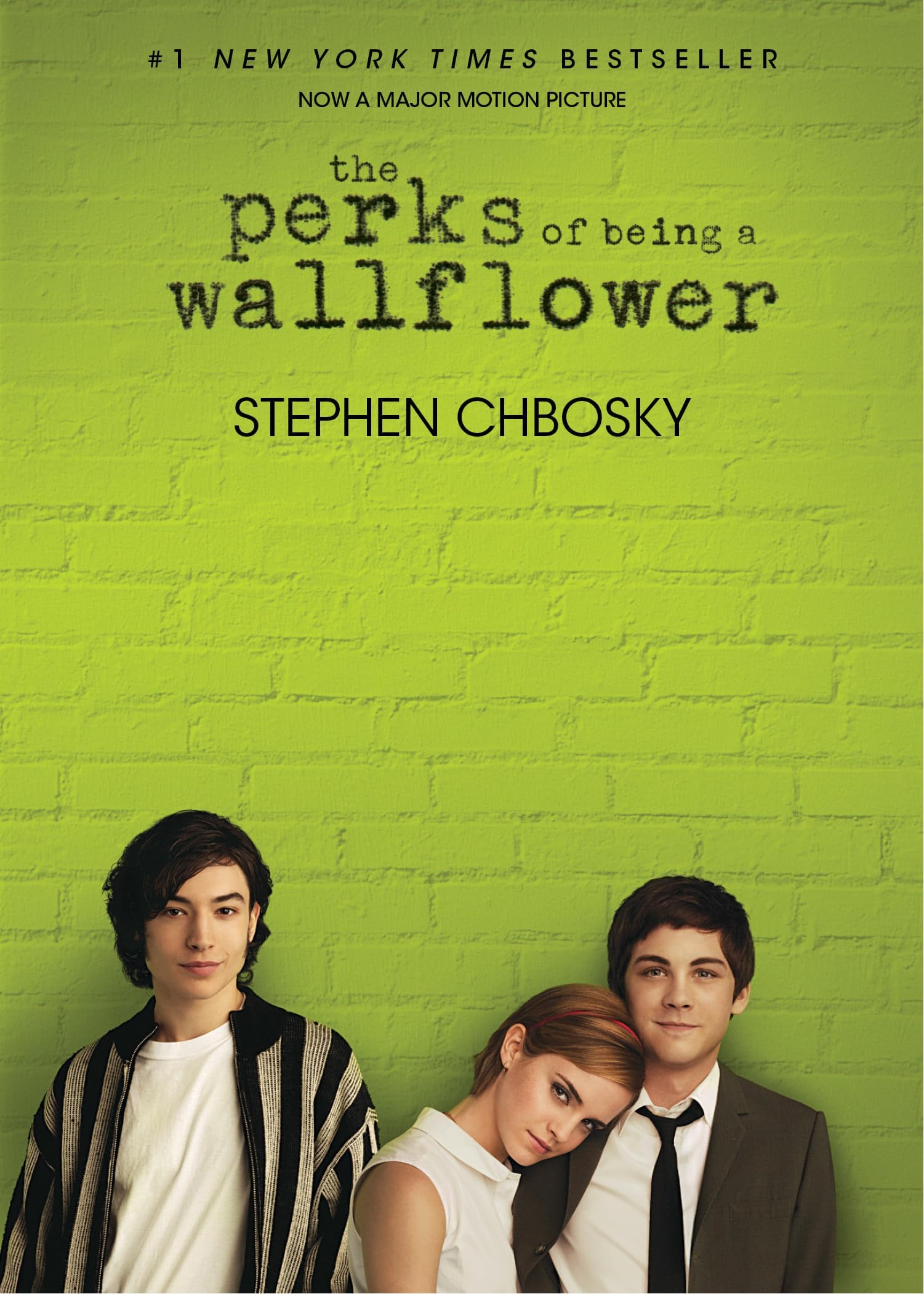
The Perks of Being a Wallflower
Product ID: 1694896
🎬Major Film Adaptation
🏆Top 3 in YA Fiction
📚NYT Bestseller #1
Desertcart purchases this item on your behalf and handles shipping, customs, and support to Tunisia.
📖 Unlock the infinite power of being yourself — don’t miss the story everyone’s talking about!
The Perks of Being a Wallflower is a #1 New York Times bestselling coming-of-age novel by Stephen Chbosky, celebrated for its honest portrayal of adolescence, mental health, and social belonging. With millions of copies sold and a major film adaptation, it remains a cultural touchstone for young adults and beyond, blending humor, heartbreak, and hope in a timeless narrative.
| Best Sellers Rank | #2,017 in Books ( See Top 100 in Books ) #2 in Teen & Young Adult LGBTQ+ Fiction (Books) #3 in Teen & Young Adult Literary Fiction #8 in Teen & Young Adult Coming of Age Fiction |
| Customer Reviews | 4.6 out of 5 stars 47,467 Reviews |
D**G
Touching and Revealing -- Seeing Our Selves and Our World "More Primarily" through Autism....
Of course I loved the book. It's so much more than "young-adult combing-of-age". For me, it was deeply moving, an often gripping story, particularly at the end, and it opened a window not just into teenagers, but into life at all stages -- this while being extremely well-written and without calling attention to its well-written-ness. What I found most striking, was showing life through a different kind of mind, what's sometimes called Asperger's Syndrome or High-Functioning Autism. AS/HFA isn't a disease, but an important difference, important to us all. What makes AS/HFA an important difference is its talents, particularly its special "perceptiveness", though not "perceptiveness" in the usual sense. More as a deep meaning to what Robert Burns wrote, "And would some power, the Gods give us, To see ourselves as others see us!" (Know this book deals directly with many painful topics including abuse, suicide and violent bullying. It's not for "more sensitive" readers.) Reading several reviews, I'm not surprised that some reviewers found the lead character, Charlie, "too sweet" and "improbable". In this, understandably, they miss Charlie's "diffferent" mind and more, his "different" way of being. I'm a psychotherapist, specializing for several decades in people for whom therapy has failed, often people, like Charlie, who've been hospitalized. And a dozen years ago, I discovered that maybe a quarter of my clients were in the autism spectrum, almost always AS/HFA -- often highly intelligent and able to relate to the neurotypically-structured social world, though relating "differently" and needing much more conscious struggling with the basics. After working several years with AS/HFA, I found these people had remarkable powers, and the usual "unable to relate or care" descritpion of autism just wasn't true in the ordinary sense. Most were neither uninterested nor uncaring -- in fact, quite the opposite. They desperately wanted to relate and, in some ways, they were over-caring, extremely sensitive to others. They related differently, not only to others, but to themselves and their world and, in particular, to language. Often not badly, but just very differently. Writing in first person gives the author no place to hide. You MUST have an extremely interesting character, and you MUST know that character with ruthless clarity. Chbosky does, and he does so well that I suspect he may have a touch of autism himself. Or at least it runs in his family. Disclosure: after several years working with AS/HFA children, teens and adults, I noticed that I was unusually drawn to them; I could almost use that diagnostically. With that awareness, I figured out that autism runs in my family. And with that, the disease faded away and the differences began to shine through. Let me note a few points from "The Perks" to illustrate. Charlie's speech, thinking and relating, at first blush, seems to be almost child-like, more charcteristic of six years old than sixteen. He has an astonishing honesty, a naive not-understanding, and his use of words frequently has that unintended poetic feel of children. But look more carefully: Yes, there are situations he doesn't get in ways shocking for a middle-teen. But as he thinks about them and questions them, he often goes right to the heart-of-the-matter, and a heart-of-the-matter that's usually missed or forgotten by those of us, especially adults, who "just get it" and go on. Let me give an extended quote from the book's end: "Later, [my friends, Sam and Patrick,] came by in Sam's pickup truck. And we went to the Big Boy just like we always did. Sam told us about her life at school, which sounded very exciting. And I told her about my life in the hospital, which didn't. And Patrick made jokes to keep everyone honest. After we left, we got in Sam's pickup truck, and just like Sam promised, we drove to the tunnel. About half a mile from the tunnel, Sam stopped the car, and I climbed in back. Patrick played the radio really loud so I could hear it, and as we were approaching the tunnel, I listened to the music and thought about all the things that people have said to me over the past year. I thought about Bill telling me I was special. And my sister saying she loved me. And my mom, too. And even my dad and brother when I was in the hospital. I thought about Patrick calling me his friend. And I thought about Sam telling me to do things. To really be there. And I just thought how great it was to have friends and a family...." "But mostly, I was crying because I was suddenly very aware of the fact that it was me standing up in that tunnel with the wind over my face. Not caring if I saw downtown. Not even thinking about it. Because I was standing in the tunnel. And I was really there. And that was enough to make me feel infinite." Starting out, it seems almost primitively black-&-white, until "And Patrick made jokes to keep everyone honest." In the context of all that literal-ness, it's startling. Charlie doesn't just note that "Patrick is telling jokes". Humor is often a struggle for AS/HFA, and so they need to work at understanding it. Through his work, Charlie is seeing not only Patrick's style of humor, but its function. Since AS/HFA often doesn't instinctively grasp "what" to do, they approach others and their world more basically through "why it's done" and "what it means". Because Charlie struggles to see the function of so much, he remains very much in touch with a stripped-down sense of that function's truth. Again, "And Patrick made jokes to keep everyone honest." Then Charlie's "telling" returns to seemingly smple description. But read again: the description is less "simple" than "primary". And in many ways, this is the importance for us in AS/HFA relating. Attention to detail, of what simply "is", is consciously, clearly combined with an almost-primary way of relating to themselves, to others, to their world, as well as a primary relating to language. And when we see ourselves, our world, our lives through Charlie's AS/HFA "primary" lens, we not only see afresh. We see what is "primary", what goes to the heart-of-the-matter, what is the stripped down function, and so what is truly important. Not preachy, but very experiential -- "truly important" very much as-lived. And Charlie winds up poetically pointing to primary experiences, connections and always-available potentials within and around us all: "And that was enough to make me feel infinite". And he got there through self and love and family and friends. Frankly, as a therapist who works most-of-all with severe trauma -- war PTSD, attachment disorders, sexual abuse, and deep grievings -- that's a short list, in those two paragraphs, of what gets lost in trauma and of what it takes to heal. OK, I'm probably probing more than interests most potential readers. As you can see in other reviews, there are many levels to enjoy in this book. If you like, though, let yourself be touched by Charlie's "primary" description-plus-function. You may find it not only intriguging and moving, but healing. And who of us can't use a touch of healing now-and-then? P.S. I read this on Kindle and, even on my laptop, I found it an easy read. It was particularly helpful because, now over 60 years old, I can boost up the print size, making reading more relaxing.
C**E
A Book for Anyone Who Has Ever Felt Different
The Perks of Being a Wallflower is one of those books that I think can mean a lot to someone who feels alone, weird, different, or like they don’t quite know where they fit. I found myself relating to Charlie in quite a few ways. I loved watching him slowly put himself out there and try to create the kind of life he actually wanted instead of simply watching everything happen around him. His effort to start “participating” really stuck with me. The letter format was perfect for this story. It lets you inside Charlie’s messy, complicated head in a way that makes his emotions feel incredibly real. There were moments when his thoughts hit a little close to home for me. I have a tendency to stay quiet or go along with things I don’t really want because it keeps the peace or because it feels easier. Sometimes it can even feel like my own thoughts or feelings don’t deserve to take up space, and I saw some of that reflected in Charlie. One of my favorite messages from the book comes from Sam: the importance of actually living your own life instead of simply doing what other people want—or what you think they want from you. I think that’s something most of us need to learn at some point. More than anything, this feels like a book about realizing that you’re allowed to participate in your own life. I think a lot of people will see pieces of themselves in Charlie, and I hope the people who really need this book happen to find it at exactly the right time.
G**N
A classic. I love it.
"So this is my life. And I want you to know that I am both happy and sad and I'm still trying to figure out how that could be." I know that I'm about 15 years late reading this, but I finally got around to reading The Perks Of Being A Wallflower. I made the mistake of watching the movie first, back in 2012, but I always figured I'd eventually get around to reading it once I started to forget specific details about the movie. To be honest, I didn't like this book as much as I was expecting to, but I think that's mainly due to the fact that a lot of people consider this their favorite YA book of all time, and everyone praises this book non-stop, so maybe I was expecting more. The greatest thing about this book are the quotes. This is probably one of the most quotable books I have ever read and I will probably fill this review with so many quotes. I tabbed the hell out of this book while reading it. I thought at times Charlie was a little immature, but I guess he is only 15 so I'm not really sure what to expect. Sam and Patrick were great side characters, and really amazing friends to Charlie. I think it's so important to have people like that in your life. "You see things. You keep quiet about them. You understand. You're a wallflower." I have always considered myself to be a "wallflower", which is probably why I enjoyed this book as much as I did. Throughout high school I was always a loner, I didn't really have any friends. Freshman year of high school was one of the hardest years of my life due to the fact that I felt completely alone, and this made me feel really nostalgic for that time. This book got to be very depressing at times and it was really hard to read because it took me back to the times in high school where I was really depressed. I felt a lot of the same loneliness and hopelessness that Charlie feels throughout the book. I haven't felt like that in a long time, so at times this book was difficult to read. This book deals with a lot of strong subject matter; rape, abuse, molestation, sex, suicide, and depression in general. "I don't know if you've ever felt like that. That you wanted to sleep for ten thousand years. Or just not exist. Or just not be aware that you do exist. Or something like that." The scary thing is I actually do know what he means. I used to feel that way all the time. Sometimes I still do. I relate so much to when he talks about seeing a couple and if you feel happy for them, it's good because it means you're happy too. If it makes you sad to see other couples, it's not because you're jealous, or you want them to be unhappy, but because you crave that same kind of happiness that is missing from your life. I just understand the things that Charlie goes through in this book. He was an extremely relatable character and this brought back so many not so great memories about high school, and things I absolutely hated about high school (especially freshman year). "Have you ever done that? You feel really bad, and then it goes away, and you don't know why. I try to remind myself when I feel great like this that there will be another terrible week coming someday, so I should store up as many great details as I can, so during the next terrible week, I can remember those details and believe that I'll feel great again. I think the reason why this book became so popular was because this book was the first of its kind. Now-a-days, it is not unusual to see these intense themes like rape, molestation, depression, and suicide in YA books. In fact, it's almost common. But back in 1999 when this book was published, I really do believe this book was pushing the limits and boundaries of Young Adult and has created something new. Reading this in 1999 would have been a completely different reading experience than reading this in 2015, because there was nothing this controversial in the 90's. Also, this book has quotes that are iconic, and connects with everyone in so many ways. One of my absolute favorites is; "We accept the love we think we deserve." It's just such a powerful quote and it's so true, and it still stands true 16 years later. This book will always be iconic and it will go on to become a classic, I'm sure of it. I'm happy that at the end of the day, this book does have a positive vibe. It was a long and depressing journey, but this book is definitely worth a read. "And in that moment I swear, we were infinite."
A**N
Infinite? Hardly, but compulsively readable nonetheless
To be clear, I actually saw the film before I read the book, but I'll discuss the novel first as its the original. Perks is a teen coming of age novel set in 1991. This is a compulsively readable book. Casually, before picking at the flaws, this is the kind of book you read in one sitting. Every time I run across something this engaging, I feel an intense relief -- pleasure really -- because so much of what I read is a bit of a chore. Probably just me being jaded. So while I'm going harass Chbosky on a few fronts, any criticism should be framed in context: This is a novel that really sucks you in and holds you. As to voice. Technically, the book is epistolary. The protagonist, Charlie, writes letters to some imaginary friend. It's a gimmick that neither adds or subtracts. This is basically a first narrative with a slightly confused back and forth between past and present tense. The writing is deliberately clunky. Chbosky is trying to sound like a 15 year-old boy -- and a gifted one at that -- but he does it by being wordy and stilted. I'll give an example: I am trying now to practice not to do that. He also said that I should use the vocabulary words that I learn in class like "corpulent" and "jaundice." I would use them here, but I really don't think they are appropriate in this format. My inner editor would rewrite this as: I'm trying to practice not to. He also suggested I use the vocabulary words from class like "corpulent" and "jaundice." I would, but they might not be appropriate in this format. This clunk-factor lessened after the first third, and I'm not sure if it was because I adapted or because the character was maturing. Either way, it does provide a bit of youthful feel and the frank honesty of the voice is highly engaging. Charlie is a straightforward reporter, cold even, rarely leaping to extreme judgement. He is most definitely not snarky. For me, the early 90s setting was a big plus, as it's free of some of the annoying distractions of the post internet age (cel phones, Facebook, etc). It's also nostalgic, being closer to my own high school era, even if Charlie is a good seven years younger (my Freshman year was 1984, his 1991). The character development is very good. Charlie, Sam, and Patrick are all very well crafted and distinct. Likable too. In retrospect, after finishing the book, I feel several elements of the story construction are a little forced. It seems unlikely that two seniors like Sam and Patrick would take a Freshman under their wing and into their social circle quite so easily. Not impossible, just a bit contrived. More substantially, the major "twist" in the story feels a bit forced, unnecessary even. This is a book with a clear theme. The writer even states it, several times: "We accept the love we think we deserve." Fine. But there sure is a lot of abuse flying around. Like 90% of the major characters experience it at some time or another in their lives. I don't mind these themes, but to have the same "startling" thing happen to not one, not two, but many characters feels forced. All this thinking was only in retrospect. While reading, the novel just draws you in from start to end. Having seen the film first, which is sexually rather tame, I was pleasantly surprised to find quite a bit of frank sexuality in the novel. I'm not sure why it was removed, and it's presence provided punch. Nevertheless, it's pretty incomprehensible that a smart well read 15 year-old like Charlie wouldn't already know about masterbation. Again, a little forced. This book has a lot of forced moments, they just play off well. So I must reiterate, these are intellectual nitpicks on a compulsively readable novel. One last observation: It's odd that Chbosky published this in 1999, went on to sell a bundle, yet has never published another novel. Andy Gavin, author of Untimed and The Darkening Dream
W**L
Amazing Read!
With an unexpected turn in the final chapters, this book is a prize for anyone dealing with individuality and fitting in to the herd. While characterized through youth, the themes apply to all. Truly one of my best reads and I hope it is for others.
C**)
If Catcher in the Rye Didn't Hurt My Brain
Today, friends, I must start with a confession: I tried to read The Perks of Being a Wallflower during high school and immediately loathed and DNFed it. As such, I’ve not tried again until 2014, at least ten years after my first attempt. I also went for a format change, because I had a vague memory of the writing being a problem, and switching formats can help with that. It’s funny, because I completely understand why my teen self loathed this book, but I can also appreciate it now and admire what it’s doing on top of enjoying the story. The writing in The Perks of Being a Wallflower probably would have been a struggle for me still, at least at the beginning. There’s a sort of Catcher in the Rye-ness to the book, but, unlike Catcher, there’s personal growth throughout the book. Perks is a full year in Charlie’s life, his freshman year of high school, and he learns a lot during that year. He grows emotionally and intellectually. For this reason, I’d say you should push through, even if you don’t like Charlie or his narration at the outset. In case you do struggle, I highly recommend this audio version narrated by Noah Galvin. Perks is one of those books written in the way that someone talks, and so it lends itself really well to the audio format. Plus, Galvin sounds like he could be 15, which is actually a really difficult thing to find in YA audiobooks. He reads with great emotion too. This was really a perfect book for the audio format. Charlie’s a really great and unique character, something which I couldn’t appreciate back when I tried to read it as a teen. At the time, I read a lot of romance, classics, and various adult fiction. YA wasn’t my thing, and I wasn’t used to reading about teen characters. Plus, Charlie’s a very unusual boy. He’s highly emotional and cries a lot, something I’ve never really done. I didn’t get him back then. Now, though, I’m so glad to see a book about a boy who cries, because our culture teaches guys to repress their feelings, and repression is not healthy. The novel’s all about learning to accept and understand yourself. There were two things I didn’t like about Perks. The first is all the drug use and smoking. Realistic, sure, but also it made me uncomfortable that smoking wasn’t shown in an unflattering light. This is one of the things that I just cannot abide personally. Then there’s Sam. She’s a full-blown Manic Pixie Dream Girl, which is a term I really don’t use often. She’s got very little personality, aside from being fascinating, gorgeous, mysterious, and sexy. I’m pretty positive John Green read this book and was greatly influenced by it. Sam’s character just isn’t interesting to me, and whenever he went on and on about her, I was rolling my eyes. The ending of The Perks of Being a Wallflower threw me for a bit of a loop. It was completely perfect and well-established by the text and at times I even wondered if something like that was coming. Still, the epilogue knocked my feet out from under me. I just am not used to epilogues containing any actual plot. Well, this one does and that plot packs a brutal punch. If you’re the sort of person who cries at books often, the epilogue should be called Sob City. It’s dark and painful, but also inspiring somehow, which is pretty damn impressive. It also brings the journey of the rest of the novel into stark relief. I’m sort of at a loss for what to say about this one without spoilers, so I guess I’ll just exhort you to give this book more of a chance than teen Christina did. This is a YA classic for a reason.
B**L
this book is great
very well written with a gorgeous ending! i typically like reading other genres but this was fantastic and i couldn’t recommend it more
S**N
A must read
I give this book a 4.8/5 stars. It can be difficult to read at times but it’s worth it. Definitely a book you should check trigger warnings if you can be triggered by things in books, but the subject matter insists on it.
K**T
The Perks of being a Wallflower
Reread after a long time. The story of Charlie stays timeless and hope-instilling ever after. Funny, dark, emotional, sad, it has it all. Love always!
K**A
overall great
I love this book so much, if you have watched the movie I recommend the book! For all ages ;great quality overall great.
H**T
Good book
Good book
S**Y
Das Leben als Mauerblümchen
Das Leben als Mauerblümchen Als Charlie sein erstes Jahr an der High School antritt, hat das Schicksal im schon viele Steine in den Weg gelegt. Seine Tante Helen, die er über alles geliebt hat, ist gestorben als er sieben Jahre alt und sein bester Freund auf der Junior High hat Selbstmord begangen. Er kommt mit nichts als schweren Gefühlen in das Leben einer High School und fühlt sich isoliert von der Welt. Sein Alltag verbringt er am liebsten mit Büchern, mitunter auch die, die ihm sein Englischlehrer immer wieder gibt und zu denen nur er Essays schreiben soll. Sein Leben ändert sich erst, als er bei einen Footballspiel Sam und Patrick kennenlernt. Sie sind in ihrem Abschlussjahr und führen Charlie ins Schulleben ein. In ein Leben zwischen Zensuren, sozialen Druck und Drogen. Immer mehr versucht Charlie sich zwischen all diesen neuen Erfahrungen sich selbst zu finden. Über die erste Liebe, über das Scheitern und das Gefühl, alles falsch zu machen. "The Perks of Being a Wallflower" ist ein Roman, der am Anfang der 90er Jahre ansetzt. Eine Zeit, in der das Internet und das Handy den Großteil des Lebens bestimmten, das soziale Leben von realen Treffen und Telefonaten über Festnetz bestimmt waren. In dieser Zeit, wo Mixtapes noch Bedeutung hatten befindet sich Charlie und versucht seinen Platz im Lebenskarussell zu finden. Bis dahin könnte man denken, man hätte es mit einer gewöhnlichen High School Geschichte zu tun, von einem, der am Rande der Gesellschaft ist und plötzlich aufsteigt und dann vielleicht wieder fällt. Doch darum geht es nicht in "The Perks of Being a Wallflower". Es geht vielmehr um eine Randfigur, in der großes Talent steckt, dass niemand sehen will. Charlie scheint für seine Umgebung fast unsichtbar und bekommt selten das zurück, was er anderen gibt. Er ist einer dieser Menschen, die sensibel sind, einfühlsam und alles tun, dass ihr Umfeld glücklich ist, aber nichts im Gegenzug verlangt, obwohl er die Anerkennung in seinem Leben braucht. Und dieser Umstand macht diesen Roman zu einer Besonderheit. Verfasst in Briefen, die an eine anonyme Person geschrieben werden, erzählt Charlie aus der Ich-Perspektive seine Geschichte. Unverkrampft, ohne große sprachlichen Spielereien, sondern schlicht und einfach auf Papier gebannt. Es sind hier die einfachen Worte, die einem das Lesen schwer machen, weil sie so ehrlich sind und vom Herzen kommen. Manchmal sieht man sich selbst mit heruntergezogenen Mundwinkeln vor dem Buch sitzend, dann wieder strahlend und bangend und wünscht sich nur das Beste für Charlie, der endlich aus seiner Isolation herausbricht und am Leben teilnimmt. Als Protagonist wiederspiegelt er die Ängste der Jugend, die jugendliche Verwirrung und die Freude, die man entfindet und die plötzliche Einsamkeit, wenn es nicht so klappt wie man es sich erhofft. Ein Jeder findet Facetten in Charlie, die einen an einem selbst erinnern. Und wenn es nicht Charlie ist, sind es die anderen Figuren, die einem ans Herz gehen. Ganz unabhängig davon ob es die einfühlsame Sam ist oder der homosexuelle Patrick, der seine Liebe zu einem Footballspieler verheimlichen muss. Stephen Chbosky eckt an mit seiner Geschichte, greift Themen auf, die keiner richtig aussprechen will. Sei es der Drogenkonsum aus Verzweiflung oder das Austesten seiner Grenzen. Der oberflächliche Gruppenzwang und das Mitmachen, nur damit man in der Gruppe anerkannt wird. Die Probleme mit der Familie, mit den Geschwistern, wenn man größer wird. Oder das Verstecken seiner eigenen Sexualität, weil sie die Gesellschaft nicht anerkennen will. Wie man sich den Normaen der Gesellschaft fügen soll, aber es aus seinen Wesen nicht kann. Jeder möchte etwas Spezielles sein, jeder möchte anerkannt werden, doch manchmal will die Gesellschaft einen nicht so nehmen wie man ist. Alle Themenfelder finden ihren Platz in diesen kontroversen Roman voller Tiefsinnigkeit, der es schafft in einfachen Worten die Geschichte eines Mauerblümchens einzufangen, das anfängt zu Leben, mit all seinen Zweifeln, Ängsten und Verwirrungen. Und der schlussendlichen Freude am Leben. Es ist diese Plastizität, die das Lesen manchmal schwer macht. Dinge wirken real, Situationen lebensecht und die Charaktere sind so unterschiedlich und einzigartig wie die Menschen selbst. Fazit Einfühlsam, authentisch und mit Blick fürs Detail hat Stephen Chbosky einen Roman geschaffen, der einen faszniert und in den Bann zieht. In "The Perks of Being a Wallflower" wird Jugend dargestellt wie sie ist. Rau, verwirrend und oftmals von vielen Ängsten geprägt. Eine nahegehende Geschichte mit Tiefgang und der Aussage, dass in jedem von uns ein Mauerblümchen stecken kann.
I**.
Perfect
Perfect
Trustpilot
3 days ago
1 month ago