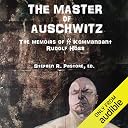
The Master of Auschwitz:: Memoirs of Rudolf Hoess, Kommandant SS
Product ID: 180076627
Desertcart purchases this item on your behalf and handles shipping, customs, and support to Tunisia.
The first-hand account of the life, career, and the practices of horror at Auschwitz, written by Auschwitz Kommandant SS Rudolf Hoss as he awaited execution for his crimes. Including his psychological interviews at Nuremberg. Review: An amazing insight into sociopathy - Hoess was possibly a unique individual in that inhuman regime. He seemed to be completely unaware of humanity while constantly harping on his exacting observations of same. It's as though I was reading an observation of humans through the eyes of an alien. This autobiography exposes a man, who might be excused as an aberrant sociopathic minor autocrat, as a major player in a horror show who fully participated in mass murder and torture. In his time in prison, he observed humanity from his own captivity and judged one-and-all of his fellow inmates and guards. Yet when he was in a position of power over such people he had no real sympathy for them. His ability to blame others for everything was unique in my readings of others from this era. In the end he did take responsibility before he met the gallows, but he didn't understand the full measure of his inhumanity. When he complained about virtually every soldier and official he worked with, it was more on a level of their personal flaws and inefficiencies rather than from the horrendous position they occupied. A cold clerk overseeing mass extermination, torture, and depravity. He felt so sorry for himself as a prisoner, yet virtually no feeling for his own victims. The only exception might be the poignance with which he described the innocence and playfulness of the gypsies in their camp before finally ordering them to the gas chambers as well. Hoess’s autobiography leaves us wondering: how can society identify and stop such figures before they wield catastrophic power? Review: Who was Höss? - Rudolf Höss was a man of many convictions, but was he a monster? Or was he simply a figure who had to carry out the extermination orders as commanded? You will have to be the judge of that as you delve into his memoir’s. This was a great book so that’s why I gave it 5 stars, but there were quite a few grammatical typo's within the text.
R**G
An amazing insight into sociopathy
Hoess was possibly a unique individual in that inhuman regime. He seemed to be completely unaware of humanity while constantly harping on his exacting observations of same. It's as though I was reading an observation of humans through the eyes of an alien. This autobiography exposes a man, who might be excused as an aberrant sociopathic minor autocrat, as a major player in a horror show who fully participated in mass murder and torture. In his time in prison, he observed humanity from his own captivity and judged one-and-all of his fellow inmates and guards. Yet when he was in a position of power over such people he had no real sympathy for them. His ability to blame others for everything was unique in my readings of others from this era. In the end he did take responsibility before he met the gallows, but he didn't understand the full measure of his inhumanity. When he complained about virtually every soldier and official he worked with, it was more on a level of their personal flaws and inefficiencies rather than from the horrendous position they occupied. A cold clerk overseeing mass extermination, torture, and depravity. He felt so sorry for himself as a prisoner, yet virtually no feeling for his own victims. The only exception might be the poignance with which he described the innocence and playfulness of the gypsies in their camp before finally ordering them to the gas chambers as well. Hoess’s autobiography leaves us wondering: how can society identify and stop such figures before they wield catastrophic power?
J**L
Who was Höss?
Rudolf Höss was a man of many convictions, but was he a monster? Or was he simply a figure who had to carry out the extermination orders as commanded? You will have to be the judge of that as you delve into his memoir’s. This was a great book so that’s why I gave it 5 stars, but there were quite a few grammatical typo's within the text.
A**R
History Facts.
A must read book.
E**P
What a monster can teach us...
I gave this book 5 stars not because it was well written - because it wasn't; or because its a pleasant read - because it isn't - but because these memoirs are incredibly important and applicable to both to our common everyday lives, as well as to the fields psychology, philosophy, and criminal justice. As the grandaughter of an Auschwitz survivor and one who has made an extensive study of both serial and mass murders throughout history, including the holocaust... I can honestly say that in all my years of research, I have never encountered a sociopath like the one presented on these pages. Attempting to describe the bone chilling unease you get listening to his writings is an impossible task... and is one of those things that must be experienced... as there are no suitable words... but despite the discomfort with the author, this memoir demonstrates what happens when you use your head without your heart, when you seek "justice" with no mercy, and when you blindly follow an ideology with no moral compass. G-d gave us rational (head) and emotion (heart) with the intent that each serve as a checks and balances on the other. These pages are screaming at us what happens when the mind is unchecked by the heart and essentially becomes a robot who follows a pre-programmed set of orders without any thought or care as to the impact those actions have on anything or anyone. For those of you who choose to learn from this disturbing memoir, pay equally close attention to what isn't said, as that is just as important as what he conveyed to paper. He was the commandant of Auschwitz for 3 years followed by inspector of the camps, and clearly was extremely well connect with the SS higherups... yet somehow, despite him documenting his assessment of a laundry list of SS men, the sadists like Mengele (the Angel of Death in Auschwitz), Amon Goeth (commandant of the labor camp featured in Schindler's list), and many others he undoubtedly knew and interacted with are not even mentioned. In a memoir where his brutal honesty invokes nausea, those omissions are deafeningly loud. Sometimes silence speaks louder than the horrific tale he has to tell. While we cannot change the past, we can try to do all his victims justice by ensuring others don't succumb to the same tragic fate. I encourage anyone with the stomach for it to study this text and learn how to recognize a real monster so it can be stopped before it grows out of control.
O**S
Shockingly honest and disturbing
I liked that he made no excuses for himself. I don't like to think about he fact that right wingers and neo-nazis can also listen to his, with a wildly different interpretation.As a native German, I have been made to witness actual concentration camp footage from the age of 10 up. It has never left me and I still struggle to process the monstrosity of the Holocaust of the 3rd Reich.This memoir has done nothing to lessen the impact of knowing that my beloved grandmother and her whole generation were complicit with sadistic murderers of the worst kind.In this memoir, does list the intended protocol for sick and injured. In light of the reality of the KZs, this particularly hair-splitting bit of German burocracy appears downright grotesque. The shame of the Holocaust will never quite leave my soul. Maybe that is just how it should be.
J**Y
Do we see the Nazi in ourselves?
This is a hard book. It is an important book. This fascinating exploration of history, morality and the metaphysical. I came by the story of Rudolf Hoess from hearing about his conversion. Here we are privy to a man describe the story of his life, the decisions he made and the consequences of those decisions. Rudolf Hoess' inhumanity and banality rightfully disgusts people. It is too easy to ostracize Hoess. It is harder to see him as a human being who deformed his soul for pride and the vanity of the applause of other men. Simply put, he like another man is a creature of philosophy. He worshipped the wrong gods. Hoess reveals that there weren't many executions prior to the summer of 1941 and that the executions stopped in 1945. He complains the same complaints of many middle manager in corporations (except his organization deals in mass murder.) He discusses how the Nazis were self conscious of comparisons to the Soviets. He spoke of his first execution, how he had to oversee the execution of a fellow SS officer and how it affected him. Hoess himself spent 5 years in prison and he has hair raising tales about his fellow prisoners. The whole story of the Holocaust is this accidental movement to mass murder in genocide. This book will frighten materialists. How can materialists demand men like Hoess stand up to Hitler and Himmler, when they don't believe in absolute truth. How can the modernists who ostracize Hoess for failing to adhere to right and wrong when they redefine right and wrong in terms of appropriate and inappropriate (read: the whims of the majority.) The book provoked in me a curiosity about the Freikorps for it is in that association the ideology of the Nazi was born. The Nazis are disgusting mass murderers who rightly deserve condemnation for all of mankind forever. But do we not see the errors they have made in the errors we have made? This is the consequence of men who choose to find an alternative Christ instead of the one who stands before us.
C**E
A deeply disturbing, yet instructional look into the mind of a mass murderer
Evil. That word has been used to describe what took place during the Holocaust. But it doesn't begin to describe the horror that ordinary men unleashed on the Jews of Europe. This book is a rare look into the mind of a man for whom the killing of Jews was no different than the killing of lice or of rodents. But a glimpse into his life and mind reveals a disturbing truth, that the men who perpetrated the greatest horror man has ever inflicted upon man were not monsters with horns, or deranged people killing for fun. These were calm, collected, even rational people who didn't necessarily like what they were doing, but felt it was their duty to their country to follow the orders of their superiors. This book lays bare the mind of a mass murderer, and disturbs the reader by revealing the seeming normality of the man.
Trustpilot
1 month ago
1 month ago