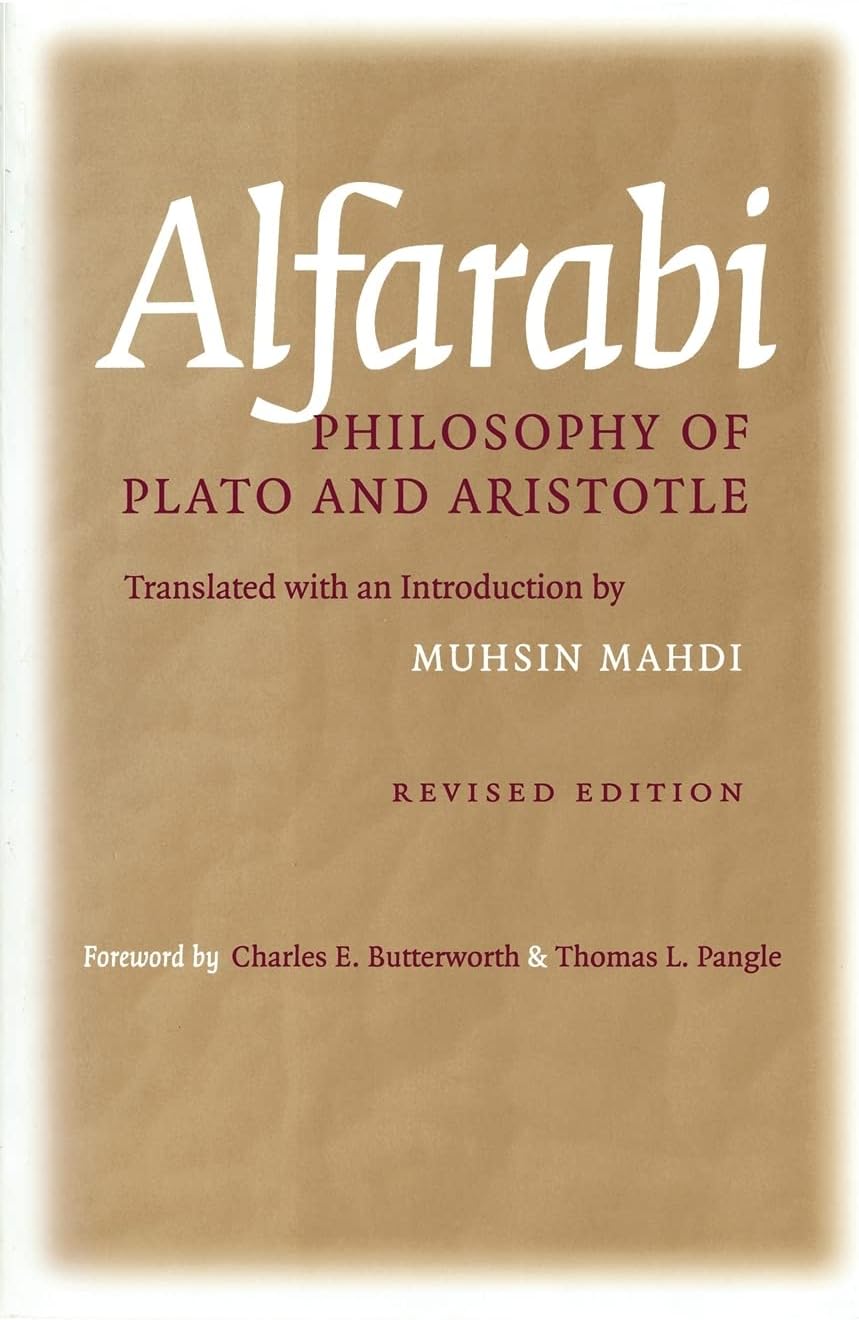
Philosophy of Plato and Aristotle (Agora Editions)
Product ID: 2558065
📚Classic philosophical texts
🧠Deep intellectual exploration
🕰️1969 Cornell edition reissue
Desertcart purchases this item on your behalf and handles shipping, customs, and support to Tunisia.
🧠 Unlock the secrets of ancient minds and elevate your intellectual game!
This used edition of 'Philosophy of Plato and Aristotle' by Alfarabi, reissued from the 1969 Cornell edition, offers a rare and profound exploration of classical philosophy through the lens of Islamic scholarship. Featuring Muhsin Mahdi’s substantial introduction and new foreword, it bridges ancient Greek thought with political philosophy, emphasizing the development of intellect as the highest human pursuit. A must-have for serious readers and philosophy enthusiasts seeking deep, original insights.
| Best Sellers Rank | #1,111,704 in Books ( See Top 100 in Books ) #1,303 in Individual Philosophers (Books) #1,745 in Ancient Greek & Roman Philosophy #2,577 in Religious Philosophy (Books) |
| Customer Reviews | 4.9 out of 5 stars 24 Reviews |
I**N
There are secrets that philosophers hide from the masses
The ancient Greeks were the first people who wrote about philosophy and the greatest of these Greeks were Plato (428/427-348/347 BCE) and Aristotle (384-322). They wrote in Greek, and since many later people did not know Greek, if it were not for Islamic writers who knew Greek and who translated their writings into Arabic, Jews and Christians would have had no knowledge of these great men or of philosophy. One of first of these Islamic writers was Alfarabi (870-950). Alfarabi tells us that Plato could not reveal the truth to everyone because they would not understand it and would feel threatened by ideas that conflict with what they felt was true: The wise Plato did not feel free to reveal and uncover every kind of knowledge for all people. Therefore he followed the practice of using symbols, riddles, obscurity, and difficulty, so that knowledge would not fall into the hands of those who do not deserve it and be deformed, or into the hands of someone who does not know its worth or who uses it improperly. In this he was right. Thus, Alfarabi, Muhsin Mahdi writes, also hid the truth from the general population by brazenly using "self-contradiction - between works, between passages, and even, at least once, within the same sentence. The uses of this device are manifold." Alfarabi states that one of these truths, in fact the basic truth that Plato could not teach the general population, is that spending one's life developing one's mind is the only true fulfillment of human existence. The thinking must focus on the practical and political, the sciences that benefit the individual and society. This knowledge can only be obtained by associating and cooperating with others and living next to them. Plato, Alfarabi writes, was not speaking of religious knowledge, another idea that the general population could not accept. Religious thinking "is not sufficient." "Religion is "an imitation of philosophy." It supplies an imaginative unexamined account of nature that the general population needs to know, but not the truth. But the perfect person, according to Plato, is one who learns the real truth and lives a life that reflects it. This was the problem faced by Plato's teacher: For when he [Socrates] knew that he could not survive except by conforming to false opinions and leading a base way of life, he preferred death to life. Aristotle, Plato's student, Alfarabi wrote, had the same understanding as Plato "and more." Aristotle investigated and described the causes of everything that he could see and think about, practical and theoretical science. He examined the purpose of everything by looking at all of its parts. He divided what he found into classes. He gave an account of all he saw. He spoke of logic, drama, poetry, and other subjects and described how they should work. Alfarabi portrays Aristotle as taking some of Plato's ideas, as well as others that Plato did not discuss, and examining them as a scientist would probe them today. Thus, for example, while Plato speaks about the soul, Aristotle defines it as the various parts of the body, such as the nutritive and respiratory systems that keep the body alive, as well as the intellect. This intellect is the true and only aspect of humans that differentiates them from animals and inanimate objects. Thus people who do not develop their intellect have failed to become truly human. All the parts of the soul die with the body, except for the intellect, but Aristotle seems to say that this surviving intellect has no recollection of its prior life. Aristotle's view of the soul is another philosophical teaching that would disturb the general population.
K**Ä
Great investment! Highly suggested!
So far since the beginning of the book which starts as The Human Things... it has been great to read. If you are a consistent reader it will be a wonderful book to consider reading.
A**A
Great book
Great book
M**B
Philosophy of plato and aristotle: alfarabi
While some would consider al-Kindi as being the first Muslim philosopher, others would consider AlFarabi as the founder of Muslim philosophy; a parallel clearly with the way Plato and Aristotle are considered in the context of the development of western philosophy. That said, AlFarabi was a prodigious translator of Greek texts into Arabic, not only providing access to texts by Plato, Aristotle, and some of the Neoplatonists, but also people like pseudo-Dionysius, whose Arabic translation was translated into Latin well before the west had access to the original Greek. This book is essentially in three parts: ‘The attainment of happiness’, ‘The Philosophy of Plato’, and the ‘Philosophy of Aristotle.’ ‘The attainment of happiness’ I found to be a brilliant example of inductive reasoning, albeit on the long side, and probably a lot closer to Aristotle in approach, than Plato (the same might also be said of the scholastics), and a total contrast in the approach taken to the same subject by Ghazali. The orientation is political in the same sense that the Republic is political, but at its heart is the establishment of virtue. The section on Plato, is a brilliantly concise overview of a large selection of dialogues from Plato’s oeuvre, drawing connections between dialogues which might have missed the attention of a less acute mind. The section on Aristotle is about twice the length of the former, which suggests a predisposition, hardly surprising perhaps given AlFarabi’s interest in political philosophy as contrasted with writers such as Averroes and Avicenna. This is not a big book, only some 130 pages plus very extensive notes, but for a different perspective on both Plato and Aristotle, it is to be welcomed.
Trustpilot
3 weeks ago
1 day ago