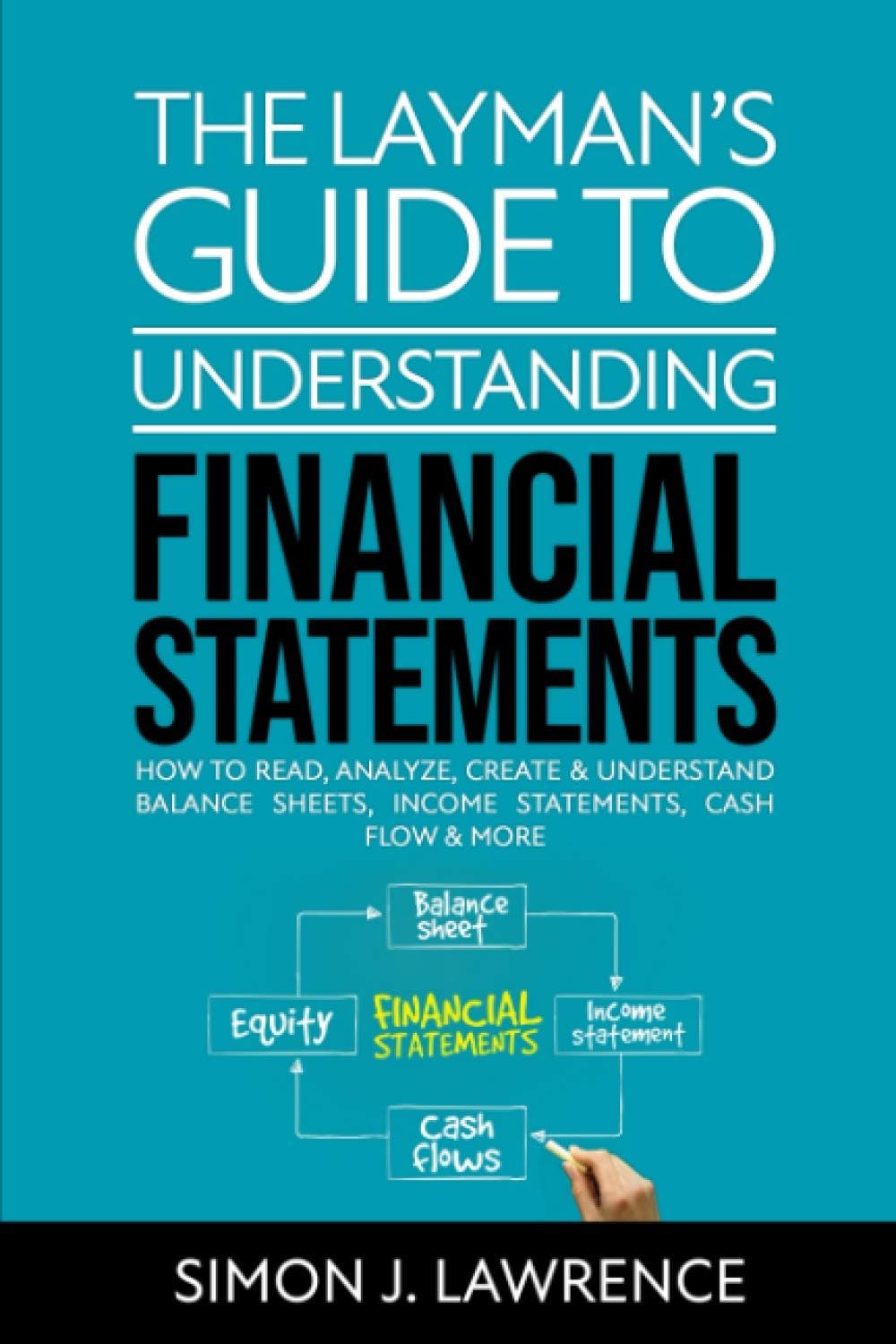
The Layman’s Guide to Understanding Financial Statements: How to Read, Analyze, Create & Understand Balance Sheets, Income Statements, Cash Flow & More
Product ID: 257185516
Desertcart purchases this item on your behalf and handles shipping, customs, and support to Tunisia.
📊 The Layman’s Guide to Understanding Financial Statements How to Read, Analyze, Create & Understand Balance Sheets, Income Statements, Cash Flow & More You don’t need a finance degree to understand your company’s numbers—you need the right guide. Whether you’re a small business owner, entrepreneur, or aspiring professional, your success depends on your ability to interpret the financial data that drives decisions. But if accounting has always felt like a foreign language, this book was written just for you. “Finally, financial statements made simple.” The Layman’s Guide to Understanding Financial Statements breaks down intimidating financial documents into plain English, so you can make sense of your business’s economic health and make smarter, more informed decisions. “No jargon. No fluff. Just numbers you can understand.” 💡 Why This Book Matters Now More Than Eve r In today’s fast-paced world, relying solely on an accountant or bookkeeper isn’t enough. You, as the business owner or manager, need to confidently read, analyze, and act on the financial reports handed to you. Whether you're managing a team, running your own company, or just trying to be financially literate, this guide puts the power back in your hands, without overwhelming you with technical jargon. “Stop guessing. Start understanding your business.” 📘 What You’ll Learn Inside This book is structured into four practical and beginner-friendly sections, each designed to build your knowledge and confidence gradually. 1. Understanding Key Accounting Terms If you’ve ever stumbled over phrases like “equity,” “liabilities,” or “deferred income,” this section is your lifeline. We define every important accounting term you’ll encounter—using everyday language, real examples, and no unnecessary fluff. No more googling definitions. You’ll start this journey with a solid foundation and a clear understanding of the vocabulary behind every balance sheet. 2. Introduction to Financial Statements Before you dive into preparation or analysis, you need to know what each financial statement is and why it matters. This section walks you through: • The Balance Sheet – what your business owns and owes • The Income Statement – whether your business is making or losing money • The Cash Flow Statement – how money is moving in and out of your business 3. Creating & Analyzing Financial Statements This is the hands-on section of the book, where you’ll learn how to actually prepare and dissect financial statements like a pro. We walk you through: • Simple methods to build each financial statement from scratch • Common tools and templates to streamline the process • Introduction to key financial ratios for powerful insights • Real-life examples, screenshots, and visual aids to guide you 4. Avoiding Mistakes & Spotting Red Flags Even seasoned professionals make errors—but you don’t have to. This final section shows you how to catch mistakes, seal financial loopholes, and safeguard your business from internal fraud or oversight. You’ll learn: • The most common financial reporting mistakes • How to detect and fix errors before they spiral • How to set up safeguards that protect your resources • What unethical bookkeepers might try to hide (and how to stop them) Inside, you’ll find practical wisdom, real examples, and a straightforward path to mastering financial statements. It’s like having a financial mentor on your desk—minus the hourly rate. 🛒 Ready to Finally Understand the Numbers That Drive Your Business? Click the BUY NOW button and take the first step toward clarity, confidence, and financial control. Let this guide light the way—and empower you to run a smarter, stronger business today Review: Super useful for business owners (and anyone else!) - This book is incredibly in-depth and should be in every business owner's repertoire, especially if they're a new business owner. I feel like anyone could learn a thing or two from this book for sure. Loved the in-depth explanations for every single term you might encounter, and it has good examples so that you're not just bogged down with finance-related vocabulary. This book covers everything you ever wanted to know about financial statements, and everything you never knew you needed to know. It's got stuff to avoid, how-tos, explanations, and every extra bit you might encounter while dealing with financial statements. Definitely worth the money. Review: Simple - Information


| Best Sellers Rank | #165,471 in Books ( See Top 100 in Books ) #77 in Financial Risk Management (Books) #129 in Home-Based Businesses #240 in Wealth Management (Books) |
| Customer Reviews | 4.1 out of 5 stars 147 Reviews |
J**J
Super useful for business owners (and anyone else!)
This book is incredibly in-depth and should be in every business owner's repertoire, especially if they're a new business owner. I feel like anyone could learn a thing or two from this book for sure. Loved the in-depth explanations for every single term you might encounter, and it has good examples so that you're not just bogged down with finance-related vocabulary. This book covers everything you ever wanted to know about financial statements, and everything you never knew you needed to know. It's got stuff to avoid, how-tos, explanations, and every extra bit you might encounter while dealing with financial statements. Definitely worth the money.
B**.
Simple
Information
S**E
A one-stop-shop to financial management
Presented simply and in straightforward fashion, The Layman’s Guide To Understanding Financial Statements: How To Read, Analyze, Create & Understand Balance Sheets, Income Statements, Cash Flow & More delivers financial management savvy to readers as promised in its title. Readers are reminded early on in the introduction how extensive the topics covered in this book can be and may stand assured knowing that they have in their hands a robust guide to the key areas of accounting together in one place. The book comforts readers in expressing that it is not necessary to be or to hire an accountant in order to make sense or even to prepare financial statements. It also makes it clear that investing energy into financial management is ideal for maintaining a thriving and productive business model. It allows readers the option to determine at what extent they wish to interact within the fiscal side of their business, and at the very least offers readers with an in-depth knowledge base for interpreting financial statements even if the reader does not wish to involve themselves in preparing them. For those hardy on learning to prepare them from scratch, this guidebook teaches the skillset as well as pointing out the common costly errors that may be avoided, which many non-accounting experts mistakenly overlook. Taking into account the fact that readers may still prefer to hire accountants, reading this book enlightens ones ability to choose accordingly for whom would be granted access to take on such task and responsibility. Impeccably structured, this guidebook is organized in a digestible learning format beginning with apparent knowledge then working its way into delivering more complexity for financial mastery. The neat organization also serves to help readers refer exactly back to specific topics and tools they need while working on one’s finances. Financial jargon and terminology is highlighted in-depth, outlining and defining important concepts and common accounting vernacular. At times redundant for the sake of clarity, the book makes sure to be as clear as possible when delineating complex items. I recommend this book to entrepreneurial readers, business owners, and anyone looking into starting their own business venture to become fully capable of handling finances without feeling the need to outsource to other bookkeepers who may not be as competent or trustworthy as oneself. This book is a one-stop-shop that offers simple and learnable approaches for managing the fiscal side of business, allowing readers to apply such concepts with ease and assurance that the monetary aspect of one’s business is flowing and in order.
Z**K
Nice book about accounting
Good book to understand a spreadsheet and accounting which sill give you an overview of accounting principles and details for you to understand a financial statement
J**G
Beware the Errors
I thought this would be a good refresher on basic financial statements but I can't trust this book. On pg 50 the author states that, "it is a government requirement that all businesses prepare accurate financial statements and make the [typo for 'them'] public." This is not true. Not all businesses are required to make financial statements public. I then didn't trust the paragraphs following that. Then on pg 57- there's slightly fuzzy printing (all the statements are) of a Trial Balance sheet in which the monetary values have an extra comma and I thought, "Who writes like that?!" Fixed assets were written as 1,30,000 instead of 130,000 and the totals were written as 3,26,000 instead of 326,000. There's at least one other pg like this and at least one with normal commas. Inconsistent. And then on pg 63 in calculating Gross Profit and Gross Margin (yes this book has to have technical terms and calculations despite saying it won't) there is a huge error in math. The formulas are stated as: "Gross Profit = Gross Revenue - Direct Costs" "Gross Margin = Gross profit / Gross Revenue" (Another typo in the 'p') And the example is: "if you sell t-shirts in an uptown shop and you purchase 100 t-shirts at a cost of $10 each. Your direct expenses would be $1000. If you were to sell all the t-shirts at the price of $12 each, your total income would be $120. Your gross profit, in this case, would be $120 - $100 = $20, and your gross margin would be ($20 / $120) × 100 = 16.6% " WHOOPS..... gross profit should be $200. Gross margin is using the wrong numbers but does come out to the same percentage but the formula doesn't say to multiply by 100 so again, inconsistent. Initially I was hesitant on buying this book because a "lay person" wrote it but because of the good reviews and the book description of, "This book may also be used by accounting students who wish to sharpen their practical accounting skills," I was sold on giving it a try. But this was misleading and that's why I'm writing this review. This book is not good for accounting students. And while overall the book gives a general overview of financial statements and that seems to be okay, for the above reasons and others, I don't have confidence in its complete accuracy. I stopped reading on pg 63 because of it. I'm giving it a 3 because there is some valid info but don't rely solely on this book if you do buy it.
W**R
Good book for the layman
Good reference source for someone with no formal accounting training.
1**S
WASTE OF MONEY
This book was not even proofread! It is written in a style that makes me think it was translated from another language by someone for whom English is not their first language. And the material is confusing; not clear; contradictory. Waste of money.
B**.
Lack of proofreading makes it hard to trust
Bought this book to refresh myself on accounting basics. As another reviewer commented, this book has numerous errors throughout that make it hard to follow at points and difficult to trust. Some are simple left out words or other grammatical errors. Others are consistently misplaced commas in example financial statements. A math example that comes out to the correct result but has wrong numbers in the process. Switching of words in ratio examples: is it debt-to-equity or equity-to-debt, the author uses both from one sentence to the next to mean the same thing. The author also states absolutes that aren't true. "All business must use the accrual method of account." Only true if your business is over a certain size. At the very end of the book he briefly mentions businesses using the cash method with no reference to his previous statement. A simple proofreading should have caught all of these mistakes. The lack of attention to detail casts doubt on the content of the whole book.
V**D
Excellent book to get overview of the accounting
The book gives overview of the accounting and financial statements prepared in any business. It will be particularly useful to understand and decipher the financial statements i.e. Balance Sheet,Income Statement and Cash Flow Statement.
B**0
excellent reference book for audit analysis
useful guide and simple to understand
S**N
A good reference quick guidance on Financial Statements
I enjoyed reading this quick guidance on Financial Statements and the content was just plain words. Sadly it didn't have any samples, nor Financial Statements charts to understand the lay out of a Financial Statements or any graphic charts to clearly understand the subject. Overall it's just a quick reference guidance book and handy to have.
Trustpilot
2 months ago
3 weeks ago