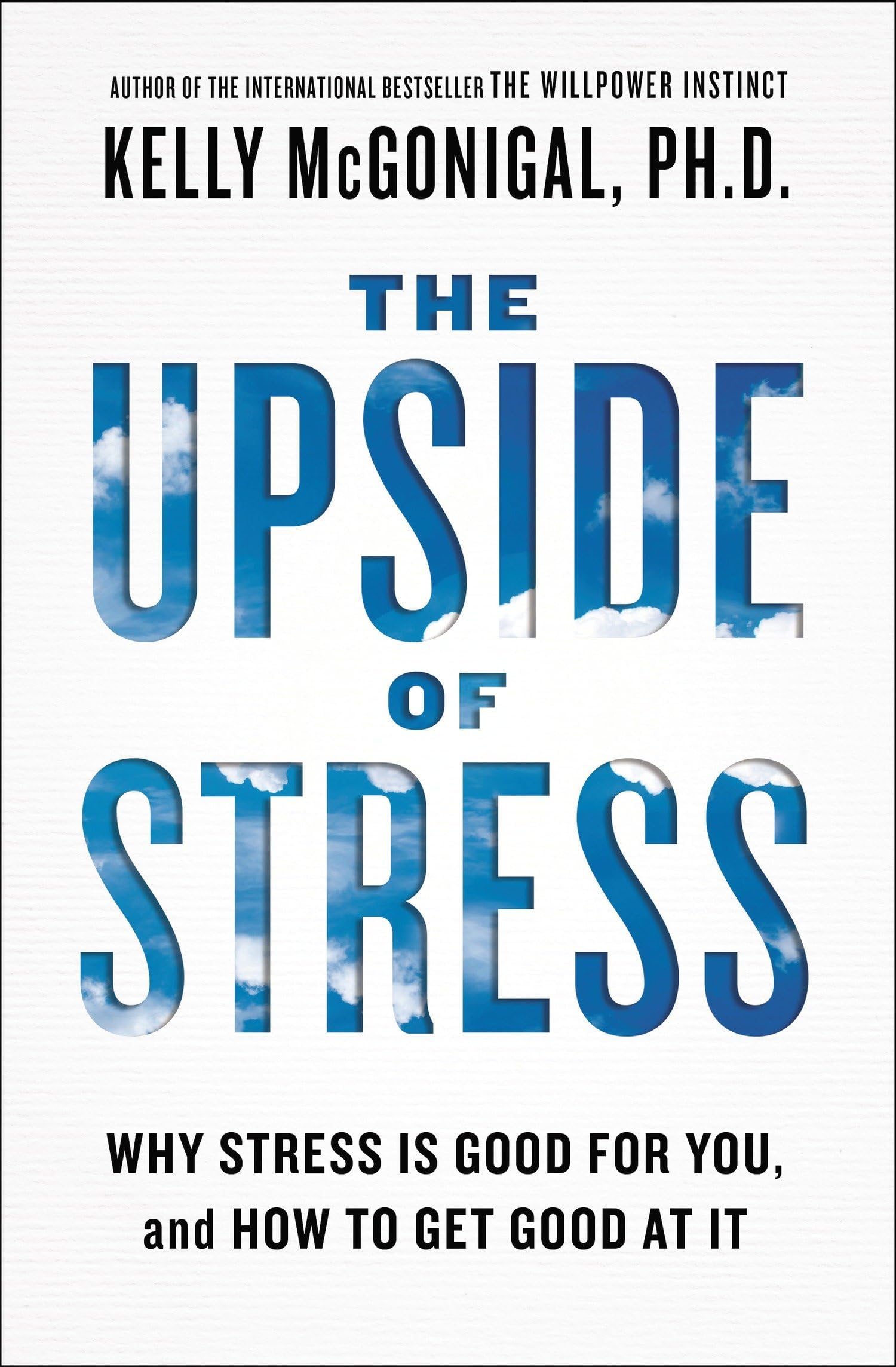
The Upside of Stress: Why Stress Is Good for You, and How to Get Good at It
Product ID: 28077269
Desertcart purchases this item on your behalf and handles shipping, customs, and support to Tunisia.
Drawing from groundbreaking research, psychologist and award-winning teacher Kelly McGonigal, PhD, offers a surprising new view of stress—one that reveals the upside of stress, and shows us exactly how to capitalize on its benefits. You hear it all the time: stress causes heart disease; stress causes insomnia; stress is bad for you! But what if changing how you think about stress could make you happier, healthier, and better able to reach your goals? Combining exciting new research on resilience and mindset, Kelly McGonigal, PhD, proves that undergoing stress is not bad for you; it is undergoing stress while believing that stress is bad for you that makes it harmful. In fact, stress has many benefits, from giving us greater focus and energy, to strengthening our personal relationships. McGonigal shows readers how to cultivate a mindset that embraces stress, and activate the brain's natural ability to learn from challenging experiences. Both practical and life-changing, The Upside of Stress is not a guide to getting rid of stress, but a toolkit for getting better at it—by understanding, accepting, and leveraging it to your advantage. Review: Helped to cultivate a new mindset on stress! - The Upside of Stress: Why Stress Is Good for You, and How to Get Good at It, is a self-help book written by Kelly McGonigal. The book challenges the notion that all stress is bad for us and instead argues that stress can have a positive impact on our lives. McGonigal's writing style is accessible and engaging, and she blends personal anecdotes, scientific research, and practical tips to create a compelling argument. She explains how stress can help us to grow, build resilience, and find meaning in our lives. One of the strengths of the book is its emphasis on the role of mindset in shaping our experience of stress. McGonigal argues that by changing the way we think about stress, we can transform it from a negative force to a positive one. She offers a range of strategies to help readers cultivate a more positive relationship with stress, such as reframing stress as a challenge rather than a threat, practicing gratitude, and seeking out social support. While the book's emphasis on the potential benefits of stress is refreshing, some readers may find the advice on managing stress oversimplified. McGonigal's focus on mindset and positive thinking is a helpful starting point, but it may not be enough to manage chronic or overwhelming stress. Overall, The Upside of Stress is an informative and thought-provoking read that challenges readers to re-think their relationship with stress. The book is well-researched and presents a compelling argument for why stress can be good for us. However, readers should approach the book with a critical eye and be prepared to supplement its advice with additional resources if they are struggling with significant stress in their lives. Review: Stress is better than we think - I just finished up a book that was bubbling to the top of my to-read pile as the Holidays passed by me at warp speed. The subject of stress does occupy many minds during the winter months and the up and coming income tax season. But as I began reading the following book I found that this book is a welcome read for any time of the year since stress comes in many forms. For most of our lives, we have been told that stress is harmful to our health. What if someone were able to prove this to be otherwise? How would you feel if you found that there are more health benefits to stress then health risks? All it takes is a change in your mindset. Kelly McGonigal argues in her book The Upside of Stress that psychologists have been telling people for years that stress is bad for you but she has discovered through research that this is not indeed the case. With her research, she can prove the benefits of stress can outweigh the harmful effects of stress that revolves around changing the mindset about stress. If one can believe that stress is beneficial than the coping mechanisms associated with stressful events can cause personal growth which will improve the health of that individual. “Mindsets are beliefs that shape your reality, including objective physical reactions (like the strength of my arm as Crum pushed on it), and even long-term health, happiness, and success. More important, the new field of mindset science shows that a single brief intervention, designed to change how you think about something, can improve your health, happiness, and success, even years into the future.” (McGonigal 2016, 4) Kelly McGonigal, Phd., is a lecturer and psychologist at Stanford University and an expert on mind-body relationship. She is a senior teacher/consultant at Stanford for Compassion and Altruism Research and Education and also teaches for the School of Medicine’s Health Improvement Program. Her work validates the claims of psychological science to personal health and happiness, as well as organizational success and social change. I understand what McGonigal means when she makes the statement, “When you face difficulties head-on, instead of trying to avoid or deny them, you build your resources for dealing with stressful experiences.” (McGonigal 2016, 18) We all face difficulties over the course of our lives. It is not a matter of what those challenges are but how we handle them that matters most in life. If we don’t manage them well, then we tend to repeat those problems until we can overcome them. This book explains the reasoning behind why McGonigal believes that stress can be healthy for personal growth. Her research she shares verify why the probability this is correct and she describes this well in the book. I did not find anything in this book that I would disagree with which is why I have rated this book with five stars. I highly recommend everyone to read this book, and hopefully, it will change your outlook on stress and help you handle those dreadful times with personal growth and resilience.

| Best Sellers Rank | #21,505 in Books ( See Top 100 in Books ) #40 in Popular Applied Psychology #72 in Post-Traumatic Stress #83 in Stress Management Self-Help |
| Customer Reviews | 4.6 out of 5 stars 1,549 Reviews |
B**N
Helped to cultivate a new mindset on stress!
The Upside of Stress: Why Stress Is Good for You, and How to Get Good at It, is a self-help book written by Kelly McGonigal. The book challenges the notion that all stress is bad for us and instead argues that stress can have a positive impact on our lives. McGonigal's writing style is accessible and engaging, and she blends personal anecdotes, scientific research, and practical tips to create a compelling argument. She explains how stress can help us to grow, build resilience, and find meaning in our lives. One of the strengths of the book is its emphasis on the role of mindset in shaping our experience of stress. McGonigal argues that by changing the way we think about stress, we can transform it from a negative force to a positive one. She offers a range of strategies to help readers cultivate a more positive relationship with stress, such as reframing stress as a challenge rather than a threat, practicing gratitude, and seeking out social support. While the book's emphasis on the potential benefits of stress is refreshing, some readers may find the advice on managing stress oversimplified. McGonigal's focus on mindset and positive thinking is a helpful starting point, but it may not be enough to manage chronic or overwhelming stress. Overall, The Upside of Stress is an informative and thought-provoking read that challenges readers to re-think their relationship with stress. The book is well-researched and presents a compelling argument for why stress can be good for us. However, readers should approach the book with a critical eye and be prepared to supplement its advice with additional resources if they are struggling with significant stress in their lives.
C**A
Stress is better than we think
I just finished up a book that was bubbling to the top of my to-read pile as the Holidays passed by me at warp speed. The subject of stress does occupy many minds during the winter months and the up and coming income tax season. But as I began reading the following book I found that this book is a welcome read for any time of the year since stress comes in many forms. For most of our lives, we have been told that stress is harmful to our health. What if someone were able to prove this to be otherwise? How would you feel if you found that there are more health benefits to stress then health risks? All it takes is a change in your mindset. Kelly McGonigal argues in her book The Upside of Stress that psychologists have been telling people for years that stress is bad for you but she has discovered through research that this is not indeed the case. With her research, she can prove the benefits of stress can outweigh the harmful effects of stress that revolves around changing the mindset about stress. If one can believe that stress is beneficial than the coping mechanisms associated with stressful events can cause personal growth which will improve the health of that individual. “Mindsets are beliefs that shape your reality, including objective physical reactions (like the strength of my arm as Crum pushed on it), and even long-term health, happiness, and success. More important, the new field of mindset science shows that a single brief intervention, designed to change how you think about something, can improve your health, happiness, and success, even years into the future.” (McGonigal 2016, 4) Kelly McGonigal, Phd., is a lecturer and psychologist at Stanford University and an expert on mind-body relationship. She is a senior teacher/consultant at Stanford for Compassion and Altruism Research and Education and also teaches for the School of Medicine’s Health Improvement Program. Her work validates the claims of psychological science to personal health and happiness, as well as organizational success and social change. I understand what McGonigal means when she makes the statement, “When you face difficulties head-on, instead of trying to avoid or deny them, you build your resources for dealing with stressful experiences.” (McGonigal 2016, 18) We all face difficulties over the course of our lives. It is not a matter of what those challenges are but how we handle them that matters most in life. If we don’t manage them well, then we tend to repeat those problems until we can overcome them. This book explains the reasoning behind why McGonigal believes that stress can be healthy for personal growth. Her research she shares verify why the probability this is correct and she describes this well in the book. I did not find anything in this book that I would disagree with which is why I have rated this book with five stars. I highly recommend everyone to read this book, and hopefully, it will change your outlook on stress and help you handle those dreadful times with personal growth and resilience.
K**R
Good book about relationship with stress and hardship.
A good book. I didn't find anything groundbreaking or something I didn't have any idea about in it, but it is well-structured, evidence-based, well-written and meaningful. The best thing it does is that it invites you to rethink your relationship with stress, problems and hardship in your life. It turns out that it's not about positivity per se. It's much more about seeing many sides of stress. The struggling is still there (and denying it would be a bad idea), but you can also see how it can help you grow stronger, more confident and connect with people in more meaningful ways.
D**N
The Tools You Need to Make Stress Work for You
"The Upside of Stress" has changed my life. I was introduced to Kelly McGonigal by her TED Talk "How to make stress your friend," and after spending the last year overwhelmed by generalized anxiety disorder and almost unable to function like I need to, I decided it was finally time to get this book. It begins with a compelling overview of the contents of the book and then dives deeply into the specific ways in which embracing stress as a positive part of our lives can change how we physiologically respond to stress. The best part is this is no gimmick: McGonigal grounds all of her claims in extensive research, using statistics and anecdotes to tell a compelling story that is at the same time informative and entertaining. I frequently found myself bookmarking pages to come back to, wanting to repeat exercises in my own life to help with issues I've faced or know I will be facing in my future. Throughout the book, she includes about a dozen or so reflection exercises to facilitate reframing our stress mindset. On my first reading, I wanted to gain a broad overview, so I rushed through these exercises and made notes to come back to them as grad school and my busy work schedule allow; regardless, understanding the science behind stress and having a toolbox of ways I can interrupt debilitating anxious thoughts has certainly proven helpful almost every day in reclaiming my life from unbearable anxiety: rather than feeling defeated by anxiety, I'm becoming able to control it and direct this energy into enhancing my life. As I take time to return to the reflection exercises she provides, I am certain this impact will grow. The only complaint I have about this book is that the sources are not cited in the text (they are, however, included in an exhaustive bibliography at the end of the book, but there is no easy way to match the text with the sources this way). Especially for a Kindle book, I appreciate being able to easily find the sources that are referenced, since as a research-minded reader, I like being able to see how recent studies are, where they were published, or any author's notes that may accompany them. I hope future editions of this book will correct this shortcoming. Overall, if you have ever suffered from undue stress or anxiety, this book will help you tame that beast and make it work for you.
L**S
but am extremely glad that I stuck with the reading
Do yourself a favor and read this book - Then share it with the people you care about. This is a valuable aid to positive living that will help you discover meaning in stress and how to shift your personal reactions to gain positive life experience, as well as increased peace and health, instead of falling victim to the "stress kills" phenom. The book provides a fuller understanding of stress that reflects new research and includes many personal stories that tie concepts into real life scenarios. I found the Introduction and beginning to be a little off-putting, but am extremely glad that I stuck with the reading. Perhaps halfway into chapter 1, I realized the gold-mine of value this book would yield. Long-assumed truisms about stress are shown to be qualified: "Stress is harmful, except when it's not. [. . .] Stress increases the risk of health problems, except when people regularly give back to their communities. Stress increases the risk of dying except when people have a sense of purpose. Stress increases the risk of depression, except when people see a benefit in their struggles. Stress is paralyzing, except when people perceive themselves as capable. Stress is debilitating, except when it helps you perform. Stress makes people selfish, except when it makes them altruistic. For every harmful outcome you can think of, there's an exception that erases the expected association between stress and something bad - and often replaces it with an unexpected benefit." (Final Reflections) McGonigal does an excellent job in a very readable fashion of explaining each of these concluding claims in both biological and psychological processes. She also gives you the means to achieve a positive change in your own response so that you can build a much better life despite stress and trauma. It is not based on an idealized glossing of traumatic experiences, but rather a balanced look at positive benefit that can be found alongside the pain we feel.
G**N
By reading this book we realize that stress not just is bound to be bad.
As written in the book, we have grown up with the idea that stress always is bad, but then by looking on many of the cases in the book we see that we have to start rethinking as many times stress actually is good. By the first case we see that what we perceive as harmful stress by changing the actual persons believing then instead was turned into being good and helpful stress. In this case it is housekeepers in hotels who weights a bit too much, and explain that they are too tired and stressed to after work go to exercising for burning calories. Then only in some of the hotels the housekeepers are learned that they don’t need to exercise, as they by their daily work already are exercising using enough calories. 4 weeks later, these housekeepers, opposite to the housekeepers in the other hotels, then have lost weight. And concerning how peoples viewing on old age affects their health we read about a research during 38 years about aging. Here it showed up that among those whit the most positive view of aging there were an 80 percent lower risk of heart attack. And besides at average they also were living 7 years longer than the other with the negative thinking on high age. And among other we read how it by research has been found that actually have some person become more bad stressed by over many hours on TV watching a catastrophe/tragedy than the persons who actually were at the place when it happened. Actually I bought the book because I during years have been fighting against stress, and always only thought of stress as being harmful, and for me without doubt has been the reason for seizures which started in 2004, a bit of a year after I to a doctor, in vain, had warned about it. So perhaps reading this book has rebuilt the memory contents in the brain and hereby helps against my actual problem. So it has been an interesting, new thinking, and speculative book to read.
A**N
How we tell the story of the stress of the coronavirus may determine our health outcomes
I had been appreciating Dr. Kelly McGonigal's book The Upside of Stress long before the coronavirus, or COVID-19, made its appearance. I pulled the book out again this week because I knew it would be helpful. Our lives have been turned upside down in the past weeks because of the coronavirus, and all of us are struggling to find our footing. McGonigal offers a number of ways to do so, in particular reminding us of her main thesis that stress is only bad when we believe it is. The Upside of Stress provides readable stories and examples of research, personal experiences, and neuroscience concepts that offer a counterintuitive take on stress. Not only is stress not always a negative, it can actually be a positive--something that enables us to fully engage with our challenges, to connect with others and express our care, and an opportunity to grow stronger. I appreciated how McGonigal was able to seamlessly weave the research in with her personal stories. I also valued her synthesis of what we can do differently so that the real stress we are experiencing becomes the kind of stress that benefits us rather than adding to our suffering. When we see stressful experiences as a call to courage, caring, and compassion, we tend to reach out to connect with others. This helps them, and also enhances our own resilience. In a time of great uncertainty, McGonigal's book reminds us that there is every reason to hope for the best.
K**Y
Mixed Feeling, but worth the read
I have mixed feeling about this book. While I believe it has merit, and I do think that they way we think and how we behave does have a lot to do with how we act and in turn how our bodies react to different things, this books makes it seem like just changing the way you think you can just magically turn a panic attack into excitement instead of fear. Some parts of this book I think are helpful and I will be giving them a try in my own life to see if it makes a difference. I could be completely off base and maybe just changing the way I view stress, seeing it as a opportunity instead of a burden, will have a impact on some part of my life :) I still think its worth the read!
M**K
How to use Stress as a Tool for Fulfilling Lives
I bought the Kindle edition of this revolutionary, well researched, very readable and inspirational book the moment it was published. I soon gave up using the highlighter as there was more yellow than white on the pages! Dr McGonigal’s book tells us that the energy of stress can be turned into a positive resource – provided that you BELIEVE that it can. Kelly explains about the link between stress and meaning. The book gives very useful brief exercises for you to use to turn threats into challenges, and for working with your values. Always practical, and well explained, with personal stories and research references. Lots of help for carers. Kelly’s analysis is based on science rather than theory. The book explains how to use “mindset mindfulness” to change your attitude towards stress. An example of a mindset switch (or “intervention”) is: Reflect on, and write about, the benefits of “Bigger Than Self” goals instead of “Self-Focused” goals. To benefit from the upside of stress, you need to understand the science – which Kelly explains fully. This enables you to believe that there are benefits from stress. Then you do an exercise that usually involves being aware, thinking and some writing. Finally you share what you’ve done, and why, with others. The author explains that there are more stress responses than just, “fight-or-flight”. Such as the “Tend-and-Befriend ” response. Acts of kindness have powerful health and well-being benefits to the giver. I’m developing a community website about “Resilience with Mindfulness”. So it’s important that I integrate Kelly’s ground-breaking ideas about the positive power of using the energy of stress with my previous thoughts about stress. I used to think that there was good stress and bad stress. Good stress was stress in manageable quantities. It motivates you to revise for exams and prepare for meetings. Bad stress was when you felt overwhelmed by stress. For explaining good and bad stress, I use the metaphor of a plant or a spring. Plants need stress from wind and weather to toughen them up. Too much wind and they become damaged. Good stress is like a spring being stretched, but not too far. It springs back. Bad stress – more than you can cope with – is like stretching the spring so far that it won’t spring back. I think Kelly’s idea of using the energy of stress as a driving force to achieving your goals while under stress is a bit like letting go of the stretched spring before it breaks, and using the energy that this releases to propel yourself forwards. What do you think? This “How To” guide shares with Mindfulness the difficult idea that by starting from where you are now, rather than starting from where you’d like to be, gives you a realistic platform for moving forward. So accepting and embracing pain and stress – for now – does not mean rolling over and accepting the unacceptable for all time. Imagine you are an Army Commander. More than half of your army has been captured by the enemy. If you don’t accept that this has happened, your rescue plan might fail because it assumes you’ve still got all of your troops to help with the rescue rather than just the few troops that have not been captured. We learn that you can feel excited and energised while still experiencing anxiety. Then you don’t need to struggle against, or avoid, the source of the stress and anxiety – you get health and well-being benefits from embracing anxiety - provided that you THINK that stress is NOT bad for your health.
A**R
Stress is harmful, except when its not
Stress: the cause of so much worry as well as all of life's problems; every writer says you should avoid stress at any cost. "Stress can kill you"; till you hear from the author of this marvelous work, "Stress is not bad, but thinking that stress is bad, not only makes it worse, but it can kill you". With this message across the whole book, she teaches various techniques not to avoid stress, but to face it. In this book, we see a shift in thinking; a new vision of how to live life; a life-long lesson. I highly recommend this book to any of you, who are under a lot of stress in this time of pandemic COVID-19; the book will be your very best friend. If you are still not convinced of my words, check out the author's TED TALK "How to make stress your friend"; it is a simple and very powerful idea. Thanks to Phd. Kelly McGonigal for getting us to look at our stressfull-life in the right perspective. Besides, if you could remove all the stressful experiences from your life, perhaps life wouldn't be so meaningful, would it?
B**E
Super !
I really enjoyed this book. I found a lot of very interesting points of view that will absolutely change mine … Moreover, this book opened my eyes on the fact that i already had, deep inside, the perfect tool to face all my new challenges : the stress mécanismes. Finally, i am very happy to understand that Nature does the things, perfectly. Stress is now one of my best Friends … Thanks a lot, dear Kelly.
F**I
Unacceptable from a researcher
I think the author deliberately misinterpreted some results trying to annihilate her predecessors' works too. If you can seriously read through lines, you'll get some useful hints from her really accurate and proper references, but throw away most of what she states as a revelation because most of the data are misinterpreted to prove right and hype the basic concept, which you can get from the title. I would suggest to use some common sense in analyzing her statements. I wonder how a respected author with those high level credentials could fall into a thing like this. It's not scientific literature, it's just few facts and tons of hype. I do not recommend this title.
T**O
Lifelong useful
The fight-or-flight survival instinct is built into our DNA. Still, in modern society, when we are in a stressful but less threatening situation, we can respond to stress in other ways—challenge response and tend-and-befriend response. They are explainable by the volatile function of oxytocin, which makes us social and brave. Thanks to this hormone, we can be strong, altruistic, and enthusiastic with a bigger-than-self goal. Stress is helpful and should be accepted, utilized, and embraced because oxytocin increases in a stressful situation.
Trustpilot
1 day ago
3 days ago