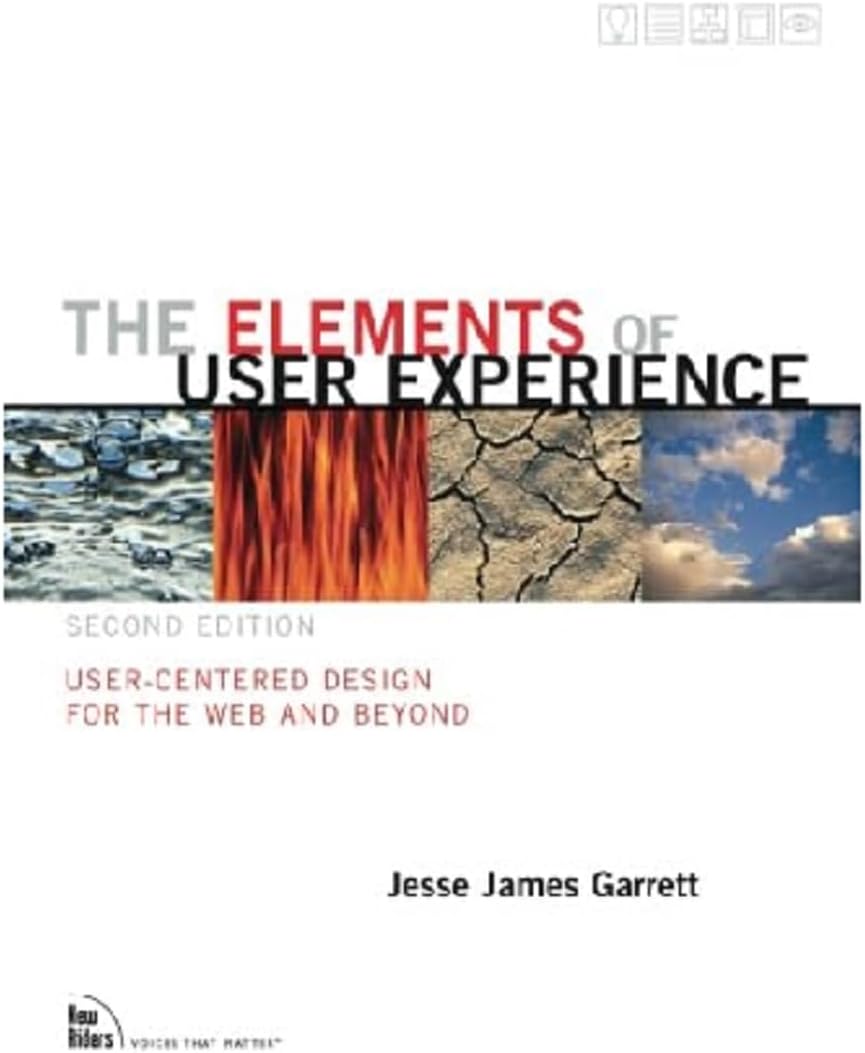
Elements of User Experience, The
Product ID: 285558018
Buy anything from 5,000+ international stores. One checkout price. No surprise fees. Join 2M+ shoppers on Desertcart.
Desertcart purchases this item on your behalf and handles shipping, customs, and support to Tunisia.
Review: Awesome!! - Best ever book for designers. It's on adaptive theory. user-centric design approach. Review: Rigid, dull, boring, bureaucratic — couldn't finish it - This book is written in a bit of a dull and boring tone, and gives a view of the UX / product design process that's rigid and suitable for bureaucratic big companies, not an independent developer like myself or a startup consisting of 6, not 60000, people. For example, the author breaks down the process into five planes — strategy, scope, structure, skeleton, surface — which is interesting, but I didn't learn enough about each of these planes that I don't already know. What, then, is the point in defining these five planes? It seems excessive and defining concepts without giving enough actionable advice. Something like 37 signals's Rework or Getting Real is 10 times more practical and useful. [...] Some of the suggestions in this book have since been discredited. For example, the functional spec — 37 signals points out that that's vague and leads to illusions of agreement. [...] Sometimes the author misses what is even to a non-expert like myself well-known. For example, he talks about the tension between designing for novices vs power users, without saying that the first step should be to try to do both. Shortcuts are an obvious example. Another is a customisable toolbar that has the tools beginners would use, but advanced users would be able to add tools for functions they use more often. The author misses such well-known methods to have the best of both worlds. On multiple occasions, I found myself waiting for the book to say something like "Instead of all that, a better technique is to..." but that never comes. I ended up doubting the author's competence. This book told me things I already know, or it defines new things I didn't know, like contextual inquiry, without telling me enough about how to use it. I'm not interested in reading a definition for its own sake, but parts of the book read like a catalog of definitions. Instead of defining a half dozen terms, tell me about one, and in the context of how I can use it to solve a practical problem. This book is also web-specific, and not the best reference if you're building a native app.
| Best Sellers Rank | #324,257 in Books ( See Top 100 in Books ) #105 in Web Development & Design #2,181 in Programming & Software Development |
| Customer Reviews | 4.5 out of 5 stars 450 Reviews |
A**A
Awesome!!
Best ever book for designers. It's on adaptive theory. user-centric design approach.
V**K
Rigid, dull, boring, bureaucratic — couldn't finish it
This book is written in a bit of a dull and boring tone, and gives a view of the UX / product design process that's rigid and suitable for bureaucratic big companies, not an independent developer like myself or a startup consisting of 6, not 60000, people. For example, the author breaks down the process into five planes — strategy, scope, structure, skeleton, surface — which is interesting, but I didn't learn enough about each of these planes that I don't already know. What, then, is the point in defining these five planes? It seems excessive and defining concepts without giving enough actionable advice. Something like 37 signals's Rework or Getting Real is 10 times more practical and useful. [...] Some of the suggestions in this book have since been discredited. For example, the functional spec — 37 signals points out that that's vague and leads to illusions of agreement. [...] Sometimes the author misses what is even to a non-expert like myself well-known. For example, he talks about the tension between designing for novices vs power users, without saying that the first step should be to try to do both. Shortcuts are an obvious example. Another is a customisable toolbar that has the tools beginners would use, but advanced users would be able to add tools for functions they use more often. The author misses such well-known methods to have the best of both worlds. On multiple occasions, I found myself waiting for the book to say something like "Instead of all that, a better technique is to..." but that never comes. I ended up doubting the author's competence. This book told me things I already know, or it defines new things I didn't know, like contextual inquiry, without telling me enough about how to use it. I'm not interested in reading a definition for its own sake, but parts of the book read like a catalog of definitions. Instead of defining a half dozen terms, tell me about one, and in the context of how I can use it to solve a practical problem. This book is also web-specific, and not the best reference if you're building a native app.
A**R
Knowledgeable
Always wanted to buy...
Trustpilot
3 days ago
5 days ago