
Desertcart purchases this item on your behalf and handles shipping, customs, and support to Tunisia.
CRITICALLY ACCLAIMED, NATIONAL BESTSELLER ONE OF THE NEW YORK TIMES 100 BEST BOOKS OF THE 21 ST CENTURY Time Magazine #1 Book of the Year • National Book Critics Circle Award Finalist Winner of the Stonewall Book Award • Double finalist for the Lambda Book Award Alison Bechdel’s groundbreaking, bestselling literary graphic memoir that charts her fraught relationship with her late father. Distant and exacting, Bruce Bechdel was an English teacher and director of the town funeral home, which Alison and her family referred to as the "Fun Home." It was not until college that Alison, who had recently come out as a lesbian, discovered that her father was also gay. A few weeks after this revelation, he was dead, leaving a legacy of mystery for his daughter to resolve. In her hands, personal history becomes a work of amazing subtlety and power, a unique coming-of-age story written with controlled force and enlivened with humor, rich literary allusion, and heartbreaking detail. How does a daughter resolve the legacy of mystery left by the man she called her father? Family Secrets: Growing up in the family funeral home, nicknamed the “Fun Home,” was only the first layer of mystery in a household built on secrets. LGBTQ+ Coming of Age: As Alison comes out as a lesbian in college, she makes a discovery about her father that forces her to re-examine her entire childhood. A Complicated Father-Daughter Story: A raw and honest exploration of a fraught relationship with a distant, exacting, and enigmatic father. Literary Nonfiction: A narrative woven with rich literary allusions and heartbreaking honesty that redefines what a graphic memoir can be. Review: Read this for a YA Lit course. So worth it. - Fun Home is a memoir by Alison Bechdel in which Alison writes about her childhood, her family, and her journey of identity and self. This graphic novel has so much depth. With literary and cross-discipline references, it can be a daunting read. But I promise you those references truly open up the book. Upon my first read, I made notes as I went, of places where I wanted to go back. And now that I'm going through again, I am in awe of Bechdel's writing. There's hidden details in the references, in the details about her father, the vocabulary, and things I did not put together the first time. The parallels, the crosses, the convergence and divergence. When people joke that "graphic novels aren't literature," I want to point them at this book. The single-volume memoir's frames are engaging, and lend much to the story. Without them I don't think the prose could stand alone nearly as well. And I think that's what makes Fun Home work so well in this form. Bechdel planned this graphic novel with such precision that the larger picture of woven memories, family details, and conclusions, wrapped in literary and philosophical references creates an impressive work that lends a voice to the deceased, Bruce Bechdel. All of these details allow for the reader to draw their own conclusions while also growing with Alison, and feeling her emotions grip you right through the page. I would recommend Fun Home to anyone that wants to experience another memoir in such a unique format. Don't be afraid to highlight or mark spots where you might not understand. I promise it's worth it. Review: Very Compelling - I got this as a gift for my wife, but I couldn't help but check it out when she was done. I read it one day. I would read a chunk of it, put it down to do something else, but the next thing I knew I'd have it in my hands again. I'd first heard of Alison Bechdel because of the "Bechdel Test," in which (to briefly define) you would take note of a television show or movie in which two women talk to each other about something other than a man. It's an intriguing notion that has stuck with me ever since I first heard it and means even more now that I have a daughter, which has heightened my distaste for sexism. This story is of course autobiographical, focusing on Bechdel and her father. I won't say more about the plot, just in case you want to avoid any hint of a spoiler. I rate this five stars because the story was very compelling and interesting, but in truth I'd knock it down half a star if I could. There were times when Bechdel chooses to use a fancy word when a simple one would suffice, which isn't to say someone shouldn't have a good vocabulary, only that sometimes it pulled me out of the story. If the narration feels like a distraction, I feel like it's an unsuccessful sentence or paragraph. I also felt that the story fell apart a bit toward the end, relying too heavily on James Joyce's Ulysses and losing some of the sharp focus that the early and middle chapters had. However, these are small criticisms within a much larger picture, one that deserves plenty of praise from readers and critics. The only book I could compare it with is Maus, by Art Spiegelman. Both are tremendous, using the form of the graphic novel to support the tale and present it in the most effective manner. Even if you wouldn't normally think to read a book in this format, I highly recommend this.


| Best Sellers Rank | #6,688 in Books ( See Top 100 in Books ) #4 in Historical & Biographical Fiction Graphic Novels #4 in LGBTQ+ Graphic Novels (Books) #5 in Humorous Graphic Novels (Books) |
| Customer Reviews | 4.5 out of 5 stars 4,783 Reviews |
A**O
Read this for a YA Lit course. So worth it.
Fun Home is a memoir by Alison Bechdel in which Alison writes about her childhood, her family, and her journey of identity and self. This graphic novel has so much depth. With literary and cross-discipline references, it can be a daunting read. But I promise you those references truly open up the book. Upon my first read, I made notes as I went, of places where I wanted to go back. And now that I'm going through again, I am in awe of Bechdel's writing. There's hidden details in the references, in the details about her father, the vocabulary, and things I did not put together the first time. The parallels, the crosses, the convergence and divergence. When people joke that "graphic novels aren't literature," I want to point them at this book. The single-volume memoir's frames are engaging, and lend much to the story. Without them I don't think the prose could stand alone nearly as well. And I think that's what makes Fun Home work so well in this form. Bechdel planned this graphic novel with such precision that the larger picture of woven memories, family details, and conclusions, wrapped in literary and philosophical references creates an impressive work that lends a voice to the deceased, Bruce Bechdel. All of these details allow for the reader to draw their own conclusions while also growing with Alison, and feeling her emotions grip you right through the page. I would recommend Fun Home to anyone that wants to experience another memoir in such a unique format. Don't be afraid to highlight or mark spots where you might not understand. I promise it's worth it.
B**H
Very Compelling
I got this as a gift for my wife, but I couldn't help but check it out when she was done. I read it one day. I would read a chunk of it, put it down to do something else, but the next thing I knew I'd have it in my hands again. I'd first heard of Alison Bechdel because of the "Bechdel Test," in which (to briefly define) you would take note of a television show or movie in which two women talk to each other about something other than a man. It's an intriguing notion that has stuck with me ever since I first heard it and means even more now that I have a daughter, which has heightened my distaste for sexism. This story is of course autobiographical, focusing on Bechdel and her father. I won't say more about the plot, just in case you want to avoid any hint of a spoiler. I rate this five stars because the story was very compelling and interesting, but in truth I'd knock it down half a star if I could. There were times when Bechdel chooses to use a fancy word when a simple one would suffice, which isn't to say someone shouldn't have a good vocabulary, only that sometimes it pulled me out of the story. If the narration feels like a distraction, I feel like it's an unsuccessful sentence or paragraph. I also felt that the story fell apart a bit toward the end, relying too heavily on James Joyce's Ulysses and losing some of the sharp focus that the early and middle chapters had. However, these are small criticisms within a much larger picture, one that deserves plenty of praise from readers and critics. The only book I could compare it with is Maus, by Art Spiegelman. Both are tremendous, using the form of the graphic novel to support the tale and present it in the most effective manner. Even if you wouldn't normally think to read a book in this format, I highly recommend this.
B**N
Excellent!! Expect sexuality, and graphic content! It's about her coming out and her father's suicide. DUH!
Excellent! I bought this because I planned to see the musical for my celebration of my own personal "survival day". Every year I celebrate the day I survived an auto accident in 1996. This was what I did for the 19th Anniversary! VERY WELL DONE! I had never heard of Alison before I bought tickets to the show and the soundtrack. I bought the book to better my understanding of the story. I can't deny it was a bit tedious to read at first. I knew it was a graphic novel. It's very well done, but the form isn't something I normally read. Once I got into it, I was hooked. It was hard to get started. I've bought her second "family narrative" book "Are You My Mother?" To learn more about her relationship with her mom. I'm also going back to NYC to experience the musical again before it closes. I'm a straight woman, but a bit of a tomboy. Move always worn guy clothes and my parents always tell the story of when I sprinted out on Christmas morning at age 4 to attack my older brother's gifts under the tree, ignoring all the frilly girl toys and dolls set out for me. He had matchbox cars, etc set out. I played with those from a young age. I wore my dad's shirts and shoes. I don't recall ever playing with make up. I'd play flag football with neighborhood kids. I'd climb trees, etc. I was once flung off a neighbor's horse into a sticker bush while riding without tackle. I was a mess. Before swim team practice I would get there early and get all the frogs and snakes out of the pool. (I grew up in GA.). Thankfully, mom moved me to CA for high school and I had a place where minds were more open to different ideas. I identify with Alison's wanting to dress in guy clothes and have short hair. That's me all the way. Even straight people can see themselves in this book.
B**D
Unique tale of dysfunctional childhood of a talented author.
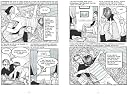
Quiz time: Name three things that Alison Bechdel (author/cartoonist behind the fabulous "Dykes To Watch Out For") had in common with Claire, the daughter on "Six Feet Under". Answer: They both had two brothers, their fathers were killed by being hit by a large motor vehicle, and both grew up living in the family funeral home. In Alison's case, the kids shortened the name of the latter to the "Fun Home", which she had made the title of her beautifully illustrated autobiographical work. It deals mostly with her relationship with her father, a fastidious and seemingly cold and distant man who inherited the family funderal business, although he also worked as a high school English teacher. His main passion, however, was restoring and decorating period buildings in their small Pennsylvania town, first the town museum and later a big gothic mansion in which he moved his family during the renovations. Alison's mother was also emotionally distant, and the family members rarely showed any affection toward each other, a burden that Alison dealt with throughout her life. It wasn't until was in college and discovered her lesbianism, and wrote home to tell her parents about it, that she was clued in on a secret his parents had been trying to hide all those years: her father was also gay, and the changing cast of students and other young men he had around him as "helpers" for the renovations were really his lovers. This revelation triggers a new attempt to get closer to him, and she does manage that to an extent, right before his accident, which she believes was really a premeditated act of suicide. A heartfelt and emotionally powerful story, told with great feeling and honesty by a talented author. I had some doubts about dealing with a self-described "tragicomic" (the book is fully illustrated with six panels per each of the 232 pages), but the author is apparently so comfortable with that medium that it allows her to tell her story to its best, and provides amazing detail and clarity to the events she relates. Five stars out of five.
K**S
The complexities of identity
I live an hour away from Beech Creek, Alison Bechdel's tiny hometown and the setting for much of her graphic memoir Fun Home. I've always found the area oppressive: dark, looming mountains casting perpetual shadows on impoverished, dying valley towns. But after reading Fun Home, I revisited Beech Creek, to see Bechdel's childhood home and the grave of her father Bruce, and to remind myself of how cruelly ironic life can be. Bruce Bechdel, a man who loves literature (in his early days he identified with F. Scott Fitzgerald; in his final days he reads Proust), an aesthete with a taste for the baroque detail of the Victorian era, and a creative and versatile designer of interior and exterior landscapes, is born and lives in rural central Pennsylvania, running the family funeral home and teaching at the local high school. He never quite fits in. Always sun-tanned and exquisitely dressed (no plaid hunter's shirts or chewing tobacco for him), persnickety and a bit prissy, but at the same time speaking with a back-country twang, Bruce seems uncannily out of place in Beech Creek. And he's a closeted gay man, who has occasional affairs on the side and otherwise sublimates his repressed sexuality by obsessively restoring the Victorian-era house in which Alison grew up. The tension of his closeted life makes him aloof, prone to violent temper tantrums, controlling, and sometimes cruel to both wife and children. Alison's Bechdel's memoir of him, and the way in which her own identity both became the inverse of his and yet in many respects parallels his, is a sophisticated narrative that underscores just how complex personal identity is. Alison is who she is, just as her father was who he was, because of the convergence of Beech Creek, sexuality, alienation, fun, repression, the need to be creative, the yearning for affection, the factuality of history and the re-creation of memory. There's no formulaic happy ending here, no artificial structuring to make more sense of the relationship between herself and her father than there really was. Instead, what the reader is offered is a profound, sensitive, bittersweet effort to explore memory in search of identity--an effort which throughout is punctuated by Bechdel's references to both Proust and James Joyce--and an appreciation for the ironies of fate which make us who we become. Other reviewers have mentioned that they read the memoir at one setting. I found it so intense that I could only take it in small portions, and even then I sometimes felt overwhelmed. For in sharing her own identity-forming memories with us, she invites us to plumb more deeply into our own. And both exercises, although potentially liberating, can also be harrowing.
K**S
Just read it--and form your own opinions.
I read about the controversy at Duke, with some students refusing to read the book because they felt it conflicted with their values (though how they would know this without reading it is unclear). I couldn't discuss that controversy with friends without first reading the book (called being informed, I think). I had never read a book in the "graphic novel" format and it took a little getting used to. I was impressed with the amount of work it must take to tell a story in both words and pictures and I found it interesting to see how the pictures, rather than simple illustrations, took the place of words and moved the story along. It was not a particularly enjoyable book to read as it was filled with unhappy, deeply self-obsessed people. Memoirs of the unhappy childhoods of persons from dysfunctional families is not my favorite genre. But the author presents all of this unhappiness brilliantly, so it is a worthwhile read.
C**G
Bad Childhood, Great Book!
Love graphics and love memoirs, Alison Bechel had a terrible childhood. Her father was the third generation in the funeral business. It is creepy enough to be around funeral decor and have t0 be very solemn always in public but but little kids having to prep the viewing room with the folding chairs and always be immaculare is a fun part of childhood. I had the experience of working in the upstair apartment of a funeral home temporarily. My first husband's law practice was there. The wallpaper and carpet were funeral home style. The worst part was that I know where the caskets had been. Alison's farher was eccentric and a perfectionist, not one to give warm hugs. He had affairs with the men he hired and I will never forgive for demanding help with the embalming of a client. Not much help but just being there with a naked corpse is not a good experience for any child. This book is one of deeply troubled childhood. The graphics and writing was top notch and now I want to read her book about her mother.
F**S
Must read
Seriously one of the best graphic novels. Adult topics -- grief, suicide, sexuality -- all handled with deep thought and introspection.
A**A
Incredibly touching
One of the best books I've read recently, I've fallen in love with Alison Bechdel way of drawing as well as writing. To write such a deep and personal story, drenching the book in a fun yet tragic atmosphere... It's like magic. I really recommend you buy this book, like, right now.
J**U
Words and text working together perfectly
I chose this for my bookclub to read as an example of a graphic novel, none of us ever having read one before. I quickly realised that this was a memoir which made it even more interesting. From the start there are pointers that her life is developing into a tragic tale. We are left in no doubt that her father was a complicated man with many internal torments. The language is rich and luxurious with the great use of some unusual words (one or two even had me looking up definitions). I've now read a few graphic books and think this book is put together brilliantly. The words and pictures both add to each other. There is great detail in the graphics as well, many of which add more to the story than the words can alone. There is much tragedy but it is related in a blackly humorous way (man times crossing back and forward the line between comedy and tragedy). The narrative sections break into four types: the overall story telling, dialogue in speech bubbles, occasional explanatory notes and labels highlighting an element of a drawing. Essentially the book is about a father and daughter relationship. They struggle to come to terms with their differences whilst refusing to acknowledge their obvious similarities. Much of the commonality is around literature and the arts, leading to a few points where the author relies too heavily on literary references. However, I very much liked the reliance on the artistic talents in the family, particularly the mother's acting which allows her to step away from her real world. What strikes me most about this book is the depth of emotion that is written into every, carefully chosen, word. It can be a cliche to say that the process of writing is cathartic but, with this book, that feels appropriate.
J**R
Um trabalho ao mesmo tempo incrivelmente pessoal e perturbadoramente artístico
É impressionante porque é ao mesmo tempo uma narrativa familiar muito íntima mas uma análise em alguns momentos até bem imparcial de uma pessoa tão próxima como o próprio pai. A arte é incrível, a narrativa é brilhante e se você tem problemas com seu pai você provavelmente vai chorar algumas vezes.
O**A
Dobra robota
Szybka dostawa. Książka przyszła w idealnym stanie. Sposób pakowania (kartonowe pudełko typu tear off) bardzo mi przypadło do gustu.
M**N
Portrait of the artist as a young woman
FUN HOME ist gewiß kein Comic im Sinne der Funnies, und das FUN im Titel steht als sarkastische Abkürzung für Funeral Home, jenes Bestattungsunternehmen, das der Vater der Ich-Erzählerin Alison neben seiner Tätigkeit als Englischlehrer betreibt. Viel „Fun“ gibt es in Alison Bechdels Autobiographie nicht, und doch gelingt es ihr, die dicht verwobene und literarisch anspielungsreich erzählte Geschichte ihrer Kindheit und Jugend mit milder Ironie und gelegentlichem Humor zu durchwirken. Fun Home ist die Geschichte vom Aufwachsen in einer Familie, in der Zuneigung und Wärme nur selten gezeigt werden und jedes Familienmitglied solipsistisch seinen Weg beschreitet. Alison Bechdel beschreibt nicht nur offen die Ursachen, sondern auch die Folgen, die ein solches Leben in der Seele eines Kindes anrichtet. Der ferne Vater, dessen Zuneigung zu jungen Männern die Familie fast ins Verderben stürzt, die Mutter, die Zuflucht auf der Bühne sucht, und schließlich Alison selbst, die als genaue Beobachterin ihrer selbst und der Familie schon von früh an Tagebuch führt und bald selbst neurotisches Verhalten an den Tag legt. Die gewissenhafte Selbsterforschung, die Fun Home auch ist, geht nicht zuletzt der Frage nach, ob der Tod des Vaters, der vermutlich ein Freitod war, in einer Beziehung zum Coming Out von Alison steht. Besonders anrührend ist die kurze Phase vor dem Tod des Vaters, als es zu einem stillen Einverständnis zwischen Alison und ihm kommt. FUN HOME setzt sich über Genregrenzen mit größter Selbstverständlichkeit hinweg. Der Text hat hohe literarische Qualität, sprachlich und in seinen intertextuellen Bezügen. Ohne dass es aufgesetzt wirkt, verbindet Bechdel ihre Biografie mit literarischen Bezügen zu Camus, Proust und Joyce. Von daher wäre FUN HOME schon als reiner Roman ein Glücksfall. Bechdel, die auch als Zeichnerin großes Potential hat, macht aus ihrer Biografie eine Graphic Novel. Dabei tragen die Bilder massgeblich zur Stimmung bei und ergänzen den Text optimal. Sollte ich das Haar in der Suppe finden, würde ich darauf hinweisen, dass die Gesichtsausdrücke ihrer Protagonisten sich immer sehr ähnlich sehen (aber es ist andererseits ja nicht ungewöhnlich, dass manche Menschen über keine große Mimik verfügen)und dass sie ihren beiden Geschwistern überhaupt keine Beachtung schenkt. Ohne jede Einschränkung ist FUN HOME zu empfehlen: Allen Lesern, die Biografien mögen; allen Lesern, die gut geschriebene Bücher lieben; allen Leser, die sich für Graphic Novels interessieren; allen Lesern, denen das Thema Coming Out nicht unangenehm, vielleicht sogar von Interesse ist. Kurzum: Jeder möge für sich selbst prüfen, warum er dieses Buch nicht schon längst gelesen oder wiedergelesen hat (ach, sie haben es schon gelesen, nur ich habe es erst jetzt gelesen? Oh, ich bitte um Entschuldigung). Bewertung: 6 von 5 stellaren Sternen.
Trustpilot
2 weeks ago
4 days ago