
Desertcart purchases this item on your behalf and handles shipping, customs, and support to Tunisia.
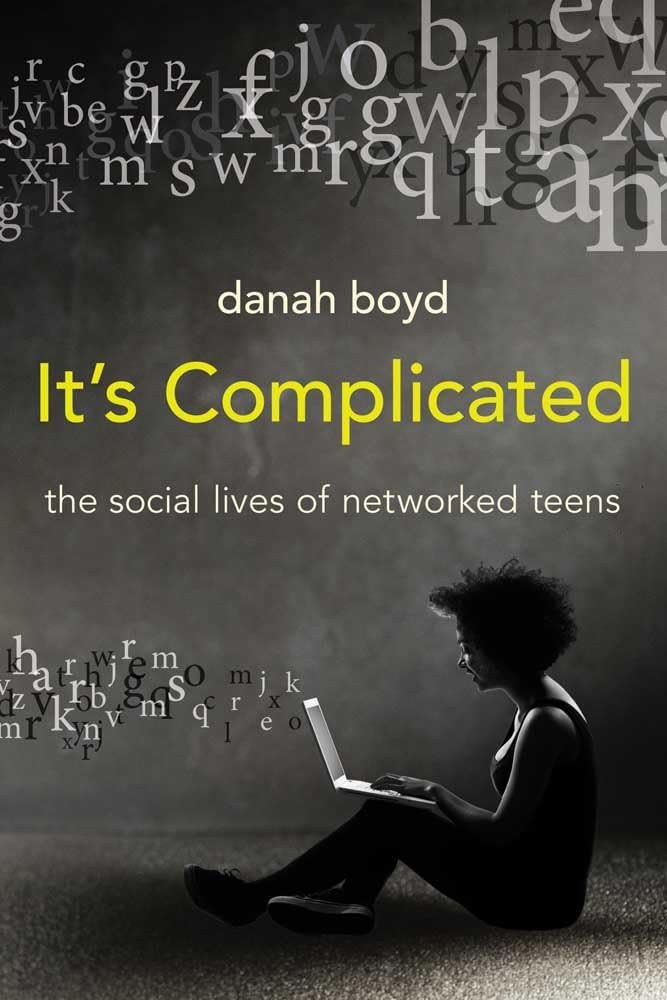
“boyd’s new book is layered and smart . . . It’s Complicated will update your mind.”—Alissa Quart, New York Times Book Review “A fascinating, well-researched and (mostly) reassuring look at how today's tech-savvy teenagers are using social media.”— People “The briefest possible summary? The kids are all right, but society isn’t.”—Andrew Leonard, Salon What is new about how teenagers communicate through services such as Facebook, Twitter, and Instagram? Do social media affect the quality of teens’ lives? In this eye-opening book, youth culture and technology expert danah boyd uncovers some of the major myths regarding teens' use of social media. She explores tropes about identity, privacy, safety, danger, and bullying. Ultimately, boyd argues that society fails young people when paternalism and protectionism hinder teenagers’ ability to become informed, thoughtful, and engaged citizens through their online interactions. Yet despite an environment of rampant fear-mongering, boyd finds that teens often find ways to engage and to develop a sense of identity. Boyd’s conclusions are essential reading not only for parents, teachers, and others who work with teens but also for anyone interested in the impact of emerging technologies on society, culture, and commerce in years to come. Offering insights gleaned from more than a decade of original fieldwork interviewing teenagers across the United States, boyd concludes reassuringly that the kids are all right. At the same time, she acknowledges that coming to terms with life in a networked era is not easy or obvious. In a technologically mediated world, life is bound to be complicated. Review: It's not complicated, just chill - This book is excellent. I couldn't put it down. Like Emily Bazelon's recent book on bullying and Lenore Skenazy's Free-Range Kids, it's underlying heart is to bring common sense to an important set of issues in parenting. However, unlike those books, its head is most clearly in the academic rather than journalistic space. This is not to deride journalists, of course, but there is a noticeable difference between work that reports on research and work that is the report on research. boyd's book falls into the latter character but somehow manages to do so in a written style that is fluid and engaging. It took 8 years of research, mostly involving in-depth interviews with teens and some parents, for boyd to put together a model and evidence of how teens interact and behave in the digital world. Along the way, it was clear that boyd had a theory as to how teens were motivated and also a hypothesis: that the digital world has changed little in those motivations and only the expression and instruments of their behaviour and interaction. What is more, like the past, parents' motivations have not changed too much and teenager choices are driven as much by parental actions (or, in most cases, restraints) as they are by teenager desires. In trying to conduct research over that period of time with regard to the digital world, there is a clear challenge: the instruments and platforms teens used to engage, digitally, changed. When the research started out MySpace was king, then Facebook and most recently, literally as the book was going to press, SnapChat and Instagram. There was a real danger the book would feel dated. However, boyd turns that into a strength. Yes, sure, this teen was using MySpace when they were interviewed but here is what that platform has in common with others today. It is basically the same deal. So let me do incredible injustice to the book and try, as briefly as possible, to summarise its findings. Teens are extremely social and want to interact with one another (so if you think looking at a screen is a sign of isolation, think again). What is more, they want to engage in that social interaction independent of adults (so if you think your kids don't want you around, remember when you were a teen). Thus, teens are trying to balance being social (sharing) with being independent (privacy). They are (a) like teens forever and (b) like people. That balance is hard to learn, understand and manage. Now insert into that mix parents (and teachers and others). Those parents are concerned for safety and have their own, largely out-dated model of what social and anti-social behaviour is. They also don't really know what they are doing but have an image of a 'stepford' like teen that they want in the end. (I should say boyd is more diplomatic than I am being here but I think that captures the true essence of the average parental mindset). So the parents engage in behaviour regulation -- usually a series of prohibitions. For instance, to keep teens safe they don't let them out. Then they are surprised when their kids want to spend all their time on social media and complain that they are not engaging in real interactions. Yes, because the only ones they would have left is you and they don't want that. If you want to see them have real social interactions, they have to be left out. This is why they go to football games (who would like to do that otherwise) or rush to school early. They are desperately pushing through the cracks to get more interaction with one another. Everything else follows neatly from that model. It is just pure substitution, plain and simple. What is more, any of the dangers from online activity -- addiction and predation -- are not borne out by any data. Instead, there is a new danger -- that the assumption by adults is that kids actually understand digital technology. They don't. That means when they are told by teachers that Google is good and Wikipedia is not, they actually believe them! They over-trust one and ignore the other. At the same time, they find it hard to work out what will last and what will not. Finally, and this is important, if parents try to peek in on teen's digital world's -- by cyberstalking them on Facebook -- they will either force teens to be cryptic to obscure potential trouble or simply not understand the context of the behaviour they are seeing. One point I want to emphasise is with respect to privacy. Because teens share so much on social media, there is a perception to think that teens do not care about privacy and also how they are perceived. The book dispels that perception. Teens are more concerned about this than we adults. They care about how they are perceived with one another and publicly in general. The self-regulate their behaviour to do so; often in really innovative ways. But when it comes to privacy, they aren't worried about governments, the media or corporations -- that is for their future fears. Instead, they want to be private essentially from their parents. They go to social media because they want to interact socially even if it looks like it is in plain site (actually, these days if they go to MySpace, they'll have all the privacy they want). They use codes and shift themselves around, to avoid the gaze of parents. And the more parents hover, the more effort teens put into being private with regard to them. Parents may wonder, "what do they have to hide?" but in reality, they just want to hide out a bit. We don't really understand the motives for privacy amongst adults too well but surely, it takes just a little respect to believe that teens might want privacy, "just because." All that said, I have one quibble with the book and also one comment. The quibble is the title "It's Complicated." It really isn't. As you read this book, you'll see it is actually quite simple: that's what a good theoretical model gets you. Teens need to be evaluated as (a) not being unusual; (b) acting like human beings and (c) being given the benefit of the doubt rather than objects of fear. Just stepping back and asking yourself "if this thing I see my kid doing is actually OK, what is really going on here?" For instance, I have seen my daughter stick her tongue out, take a picture and "share" it on SnapChat. One interpretation of this is: why would you do that? The other interpretation is: it is good that you chose to do that on SnapChat where the picture will last only 10 seconds? In one interpretation, she is an unusual deviant. In the other, she is someone who has actually learned what appropriate behaviour is and sensibly chosen the right technology for the job. My point here is that it is not complicated at all. It is really simple: just chill, it is normal behaviour going on and no permanent harm is being done. Indeed, it is probably all for the best. I've only scratched the surface of this issue in this review. boyd's examples are great and really give you a sense as to what is going on. But here I come to my comment. There is one limitation of being a book grounded in what we know and that is, this isn't a parenting book. There is no big advice chapter in the end. boyd doesn't tell parents to chill although you would have to be a moron not to take that away. She doesn't list a set of advice to follow. That is because she hasn't evaluated how to deal with these things and so cannot speculate on it. Moreover, she hasn't studied what happened before (should younger kids be on social networks) and what happens after (do teens that are on social networks turn out to be 'better' young adults). The focus is on teens and nothing else but, in many respects, that still left me wanting more. Nonetheless, that does not mean this isn't a book for parents. It is a book that will give you perspective and reduce the fear in managing teenagers and give you the opportunity to have a better relationship with your teens; even if it is not the ideal fantasy in your mind. Review: I do not get too distracted by social media and typically only use it when I am bored. However - Although we are only four years apart and grew up in the same environment, my use of social media is surprisingly different than that of my seventeen-year-old sister Sierra. Most of the time, I do not get too distracted by social media and typically only use it when I am bored. However, I regularly become frustrated with Sierra when she appears to be more focused on her phone or her laptop than on what I am trying to say to her. I cannot accurately remember what my social media use had been like at that age, but it would not be truly comparable to Sierra’s because I did not have a smart phone until I went to college. But if the smart phone is not to blame, why is it so much harder for Sierra to separate herself from her technology? Seeking to understand whether our clashing habits were simply a due to personal differences or something else entirely, I began reading It’s Complicated: The Social Lives of Networked Teens by danah boyd. This book has changed the way I view the discrepancy between my social media use and that of my sister as well as most other American teens. Throughout It’s Complicated boyd argues that adults should be less quick to blame technology for teens’ seemingly antisocial behavior. Instead, we should recognize the means it provides adolescents for fulfilling their healthy and desire to socialize with their peers, an essential part of the overarching developmental goal of constructing a social identity. More specifically, teens’ struggle for autonomy leads them to seek out places to socialize in which they are free from adult supervision. Although this is nothing new, today’s teens typically lead much busier lives and face many more restrictions than ever before. As teens’ ability to connect in person has diminished, networked publics on social media provide a means for them to socialize despite this. Free from adult supervision, teens may use social media as a valuable way to learn who they are and how to interact with others. In sum, teens use social media primarily to socialize, and this socialization is not new but a standard and important part of adolescence. boyd uses each chapter to address various utopian and dystopian views of social media’s role in teens’ lives as well as its role in society. She was particularly effective when addressing the dystopian notion that teens are addicted to social media by expanding on the central argument of this book. She also successfully addressed the notion that teens have little regard for privacy on social media. boyd points out that teens do in fact care about privacy, but it generally involves privacy from adults rather than from their peers. Teens’ online social networks are often analogous to those offline, which can circumvent the issue of context collapse. Even when this is not the case, boyd mentions ways in which teens may create the illusion of being public while only providing their audiences with limited information. The examples she includes from interviews with a diverse sample of adolescents seem generally applicable and relatable to the vast majority of teens, which further strengthen her arguments. When addressing other dystopian views of social media such as cyber bullying and sexual solicitation, boyd seems to make more dubious and controversial claims. She does not always effectively use interviews to make her case, but instead relies upon anecdotes or interviews describing rare, even extreme circumstances. For instance, she describes one teenager named Sabrina who hardly leaves her house and exercised just as much caution when it came to her online activities; this definitely does not seem like a generalizable scenario. Her sparse use of evidence creates the sense that there are exceptions to commonly held notions about how adolescents use social media, but they do not provide clear and convincing counterarguments. Later on, she describes how teens interacting with adults online often lie by claiming that they are also adults. Although boyd identifies the contributions of social media, these positive contributions do not necessarily preclude the negative outcomes. Despite the shortcomings of these sections, she make the valid claim that social media enables troubled and at-risk teens to vent their problems, to be seen, and hopefully to receive help. The final chapters in It’s Complicated address the utopian idea that technology would eradicate inequality by fostering the global exchange of ideas and information. boyd makes it clear that this is not the case, and instead posits that social media is yet another source of inequality. She describes how in an age where information and technological skill is increasingly valuable, underprivileged teens are at a serious disadvantage. Not only do these adolescents have limited access to social media which allows them to make potentially useful social connections among achieving other developmental goals, but their knowledge of how technology works and what it can provide are significantly limited. boyd emphasizes the need for society to discontinue the idea that teens are all media-literate “digital natives”. Teens vary in terms of their experience with technology such as social media, and all teens must learn through instruction and experience how to use these technologies effectively and responsibly. I think that acknowledging the limitations of teens’ overall positive use of social media is an appropriate way of concluding this book. This book provided a clear answer to my question: my teenage sister’s frequent use of social media does not reflect inherent qualities of her technology or her as a person so much as it reflects her healthy desire to socialize with her peers. The difference between her social media use and mine does not necessarily stem from our differences as people, but from our different stages of development and respective needs. I learned that I may have taken for granted how easy it is to socialize as a college student compared to when I was in high school and relied more on social media. By highlighting the positive affordances social media provides for adolescents, It’s Complicated allays older generations’ prominent concerns about teens’ interactions with social media. boyd ultimately replaces these concerns with a more valid and constructive matter: how, as a society, can we reduce the inequality surrounding access to and knowledge of technology for people of all ages? This concern is beyond the scope of the book, but if the American people are willing to listen to boyd, it may not be beyond the scope of our society.
| Best Sellers Rank | #1,172,537 in Books ( See Top 100 in Books ) #115 in Medical Adolescent Psychology #122 in Children's Studies Social Science (Books) #146 in Popular Adolescent Psychology |
| Customer Reviews | 4.3 out of 5 stars 349 Reviews |
J**S
It's not complicated, just chill
This book is excellent. I couldn't put it down. Like Emily Bazelon's recent book on bullying and Lenore Skenazy's Free-Range Kids, it's underlying heart is to bring common sense to an important set of issues in parenting. However, unlike those books, its head is most clearly in the academic rather than journalistic space. This is not to deride journalists, of course, but there is a noticeable difference between work that reports on research and work that is the report on research. boyd's book falls into the latter character but somehow manages to do so in a written style that is fluid and engaging. It took 8 years of research, mostly involving in-depth interviews with teens and some parents, for boyd to put together a model and evidence of how teens interact and behave in the digital world. Along the way, it was clear that boyd had a theory as to how teens were motivated and also a hypothesis: that the digital world has changed little in those motivations and only the expression and instruments of their behaviour and interaction. What is more, like the past, parents' motivations have not changed too much and teenager choices are driven as much by parental actions (or, in most cases, restraints) as they are by teenager desires. In trying to conduct research over that period of time with regard to the digital world, there is a clear challenge: the instruments and platforms teens used to engage, digitally, changed. When the research started out MySpace was king, then Facebook and most recently, literally as the book was going to press, SnapChat and Instagram. There was a real danger the book would feel dated. However, boyd turns that into a strength. Yes, sure, this teen was using MySpace when they were interviewed but here is what that platform has in common with others today. It is basically the same deal. So let me do incredible injustice to the book and try, as briefly as possible, to summarise its findings. Teens are extremely social and want to interact with one another (so if you think looking at a screen is a sign of isolation, think again). What is more, they want to engage in that social interaction independent of adults (so if you think your kids don't want you around, remember when you were a teen). Thus, teens are trying to balance being social (sharing) with being independent (privacy). They are (a) like teens forever and (b) like people. That balance is hard to learn, understand and manage. Now insert into that mix parents (and teachers and others). Those parents are concerned for safety and have their own, largely out-dated model of what social and anti-social behaviour is. They also don't really know what they are doing but have an image of a 'stepford' like teen that they want in the end. (I should say boyd is more diplomatic than I am being here but I think that captures the true essence of the average parental mindset). So the parents engage in behaviour regulation -- usually a series of prohibitions. For instance, to keep teens safe they don't let them out. Then they are surprised when their kids want to spend all their time on social media and complain that they are not engaging in real interactions. Yes, because the only ones they would have left is you and they don't want that. If you want to see them have real social interactions, they have to be left out. This is why they go to football games (who would like to do that otherwise) or rush to school early. They are desperately pushing through the cracks to get more interaction with one another. Everything else follows neatly from that model. It is just pure substitution, plain and simple. What is more, any of the dangers from online activity -- addiction and predation -- are not borne out by any data. Instead, there is a new danger -- that the assumption by adults is that kids actually understand digital technology. They don't. That means when they are told by teachers that Google is good and Wikipedia is not, they actually believe them! They over-trust one and ignore the other. At the same time, they find it hard to work out what will last and what will not. Finally, and this is important, if parents try to peek in on teen's digital world's -- by cyberstalking them on Facebook -- they will either force teens to be cryptic to obscure potential trouble or simply not understand the context of the behaviour they are seeing. One point I want to emphasise is with respect to privacy. Because teens share so much on social media, there is a perception to think that teens do not care about privacy and also how they are perceived. The book dispels that perception. Teens are more concerned about this than we adults. They care about how they are perceived with one another and publicly in general. The self-regulate their behaviour to do so; often in really innovative ways. But when it comes to privacy, they aren't worried about governments, the media or corporations -- that is for their future fears. Instead, they want to be private essentially from their parents. They go to social media because they want to interact socially even if it looks like it is in plain site (actually, these days if they go to MySpace, they'll have all the privacy they want). They use codes and shift themselves around, to avoid the gaze of parents. And the more parents hover, the more effort teens put into being private with regard to them. Parents may wonder, "what do they have to hide?" but in reality, they just want to hide out a bit. We don't really understand the motives for privacy amongst adults too well but surely, it takes just a little respect to believe that teens might want privacy, "just because." All that said, I have one quibble with the book and also one comment. The quibble is the title "It's Complicated." It really isn't. As you read this book, you'll see it is actually quite simple: that's what a good theoretical model gets you. Teens need to be evaluated as (a) not being unusual; (b) acting like human beings and (c) being given the benefit of the doubt rather than objects of fear. Just stepping back and asking yourself "if this thing I see my kid doing is actually OK, what is really going on here?" For instance, I have seen my daughter stick her tongue out, take a picture and "share" it on SnapChat. One interpretation of this is: why would you do that? The other interpretation is: it is good that you chose to do that on SnapChat where the picture will last only 10 seconds? In one interpretation, she is an unusual deviant. In the other, she is someone who has actually learned what appropriate behaviour is and sensibly chosen the right technology for the job. My point here is that it is not complicated at all. It is really simple: just chill, it is normal behaviour going on and no permanent harm is being done. Indeed, it is probably all for the best. I've only scratched the surface of this issue in this review. boyd's examples are great and really give you a sense as to what is going on. But here I come to my comment. There is one limitation of being a book grounded in what we know and that is, this isn't a parenting book. There is no big advice chapter in the end. boyd doesn't tell parents to chill although you would have to be a moron not to take that away. She doesn't list a set of advice to follow. That is because she hasn't evaluated how to deal with these things and so cannot speculate on it. Moreover, she hasn't studied what happened before (should younger kids be on social networks) and what happens after (do teens that are on social networks turn out to be 'better' young adults). The focus is on teens and nothing else but, in many respects, that still left me wanting more. Nonetheless, that does not mean this isn't a book for parents. It is a book that will give you perspective and reduce the fear in managing teenagers and give you the opportunity to have a better relationship with your teens; even if it is not the ideal fantasy in your mind.
G**O
I do not get too distracted by social media and typically only use it when I am bored. However
Although we are only four years apart and grew up in the same environment, my use of social media is surprisingly different than that of my seventeen-year-old sister Sierra. Most of the time, I do not get too distracted by social media and typically only use it when I am bored. However, I regularly become frustrated with Sierra when she appears to be more focused on her phone or her laptop than on what I am trying to say to her. I cannot accurately remember what my social media use had been like at that age, but it would not be truly comparable to Sierra’s because I did not have a smart phone until I went to college. But if the smart phone is not to blame, why is it so much harder for Sierra to separate herself from her technology? Seeking to understand whether our clashing habits were simply a due to personal differences or something else entirely, I began reading It’s Complicated: The Social Lives of Networked Teens by danah boyd. This book has changed the way I view the discrepancy between my social media use and that of my sister as well as most other American teens. Throughout It’s Complicated boyd argues that adults should be less quick to blame technology for teens’ seemingly antisocial behavior. Instead, we should recognize the means it provides adolescents for fulfilling their healthy and desire to socialize with their peers, an essential part of the overarching developmental goal of constructing a social identity. More specifically, teens’ struggle for autonomy leads them to seek out places to socialize in which they are free from adult supervision. Although this is nothing new, today’s teens typically lead much busier lives and face many more restrictions than ever before. As teens’ ability to connect in person has diminished, networked publics on social media provide a means for them to socialize despite this. Free from adult supervision, teens may use social media as a valuable way to learn who they are and how to interact with others. In sum, teens use social media primarily to socialize, and this socialization is not new but a standard and important part of adolescence. boyd uses each chapter to address various utopian and dystopian views of social media’s role in teens’ lives as well as its role in society. She was particularly effective when addressing the dystopian notion that teens are addicted to social media by expanding on the central argument of this book. She also successfully addressed the notion that teens have little regard for privacy on social media. boyd points out that teens do in fact care about privacy, but it generally involves privacy from adults rather than from their peers. Teens’ online social networks are often analogous to those offline, which can circumvent the issue of context collapse. Even when this is not the case, boyd mentions ways in which teens may create the illusion of being public while only providing their audiences with limited information. The examples she includes from interviews with a diverse sample of adolescents seem generally applicable and relatable to the vast majority of teens, which further strengthen her arguments. When addressing other dystopian views of social media such as cyber bullying and sexual solicitation, boyd seems to make more dubious and controversial claims. She does not always effectively use interviews to make her case, but instead relies upon anecdotes or interviews describing rare, even extreme circumstances. For instance, she describes one teenager named Sabrina who hardly leaves her house and exercised just as much caution when it came to her online activities; this definitely does not seem like a generalizable scenario. Her sparse use of evidence creates the sense that there are exceptions to commonly held notions about how adolescents use social media, but they do not provide clear and convincing counterarguments. Later on, she describes how teens interacting with adults online often lie by claiming that they are also adults. Although boyd identifies the contributions of social media, these positive contributions do not necessarily preclude the negative outcomes. Despite the shortcomings of these sections, she make the valid claim that social media enables troubled and at-risk teens to vent their problems, to be seen, and hopefully to receive help. The final chapters in It’s Complicated address the utopian idea that technology would eradicate inequality by fostering the global exchange of ideas and information. boyd makes it clear that this is not the case, and instead posits that social media is yet another source of inequality. She describes how in an age where information and technological skill is increasingly valuable, underprivileged teens are at a serious disadvantage. Not only do these adolescents have limited access to social media which allows them to make potentially useful social connections among achieving other developmental goals, but their knowledge of how technology works and what it can provide are significantly limited. boyd emphasizes the need for society to discontinue the idea that teens are all media-literate “digital natives”. Teens vary in terms of their experience with technology such as social media, and all teens must learn through instruction and experience how to use these technologies effectively and responsibly. I think that acknowledging the limitations of teens’ overall positive use of social media is an appropriate way of concluding this book. This book provided a clear answer to my question: my teenage sister’s frequent use of social media does not reflect inherent qualities of her technology or her as a person so much as it reflects her healthy desire to socialize with her peers. The difference between her social media use and mine does not necessarily stem from our differences as people, but from our different stages of development and respective needs. I learned that I may have taken for granted how easy it is to socialize as a college student compared to when I was in high school and relied more on social media. By highlighting the positive affordances social media provides for adolescents, It’s Complicated allays older generations’ prominent concerns about teens’ interactions with social media. boyd ultimately replaces these concerns with a more valid and constructive matter: how, as a society, can we reduce the inequality surrounding access to and knowledge of technology for people of all ages? This concern is beyond the scope of the book, but if the American people are willing to listen to boyd, it may not be beyond the scope of our society.
C**W
Marvelous book about teenagers and the internet
danah boyd interviewed teenagers about their use of the internet and social media. She thinks that teenagers are hanging out on the internet for the same reasons that previous generations used to hang out at the mall, in public parks, or wherever else was available as a place where groups can meet. They are practicing being "in public" with their friends and acquaintances. Many of the interviews were clear that they would prefer to meet their friends face-to-face, but that busy schedules and protective parents meant that social media was the best available way of doing something close to that. boyd gives examples that show her informants getting into various forms of trouble with social media, often because they write something 'in the moment', successfully communicating with their peer group, but forgetting that on social media their comments will be around essentially forever, and might be read by parents, teachers, and others who won't necessarily understand what was meant. This is a real difference between social media and the mall, where interactions would be just as public but not as persistent. She also talks about 'moral panics', pointing out that both parents and the society as a whole are prone to panicked reactions whenever teenagers use unfamiliar things as part of their growing into social adults. She thinks that society has over-reacted to the (in her view rare) possibility of on-line sexual predators, and underestimated the negative consequences of trying (and usually failing) to control teens' activities (both on- and off- line). danah boyd is a card-carrying Ph.D sociologist, and the book is published by Yale University Press, but she tries hard to stay away from academic jargon, and mostly succeeds in doing so. I'm not sure I get the distinctions between 'being public', 'being in public' and 'networked publics', and I suppose they would mean more to properly trained sociologists. This work is ethnographic, which means that the interviewer is supposed to get close to, perhaps participate in and certainly understand the practices of the group she is describing. So there's some chance that some of the ideas are really coming from danah boyd as much as they are coming from the teens themselves. She has obviously been selective in choosing what to emphasize and what to downplay, but I'm fairly confident that she has done about as well as anyone else would have in giving a fair representation of what the interviewees actually think. The voices of the teens come through. Early on, boyd says that she is not going to offer critique of the way advertising and western capitalism plays into the lives of the interviewees, and, once again, she is pretty successful in sticking to that position. You won't find many scholarly books that are as engaging and easy to read as this one. It is clearly going to be a roaring success, and it really is a proper work of scholarship, not just a piece of pop science.
W**R
Informative but lacking in printed delivery
Informative and well written. Seems to be well researched. The information is presented in a clear and easy to follow manner. My only problem with the printed version is that the book is small and the font on the paper is also small and hard on the eyes. Since the target audience is probably an older generation trying to understand the younger generation, readability is a factor. I should have purchased the eBook version instead of the printed version. Sadly there is no Kindle MatchBook opportunity available for this book. If this were a review of the eBook version I would have given all five stars.
P**R
Excellent book on the topics of teens an the internet
If you are involved with teens, either as a parent, and educator, or just because you are a teen yourself, "It's Complicated" is a book worth reading if you want to deeply understand teens and social media. As the title indicates, the issues surrounds the topic are much nuanced than we typically encounter in the media or - sadly enough - in schools. boyd's readable mix of personal interviews, research, and observations to touches on a number of major topics: identity, privacy, addiction, danger, bullying, inequality and literacy. Running through each of these is the idea that for most teens, social media is an extension of their very socially-oriented lives, and not something totally separate. This idea is often lost by adults in a rush to understand these young people solely though the lens of the technology, which is where we get ideas like "cyber-bullying", "internet addiction" and "digital natives." Power relationships, hanging with friends, interpersonal conflict, social divisions - all of these offline concepts can manifest themselves online, but are not uniquely technology driven. Technology does bring other issues to social relationships, such as context collapse (i.e. when your parents see something you posted for friends) and permanence (a comment you made weeks ago gets read today and taken out of context), making the management and balance of social lives of teens today complex indeed. Although I have generally found myself in agreement with boyd's writing over the years, this book consolidated much of that thinking for me, and pushed my assumptions in areas that I hadn't thought about very much. If you have time to read only one book on the topic of teens and the internet, this would be the place to start. If you have more time, the bibliography is an excellent place to expand your reading.
A**R
I've had the pleasure of meeting danah through mutual friends and she's one of those crazy smart people that would make you feel
I've scaled back the book reviews on my blog. Combination of being busy and just being less interested than in the past in doing so. That said, I intend to make a point of adding reviews for books I deem important, and danah boyd's book, It's Complicated, is just such a book. I've had the pleasure of meeting danah through mutual friends and she's one of those crazy smart people that would make you feel woefully inadequate, were she not so personable and engaging. It's Complicated represents the culmination of over a decade's worth of her research into American teens and how they use technology and social media. It is a groundbreaking, nuanced, thorough look at the topic and it's many facets. The book opens with a discussion on 'networked publics', the virtual spaces created by online participation, and the ways in which these spaces overlap and collide with each other and the real world networks in which we live. It then goes on to discuss the many ways in which youth today use and participate in these networks as part of their participation in society and as part of their growing into adults. From the closing passage of the book, boyd summarizes why I think the book is so important: "Growing up in and being a part of networked publics is complicated. The realities that youth face to not fit neatly into utopian or dystopian frames, nor will eliminating technology solve the problems they encounter. Networked publics are here to stay. Rather than resisting technology or fearing what might happen if youth embrace social media, adults should help youth develop the skills and perspective to productively navigate the complications brought about by living in networked publics." Ultimately, this is a book about modern teenage life in our society, how it differs from the actual and idealized world of their parents' teenage years, and the role that technology does and doesn't play in that difference. It's also about media literacy and how kids and parents are struggling to make use of, and sense of, a shifting landscape of technology that is reshaping how we view our relationships to one another. I started reading the book as a technology guy looking to learn more about where things were heading. However, I think the side of me that is a father of three will-be-teens-before-you-know-it kids got the most out of it. Strongly suggested reading for anyone in tech and anyone with kids.
A**R
It's Complicated Book Review
“It’s Complicated” was a fascinating read that shed light on a somewhat controversial aspect of our society today. The issue of teenagers and their interactions with technology is controversial because of the conflicted opinions shared between teenagers and adults. I am twenty-three years old, so it was easier for me to relate to Boyd’s opinions expressed by younger people in today’s culture. However, I also am an adult working in the professional world, so I do carry a diverse perspective. I found it very surprising and somewhat refreshing to hear her take such an optimistic role. I appreciated her point of view because she had done incredible amounts of research and conducted many interviews. Instead of acting solely on emotion or assumption, Boyd was focused on incorporating data and real-life examples. The ways that Boyd constructed her arguments throughout the book were honest and open-minded. In the ‘Danger’ chapter, Boyd stated: “As always happens whenever adults obsess over child safety, restrictions emerge and fearful rhetoric abounds (pg. 103).” I did notice how Boyd used absolutes like this throughout the book that weren’t always accurate. To say that something ‘always happens’ is an unrealistic extreme. I know parents who are overbearing when it comes to the safety of their children and they focus their fears by having healthy conversations, not automatically imposing restriction. Overall, the ways that Boyd argued were very fair in addressing both sides of the issue and giving teens a fair say in what was expressed. I found her stories to be engaging and accurate. One thing that I wished Boyd touched on more throughout the book was the issue of safety from a privacy standpoint for teens on the internet. A fear that I have for young people comes from the horror stories of young girls or boys getting involved with adults online and getting taken advantage of in vulnerable ways. I admit that this is an aspect of the digital world that I do not fully understand so I do want to know how I can better equip young people to not fall into those traps. I found it interesting when Boyd said: “When parents choose to hover, lurk, and track, they implicitly try to regulate teens’ practices. Parents often engage in these acts out of love but fail to realize how surveillance is a form of oppression that limits teens’ ability to make independent choices (pg. 74).” I see what Boyd is talking about here, but I do wonder how to achieve the balance of having some sort of surveillance without making teens feel limited. It would have been nice for Boyd to elaborate on this more. Overall, I thoroughly enjoyed this read and appreciated Boyd’s refreshing style of writing that provided clarity and perspective on a prevalent topic in our society today. I would recommend this book to be read by educator’s and parents who desire a holistic understanding on the social lives of networked teens. Boyd creates awareness about many aspects of the online world while also helping eliminate misconceptions that adults might have. If we are to better reach our students today, I think we need to be more like Boyd and try to understand their desire for an online presence from their point of view.
C**Y
A must read for anyone working with students
As a student pastor, I'm around kids all the time who are using their phones and computers for social media. As an adult, I've spent years standing back and making comments about how students use social media. Many of my opinions were less than favorable. As a researcher, boyd takes a different approach. Instead of just standing back and commenting about how students use social media, she has spent years asking them how they use social media. Their answers, and thus her conclusions, are in many ways very different from my observations. I do still believe there are, and will be, major effects of social media on today's youth culture. As youth connect with their friends primarily through "networked publics" (as boyd calls it) instead of through face-to-face interaction, today's youth are having considerably different experiences than youth had even ten years ago. As adults, we'll need to help our kids think through this change (which boyd highly encourages). But I do believe boyd convincingly argues that students are not addicted to social media but instead they are addicted to relationships (and always have been). Social media is just the current means whereby students have chosen (or boyd would say, are forced) to feed this addiction for friends. I believe this book is a must read for anyone working with students. It has helped me rethink how I view my students' use of social media. Instead of just shaking my finger at their apparently lack of discipline, I now want to be their friend to help them connect with each other well (and of course, with more discipline).
J**R
Social media and teenagers: it's complicated!
Don't worry that this book is 'out of date'. You may think that because social media moves so quickly that a book written 2 years ago may not be able to fully outline the world we live in today. This book preempts and counters that argument very early on. If you have children, or you are a teacher, you need this book. The relationship between teenagers and social media is complex and vast, but this book will clear up a lot of the doubts you have. The book is written by an anthropologist, not a social media guru.
J**D
Great insight
This book gave me more insight in to my 13 year old's life online. Even though I am very technical, the psychological and historical side eluded me in why my daughter spends so much time with friends online. This is a great read about what is going on, why and how we can react to it without freaking out.
M**R
Excellent insights into today's youngsters
Can only recommend this insightful source of understanding. A very useful guide for parents, relatives (especially we grand parents!!!) of teenagers dealing with communications processes barely comprehensible to those not born with a iPhone in their hand. Excellent reference for marketing execs and government agencies struggling to reach this challenging market segment.
T**T
Scientifically rigorous, refreshingly empathetic and useful for marketeers and parents who want to demystify the next gen.
Finally, a book about young people that is not judgemental but properly rigorous in its efforts to understand them. Relevant to parents worried or just interested in their kids' development. As well as marketeers who want to engage the next generation more effectively. I love the fact it is so strongly empathetic to the world young people are growing up in. . .
M**.
spunti interessanti
Sicuramente l’autrice osserva la questione da un’angolazione diversa dal solito e mette in luce aspetti davvero interessanti che sfuggono ai più, con l’aiuto delle testimonianze dirette dei ragazzi stessi.
Trustpilot
1 week ago
3 days ago