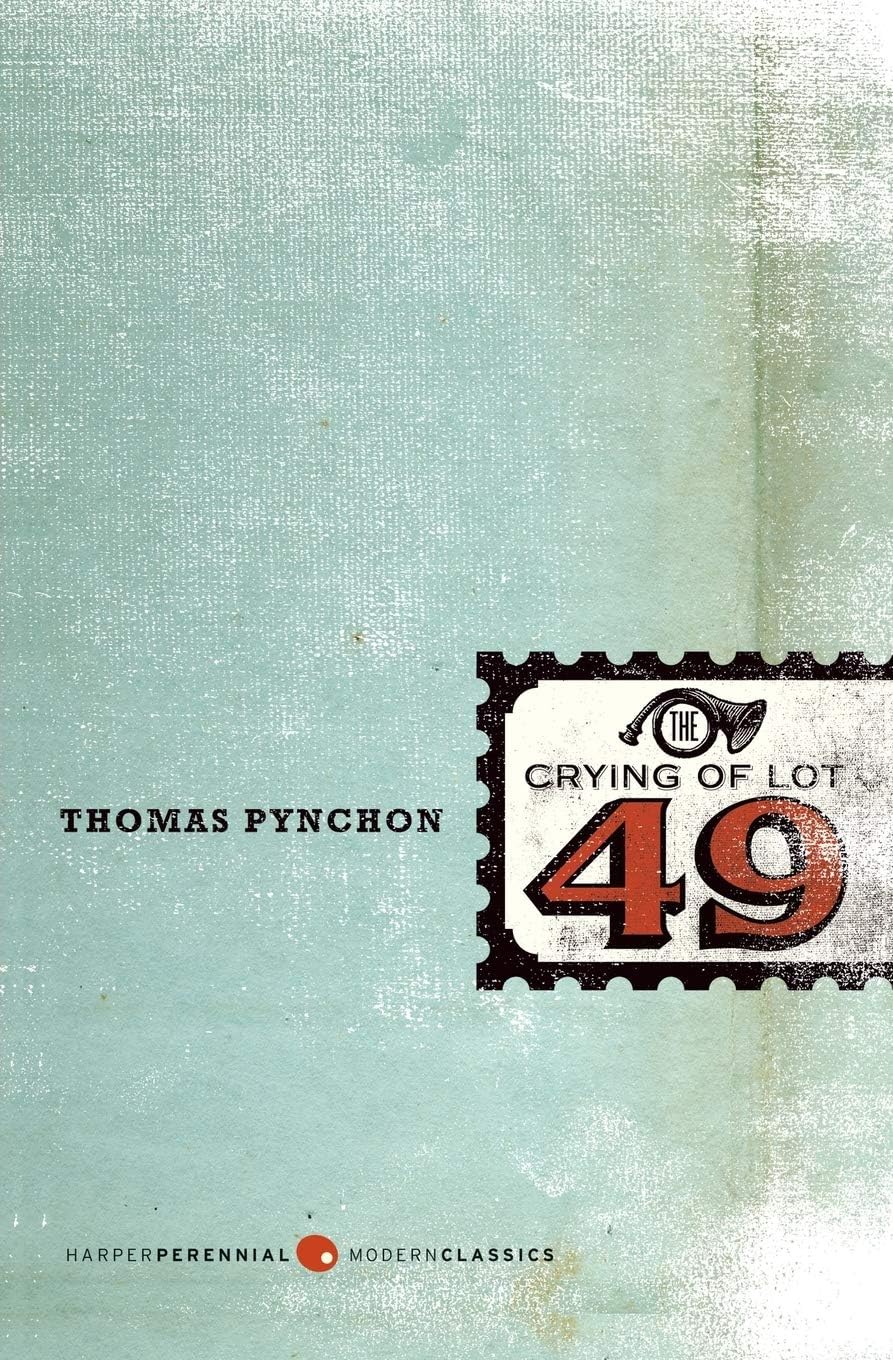
The Crying of Lot 49: A Novel (Perennial Classics)
Product ID: 3036952
Desertcart purchases this item on your behalf and handles shipping, customs, and support to Tunisia.
One of The Atlantic ’s Great American Novels “A puzzle, an intrigue, a literary and historical tour de force.” — San Francisco Examiner The Crying of Lot 49 is Thomas Pynchon's highly original classic satire of modern America, about Oedipa Maas, a woman who finds herself enmeshed in what would appear to be an international conspiracy. When her ex-lover, wealthy real-estate tycoon Pierce Inverarity, dies and designates her the coexecutor of his estate, California housewife Oedipa Maas is thrust into a paranoid mystery of metaphors, symbols, and the United States Postal Service. Traveling across Southern California, she meets some extremely interesting characters, and attains a not inconsiderable amount of self-knowledge. Review: Guide to Being Paranoid - Thomas Pynchon writes the perfect guide to paranoia in The Crying of Lot 49 (published in 1965). His gutsy and self-reliant heroine, Oedipa Maas (more about Pynchon's fabulously funny names later) is named executor of the far-flung estate of an ex-boyfriend. Pierce Inverarity had his fingers in pies of all sorts, including a possible shadow group fighting the monopoly of the US Mail system over mail delivery. The struggle to control the mail dates back centuries (it really does: Pynchon is not making this part up) and the Trystero conspirators are gearing up for an overthrow, offering clandestine methods of getting mail around. Or are they? That's where the paranoia comes in. As Oedipa finds out more and more about seemingly unrelated (but are they?) subjects such as the history of postal subversion (including the philatelical dimensions of forged stamps bearing small, incongruous details in black), and the bones of GIs left at a the bottom of a lake in Italy during World War II and then brought back to the United States to serve as interest for scuba divers in a lake built and outfitted by Inverarity, and the history and performance of Jacobean revenge plays (including one play considered so pornographic and destabilizing that the Vatican keeps it locked up in its library -- another paranoid conspiracy waiting to be written) and resurgent Nazism in San Francisco (not so paranoid, after all), we are as drawn into the twisted story of Inverarity's schemes as she is, and left with the same question: has he created the whole paranoid conspiracy to punish Oedipa or is it a real conspiracy that he was a part of or are all the concurrent acts and facts just coincidences? And if you cannot understand a thing I wrote in this paragraph, don't blame me: read the book. The book was written over forty-four years ago and yet it not dated. The California he writes about is perhaps a bit more innocent and open-spaced than now, but the groundwork for the future is being laid in spiraling real estate developments, spreading smog, and disconnected persons seeking connection, even if it is only the most paranoid grasping for a connection that does not exist. However, there is a noted difference in The Crying of Lot 49 in the 1965 perspective on the Holocaust and World War II, and in today's. In 1965 many survivors and perpetrators of the holocaust were still alive, and WWII was the war people still talked about as a participatory event. It was not an academic discussion of genocide and war, and Pynchon makes the war and the genocide horrible and immediately relevant to his characters. In a way, the characters are seeking to distance themselves from that history, and aligning themselves with an even older history of the struggle against repression while at the same time flying on the balloon of the sixties, trying to get high and find themselves and get laid. I loved how Pynchon uses the 1960s backdrop for his naming of the characters. Pynchon is a timely and sophomoric (but still funny) version of Dickens with his Oedipa Maas (sometimes called "Oed" and sometimes just "Edna"), married to Mucho Maas; we also meet Manni Di Presso, Dr. Hilarius (a Freudian shrink), Stanley Koteks, Mike Fallopian, Genghis Cohen (who calls Oedipa "Miz Maas"), and so on and so on. Pynchon uses silly humor, slapstick, and sly inversions of reality to hold the readers' attention and it all works. The plot of The Crying of Lot 49 is crazy but Oedipa holds it all together, works out all the kinks and twists for me, and makes me a believer. Our Oedipa is an honest and serious girl (she does have some fun in a very funny scene of undressing layers upon layers); she is also an optimist and as dogged as a pit bull. By the end of the book, she accepts paranoia as a necessary state. And she is right, after all. Better to question and wonder, than to be complacent and therefore, unwittingly compliant in the conspiracy. What conspiracy? Take your pick, there are many out there, so keep your eyes open and your brain open, and your options, open. Great good comes from reading great books. For more go to [...] Review: Baffling and irritating, but oddly compelling - I don't normally advocate criminal behavior, but if you're going to read this book, I might suggest you smoke something a bit stronger than tobacco if you're into that kind of thing. It might help to bring this book into focus. I wouldn't be surprised to learn that the author was in a similar state when he wrote it. I'm not sure how much I can tell you about the plot. We start off with Oedipa Maas, a young suburban California housewife, who finds out that she's been named executor of her ex-boyfriend's estate. While diligently attending to the estate (not to mention attending to her co-executor), she stumbles upon a symbol scrawled on a bathroom wall with a reference to something called "WASTE". Oedipa develops an obsession with the symbol which seems to pop up with increasing frequency the more she pursues its meaning. Her adventures lead her from person to person, each character more bizarre than the last, and from unbelievable situation to impossible event. This book is maddeningly impossible to get your head around. Nothing ever quite makes sense, but there's always something tantalizing just around the bend. Maybe if you read a few more pages it will start to make sense. But the further you go on, the less sense it makes, but yet the more we feel we might just get rewarded if we read a little further. We follow Oedipa's descent into conspiracy madness through a long-winded description of a five-act Jacobean revenge play, an encounter with a truly mad scientist, an all-night ramble through the seamy side of San Francisco, the intricacies of stamp collecting, and epic accounts of the obscurest points of the history of mail delivery (although, how much, if at all, that "history" resembles reality is more than I can say). At one point in her obsession, Oedipa looks at the possibilities. Either she's stumbled into one of the most elaborate conspiracies in the history of the world, or she's been set up by her late ex-boyfriend in some sort of elaborate hoax, or else she's mentally ill. We sense all along that the author is playing with Oedipa, poking fun at her and her frail human ability to grasp and comprehend. But then we realize that he's poking fun at us too. And at life itself and all of our grand and serious searching for The Meaning of Life. The characters are mostly quite unsympathetic and unengaging. Mostly that's because they don't stick around long enough for us to get to know them. But even the main character, Miz Maas, doesn't arouse our sympathy. That's because none of the characters are actual human beings; they are mere symbols in Pynchon's game of life. Our clue is in their corny, punny names: "Mucho" Maas, Genghis Cohen, you get the picture. The book is not meant to be taken as a literal story any more than "Gulliver's Travels" is. Both are satires. But unlike "Gulliver's Travels", it is unclear who or what is being satirized in "The Crying of Lot 49". Some things are obvious, like America's post-war cookie-cutter suburban blight and the empty lives that accompany such blight. But it's more than that, though what the "more" is, is always just out of reach. Although this is a very slim volume, it's not easy reading. Pynchon's wordy prose can at times go on for pages without completing a single paragraph. It is almost always difficult to follow exactly what's happening and to keep the characters straight. Nonetheless, I recommend this book as an introduction to Thomas Pynchon largely because it is so short. Judging by the reviews, Pynchon has a devoted following and a number of critics. This book is perfect for discovering which you are. For myself, I'm not quite sure yet. I ended up liking the book in spite of myself, but I don't really think it will stick with me. Some ambiguous books leave me puzzling over them for weeks or months to come, but I don't think this will be one of them.
| Best Sellers Rank | #9,925 in Books ( See Top 100 in Books ) #13 in Action & Adventure Short Stories (Books) #31 in Sea Stories #34 in Indigenous Fiction |
| Customer Reviews | 4.1 out of 5 stars 2,605 Reviews |
A**R
Guide to Being Paranoid
Thomas Pynchon writes the perfect guide to paranoia in The Crying of Lot 49 (published in 1965). His gutsy and self-reliant heroine, Oedipa Maas (more about Pynchon's fabulously funny names later) is named executor of the far-flung estate of an ex-boyfriend. Pierce Inverarity had his fingers in pies of all sorts, including a possible shadow group fighting the monopoly of the US Mail system over mail delivery. The struggle to control the mail dates back centuries (it really does: Pynchon is not making this part up) and the Trystero conspirators are gearing up for an overthrow, offering clandestine methods of getting mail around. Or are they? That's where the paranoia comes in. As Oedipa finds out more and more about seemingly unrelated (but are they?) subjects such as the history of postal subversion (including the philatelical dimensions of forged stamps bearing small, incongruous details in black), and the bones of GIs left at a the bottom of a lake in Italy during World War II and then brought back to the United States to serve as interest for scuba divers in a lake built and outfitted by Inverarity, and the history and performance of Jacobean revenge plays (including one play considered so pornographic and destabilizing that the Vatican keeps it locked up in its library -- another paranoid conspiracy waiting to be written) and resurgent Nazism in San Francisco (not so paranoid, after all), we are as drawn into the twisted story of Inverarity's schemes as she is, and left with the same question: has he created the whole paranoid conspiracy to punish Oedipa or is it a real conspiracy that he was a part of or are all the concurrent acts and facts just coincidences? And if you cannot understand a thing I wrote in this paragraph, don't blame me: read the book. The book was written over forty-four years ago and yet it not dated. The California he writes about is perhaps a bit more innocent and open-spaced than now, but the groundwork for the future is being laid in spiraling real estate developments, spreading smog, and disconnected persons seeking connection, even if it is only the most paranoid grasping for a connection that does not exist. However, there is a noted difference in The Crying of Lot 49 in the 1965 perspective on the Holocaust and World War II, and in today's. In 1965 many survivors and perpetrators of the holocaust were still alive, and WWII was the war people still talked about as a participatory event. It was not an academic discussion of genocide and war, and Pynchon makes the war and the genocide horrible and immediately relevant to his characters. In a way, the characters are seeking to distance themselves from that history, and aligning themselves with an even older history of the struggle against repression while at the same time flying on the balloon of the sixties, trying to get high and find themselves and get laid. I loved how Pynchon uses the 1960s backdrop for his naming of the characters. Pynchon is a timely and sophomoric (but still funny) version of Dickens with his Oedipa Maas (sometimes called "Oed" and sometimes just "Edna"), married to Mucho Maas; we also meet Manni Di Presso, Dr. Hilarius (a Freudian shrink), Stanley Koteks, Mike Fallopian, Genghis Cohen (who calls Oedipa "Miz Maas"), and so on and so on. Pynchon uses silly humor, slapstick, and sly inversions of reality to hold the readers' attention and it all works. The plot of The Crying of Lot 49 is crazy but Oedipa holds it all together, works out all the kinks and twists for me, and makes me a believer. Our Oedipa is an honest and serious girl (she does have some fun in a very funny scene of undressing layers upon layers); she is also an optimist and as dogged as a pit bull. By the end of the book, she accepts paranoia as a necessary state. And she is right, after all. Better to question and wonder, than to be complacent and therefore, unwittingly compliant in the conspiracy. What conspiracy? Take your pick, there are many out there, so keep your eyes open and your brain open, and your options, open. Great good comes from reading great books. For more go to [...]
D**E
Baffling and irritating, but oddly compelling
I don't normally advocate criminal behavior, but if you're going to read this book, I might suggest you smoke something a bit stronger than tobacco if you're into that kind of thing. It might help to bring this book into focus. I wouldn't be surprised to learn that the author was in a similar state when he wrote it. I'm not sure how much I can tell you about the plot. We start off with Oedipa Maas, a young suburban California housewife, who finds out that she's been named executor of her ex-boyfriend's estate. While diligently attending to the estate (not to mention attending to her co-executor), she stumbles upon a symbol scrawled on a bathroom wall with a reference to something called "WASTE". Oedipa develops an obsession with the symbol which seems to pop up with increasing frequency the more she pursues its meaning. Her adventures lead her from person to person, each character more bizarre than the last, and from unbelievable situation to impossible event. This book is maddeningly impossible to get your head around. Nothing ever quite makes sense, but there's always something tantalizing just around the bend. Maybe if you read a few more pages it will start to make sense. But the further you go on, the less sense it makes, but yet the more we feel we might just get rewarded if we read a little further. We follow Oedipa's descent into conspiracy madness through a long-winded description of a five-act Jacobean revenge play, an encounter with a truly mad scientist, an all-night ramble through the seamy side of San Francisco, the intricacies of stamp collecting, and epic accounts of the obscurest points of the history of mail delivery (although, how much, if at all, that "history" resembles reality is more than I can say). At one point in her obsession, Oedipa looks at the possibilities. Either she's stumbled into one of the most elaborate conspiracies in the history of the world, or she's been set up by her late ex-boyfriend in some sort of elaborate hoax, or else she's mentally ill. We sense all along that the author is playing with Oedipa, poking fun at her and her frail human ability to grasp and comprehend. But then we realize that he's poking fun at us too. And at life itself and all of our grand and serious searching for The Meaning of Life. The characters are mostly quite unsympathetic and unengaging. Mostly that's because they don't stick around long enough for us to get to know them. But even the main character, Miz Maas, doesn't arouse our sympathy. That's because none of the characters are actual human beings; they are mere symbols in Pynchon's game of life. Our clue is in their corny, punny names: "Mucho" Maas, Genghis Cohen, you get the picture. The book is not meant to be taken as a literal story any more than "Gulliver's Travels" is. Both are satires. But unlike "Gulliver's Travels", it is unclear who or what is being satirized in "The Crying of Lot 49". Some things are obvious, like America's post-war cookie-cutter suburban blight and the empty lives that accompany such blight. But it's more than that, though what the "more" is, is always just out of reach. Although this is a very slim volume, it's not easy reading. Pynchon's wordy prose can at times go on for pages without completing a single paragraph. It is almost always difficult to follow exactly what's happening and to keep the characters straight. Nonetheless, I recommend this book as an introduction to Thomas Pynchon largely because it is so short. Judging by the reviews, Pynchon has a devoted following and a number of critics. This book is perfect for discovering which you are. For myself, I'm not quite sure yet. I ended up liking the book in spite of myself, but I don't really think it will stick with me. Some ambiguous books leave me puzzling over them for weeks or months to come, but I don't think this will be one of them.
B**N
This Novel Stands with The Great Gatsby
Her name is Oepida Maas. Her husband is Mucho Maas. Her lover was Pierce Inverarity who ran Yoyodyne Corporation in San Narciso. He psychiatrist is Dr. Hilarious. You get the idea - there are funny names in this story. Oepida is made the executor of Pierce's estate. Diligently, in this romance, satire, antidetective novel, she tries to find out the extent of her duties and the extent of the estate. Along the way, things go from simple to complex, ordered to disordered, concrete to abstract, just the opposite of the usual novel, and she becomes enmeshed in either a worldwide conspiracy called Trystero or enmeshed in her imagining of a worldwide conspiracy called Trystero, and organization, if it exists, dedicated to alternative culture and government derived from the Thurn and Taxis Postal system started in 1577 in Holland. Oepida's quest reminds me of the Faerie Queene charmed from her human virtues while searching for self-knowledge. Her sensitivity to external events and the hidden meanings in the nature of things (are they really there, those meanings?) reminds me of Emily's sensitivity to external things in The Mysteries of Udolpho. But her and Pynchon's language reminds me of nothing I have ever seen: It is an original blend of erudition, and slang with scintillations, multiple meanings, cross references, parody, outlandish puns, pawky black humor -- all of which is steadily and intelligently directed and reflects an extraordinary writing talent. The characters are everywhere plugged in elsewhere, so Oepida can't connect with anyone except perhaps her two lovers and then only tentatively: one leaves her for a teenager; the other kills himself. The plot is driven by concepts in physics including the second law of thermodynamics and Maxwell's demon as well as by the idea that information theory equations reduce to entropy equations. Indeed the theme is that the world's entropic decline is evidences by its capacity for bureaucracy, atomic war, and domestic violence, all of which can be prevented by an increase in meaningful human communications. I like that idea and I like the comic ribbings of California manners and pop culture gone to rock and ruin. This novel stands with The Great Gatsby in concise attempt to capture dangerous exaltations in the closed entropic system known to us as America and in so doing reasserts the wonder that can animate the novel.
W**B
Important literature but a tough read-
First, you have to remember when it was written- and it represents a genre in a way- hard tow read-- and I must say I did not much like the book- but-- I felt I needed to fill in this gap in my literature ! But, as a good fun read, well-- it is a struggle- knowing some will love the book- just not my taste
C**C
Farcical critique of upper class Americana
I feel like I have to read this book at least twice more before I could write the review I'd like to write. Perhaps I'll read it again and find time to alter these notes at a later date. For now, I'll just focus on the concept of the entire narrative as farcical critique of upper class Americana. Pynchon reveals anti-heroine Oedipa Maas as an adulteress on the novel's first pages, executor of the wealthy estate of a recently deceased ex-lover, Pierce Inverarity (How great are these names, by the way? All of Pynchon's choices for character names in this book are hysterically funny). Her journey from there is hilarious, surprising at every turn, chock full of conspiracy theory and peppered with meaningless sex and sexual advances. Oedipa's obsession with the mystery she believes Inverarity left behind for her to solve, that of an underground mail service called the Trystero, speaks to the boredom Pynchon assumes for the American upper class of his day, the longing for a purpose and constant uncertainty as to whether that purpose really means anything at all. Here are three quotes where I feel Pynchon writes very directly with regard to American life: "`I came,' [Oedipa] said, `hoping you could talk me out of a fantasy.' `Cherish it!' cried Hilarius, fiercely. `What else do any of you have? Hold it tightly by its little tentacle, don't let the Freudians coax it away or the pharmacists poison it out of you. Whatever it is, hold it dear, for when you lose it you go over by that much to the others. You begin to cease to be.'" (page 113) "You're chicken, she told herself, snapping her seat belt. This is America, you live in it, you let it happen." (page 123) ". . . maybe even [stumbled] onto a real alternative to the exitlessness, to the absence of surprise to life, that harrows the head of everybody American you know, and you too, sweetie." (page 141) The Hilarius (another fantastic name, of course) quote from page 113 says to me that Pynchon feels we Americans need our fantasies, need an element of craziness in our lives because the easy life here isn't necessarily what people expect it to be. It's set up beautifully by Oedipa's desire at that moment to give up her search. The quote from page 123, Oedipa talking to herself about what she should be able to do, how she should be able to affect outcomes and events, delineates an expectation so many Americans have that's, unfortunately, not always met with success. The most powerful quote of the three, in my opinion, is the one from page 141. Whether Oedipa's mission was real or contrived, worthy or a waste of time, here she describes "everybody American" she knows as living with "exitlessness" and an "absence of surprise to life," and includes herself in that group. Through Oedipa and her adventure and her own conflicting opinions about it, Pynchon conveys a strong desire to break from quotidian life in the leisure class, a yearning for any sort of struggle but an uncertainty about that very yearning. Part of what Pynchon writes in The Crying of Lot 49, in my opinion, presents random sex and infidelity as one answer attempted by people in Oedipa's shoes, the bored housewives and their working husband counterparts, and this purported solution comes up empty time and time again. Oedipa herself seems to realize this as the novel progresses, succumbing to seduction early on but then rejecting it and feeling disgusted by its perpetrators later. Surely a long essay could be written just about Pynchon's treatment of sex in this book, but this review is getting long, so I'll cut it off here. I loved this book for all of its complexity, this review is just a few thoughts on one theme that stuck with me.
P**L
Oedipa's Epistomological Mysteries Tour
It is precisely facts that do not exist, only interpretations -- Nietzsche Shall I project a world? -- Oedipa Maas Thomas Pynchon's The Crying of Lot 49, rich in allusion, multilayered, and bristling with scintillating gems of simile and metaphor drawn from thermodynamics, mathematics, and information theory, is an example of an increasingly prominent school of imaginative literature in which the novel decidedly is constructed as a problem of semiotics or meaning that is more like a puzzle than a story. As such, it begs the question whether it marks a point in the development of the novel analogous to the period soon after the perfection of the camera when painters all but abandoned representational art for the "abstract" art of the mind's eye. The first suggestion that CL49 involves a similar departure comes by way of its protagonist's very name, Oedipa Maas. Fatuous and Improbable, Oedipa is not so much a name as a signifier that directs readers to other texts, bringing to mind Sophocles' Oedipus Rex, Freud's Interpretation of Dreams, and perhaps even Deleuze and Guattari's Anti-Oedipus: Capitalism and Schizophrenia. So extensively does the text prompt such sleuthing for cross-references that diligent readers soon find themselves immersed in something much like the mind-bending discovery phase of Oedipa's effort to execute the will of a former lover, California tycoon Pierce Inverarity. "As things developed, she was to have all manner of revelations. Hardly about Pierce Inverarity, or herself; but about what remained yet had somehow before this stayed away." A northern California housewife holdup in the suburbs at the novel's outset, during the 1960s, Oedipa, educated, childless, and very much a ward of the 1950s, sees herself as being like Rapunzel, imprisoned in a tower and waiting for someone or something to free her. Once, years before her feckless marriage to Wendell "Mucho" Maas, she had seen Inverarity as the agent of her liberation, but "all that had gone on between them had really never escaped the confinement of that tower." Her effort to uncover and settle Inverarity's vast, shadowy, and complicated holdings launches her into what might be called an epistemological mysteries trip in which every revelation begets a riddle and ever riddle becomes a clue to some deeper mystery leading her to wonder whether she had lost her mind, stumbled on a global conspiracy, or fallen for a cruel hoax. As hyperbolic as her situation may seem, it presaged a real-world case in point. Three years after the book's 1966 publication, it was rumor that The Beatles' Paul McCarney had been killed in a 1966 car crash. Evidence of both his death and his replacement by a look-alike, it was said, could be found when certain Beatles songs were played backwards and when various Beatles album covers were examined closely. In the mass mania that followed, the turntables and styluses destroyed by playing records backwards were innumerable, as were the hours spent pouring over album covers. For some, as with Oedipa, everything, even the slightest coincidence, got immeshed in the conspiracy; and the weight of it all was more than they seemed able to bear. Whether madness, hoax, uncanny coincidence, or conspiracy, Oedipa's trip permits this observation: Such meaning as one finds in life springs from the same human tendency as that which makes the Big Dipper and Orion, the hunter, appear in the night sky: that 20-watt apparatus between ones ears connects the dots even when no such connections actually exist. Nor does restricting the mind's operation to the norms of science offer an escape from uncertainty and the prospect of illusion. Instead, such efforts confine the self to a realm that admits nothing that can not be objectified. Yet those other things--such as love, community, and hope--would always remain at the twilight edges of awareness where, under the circumstances, they can only induce dread.
K**R
Fun on the driveway !
A big Amazon van and an unmarked large white van were in my driveway. When I went out (in the rain) to check, the Amazon driver told me his van had broken down, the white van was supposed to help it but couldn't, and now everyone was waiting for a tow-truck, The Amazon guy yelled through the rain, "I'm so sorry for the inconvenience." And I yelled back "One of these books is about paranoia, so this is actually perfect !" It's the most fun I've ever had on my driveway.
S**H
The Deconstruction of Deconstruction
I think that it is an injustice to discuss this novel in the generalizing language that book reviews invite. Did I enjoy it? Sometimes. Is the plot engaging? Dreamlike and strange, it is not so much engaging as engulfing. This novel does not ask for your attention, does not attempt to maintain the reader’s attention. It simply inhabits you without your permission, carves out a corner of your mind and establishes itself permanently. Are the characters believable? Well-drawn? Not really—but that in itself becomes part of the mythos of Pynchon’s world. He is referred to as the novelist of possibility, not reality; therefore, the manic insanities of these characters become genuine even when they are unbelievable. That said, The Crying of Lot 49 is a genius work of fiction. It unravels language at the seams, attacking our most basic assumptions about experience and reality. It rips through our constructed realities and reveals either something transcendent or a cold nothing at all, either the impossibility of communicating with reality or the lack of a reality to communicate with (and each symbol in the novel disintegrates into this similar binary). The final pages, however, undermine even that binary, warning about “excluded middles” and the notion of “diversity,” simultaneously asserting and denying the very binaries of reality. And for that—this novel is a tour de force, a powerful deconstruction that is careful to keep the deconstruction itself deconstructed. I am reminded of the Buddhist notion of emptiness, wherein even the notion of emptiness is itself empty, for the assertion of a positive reality characterized by deconstruction or emptiness is another kind of grasping for substance.
C**R
Masterpiece of paranoia and intrigue
Pynchon's 'The Crying of Lot 49' is a labyrinthine journey into paranoia and conspiracy. It's a tightly woven tapestry of intrigue that keeps you guessing until the very end. It's like a rollercoaster ride through a hall of mirrors - thrilling, disorienting, and utterly unforgettable: it even has a bloody full-on play-within-a-play! Unrivalled.
J**A
11/10
A book that as soon as you finish reading enters the top 3 of your favourite books ever
M**.
Bis dato schönste Edition und zudem als Hardcover
Ein Meisterwerk Pynchons, das jedem Einsteiger in sein Werk empfohlen sein sollte. Ich hatte bereits andere Ausgaben im Taschenbuchformat. Diese der Erstausgabe nachproduzierte HC-Edition ist für mich die schönste. Ich habe ebenfalls die von V. gekauft und hoffe nun, wie vermutlich so einige seiner Leser, auf einen Nachdruck der Erstausgabe von Gravity‘s Rainbow.
R**H
Mind boggling postmodern novel, A salute to Pynchon's artistry
No issues for the quality,but it's a postmodern novel ,if you have not studied detail about what's paranoid self in postmodern time , what's fluid identity then all this meaninglessness in the depiction may seem to u buying worthless.Oedipa's search for truth is meaningless as she feels herself appropriate to be a detective and to collect info about her ex-boy friend she goes trough several steps and on her search she gets nothing even if she's at a moment of reaching the truth somehow it's destructed.The novel also ends with re reality that's misrepresented...
A**E
Commentaire totalement subjectif
Attention, ce commentaire est totalement subjectif et ne se base que sur mon appréciation de l'histoire car l'objet en lui même est de bonne qualité (c'est un livre quoi). Je déconseille fortement ce livre à tous ceux qui n'aiment pas les livres sans queue ni tête. L'histoire va dans tous les sens mais sans jamais aller au bout, les personnages n'ont aucun charisme, le lecteur n'a aucune empathie pour l'héroïne et enfin, la trame principale est totalement incompréhensible... Pour être totalement honnête, je n'ai acheté ce livre que parce qu'il figurait sur ma liste d'oeuvres à étudier.
Trustpilot
2 weeks ago
5 days ago