
Buy anything from 5,000+ international stores. One checkout price. No surprise fees. Join 2M+ shoppers on Desertcart.
Desertcart purchases this item on your behalf and handles shipping, customs, and support to Tunisia.
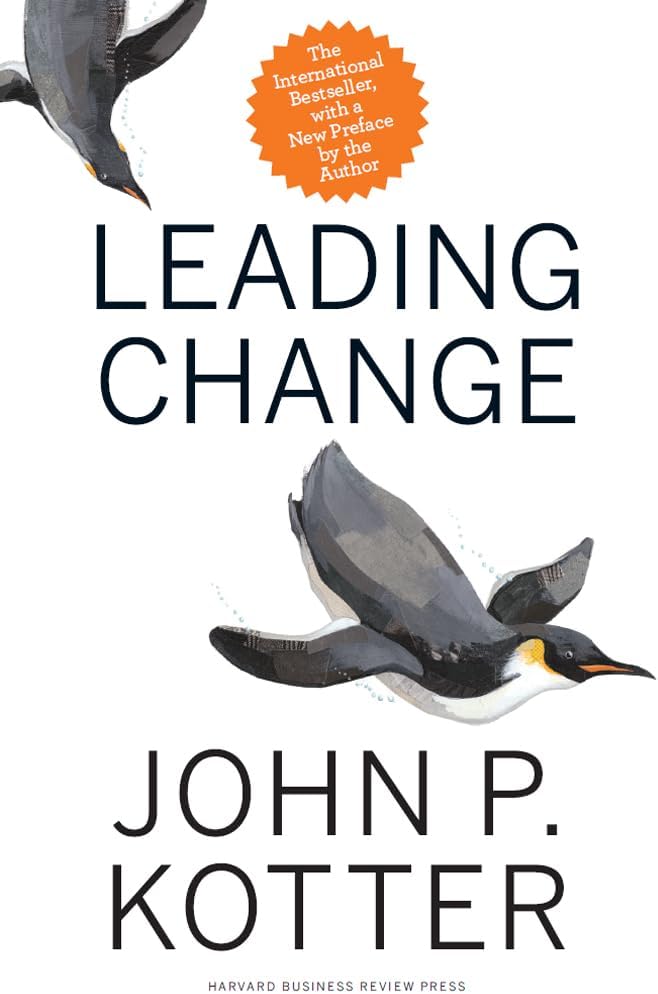
The international bestsellernow with a new preface by author John Kotter. Millions worldwide have read and embraced John Kotter’s ideas on change management and leadership. From the ill-fated dot-com bubble to unprecedented M&A activity to scandal, greed, and ultimately, recessionwe’ve learned that widespread and difficult change is no longer the exception. It’s the rule. Now with a new preface, this refreshed edition of the global bestseller Leading Change is more relevant than ever. John Kotter’s now-legendary eight-step process for managing change with positive results has become the foundation for leaders and organizations across the globe. By outlining the process every organization must go through to achieve its goals, and by identifying where and how even top performers derail during the change process, Kotter provides a practical resource for leaders and managers charged with making change initiatives work. Leading Change is widely recognized as his seminal work and is an important precursor to his newer ideas on acceleration published in Harvard Business Review. Needed more today than at any time in the past, this bestselling business book serves as both visionary guide and practical toolkit on how to approach the difficult yet crucial work of leading change in any type of organization. Reading this highly personal book is like spending a day with the world’s foremost expert on business leadership. You’re sure to walk away inspiredand armed with the tools you need to inspire others. Published by Harvard Business Review Press. Review: Highly readable, useful, and even inspiring - What happens when an organization needs to change (if it hopes to be successful in the future) but hasn't put much thought into what the process of change itself looks like? More than likely: failure. John Kotter outlines here a critical difference between change efforts that have been successful, compared to change efforts that have failed. Drawing on decades' worth of experience consulting with firms and coaching leaders, and attentive to ever-increasing globalization of markets and competition, Kotter offers an eight-stage change process. The eight stages are: 1. Establishing a sense of urgency 2. Creating the guiding coalition 3. Developing a vision and strategy 4. Communicating the change vision 5. Empowering broad-based action 6. Generating short-term wins 7. Consolidating gains and producing more change 8. Anchoring new approaches in the culture Successful change, Kotter argues, "is 70 to 90 percent leadership and only 10 to 30 percent management. Yet for historical reasons, many organizations today don't have much leadership." Kotter articulates what effective leadership -- not management -- actually looks like. Kotter provides a helpful, clear, and concise chapter devoted to each of the eight stages. He articulates precisely what is needed at each critical moment in the transformation process. He provides numerous examples of what happens when any stage is ignored (basically, he suggests that to ignore any of the eight stages will likely lead to failure). Specific guidance and steps are offered at every point along the way. A useful summary of the whole process is provided on page 21. The final couple chapters provide a glimpse into the organizations and leaders of the future. "The rate of change in the business world is not going to slow down anytime soon. . . . The typical twentieth-century organization has not operated well in a rapidly changing environment. . . . If environmental continues to increase, as most people now predict, the standard organization of the twentieth century will likely become a dinosaur." The winning enterprise of the twenty-first century will have a persistent sense of urgency, teamwork at the top, people who can create and communicate vision, broad-based empowerment, delegated management for excellent short-term performance, no unnecessary interdependence, and an adaptive corporate culture. Leaders of the future are going to be people with high standards and a strong willingness to learn. Arguing that leadership traits can be learned, Kotter provides examples of people he has known over an extended period of time who once upon a time showed little promise, but who developed superlative leadership skills and have become highly effective, successful, influential leaders. Just as organizations need to continue to continue to change and grow, so too will organizations' future leaders. Overall, this is a highly readable, useful book. It is obviously useful for leaders in the corporate world. I would argue that it is also highly useful for leaders in ANY organization that is trying to thrive in the twenty-first century. I wish I had read it years ago! Review: Good Book - This book came in great condition! Also it is a very informative and engaging read about the need to change in business organizations. I would recommend this book if you are interested in change management and how to lead a change initiative at your job.

| Best Sellers Rank | #6,614 in Books ( See Top 100 in Books ) #38 in Business Processes & Infrastructure #64 in Business Management (Books) #73 in Leadership & Motivation |
| Customer Reviews | 4.6 out of 5 stars 4,194 Reviews |
B**S
Highly readable, useful, and even inspiring
What happens when an organization needs to change (if it hopes to be successful in the future) but hasn't put much thought into what the process of change itself looks like? More than likely: failure. John Kotter outlines here a critical difference between change efforts that have been successful, compared to change efforts that have failed. Drawing on decades' worth of experience consulting with firms and coaching leaders, and attentive to ever-increasing globalization of markets and competition, Kotter offers an eight-stage change process. The eight stages are: 1. Establishing a sense of urgency 2. Creating the guiding coalition 3. Developing a vision and strategy 4. Communicating the change vision 5. Empowering broad-based action 6. Generating short-term wins 7. Consolidating gains and producing more change 8. Anchoring new approaches in the culture Successful change, Kotter argues, "is 70 to 90 percent leadership and only 10 to 30 percent management. Yet for historical reasons, many organizations today don't have much leadership." Kotter articulates what effective leadership -- not management -- actually looks like. Kotter provides a helpful, clear, and concise chapter devoted to each of the eight stages. He articulates precisely what is needed at each critical moment in the transformation process. He provides numerous examples of what happens when any stage is ignored (basically, he suggests that to ignore any of the eight stages will likely lead to failure). Specific guidance and steps are offered at every point along the way. A useful summary of the whole process is provided on page 21. The final couple chapters provide a glimpse into the organizations and leaders of the future. "The rate of change in the business world is not going to slow down anytime soon. . . . The typical twentieth-century organization has not operated well in a rapidly changing environment. . . . If environmental continues to increase, as most people now predict, the standard organization of the twentieth century will likely become a dinosaur." The winning enterprise of the twenty-first century will have a persistent sense of urgency, teamwork at the top, people who can create and communicate vision, broad-based empowerment, delegated management for excellent short-term performance, no unnecessary interdependence, and an adaptive corporate culture. Leaders of the future are going to be people with high standards and a strong willingness to learn. Arguing that leadership traits can be learned, Kotter provides examples of people he has known over an extended period of time who once upon a time showed little promise, but who developed superlative leadership skills and have become highly effective, successful, influential leaders. Just as organizations need to continue to continue to change and grow, so too will organizations' future leaders. Overall, this is a highly readable, useful book. It is obviously useful for leaders in the corporate world. I would argue that it is also highly useful for leaders in ANY organization that is trying to thrive in the twenty-first century. I wish I had read it years ago!
K**H
Good Book
This book came in great condition! Also it is a very informative and engaging read about the need to change in business organizations. I would recommend this book if you are interested in change management and how to lead a change initiative at your job.
B**E
Classic on change management - pretty good
Leading Change from Kotter is one of the classics on modern change management and it is a pretty good book. Though, definitively not perfect and it does, in my opinion, have a bit a 'traditional management' taste to it. But, well, as that is probably practices in the majority of the companies, I can't blame this book for it. Leading change is fairly short, a bit less than 200 pages. It consists of 3 different parts: 1) The change problem and its solution (or it could be called "overview"), 2) The eight-stage process, 3) Implication for the twenty-first century. The first part consists of 2 small chapters. The first cover why organizations fail with their change efforts and it provides eight mistakes (which is basically the reverse of his later proposal). In the second chapter, Kotter introduces his 8-step change process for managing change in an organization. The eight steps are also the eight chapters of part 2. They are: - Establish a Sense of Urgency - Creating a Guiding Coalition - Developer a Vision and Strategy - Communicating the Change Vision - Empowering Employees for Broad-Based Action - Generating Short-Term Wins - Consolidating Gains and Producing More Change - Anchoring New Approaches in the Culture. Each of the chapters in Part 2 describe the change step, why it is needed and give some advise and stories about the change. The third and last chapter speculated about the future and how change is becoming more and more important. All in all, the book was actually pretty good (better than I had expected, as I was familiar with the basic content already). It is well-written and in quite a convincing way. I did get uncomfortable at times, these were mainly about 3 assumptions that I felt throughout the book. 1) The enormous focus on 'leadership' which, I believe, somewhat misses the point of building an environment in which all people flourish (and yes, you might say the leader does it, but why not all people? Isn't it just caring?). 2) A lot of focus on "top-down" change rather than grass-roots change and with it a lot of focus on traditional management roles, and 3) A lot of focus on BIG change efforts over many small ones (many small ones is more a Kaizen spirit). It felt in line with the "big project" and "re-engineering" thinking rather than the view of gradual change. Anyways, all three of these are to be expected and as the book has a clear focus/audience, it doesn't matter too much. Thus, a good book on traditional change management and worst reading from that perspective. It wasn't an *aha* book for me, it was just good. For that reason, I'll stick with 4 stars. Pretty good.
J**F
Finally a book about LEADING change...
In Leading Change, John P. Kotter introduces an eight step process for change that focuses not on management but on leadership. He charges leaders to establish a sense of Urgency, Create a guiding Coalition, Develop a Vision and Strategy, Communicate the change Vision, Empowers Employees for Broad-Based Action, Generate Short Term Wins, Consolidate Gains, and Anchor New Approaches in the Culture. Kotter casts a vision for both organizations and leaders of the future that endeavors to negate the effects of over-management and to lessen the impact under-leadership. Kotter proposes that leadership be driven down into the lower levels of an organization through adoption of a philosophy of lifelong learning at both the individual and organizational levels. This philosophy is intended to create leaders who are continually growing and improving themselves and their organizations. I found Kotter's approach to be both practical and well reasoned. His eight steps are well grounded and realistic. This is a well written book that has plenty of hands on advice that can be implemented immediately. This will remain a reference for leadership versus management and will undoubtedly become well dog-eared in the coming years. I recommend you read Leading Change by John P. Kotter. His down to earth style helped make this an easy read and you and your organization will benefit from his advice.
P**A
Inspiring for change agents
I am a sustainability professional who works to help institutions become more sustainable and better stewards of the environment. Because of the nature of my work, I am always trying to coax, create, inspire, and implement change. After years of learning about the technical knowledge of what to do and how to do it, this is the most helpful book of all which deals with the sequence of implementing change. When you are dealing with other people or a large organization, you cannot just start changing things left and right. You need to establish a foundation, get buy in, and leverage small changes into bigger changes. Where do you start? Who do you talk to? What do you do first? What do you do next? This book shows you what to do first, second, and third in the 8 step process to change. It shows the difference of being a leader rather than a manager or worker. A leader's most important task is to have vision and help others buy into that vision. The ability to implement and deep technical knowledge is useless unless there is support for change and a structure that allows for it to happen. I like that Kotter's book lays out clearly an architecture for change. While the book was short, didn't have many examples or diverse applications (such as outside of the corporate environment), I appreciate its conciseness, which allows you to spend more time thinking about how the principles apply to your own situation. It can be skimmed easily and the charts and summaries at the end of each chapter cogently summarize the main points of each chapter. I highly recommend this book for all leaders that try to create change.
P**S
Great Insights into Change and Leadership
This was a very enjoyable business book to read. It was short and concise, which is a breath of fresh air for business books. Some books are very repetitive and filled with examples which can be exhausting to read as the same points are made over and over again. In this book, the points are succinct and the examples simple. The focus is on the need for leadership, the steps for change, and the hard work needed to go through those steps. No sugar coating here! I think this is a great book for anyone working in a corporate environment. Leaders about to embark on a large change effort or those at any level who are in the middle of such change. I would recommend this book because it is honest, straightforward and thought provoking. It is an easy and interesting read.
W**E
Change - Ya Gotta Love It. REALLY.
What does it mean to be a change leader? In times of fiscal upheaval, can a state agency stay true to its mission and vision? Or, must these be sacrificed on the altar of efficiency to the (presumably) lean God of Economy? These are the challenges that confront our elected representatives, agencies that serve the public, unions that represent the workforce, and their constituencies. In "Leading Change," John Kotter reveals his Eight-Stage Process of Creating Major Change: 1. Establishing a Sense of Urgency 2. Creating the Guiding Coalition 3. Developing a Vision and Strategy 4. Communicating the Change Vision 5. Empowering Broad-Based Action 6. Generating Short-Term Wins 7. Consolidating Gains and Producing More Change 8. Anchoring New Approaches in the Culture In Kotter's experience, neglecting any one stage undermines and imperils the entire change effort. So it is clear that change is coming. It always does. Particular change can be envisioned in an instant but implementation can take some time. This is especially true in large, complex organizations like government bureaucracies, with highly interdependent structures and systems. Serving the public is a process and jobs are maintained to provide the service. Nearly every process in one system is connected to many other systems, and one change will, of necessity, affect changes to hundreds or thousands of processes. To say that change requires hard work and sacrifice in this environment is an understatement. Change in a government bureaucracy requires a seismic shift in thinking by those who have been working at the same agency for decades, especially those who really believe they have made a difference for the public good. "We have always done it this way so why change now?" Their contributions provide valuable lessons but time marches on. Not only are policies and procedures not cast in stone, but future generations deserve the right to have them evolve. Whether they evolve for the better -or not--is the responsibility of the change agent... basically, you and I. By definition, government services "serve" the public. The way government serves the public today could not have been envisaged at its founding. America has had some time to think about and see some good ideas become reality. We have codified them, managed them, regulated them, raised revenue from them, underwritten, audited, overseen the audit, re-codified, re-managed, re-regulated, created increasingly complex financing mechanisms, then audited everything again.... It is only natural that before long, the original idea... the "mission" and "vision" becomes lost in the risk averting, litigious-avoiding (though interconnected) world of bureaucratic government. How do you empower interdependent agencies with different functional missions to work seamlessly together? What can a workforce do when it is saddled with legally mandated interconnected systems that do not fulfill the mission or vision of the agency but are relics of an earlier era, or simply symptoms of jurisdictional overreach? For change to really happen and take hold in a governmental bureaucracy, with organizational structures and personnel performing different functions and serving different (sometimes opposing) constituencies, and systems of supports and services serving a large and growing base of populations, the change must produce benefits and personal satisfactions that are superior to the way things are today. Today it will take more than the desire to "do more with less," or even to "do more, better." Indeed, the organizational culture itself must be changed. Purging unnecessary interconnections can ultimately make a transformation not only possible, but easier. It may not be necessary to consolidate agencies when it would be more efficient to coordinate them instead. Streamline procedures and approval processes by putting systems in place that satisfy regulatory requirements and align with the agency's mission. Government and unions can be powerful allies to responsibly empower a highly trained public workforce. The wins must be real, and they must come soon. Paraphrasing Kotter, "Truly adaptive governmental bodies with adaptive cultures are awesome competitive machines." At a visceral level, you have to appreciate change, respect it, embrace it... lead it. "Leading Change" reminds us that change starts with you and me.
O**H
Change is here to stay
In this book, the author discusses in detail an eight-stage process of creating major changes. The steps are as follows: establishing a sense of urgency, creating the guiding coalition, developing a vision and strategy, communicating the change vision, empowering broad-based action, generating short-term wins, consolidating gain and producing more change, and finally anchoring new approaches in the culture. Anyone who has dealt with change can identify some of the stages outlined. The challenge is to work through them methodically and ensuring that each stage is successful to build a lasting change on a solid foundation. From my experience, numerous changes attempt to fast-track or skip some of these stages. While on the short term, this may not seem like an issue, sooner or later the change ultimately fails to achieve the desired outcome. In addition, despite that big changes take time to complete, it is vital to build and achieve small wins to maintain the change momentum. John offers extensive examples from his professional career, through which he illustrates both successful and unsuccessful changes. One of the pivotal points he makes is around leadership and management, what their role is in the change and the differences between them. For a change to succeed both strong leaders and strong managers are needed. Overall a very interesting read for anyone leading a major project/change initiative. I will conclude from a quote from the last chapter, which I particularly enjoyed reading on personal development and the concept of competitive capacity: "In attempting to explain why most (students of HBS) were doing well in their careers...I found the two elements stood out: competitive drive and lifelong learning." Competitive drive is characterized by a level of standards, a desire to do well and self-confidence in competitive situations. Lifelong learning is characterized by a willingness to seek new challenges, and a willingness to reflect honestly on success and failures.
L**V
A manual for change
This book reads as a manual for change projects, while inspiring at the same time. I very much like the definition of leadership vs management. This helps me with a lot of observations on what goes well or wrong
A**O
Maior contribuição para a gestão de mudanças!
Trata dos princípios do change management como ninguém! Inspiração para a verdadeira transformação dos negócios
H**E
bon service de amazon et vendeur : livre de kotter est un livre a avoir lu pour traiter les questions de conduite du changement
le livre de john Kotter présente une méthode de gestion du changement qui a fait legion pendant de nombreuses années. Il montre aussi pourquoi les projets de gestion du changement échouent et comment ces problèmes peuvent être évités. Le titre introduit dja - la notion de leadership - lead - et une question qui suivra sera quel leadership pour le contexte actuel sachant que ce livre a été ecrit il y a plus de vingt ans Il est aussi important de repositionner le contenu dans un contexte de mondialisation. Je trouve ce livre trés utile.
P**E
An Excellent Guide for Leading Major Change
This book has become something of a classic among management books. Kotter starts by listing eight reasons why major organisational change initiatives fail. He then goes on to give his eight point plan for leading change. The process he recommends is: Establish a Sense of Urgency Create a Guiding Coalition Develop a Vision and Strategy Communicate the Change Vision Empower Employees for broad-based Action Generate Short-Term Wins Consolidate Gains and Produce more Change Anchor the New Approahces in the Corporate Culture He clearly explains the why and how for each point and stresses the importance of following this procedure in sequence and of not omitting any steps. Both leadership and management is needed in the process and he shows their different roles. The book is easy to read and the arguments are cogent. There are many examples and stories - though no proper case studies. Overall it is a highly valuable guide to the tough challenge of leading large-scale change.
K**R
Change basics
A fantastic structured look at change and transforming an organisation. The way Kotter writes it all appears common sense. But for those of us in Change roles we know that it I'd not that easy. A great read and an interesting insight that although this nook was written a few years ago today, the issues have not changed.
Trustpilot
2 days ago
5 days ago