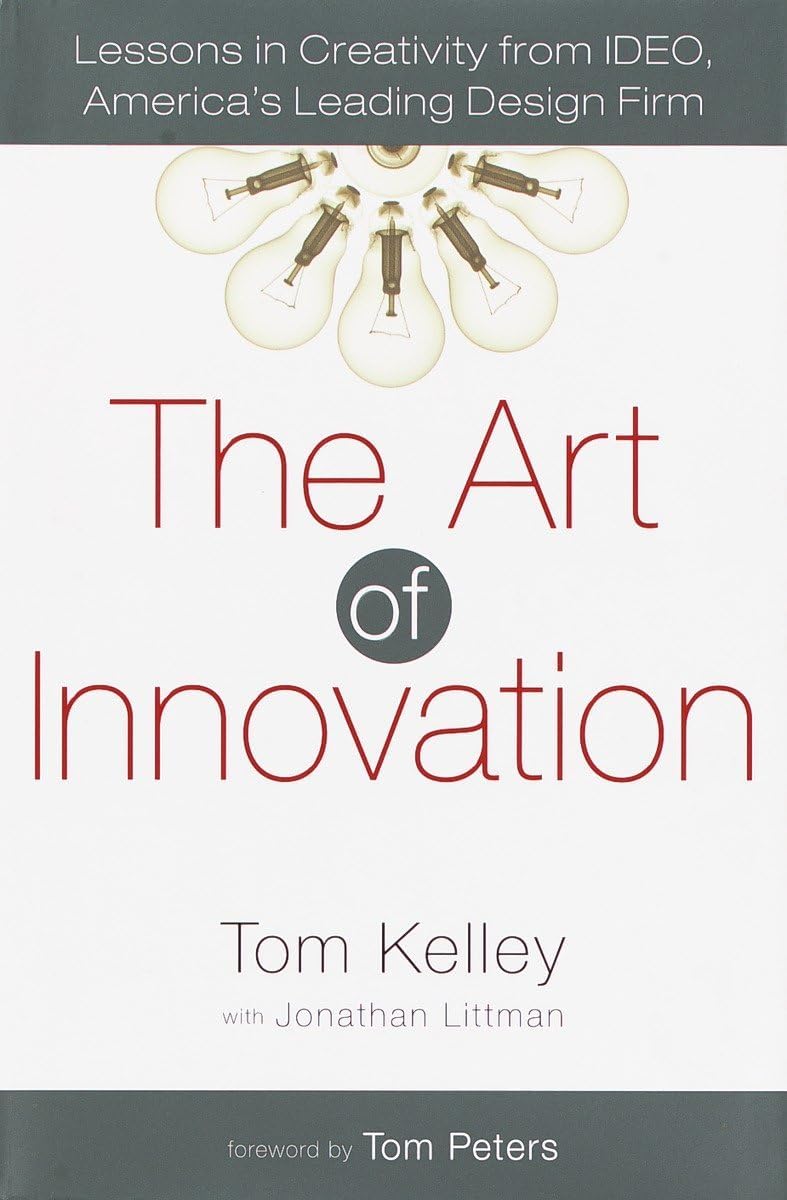
The Art of Innovation: Lessons in Creativity from Ideo, America's Leading Design Firm
Product ID: 3783237
⚡Rapid 'Deep Dive' prototyping process
🏆Award-winning innovation legacy
🤝Collaborative, cross-disciplinary teamwork
Desertcart purchases this item on your behalf and handles shipping, customs, and support to Tunisia.
🚀 Innovate like IDEO: Where creativity meets breakthrough success
The Art of Innovation by Tom Kelley reveals the award-winning design firm IDEO’s proven strategies for fostering a culture of continuous creativity and rapid prototyping. Packed with insider insights, this book guides business leaders and creatives alike to harness teamwork, embrace risk, and apply IDEO’s ‘Deep Dive’ process to consistently deliver groundbreaking products and services that dominate markets.
| Best Sellers Rank | #346,479 in Books ( See Top 100 in Books ) #20 in Business Operations Research (Books) #298 in Company Business Profiles (Books) #930 in Systems & Planning |
| Customer Reviews | 4.4 out of 5 stars 603 Reviews |
C**R
Foster an environment that brings a creative, innovation force...
This book is NOT a step by step process on how to give your company an "IDEO Makeover". Not even close. Instead, this is THE book to learn how to foster an environment that promotes creativity. Whether you're in the "messy startup mode" or "established 3-piece suit mode", you'll be able to apply what you learn and bring a massive creative force in your business. Innovation will flow fluidly once you demolish barriers that contain creativity. Tom Kelley's logic is basically this: 1. Bring together insightful, motivated people, regardless of disciplinary background. 2. Put them under deadline pressure, but pamper them in ways that reinforce a sense of community. 3. Challenge them to do innovative, creative work. 4. Then simply stand back as they blow you away with sideways solutions the likes of which the world has never seen. What I learnt in this book helped our company come out with innovative products that blew the competition away. I got my copy almost free using a coupon from UnderTag.com
J**L
A New Perspective
The Art of Innovation was a great read for me. I bought this book purely so I would have something to read on the commuter rail while on my way to my new internship. Without reading any prior reviews of the book, I just expected it to be about the process that a designer goes through when designing a new product. It caught me off guard when the book had a lot more to offer to a young designer. As a young design student, I am aware of the major impact that IDEO has had on the industrial design community. In this book, Kelley not only explains IDEO's design process but he goes past that and talks about how to use this process to make your designs successful and innovative. Don't let the publishing date turn you away from reading this book. I have found that the processes discussed in this book to still be completely relevant almost a decade later. The methods used to portray a solution may change, but the core steps taken to arrive at that solution stay the same. I really enjoyed the section about brainstorming. This is one of the most important parts of the design process and Kelley gives a great description on what can make and break a brainstorming session. Some of my favorites were: - The Space remembers - Build and Jump - Playful Rules Overall I would say that this book would be a great read for someone who is trying to expand his or her creative side. It could help anyone from a young designer to a typical businessman. The IDEO model could be applied almost anywhere.
N**R
Great Book
Good read for creatives
A**M
An Excellent Read
I purchased this book after I watched Charlie Rose interview Tom Kelly on PBS. Because of some of the issues Mr. Kelly talked about, I decided to purchase the book. I must say that I am glad I did. I am still reading the book-almost done. I enjoy the simplicity of the stories and ideas raised in it. This book has no gimmicks to its approach. It is practical, honest in dealing with difficult projects, and clear in its explanation. Above all, I find it very engaging without boring one with unnecessary details.
G**N
Well written and widely applicable advice
A great collection of innovation strategies that can be applied by anyone working in any field. Presented in a fun, readable fashion, the author pulls you through example after example illustrating the points he's making. Short chapters and shorter subsections make it an easy book to pick up and read a few pages of at a time. If you're serious about wanting to learn how to form an innovative organization, this should be the first book you pick up.
S**K
Less than expected
The Art of Innovation is the story of the famous Palo Alto based design firm, IDEO. The book is easy to read and moves quickly. The author, Tom Kelley, is the brother of founder David Kelley. Tom is the General Manager and is an ex-management consultant. This is important because the book really devolves into a light treatise on business management practices. This makes sense since given Tom Kelley's responsibilities at IDEO and his background. It also explains the Tom Peter's Foreword. If you like Tom Peter's books, you will enjoy this book. If you are looking for real insights into the IDEO design process you will be disappointed. Most of the insights are of a personnel management nature, and even those are at a relatively high level. Mr. Kelley pokes more than a few veiled barbs at the slow industrial giants who simply cannot compete with the brain power and management prowess at IDEO. That may sound sarcastic, but Mr. Kelley's pride in his company often crosses that fine line into arrogance. There are a few actual projects described to point out how valuable a certain IDEO practice is. There are repeated references to IDEO's contribution to the invention of the Apple mouse and follow-up work on the Microsoft Mouse. Also, a great deal of time is spent talking about the redesign of the common shopping cart that was done in one week for a segment on Nightline. I know that IDEO has had many important clients and recent important projects. Perhaps they can't talk about them because of non-disclosure agreements. There are color pictures of some products at the beginning of each of 15 chapters but often there is no mention of those products in the text. Some black & white photographs of products and the IDEO workspaces also accompany the text. There are no diagrams or illustrations. A great deal of the book outlines the emphasis that IDEO puts on the treatment of their employees and their penchant for quick and frequent prototyping as a key to success. All projects start by assigning a "hot" team and letting them brainstorm and prototype their way into some great ideas. No details are given on how the teams are formed or managed. This book is for you if you are looking for a light management practices book and just a little insight into a premier design firm. You will probably be disappointed if you want to find out how products are designed or what specific processes are used to manage the design process. You also will not get a great deal of competitive information about IDEO. The book assumes that you have at least a general idea of what Industrial Design is about. Tom Kelley admits that workshops about the "IDEO way" have been turned into a profit center. They give seminars on how to organize product development at client companies. I could see IDEO including this book with their seminar, or perhaps they could give it to a prospective client to whet their appetite. It definitely leaves you wanting more information. I am left wondering, "How much is that seminar, and will they let me in?"
C**S
Good Read, but Maybe Not Ideal for the Kindle
As a new Kindle owner, I get excited whenever I run across a Kindle version of a book I have been wanting to read. When I saw that this was available, I ordered it immediately, and began reading. This is especially timely for me, because my company has put together several "innovation teams" whose purpose is to review and recommend and implement changes to many aspects of the corporation. I was hoping to get a few ideas that I could pass along to the rest of my team. First of all, I have really enjoyed this book. True, there are a lot of high-level ideas and maybe not enough specifics, but a reader can't help but get a bit excited to read about an innovative operation such as IDEO's. I found myself remembering and longing for some better, more creative days in my employment past, and hoping for some truly innovative, exciting times in the future. That being said, my anal side gets a bit aggravated and distracted by the misspellings common to this and nearly all Kindle editions. It's not a deal-breaker, but it's sort of like that tiny rock in your shoe that just keeps moving around. Also, the photos at the beginning of each chapter didn't "translate" well to the Kindle. Most are dark, and some are almost unrecognizable and, consequently, do little to illustrate the text. I like having the book on my Kindle but, given another chance, I would probably buy the printed version.
R**R
A must read if you are serious about innovation in your business
I have been studying innovation and working in the field of innovation for more than ten years now, and for me, this is the definitive guide of the principles, practices, and "how-to" guide for innovation in any business. Start with this book if you want to master innovation in your business.
T**A
Thought provoking
Interesting text
S**E
A compelling read!
This is a little gem of a book for anyone interested in innovation. It focuses on the work of IDEO (one of the most renowned and innovative design companies in the world) and provides an endless number of insights and anecdotal information (although some of the technology examples are starting to look a little dated now. If you are looking for a book that provides academic insights into the innovation process, this is not for you. If you are looking for a practical and pragmatic approach to innovation, then carry on reading. Having read the book from cover to cover, I suspect it is the sort of book you could re-read time and time again and glean something new from it every time. As well as providing an insight into the inner workings of IDEO, it covers the cross-over between design and innovation. This is an important aspect of innovation and something that is often overlooked. A great read. Highly recommended.
M**Z
Some inspiration on how to go about innovating
Innovation does not come easy and in this book the guru of the Design Thinking tells the story on what it is needed to succeed, innovate and make incredible changes. It is proven that this methodology can be applied to any field! Loved it!
S**O
Están en ingles, es un libro con adn de silicon valley
Es sin duda un libro que te deja una grata leccion y aprendizaje sobre el proceso para innovar en prácticamente cualquier área.
F**G
The art of innovation
Takeaways from learning about design thinking: Observe: - Start of chapter 3: Innovation begins with an eye. - Start of chapter 7: Observations, brainstorming, and prototyping are “the fundamentals, the reading, writing and arithmetic of innovation.” Develop ideas: Chapter 7: Redesign your office space so it helps you develop ideas. Make prototypes: Do prototyping using different materials, tools, techniques, and machines / equipment. Test: The last phase, testing, should, I learned, not be underestimated. Testing an idea / prototype in the market can lead to good insights for doing improvements, as you find out how people react. In this regard, I learned that it can be useful to go back to initial phases and adapt things, develop more ideas etc. and then try out things again. In other words, keep learning, rethinking / refining and experimenting / testing / trying out.
Trustpilot
1 month ago
1 month ago