Desertcart purchases this item on your behalf and handles shipping, customs, and support to Tunisia.
🛠️ Gauge your way to flawless belt performance—don’t let tension slip away!
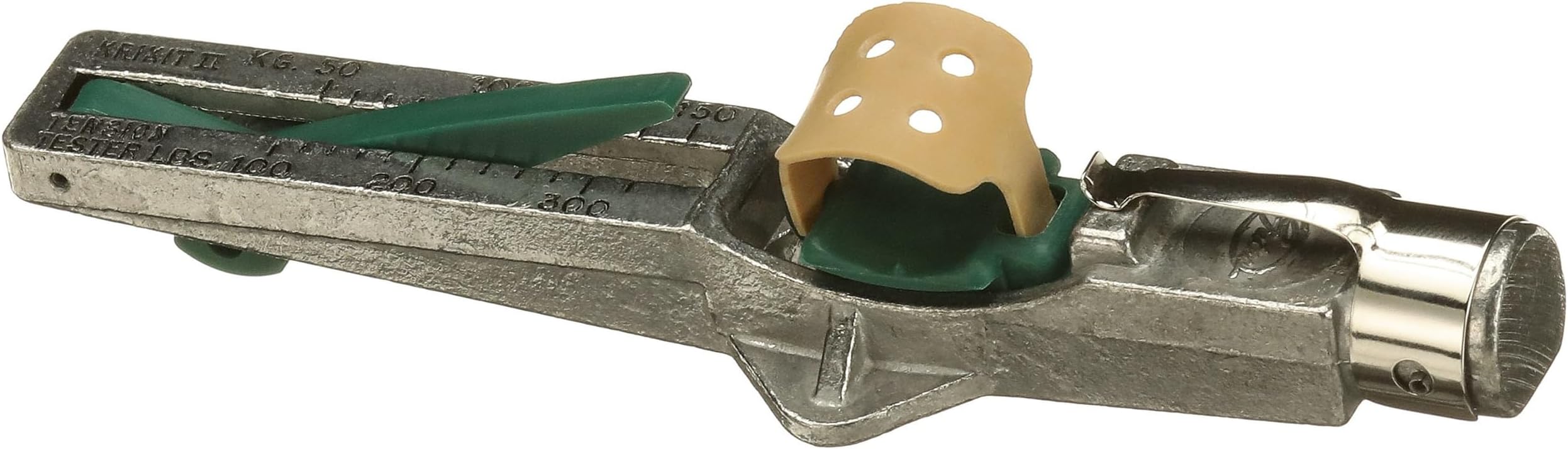
The Gates 91132 Krikit V Ribbed Belt Tension Gauge is a professional-grade tool designed for quick, precise measurement of V-ribbed belt tension on a wide range of vehicles. Featuring a bright green pressure pad and calibrated scale from 100 to 320 lb (50 to 150 kg), it supports belts up to eight ribs wide, ensuring optimal belt life and drive performance. Trusted by mechanics and fleet managers alike, it’s a must-have for maintaining vehicle reliability.


| ASIN | B000CRDLZM |
| Best Sellers Rank | #104,200 in Automotive ( See Top 100 in Automotive ) #1,449 in Diagnostic, Test & Measurement Tools |
| Brand | Gates |
| Brand Name | Gates |
| Customer Reviews | 4.4 out of 5 stars 701 Reviews |
| Global Trade Identification Number | 00072053006308 |
| Included Components | Gates 91132 Krikit V-Ribbed Belt Tension Gauge |
| Item Dimensions | 7 x 3 x 3 inches |
| Item Highlight | Replaces MP2242 93866 93874 KR2 09002 09003. Direct-fit OE-grade replacement. |
| Item Type Name | Gates 91132 Krikit V-Ribbed Belt Tension Gauge |
| Item dimensions L x W x H | 7 x 3 x 3 inches |
| Manufacturer | GATES |
| Material | Various |
| Material Type | Various |
| Model | 91132 |
| Number of Items | 1 |
| Number of Packs | 1 |
| Part Interchange Info | 91132 |
| Part Number | 91132 |
| UPC | 072053006308 |
| Unit Count | 1 Count |
| Warranty Description | Please contact retailer/seller for assistance |
R**B
No need for more expensive gauges.
The way this tool works is you put the arm of the tool in the down position, and then put the tool midway on the belt between two pulleys. Then push on the tool until you feel the click. Once you feel the click, you stop pushing tension on the belt with your finger and then look at the resulting measurement. The top of the moving arm (left of the picture in this product description) intersects with the scale of numbers engraved on the tool. Wherever that intersection point lies is the resulting belt tension number. I can tell the tool basically converts some level of belt deflection into a corresponding tension number. By applying the specified amount of tension (i.e. up to the point of the clicking noise of the tool), the belt has deflected a certain amount and the moving arm will only move up as much as the belt has deflected. So I would say the key aspect to this tool is when the clicking happens which assures when the appropriate amount of deflection has been applied and then to read the measurement thereafter. Very cool tool. The only possible ways I can see a wrong measurement occuring is if the user applies more force to the belt (after the clicking already happened) or if the clicking mechanism is out of calibration and clicks too early or too late (thereby applying too little or too much force to the belt to create a wrong measurement). I can't imagine the clicking being out of calibration as it looks like a very simple mechanism. So I would say this tool is very accurate almost all the time. I took a few readings of my belt and always got fairly consistent readings, maybe differing by plus/minus 10 lbs. I read in some forums where people would say they had no room to insert this tool, but the tool is only 5 inches long (shorter than most pens) and for the most part, if you have room to put your finger on a belt and be able to push on it, you will most likely be able to fit this tool there too. The tool has a rubber strap for your finger to help prevent you from dropping it while finding your way to the belt. Since it's so small, I might recommend you have one of those telescopic magnetic pick-up tools handy in case you drop it down in the engine compartment somewhere since the tool is that small (however, the only magnetic part of the krikit I got is on the pen clip). You should also be aware that the krikit model 91132 has a tension measurement range of 100-320 lbs while model 91107 has a lower range (30-160 lbs). My car ('03 G35) requires a new belt tension of greater than 200 lbs on one of the belts, so I got the 91132. I also wanted to comment on the other amazon user reviewer who mentioned the gauge was ineffective for him. I would have to say he likely has loose belts because the tool, in my opinion, is highly accurate if used correctly and it's kind of hard to use it incorrectly. But even with loose belts, you might never notice any noticeable squeeling...basically you can be lucky and never see a problem until the next belt change. I tried to cover as much as I can because I could never find anyone giving a detailed review of this product which would have helped me evaluate this product prior to buying it, but now that I have it and actually used it, I think it's a very handy gauge and anyone who needs to manually adjust their belt tension should get one. I know some people can tension their belts by feel or using some belt twisting rule of thumb, and that's how I used to do it too, but I get much peace of minding know that my belt is tensioned EXACTLY to specs.
F**C
Gates 91132 Krikit II belt tension gauge
Okay. Read reviews. Some complained it was hard to use, not accurate. I used this on my '01 Jeep XJ belt change. Once you figure out how to use it, it is actually a great tool for the stupid XJ 4.0 belt tentioner. As everyone that owns an XJ knows, you always under tighten the tensioner because you don't want to mess up pulley/water pump bearings. First tries without using the tensioner, that showed up today while I was doing the belt, was met with the squeal when I put the AC on. Used the tensioner, I was at about 180 lbs. Went to 190 lbs, squeal. Went to a hair over 200 lbs, no more squealing. This tool is very easy to use and tells you exactly where you need to be. Voltage was lower than it should have been due to a slipping 10-15 yo belt with cracks all over it. After with proper tension on the new belt, voltage is right where it should be and it increases voltage with more gas like it should. Note: If you think you have a bad battery and/or alternator, change your belt first and properly tension it with this tool!!!!! I could have saved a few hundred bucks if I had just did a belt change first.
J**N
Works perfect. Shipping just took a while
Works perfect. Only issue I had was shipping took going on a week longer than it originally claimed. Even after paying the extra 7 bucks for it faster
T**D
This worked perfect for changing the belts on my 2004 nissan pathfinder ...
This worked perfect for changing the belts on my 2004 nissan pathfinder LE. My belts had squealed a little bit over the past 3 years and it was one of those things that I was eternally going to get around to. I finally decided to do it after the squealing became worse. No youtube videos were available for my model or engine, but it looked straight forward enough and was easier than expected. You end up accessing everything from the bottom of the vehicle and work the belt around the fan. I checked the old belts before i took them off. they didn't even register on the tester, it would click below 100lbs. This wasn't a surprise since i knew they squealed and were loose. changed belts. used gauge to tension them. I had read somewhere to run engine for 5 minutes and then retest. I did and found i needed to tension them a bit more. double checked later in the day after letting belts cool again. Perfect tension still. My belts required upwards of 200lbs of tension so this version of the tester did the trick. for less than 100lbs you will need the other version as stated by other reviewers. I highly recommend getting this tool for your collection. Very well priced and much less than other testers.
B**N
A lot of Bang for a Little Buck!
I see that someone else here had a bad experience with this gauge. Gates makes several versions of this gauge for different tension ranges and belt styles. I can only vouch for the Krikit II (91132) version. Personally, I love it. I have found it to be very accurate. I had my belt professionally adjusted with a much more expensive (and admittedly, more impressive) gauge. I then put this belt tension gauge on it and tried it 3 times. Each time I came up with the same value and it was within a few pounds of what the mechanics gauge read. Well within any tolerance I would ever need. I've used it on other people's belts and it has worked well. You have to be a bit careful to keep it flat against the belt and it has to be mid span at the longest distance between pullies (which can be a pain on some vehicles). But it isn't rocket science either. I've used it on both V belts and Flat belts with great results. (It is not recommended for flat belts but hey! Works for me.) For $20 I am one happy camper! Highly recommended! I have recommended it to several friends and they are as happy as I am.
S**E
Good but zero instructions
Seems like it works but it didn't come with any instructions whatsoever. There's almost no way of telling how tight you need to have your belt since they didn't provide any guidelines or a sheet for instructions or any type of specs. Try looking online for any type of spec for this tool and it's almost impossible to find it. The company needs to provide some sort of spec sheet or chart so we know by the thickness of the belt what we should set the tension at.
M**L
Push slow, repeat in the same spot, dont accidentally knock the arm after taking a reading.
Works great for doing frontier 3.3 belts with manual tensioners. Make sure you go slow pushing till you hear the click, then stop and bring it out slowly so you dont move the arm. Measure it the same spot everytime got me roughly the same result. Within 5-8lbs.
W**N
Belt Tension Gauge
I've purchased 3 automotive belt tension gauges and this is the only reasonably priced gauge that works under $100. The measurements are in ft. lbs. which is correct for the tension or "Borroughs" measurement of a belt. ( maybe because Gates makes rubber composite fan belts.) The stick type gauge can also work but the O-rings tend to wear, slip from oil and grease or just get lost. Most other gauges also tend to measure in distance (inches) which is irrelevant for this application. The only way to get a meaningful value from a distance gradient like inches, would be to observe what this (or a >$100.00 gauge shows) and then matching that distance to ft. lbs. for subsequent use with one of these other gauges, ie: 1" = 12 ft. lbs. This gauge is also made of pot metal or pewter so it's sturdy and reliable for continued use which isn't that often.
Z**A
Top
Top alles gut .
A**O
Perfecto
Lo requerí para el cambio de la banda de mi auto todo bien!!!
R**A
Recomendada para mediciónes rápidas y precisas
La herramienta es buena y de calidad
L**C
Parfait pour la tension de ma moto Zero
Parfait fait son travail, mais attention la graduation commence à 50kg
B**C
Easy to use.
I went from a shaft drive motorcycle to a Spyder which is belt drive, so I required a belt tension tester. This one is talked about the most, so I purchased it. Delivery was on time, sturdy construction and simple to use. Worked as advertised. You should know that this type of tester comes in two different models, one for low belt tension and one for higher belt tension. Check your owner's manual to ensure you purchase the correct model.
Trustpilot
1 day ago
2 months ago