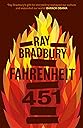
Fahrenheit 451 (Flamingo Modern Classics): The gripping and inspiring classic of dystopian science fiction
Product ID: 48033050
⏳Over 70 years of cultural impact
📚Timeless literary masterpiece
🔥Classic dystopian fire symbolism
Desertcart purchases this item on your behalf and handles shipping, customs, and support to Tunisia.
🔥 Ignite your mind with the book that predicted our future.
Fahrenheit 451 is Ray Bradbury’s seminal dystopian novel about a future society where firemen burn books to suppress dissenting ideas. Celebrated for its poetic prose and prophetic insight, it remains a top-ranked science fiction classic with over 58,000 reviews and enduring cultural influence across literature and film.
| Best Sellers Rank | 1,205 in Books ( See Top 100 in Books ) 4 in Science Fiction Short Stories 4 in Science Fiction History & Criticism 9 in TV, Movie, Video Game Adaptions |
| Customer Reviews | 4.2 out of 5 stars 59,517 Reviews |
J**R
Amazon's personal nightmare?
Fahrenheit 451 is one of my favourite books of all time. I read it again every now and then. With the passing of Bradbury, I read it yet again. Strange that I never fail to be blown away by the same 50,000 words. Fahrenheit offers a bleak, eerily prophetic outlook for the future. People, decent people, should be just slightly uneasy at Bradbury's vision. A world where firemen start fires, don't fight them and all to burn books. Fahrenheit 451, the temperature at which books burn. Is this Amazon's personal nightmare? A world in which hitting an old woman in the face "with amazing objectivity" is acceptable. When I first read Fahrenheit many years ago, I couldn't quite see future echoes of the world, my world, in it. In 2012, it's alarming to see how much nearer to this vision we have moved. We're not burning books. We might in fact be reading more voraciously than ever with the dawn of eBooks and eReaders and that's a good thing. The irony of the name Kindle though does not escape me. However we do talk less, staring at TVs more and talking about what we saw there, interacting with people by artificial means, all saying the same things, wanting everything in condensed wiki format so it's quick then on to the new thing whilst learning nothing, and it's worrying to read a science fiction that predicts this. The signs must have been there for a long time. Ray's understanding of technology of the time is instrumental but less important than his grasp of human nature. That is the truly worrying bent of this story. He does indeed hold up a mirror and make us take a long, hard look. Part of the beauty of Fahrenheit is this close-to-the-bone stab at reality. It's close enough to be uncomfortable and make you look around with a realisation that yes, this could be where we're heading. That's only part of the beauty though. Bradbury's writing is a joy to read for the quality of his prose. It's not what I would call easy reading and yet not either what I'd call complex. Sometimes a sentence is a paragraph long. If you were reading it aloud you'd run out of breath before you finished the line. It might even say what could be said in far fewer words but Bradbury's words are so beautifully juxtaposed and balanced that the length of a sentence is unimportant. You drink the words in and find that he might not even have said very much in a great many words, but the image and sense, the reality he creates, have become a tangible but distant fact in your mind. A horrifying understanding that these things might yet come to pass. Ray Bradbury is hailed as a master and quite rightly so. He would say of his own accord that not all of his work was of this standing. Certainly prolific, Bradbury advised writers to keep writing - you can't get it wrong every time and that strategy served him well. To turn out novels like Fahrenheit, even your least shining examples can't be so bad. Proliferation is one thing, but few writers have the talent of Bradbury to create like this. Read Fahrenheit 451. Challenge your perspective and fall in love with beautiful writing. You will want to read more, of anything, everything, both as a result of the concept and as influenced by the sheer joy of reading a really great novel. I have several copies of Fahrenheit. I may leave instruction that one is cremated with me. See who gets the irony.
P**T
Seen the film. Read the Book.
Fahrenheit 451by Ray Bradbury I have seen the acclaimed 1966 movie 'Fahrenheit 451' directed by Francois Truffaut many times. But this is the first time I have read the original novel by Ray Bradbury (August 22, 1920 - June 5, 2012),who was one of the most celebrated science fiction writers of the 20th century. His 1953 novel 'Fahrenhit 451', was set in a dystopian America, in which ignorance is enforced by law and firemen burn books. The title refers to the temperature at which paper burns. There are a number of surprising differences between the movie and the book. What was not a surprise was Bradbury's beautiful poetic prose. Here is the book's breath taking beginning. "It was a pleasure to burn. It was a special pleasure to see things eaten, to see things blackened and changed. With the brass nozzle in his fists, with this great python spitting its venomous kerosene upon the world, the blood pounded in his head, and his hands were the hands of some amazing conductor playing all the symphonies of blazing and burning to bring down the tatters and charcoal ruins of history. With his symbolic helmet numbered 451 on his stolid head, and his eyes all orange flame with the thought of what came next, he flicked the igniter and the house jumped up in a gorging fire that burned the evening sky red and yellow and black. He strode in a swarm of fireflies. He wanted above all, like the old joke, to shove a marshmallow on a stick in the furnace, while the flapping pigeon-winged books died on the porch and lawn of the house. While the books went up in sparkling whirls and blew away on a wind turned dark with burning." The most obvious differences between the film and the book are the least important. The movie is set in Britain and not America and there is no nuclear attack. And there is no robot for hound in the movie. They just end no have the special effects to make it look real then. A prop hound was made for the film, but the director thought it looked rubbish and it up to much time to get it ready for each shot, so it not used. Howeber, the big difference is the central problem. Which is why do firemen burn books. In the movie all books and all reading as been banned. No one seems to be able to read. Not so in the novel. The problem is people can still read certain things. "Comic books" "Technical scientific journals" and "trade papers" are still read. There are even rewritten history books. What is banned are novels, politics, philosophy, religion, and poetry. There are no books that will make people think. Any book that could possibly upset anyone for any reason must be burnt. Can you see where this is going. When Montag, the book's central character witnesses a women choose to go up in flames with her library, he has a crisis of conscience. The Fire Cheif Beatty, gives him a pep talk. And he tells Montag how they got to be where they are; "Magazines became a nice blend of vanilla tapioca. Books, so the damned snobbish critics said, were dishwater. No wonder books stopped selling, the critics said. But the public, knowing what it wanted, spinning happily, let the comic-books survive. And the three-dimensional sex-magazines, of course. There you have it, Montag. It didn’t come from the Government down. There was no dictum, no declaration, no censorship, to start with, no! Technology, mass exploitation, and minority pressure carried the trick, thank God. Today, thanks to them, you can stay happy all the time, you are allowed to read comics, the good old confessions, or trade-journals... Give the people contests they win by remembering the words to more popular songs or the names of state capitals or how much corn Iowa grew last year. Cram them full of non-combustible data, chock them so damned full of “facts” they feel stuffed, but absolutely “brilliant” with information. Then they’ll feel they’re thinking, they’ll get a sense of motion without moving. And they’ll be happy, because facts of that sort don’t change. Don’t give them any slippery stuff like philosophy or sociology to tie things up with. That way lies melancholy... I hope I’ve clarified things. The important thing for you to remember, Montag, is we’re the Happiness Boys, the Dixie Duo, you and I and the others. We stand against the small tide of those who want to make everyone unhappy with conflicting theory and thought. We have our fingers in the dyke. Hold steady. Don’t let the torrent of melancholy and drear philosophy drown our world. We depend on you. I don’t think you realize how important you are, to our happy world as it stands now.’ There you have it the road to dystopia was not hammered with a iron fist, but gently laid with the gloved hand of market forces, mindfulness, and the right to happiness. It sound all too plausible and prescient. After Montag breaks with his conditioning, he joins a group of social outcasts called "The Book People". In order to preserve the literature and wisdom of humanity each Book Person commi
C**E
More like a short story than a novel
This short novel was adapted from five short stories by the author, and to be honest, it shows. The characters are not well developed, there are no sub plots and the progression of the story was predictable. The only interesting and likeable character, Clarisse, unexplainably disappears a third of the way into the novel and is never seen again (the author admits in the introduction that he should have given Clarisse a proper ending). As a book lover, I did enjoy the musings on the nature and value of books, and their effects on society both good and bad, but it did still feel like more of a short story or even an essay than a complete novel. Rather than making me think, I felt like the whole book debate and all its arguments were just handed to the reader on a plate. Funnily enough I actually enjoyed the final 20% of the book the most, when it became the story of an outcast running from the law in a post-apocalyptic world; that was the only point at which I felt any tension because the ending was the only part that wasn’t predictable, and I didn’t know whether Guy would be captured or not. I wish the novel had been extended to show what happened after the city is bombed, and how the men slowly re-introduce literacy, because that was the part I felt most intrigued about. I’m glad I read it because it’s a classic, but it’s a strange book and the structure and pacing didn’t work for a novel.
B**O
A poetic awakening
Unlike some classics, this book manages to convey a message, despite its sometimes complex wording. It felt like reading a long poem, where a powerful message awaits to be perceived. There is no doubt this book has impacted my perception of life, falling into my lap at a moment that feels intentional and inevitable, causing a paradigm shift that unnerved me whilst grounding me. I hope to revisit this book in the future, to perhaps come away with something new, or even reaffirm what I take away from it now. This beautiful book that I have sat with and absorbed over the last month. Quote: "Do your own bit of saving, and if you drown, at least die knowing you were headed for shore."
H**N
Intriguing and ahead of it’s time
Guy Montag is a Fireman and in this dystopian version of America books are banned and his job is to burn them whenever someone is found in possession of any. Montag has never had cause to question his job, and actually quite enjoys what he does, until he meets Clarisse and events start to spiral out of control. I’ve never read any Ray Bradbury before but I’ve often seen “Fahrenheit 451” on those lists of books you really should read. I hadn’t realised how short this was until I downloaded it and saw the page count and I do think it suffered from being so short. I would have loved to see more of how the world got into the position it was in, maybe through flashbacks or something, and of course I was left dying to know what happens next. That is my only real complaint though and let’s face it, it’s not a bad problem to have. Certainly better than when the book is too long and you wish it would end! There were a lot of parts that reminded me of the way things are right now. This is a world where people live in houses with screens the size of their walls that run shows that people refer to as their “families” and these screens are how they get any news about the world, which is obviously only the news the Government wants you to hear. This definitely made me think of people’s obsession with reality TV and social media. In Bradbury’s world the people think they’re happy because they’re not being challenged in any way or forced to think about anything. Everything becomes disposable to them. Montag’s wife, Mildred, has a friend who is on her third marriage and says if her current husband dies in the war she’ll just move on to a fourth. There also seem to be a lot of wars, which reminded me a bit of “1984” and how Big Brother used war to control the masses. Bradbury got me thinking a lot about what I would do if I wasn’t allowed to read or own books anymore and I would obviously massively struggle with this. Books are a huge part of my life and I find the idea of banning them completely unfathomable. I am often aware, however, that reading has become a bit of a dying past time. A lot of my friends wouldn’t dream of picking up a book, I know lots of kids think reading is “boring” and it is definitely concerning that maybe nobody would have to ban books specifically if everyone just stops reading. Although I have heard that during this current lockdown situation more people are turning back to books to help keep them occupied, which absolutely fills my heart with joy. I enjoyed Bradbury’s writing style. He throws you straight into this world he has built for Montag to inhabit, where everything is very mechanical but there were a lot of good things about it, fireproof houses in particular would be amazing. The idea of “The Hound” a mechanical beast that could be set to your specific biological signature and hunt you down was a little disconcerting, I’m not gonna lie. It was also interesting to see the almost amnesia like state that the characters live in. Their memories inn general are terrible and I wonder if this is because it is reading and using your imagination that keeps your brain functioning and as they have stopped doing that it’s making it hard for them to remember things. Overall, I’m really glad that I gave this a try and I will definitely be checking out some more of Bradbury‘s work in the future.
L**L
The prescient view of Science Fiction writers
I have been re-reading some earlier SF classics, - most recently, Ray Bradbury's Fahrenheit 451. Bradbury may not be writing such well crafted complex characters as some heavyweight literary SF writers like John Wyndham or H.G.Wells, and the plot of this itself may even be a bit sparse or creaky, but my goodness, I am shocked and chilled and awed by how much of today's culture Bradbury was predicting 60 years ago Reality TV where we all become content not only to watch others living, rather than living ourselves, but, no doubt, the next step arriving very soon where our TV becomes interactive and we ourselves yet inserted as bit players in the soaps we watch, or software that inserts our names into live TV, so that the TV talks directly to us, with announcers addressing us directly. Then we can live even less. He seems to have mainlined into the fact that we have dumbed culture down, his description of the way people talk to each other so that actually they are not talking about anything at all seems unnervingly like the and then he said, he was like, it was, you know, like, it was, yeah, no, know what I mean? You hear these conversations all around, more and more being said without any meaning: `People don't talk about anything'...'They name a lot of cars or clothes or swimming pools and say how swell! But they all say the same things and nobody says anything different from anyone else' He predicts also the worst excesses of PC speak, and puts his finger neatly on the button of our expectation of happiness as a right, our inability to come to terms with the fact that pain and suffering are a real part of embodiment, of living in a world of matter. The best, the justest, the fairest society will not be able to end our personal suffering `Ask yourself, what do we want in this country, above all? People want to be happy, isn't that right? Haven't you heard it all your life? I want to be happy, people say. Well, aren't they? Don't we keep them moving, don't we give them fun? That's all we live for, isn't it? For pleasure, for titillation? And you must admit our culture provides plenty of these' I was shaking my head in amazement at the accurate identification of our can't be still, can't reflect society which settles for circuses (never mind the bread) and drinks, drugs, medicates, and buys its way out of having to acknowledge that pain is an unavoidable part of life itself - we will grow old (if we are that lucky) we will have to manage the loss, at some point, of those we love, and we too will die. There is more - a society which cannot deal with complexity, with the fact there may not always be an obvious right and an obvious wrong, and this too, we cannot bear. One of the great challenges are situations where whatever action is taken, it will not be without some great cost, and yet we have to take some action. How do we live without the comfortable and childish security of a world which is black OR white, but confusingly, and therefore far more challengingly, ever more subtle complexities of both: `If you don't want a man unhappy politically, don't give him two sides to a question to worry him; give him one. Better yet, give him none'. And, seeing ahead to the vapid game show, where factual knowledge gives us the illusion we have intelligence and wisdom `Give the people contests they win by remembering the words to more popular songs or the names of state capitals or how much corn Iowa grew last year. Cram them full of non-combustible data, chock them so full of facts they feel stuffed, but absolutely brilliant with information. Then they'll feel they're thinking, they'll get a sense of motion without moving" He talks also about our inability to bear silence - everyone cushioned from the world by their own blare of noise wall to wall music piped into our heads, children plonked in front of the pabulum TV, learning early to be passive not interactive, - even the fashion for elective caesarians on non-medical grounds. What makes this book so powerful still is the fact that so much of its dystopian vision is the way our lives actually are; not in fact so much `science fiction' after all, rather a sociological analysis I had forgotten how good this was - much more than the shocking concept of burning of books by an authoritarian society, bent on infantilising its peoples, targeting literature as an enemy because literature (unless purely escapist) encourages thought, and presents us with complexity, debate and challenge.
S**E
Simple and well paced!
It's not everyday that I get easily sucked into a book to the point that I actually read the thing in one sitting. I am admittedly one of those people who struggle to read for long periods of time. But there has been a few odd occasions where my primitive little brain has a spark go off and I sit there for a few hours until I'm done. The most recent books that encouraged this behaviour was Fahrenheit 451, a book Amazon recommended after a similar quite binge of 1984. Fahrenheit 451 is a book written by Ray Bradbury. The novel was originally published in 1953 and from what I've read, this is generally considered his most famous and most popular book. The story is about a dystopian future where books have been completely outlawed. They have been known to bring out the worst in people by producing unhappiness and stupid behaviour. To combat this problem, the "firemen" are tasked with finding each piece of literature. When they find it, they immediately destroy it and the housing of those who owned them. We follow one of the "firemen" called Guy Montag. This poor fellow becomes disillusioned with his job after becoming friends with a young rebellious teenage girl. She encourages him to question everything, teaches him to start enjoying the simple things in life and this results in Montag committing himself to preserving all forms of literature. The plot of the book is reasonably simple and is very easy to understand. I thought Ray Bradbury did a great job making poor Guy sympathetic. The world in which he lives, it truly sounds depressing, full of mindless humanoids staring at television screens and void of uniqueness (just like 2020). The book doesn't take long to introduce you to the important characters. Each character is quite unique and has just enough detail to help move the plot along at a very quick pace. Before you know it, everything is (literally) up in flames and the story becomes a bit of a rush. I really enjoyed the world in which Fahrenheit 451 takes place. It's very clear that this novel could have been more in depth and it would certainly have been interesting. I would love to know more about the political structure of this version of America, as an example. With no offense to Bradbury intended, It makes me wonder what a more talented writer could do with this material. It's a very good concept, it has great characters and a very interesting setting. It has the potential to be so much more than it is. But as good as that sounds, if we got that kind of detail, It would quite simply murder the pacing of the book. A quality I quite enjoyed. Sometimes less is more. It at least encourages us to use our imagination more. That's never a bad thing. Fahrenheit 451 is a very easy book to read and if you've just read 1984 like myself, you'll want to pick this one. It's not quite as well written from a technical stand point as say 1984 but it's very imaginative story that I really enjoyed. I highly recommend a copy of this book.
R**E
Burning books is a chilling warning
I read this novel many decades ago during my early twenties when I devoured endless sci-fi by all the masters, including Ray Bradbury. Yes, it’s a classic novel but being honest this was never my favourite Bradbury – that would be Something Wicked This Way Comes. I've recently re-read the book and re-discovered its depth and complexity. I was pleased to re-discover elements that I had forgotten, like the Mechanical Hound, probably because it scared me as it did Montag as he fled from it and his old life as a fireman burning books. However, the concept of a world where books were burnt and the media controlled people has become frighteningly true. The concept of people finding a way for books to survive resonated with me, and has drawn me to similar books since. Therefore, I had to relive the horror of a ‘bookless world’ that Ray Bradbury captured in his words. The danger is real and always there; although we have reached the point that the media is controlled as well. The story never lets up and the writing keeps pace with the nightmare. I felt that there was no hope for the wife he leaves to her drugs, fake friends, and shrinking lives – echoed in so much all around us today. As a reader, I became Montag and desperately prayed for his escape, unable to remember the ending. It was also good to read some of Bradbury's background and thoughts on the book in the prefaces, written over the years. He explains how the book was created and that it was written in a very short time at the beginning of his career. So, is four stars me the jaded adult being mean? Not when I would give his later books five. Am I doing the master a disservice? Or perhaps I am letting another version of Fahrenheit 451 colour my vision – Francois Truffaut’s 1966 film, which focuses on elements of the book. However, I always feel that in the short time available that a filmmaker cannot capture all the complexity of a novel, so to me Truffaut did an excellent job. The film became a separate creation - a remediation. Fahrenheit 451, the book will always be where the horror and the warning began. 4.5 stars then.
C**E
A classic!
Amazing read!
Ö**N
Distopya Şaheseri
Ray Bradbury'nin yakın gelecekteki korkulara ilişkin kaleme aldığı baş yapıtı.
I**T
Livre
Impeccable
G**D
Perfect product
Quick delivery, well packed, products as displayed, very pleased!😁
S**C
I really liked it
I really liked the book. And this particular one was just enjoyable to read, with a beautiful cover and all.
Trustpilot
1 month ago
1 month ago