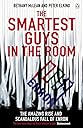
The Smartest Guys in the Room: The Amazing Rise and Scandalous Fall of Enron
Description
What went wrong with American business at the end of the 20th century? Until the spring of 2001, Enron epitomized the triumph of the New Economy. Feared by rivals, worshipped by investors, Enron seemingly could do no wrong. Its profits rose every year; its stock price surged ever upward; its leaders were hailed as visionaries. Then a young Fortune writer, Bethany McLean, wrote an article posing a simple question - how, exactly, does Enron make its money? Within a year Enron was facing humiliation and bankruptcy, the largest in US history, which caused Americans to lose faith in a system that rewarded top insiders with millions of dollars, while small investors lost everything. It was revealed that Enron was a company whose business was an illusion, an illusion that Wall Street was willing to accept even though they knew what the real truth was. This book - fully updated for the paperback - tells the extraordinary story of Enron's fall.
Specifications
| Dimensions | 13 x 3 x 19.7 cm |
| Edition | New Ed |
| Isbn 10 | 0141011459 |
| Isbn 13 | 978-0141011455 |
| Item Weight | 336 g |
| Language | English |
| Print Length | 480 pages |
| Publication Date | 30 Sept. 2004 |
| Publisher | Penguin |
Reviews
User
Barbarians in the Accounting Department
This is a great book about a truly remarkable part of our economic history. I have a minor physical complaint I might as well get off my chest: In their desire to make sure readers get bang for buck (fear not: you do), the publishers have elected to set this book in miniscule type, meaning firstly that you may need reading glasses if not before then after reading it, and secondly that while this looks like a 400 page book, if it were ordinarily typeset it would have the heft of an MM Kaye novel.On the other hand, if over-length in a business book is the sort of thing that dissuades you, don't let it: this is one of the most riveting books on the history of finance you'll read, and it gets more and more addictive the further you go on.As a number of reviewers have noted, it is simply staggering that Enron can have ever got where it got to at all, let alone stayed there for the best part of a decade, with all the ostenisble checks and balances that sophisticated capital markets provide. Staggering. In checks and balances I don't mean regulators, who will always be the last ones to find out where market-based moral turpitude is concerned, but investors, stock analysts, brokers, lenders, rating agencies and fund managers: people who don't just earn huge remuneration, but stake their reputations on being sceptical in the face of unconvincing bluster.But as McLean and Elkind make clear in chapter after chapter, barely disguised and unconvinving bluster was, in large part, all Enron was. For all the "black box" accounting, it is simply inconceivable that Enron's true internal wiring could be kept anything like properly secret, since far too many people had to know about it. Internal and external to Enron there must have been junior lawyers, accountants, auditors, traders and marketers who all had to know what was going on, and people *do* talk: they gossip, they change jobs, they make inappropriate remarks. What's more, the existence (if not the detail) of many of the more toxic situations - the LJM Partnerships, the prepay contracts - were on the public record, so the burning question to my mind, which McLean and Elkind do not address, isn't so much how people could have been so greedy and deceitful (that's not hard to understand at all), but what sociological and psychological factors caused everyone else, collectively, to entirely suspend the critical faculties which they used to evaluate risks in the market. This is no idle query: accurately calibrating and understanding risk is the very key to making money on Wall Street: it's hardly an incidental oversight.Making a pejorative moral assessment of the acts of the Skillings and Lays with the benefit of hindsight is futile, self-serving, and actually unjust: our moral view of corporate behaviour *today* is conditioned and informed by the example of Enron; before Enron, our moral view was ipso facto different - if it hadn't been, Enron couldn't have happened.If we assume that, in the context of the markets, "moral consensus" is aimed at making sure people don't needlessly mislead, deceive or unfairly disadvantage each other, the far more interesting question is *how could the prevailing moral framework have failed so badly*? Why was it so inadequate at dealing with outcomes of actions we can now see (with the benefit of hindsight and our newly adjusted moral binoculars) are transparently odious?And that prompts a deeper question yet: what could it be about *our* prevailing economic mores which could allow a disaster on a similar scale to happen again?Had Elkind and MacLean ventured into that territory this would have been an outstanding book (it is still worth 5 stars in my view): as it was - and with an admirable absence of judgmental prurience - the writers stick to pure reportage, to the point where the epilogue ends rather abruptly without so much as a conclusion.But that's small beer: this is a fascinating, rewarding read.Olly Buxton
User
A non-technical, tragic story, with modern implications...
I read the book a lot quicker than I expected too. The book goes through the operations and accounting for Enron, and explains in simple terms what the company did to go so wrong as to go out of business, with widespread implications. But again, like many stories involving American market trading and accounting methods, it seems lessons haven't really been learnt from the event.The bulk of what is in the book is more than enough ammunition to level fair criticism at many aspects of the financial sector of the US, but there is a lot of interesting and passionate character studies within the book too. A slight criticism from me would be that many people are written as two-dimensional in many respects, which I suspect is embellished. From experience people don't tend to be so neatly fitting into 'types', although I'm willing to except Enron wasn't a normal place to work, for many reasons.There is a good and necessary criticism at regulators, internal and external, and credit-rating agencies and analysts for being too respectful and too paid up to criticise the company throughout it's decline, which is surely food for thought for anyone going forward. But given when happened on a much larger scale roughly half a decade later, it wasn't enough time for anyone to stop a much larger crash. It is interesting the book didn't discuss or deal with 'bail-out', from memory, so it appears no one was willing to prop the company up.Another intersting reflection on the personnel side of the company was how many people in positions of power at Enron seemed so 'normal', without much citation of talent necessary to work at a level where billions of pounds is at stake. A very good read.
User
Read this and weep for mankind
The first thing to say about this book is that it is superb. Superbly researched and superbly written. The pace never falters and, whilst one knows the ending, the tension builds as the tsunami of misdeeds builds and builds before finally crashing down on the famous three, Lay, Skilling and Fastow. The numbers are extraordinary. Personal enrichment isn't in the hundreds of thousands of dollars, or even millions - it's in the tens of millions. Not just life changing amounts of money, but enough to change the lives of descendants of these three for many generations. The book ends before the story does . The congressional hearings and court cases aren't covered but nevertheless this is a must read for anyone wanting to understand why light touch regulation, so in vogue in the run up to the 2008 banking collapse, will never be adequate protection for the poor, the powerless and the unwitting.
User
What a good book!
Just when you think the authors have revealed the most outrageous anecdote or ridiculous scheme or pathological behaviour, they pull yet another out of the seemingly bottomless pit that was Enron. The book is a detailed semi-chronological account of Enron from ‘cradle to grave’. However, the authors enrich and colour the story by giving in-depth descriptions of the members of Enron management, and by dropping in helpful context from elsewhere in the timeline. One can only imagine the pains the authors went to to synthesize and rationalize dozens of interviews and thousands of documents spanning over 15 years of one the most opaque and counter-intuitive businesses ever to have existed! The result is readable, understandable and enjoyable. An expert piece of journalism.
User
A good account albeit probably longer than needed
Overall I would say this provides a very detailed account of the history of Enron and what happened to cause its collapse. While I was aware high level of the Enron fraud, I didn’t really have any detail on what happened - this book certainly fills the gaps.Firstly, just a warning, the text size is small and pages are full, so it’s a pretty long read (my heart sank a little when I first opened it and saw the text size!).The book is clearly a product of a tremendous level of research - there is an awful lot of detail in here of the different businesses / deals and ‘characters’. I do think however at times it is too detailed - you really have to ‘keep at’ this book to get through it and I think it would be just as effective even if it was a third shorter.The level of complexity of the book I would think is accessible for most readers (some of the structures talked about are complex so will always be hard to understand for anyone).Having read the book it’s really interesting to see how a culture is led downhill and bad behaviour spirals to the point where it’s normalised behaviour in the company, the end result being shocking.At the start of the book the authors seemed to be taking issue with mark-to-market accounting as a principle which I found annoying (later on it was more clear that what they actually were referring to was the misuse of it as Enron it seems frequently did).I did find the book interesting hence the 4 stars (I debated between 3 and 4) but ultimately think I would have enjoyed it more and been no worse off if it were shorter!
User
Required reading - a classic
I can't add much to the reviews already here, but wanted to say that this book is still as important & what's more a gripping read in 2008/09 as it was when the Enron scandal was still fesh in people's minds.Like 'when genius failed' - another excellent book - the circumstances of this story are as relevant today as they ever were and the lessons should not be forgotten. We might be in a bear market now, but the bulls (and bubbles) will return.The books is excellently written, well-researched and does a great job of explaining a very complex accounting structure in a way that a layperson can grasp the basics of.
User
Corporate Slog
I'm about 25% through and it's dragging along. Really detailed descriptions of corporate excess and corrosive management but it lacks a narrative through time, from Enron's start to finish.That said it is a description of all that is bad in American capitalism, where there's never enough profit, the Wall Street mantra is grow our die and none cares about the long term future.Pretty depressing.
User
Brilliant book - couldn't put it down!
This book is a fabulous read. The story is so well written that it propels you along the upward spiral with such energy and drags you down hard with the shocking end (even though one already knows the ending).Yes it can be complex but it is not unfathomable by any means (I do have a business background but am not an accountant). It is important to understand such a multi-layered build up of 'success' for Enron as it helps to explain the sheer scale of the meltdown, the biggest corporate bankruptcy ever...apart from WorldCom and Lehman Brothers which followed.I would wholeheartedly recommend this book - if it were fiction it would be unbelievable.
User
No todo vale para ganar
Muy interesante libro que refleja la caída de un imperio energético (y financiero) así como el final de una era. Si no fuera porque los protagonistas vulneraron sistemáticamente la ley con muchas de sus decisiones (y su desmedida ambición), casi se podría sentir admiración por ellos. No todo vale en esta vida para ganar y este libro sirve un ejemplo paradigmático.
User
Excellent, detailed account of the Enron scandal
This outstanding, detailed and methodically researched book gives a blow by blow account of Enron in its glory days and Its eventual downfall. Highly recommend.
User
J-SOX 本よりずっと役に立つ
SOX 法が作られる元となったエンロン事件のドキュメンタリー。J-SOX法は、さまざまな内部統制のプロセスを実装することを要求するが、本書を読むと実はエンロンはその多くのプロセスを実は持っていたことがわかる。ただ、プロセスは、このような事件を起こすことを防げるわけではなかった。J-SOX 法の対策がおわったら、次に何を行うべきか。いろいろなヒントが詰まっていると思う。実務の話はここまでとしても、単純に人間関係のドキュメントとしても、一級品である。映画は日本語字幕つきで DVD になっているものの、本書の翻訳はまだのようだ。一刻も早く翻訳が出てほしいと思う。
User
Excellent Book
The Smartest Guys In the Room is a well-written, well-researched to unravel the financial and operational irregularities that led to Enron’s bankruptcy. It’s a compelling (and sometimes soapy) indictment of the worst side of business. Must read for all audit professionals
User
The rise and fall of Enron
It is easy to read, even for people with no financial background. I sometimes miss a little more detail about their accounting practices but understand that this might be tough to read for others. All in all, it explains very well what and why things went so terribly wrong with Enron.
Common Questions
Trustpilot