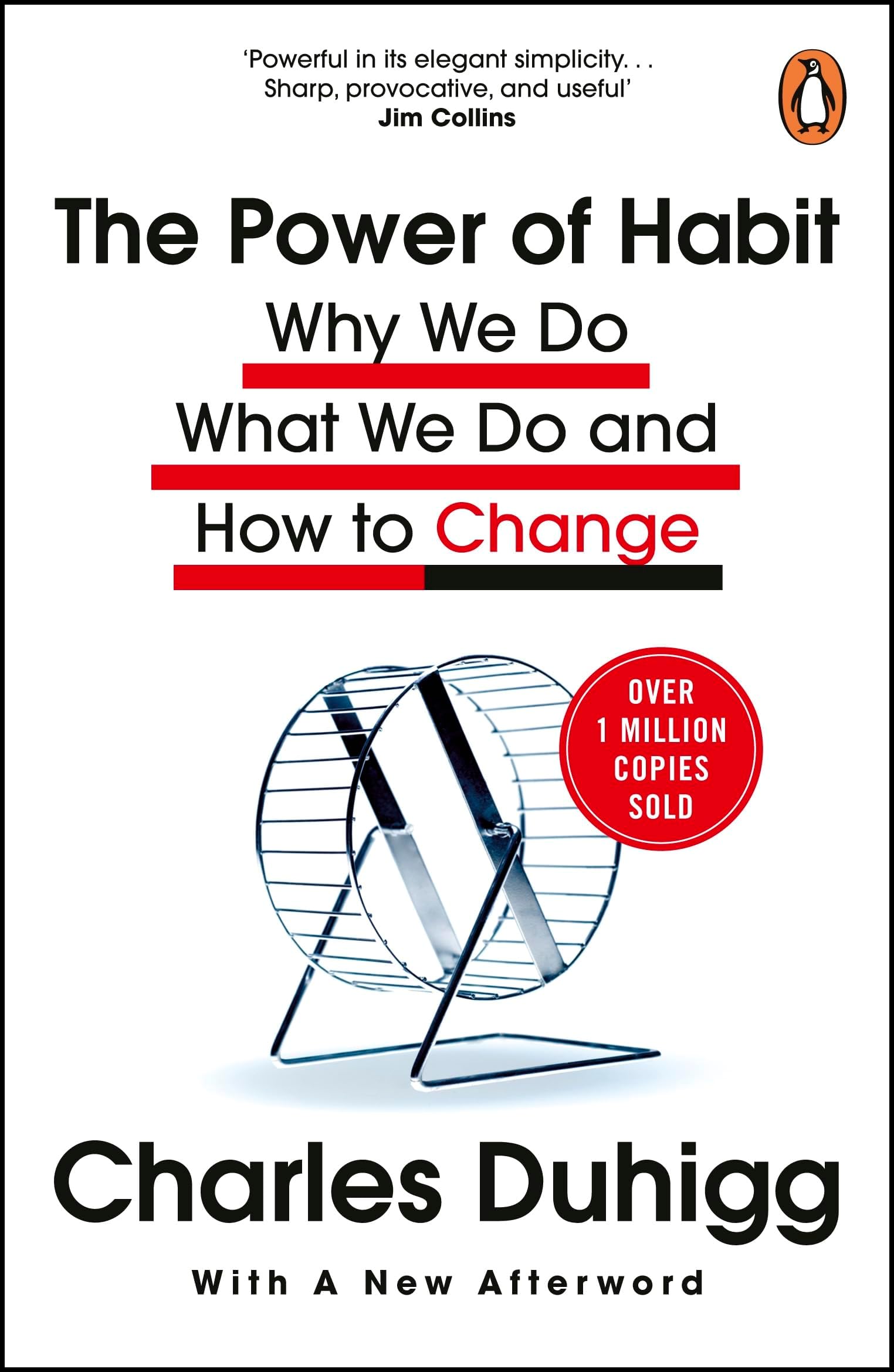
The Power of Habit: Why We Do What We Do, and How to Change from the Award-Winning Journalist
Product ID: 48377387
🏆Top 5 in Compulsive Behaviour
📊4.5⭐ avg rating
📚38,857 reviews
Desertcart purchases this item on your behalf and handles shipping, customs, and support to Tunisia.
🔄 Transform your routines, transform your life!
The Power of Habit by Charles Duhigg is a bestselling, scientifically grounded exploration of how habits form and how they can be changed. With 4.5 stars from nearly 39,000 readers, this award-winning journalist reveals the neuroscience behind habits and shares compelling real-world examples from elite athletes, CEOs, and social leaders. Ideal for professionals seeking to optimize productivity, wellbeing, and organizational success through actionable insights into human behavior.


| Best Sellers Rank | 9,522 in Books ( See Top 100 in Books ) 2 in Compulsive Behaviour 164 in Psychological Schools of Thought 191 in Popular Psychology |
| Customer Reviews | 4.5 out of 5 stars 38,936 Reviews |
A**T
Insightful and cleverly written with some great revelations inside
Through the slow, incremental work of science we are diligently reverse engineering our aeon-old soft and hardware to arrive at deep insights into how we tick. In The Power of Habit Charles Duhigg uses his considerable journalistic skills of brevity and story-telling to take us inside how we build some of our most common psychological routines. Like a container ship ploughing the world's oceans can't help pick up a community of marine fauna, our minds, scything through an ocean of experience, get stuck with a seething mass of often chaotic, sometimes damaging, habits. Turns out the ones we often focus on, the bad ones, are simply a particular species of a panoply of simple cue-routine-reward cycles that means we can get from one complex task to the next without blowing mental gaskets. Which means, basically, much of our daily experience is constructed from habits, or, as the more-quoted business aphorism goes, we are indeed, '...what we repeatedly do.' We develop habits because we only have a limited strip of deep thinking neocortex wrapped around the outer edges of our brains and if this was constantly used for every response we would very soon run out of gigabytes to think with. Habits are small sub-routines downloaded into the deeper, more primitive parts of our brain when we have mastered a skill or process. They are initiated virtually automatically by a cue, involve a repeat behaviour - routine - and always finish up with a reward, which serves to reinforce them. Without habits, brushing your teeth or tying your shoelaces would absorb your attention fully and there'd be no thinking space left to plan the day ahead. So, knowing that these automatic thinking routines stick in our brains like those barnacles on a ship, we need to attend very carefully to the ones we let stick around. Most habits are about simple efficiency, taking learnt things and clearing our mind space so new things can be taken on board and some are overwhelming good, like the habit of exercise or reading daily. It is the conscious choice to adapt your habits and look at your behaviours in a new light that this book provides which is so very helpful. Select any habit, good or bad, and you can forensically unpack it, unpicking its antecedents and understanding its triggers before, armed with this knowledge, you can go at the wild garden of your psychology with the pruning shears. Habits are everywhere and they can be tamed and beaten, even some of the really damaging ones, if we explore the cues and the rewards that drive them, replacing the unwanted routines they set us unthinkingly performing. And this is the most powerful insight of this book, the opportunity it gives us to gain a deep insight into our worst habits and bring them within the scope of our will through that awareness. The way to do this, break the cycle, involves using the cue and delivering the reward, but changing the routine in the middle. It also means using an experimental approach to your own psychological reactions and trying out solutions that might move you forward. The author uses an example of how he tried to tackle a new habit that arose whilst he was writing the book. The habit involved getting up mid-afternoon from his desk at work and wondering down to the cafeteria, having a chat with co-workers over a coffee and eating a chocolate cookie. These additional calories five times a week inevitably caused him to put on a few pounds, so he reverse-engineered the cycle and tried to understand this new and irritating habit from the inside out. He decided that the cue was the need to stretch his legs after a long afternoon of working and after some failed attempts to prevent the purchase of the cookie, that the reward wasn't actually the chocolatey snack, but the social connection he gained with his co-workers. Once the cue and reward were nailed, he just needed to amend the routine in the middle which he did by making sure he packed enough fruit to replace the biscuit as he went through the habit of going to the cafeteria and meeting up with co-workers. So, in a sense, the habit remained via the cue and the reward, but he'd just changed the automatic and slightly damaging routine in the middle of it. A book full of powerful insights into how our minds work and it also has sections dealing with the organisational habits of large businesses and how these can be maximised for the benefit of the company. It also goes onto the explore in its least convincing section how paradigm shifts in social values can be driven by processes as automatic as habits. Intelligent, readable and insightful and therefore highly recommended. ***** 5 stars
P**E
Less 'habit' - but plenty of psychological goodness!
A thorough (and well researched) psychological romp through the subconscious machinations... tenuously held together by the vague term "habit". Whilst the title and tag-line implies it's akin to the saturated backlog of books promising to 'transform your [career / relationships / life / chronic nose hair]' that make you want to stab your eyes out with the nearest writing utensil... this is anything but. It makes no attempt to preach a 'model', but simply reports a vast swathe of psychology and decision-making which outline a curious framework for your understanding. The one (and only) bone I have to pick is that 'habit' feels like a slight misnomer with this book. It ends up being used as an umbrella term for "anything subconscious"... be it willpower, motivation or preferences. Truth be told, the core meat of how habits form, function and are malleable are covered within the first chapter or two. The rest is more social psychology, management and advertising. You hear how Target explored and perfected its data algorithms to identify pregnant women (and subtly masked this knowledge from them) - then get a "and from this we can see how habits can be formed" shoe-horned in to bring the topic back to the fore. Not that any of these other topics are disinteresting or poorly written, but it felt a bit directionless at times. More a compendium of fascinating psychological findings than a structured flow. It's thorough, but there's a few points I craved a bit more exploration of the idea (and its applications). But that is where the critique ends. If you disassociate the idea that this is a psychological guide on habit forming / breaking... but simply a broader, superbly researched journey through various aspects of the subconscious; how they work and how others try to tap into them... Then it's a superb read suitable for anyone craving a deeper understanding of psychology. It's well paced and warmly engaging, even if somewhat soul destroying reading about how companies abuse psychological quirks to take advantage of others. One thing to bear in mind is that this is written by a skilled reporter, not a doctor or life "coach". In other words, the tone isn't like a model/prescription to apply to make things better... but more a reporting of facts, outcomes and decisions for you to make of what you will. Not necessarily a bad thing, mind you! The writing is also perfectly balanced to be scientific, yet approachable. So a pleasant surprise indeed. A welcome, though not quite astounding, entry to any psychological bookshelf.
M**S
How to change your bad habits
I know my good, bad and ugly habits. Just never understood clearly how to make a lasting change for the better. The Power of Habit comes with excellent case studies, of which some has caused deaths as a result of bad habits. Or worse, people acting out of incompetence or refusing to change, thereby causing themselves and/or others harm. I know what habits I need to change. And Charles Duhigg has showed me the path to change, without lecturing or patronising, but being gentle. Keep reading to the end of this book, as it comes with practical suggestions for how you can change your bad habits.
A**T
Loved it.
I read the first half of this book about 10 years ago and then stopped because I got bored. I reread it and finished it in about 3 days just now, and I’m so pleased I got to the end. Habits are like water to fish. Invisible. But, they are the difference between having everything and nothing. I hope I can continue to cultivate good habits and get rid of my bad habits. And you too :)
S**T
Excellent exposé on how habits rule us
Duhigg writes a compelling argument in how habits rule us. I've done a lot of personal development, Tony Robbins etc, and feel I have a lot more willpower than I've ever had. However, I was often beating myself up about several habits I wasn't able to inculcate or things I wasn't able to do. This book helped me look at myself more compassionately. It made me realise that actually every single day was pretty much the exact same rehash. Wake up, check phone, meditate, but if I went on the laptop then the meditation often got list, go to work, same schedule, same post lunch coma after a carb heavy meal, etc etc on through the evening. And times when I tried to overhaul my habits caused me great stress, and I wondered if there was any subconscious story underlying it. There wasn't. I was just going against habit. I've since begun to be much more aware of my habits. I don't use the internet in the mornings, have a carb light lunch, meditate first thing in the morning and first thing after I get home in the evenings, Ten thirty PM and my nighttime ukulele practice and journaling habit kicks in. I haven't fully incorporated the new habits, but gradually and gently going where I'd like to go. I'm also aware of old habits I'd like to extinguish. For eg, that afternoon biryani addiction that results in a post lunch coma, and I find how easy it is to go there if I'm hungry or tired, cue a breakfast habit settling in. Break the old pattern or habit, consciously aim to not repeat it, gradually and gently, very gently incorporate new habits and grease them into their own groove in my daily life. If I fail and sunk back, re-evaluate and move forward again. A daily check in or journal with the habits I would like to do less of, and the habits I would like to do more of also helps. A beautifully, written, compelling read. Heard a voice in my head for years telling me I should read this. Glad I listened to it, better late than never. A definite recommended read to anyone suffering from poor habits, poor self control, procrastination or anyone who wants to change their behaviours and slot in new ways of being.
A**R
well written but disappointing
It was an interesting read but, I have to say at the end I was left a little confused what I would have liked to see was a few true stories on successful implementation of the technique and the pitfalls or traps you can fall into. It starts off talking about how someone made a complete turn around in their life yet it doesn’t say how they came to that point, admittedly I think it also says that the person couldn’t identify directly what she had done to come to that point but that is the kind of example I was looking for. There are lots of research based stories in the book and its all very intriguing but in the end I became disappointed that there wasn’t enough facts or stories about what happened to people after the discovery of this technique. By that I mean it tells you how to do things in quite a clear fashion but for the life of me (as another reviewer has said) I don’t know what half of the stories had to do with habit formation (civil rights movement, kings cross fire, etc) I would have thought they were just tasks, and different ways of thinking. I understood that getting America to brush their teeth did involve habit formation but others were difficult to get to grips with. I don’t deny that the bits of info I consider to be on topic (as far as I could decipher), were done very well, but my one hope would be for a follow up book with inspiring stories. Perhaps how someone tried to implement the new technique by exercising after breakfast and lost weight, while others may have tried and failed also telling us why that happened. It sounds stupid but there was just a sort of to do list at the end, or a summary which kind of made me feel that I read the entire book to find that most of it could have been summed up briefly, and what I was looking for wasn’t there. Another thing that could have been discussed in depth would be the kind of treats that you could incorporate into your routine, I can only think of food, music and tv, and that isn’t possible 24/7 especially the former. But I will end on a more positive note and say that it is worth reading to find the method but can be confusing at times as to how certain stories relate, how to keep up the motivation etc. A good follow up book is mini habits
M**L
Well written, enjoyable, but lacks good examples of applying the proposed framework for change
I was impressed by how well this book is written. The author made me think of Malcom Gladwell's writing. Captivating, insightful. Charles Duhigg is a very good writer, who writes in a way that keeps you wanting to continue reading and, at the same time, take time aside to reflect on your own life and how you can apply what you are learning while reading this book The subject is extremely insteresting and I would gladly recommend it for anyone looking to change something in their lives, at work or somewhere else, togheter with "Switch" from Chip and Dan Heath. Switch: How to change things when change is hard On the not so great side, and here's the reason why I don't give it 5 stars, the practical side of the book can truly be improved. The real-life author's example of how a habit can be changed applying the framework of the book is good to understanding concepts, but changing the habit of eating a cookie in the afternoon is generally not a problem for most people. I would have preferred something more practical like the 1-page "How to make a switch" from the Heath brothers or a few more real-life examples of application of Duhigg's framework on harder-to-change habits. All in all, good book. I can only highly recommend it. I enjoyed reading it.
M**N
Stimulating new take on choice and decision making
Get to my age and you are an amalgam of bad and some good habits - you might like to think you make choices but in fact most of the decisions are habits. This book explores why habits exist and how they can be changed. It draws on a rich seam of individual accounts, of personal interviews and stories which bring the books to life. Charles Duhigg's book deals with personal habits, with the habits of organisations and the habits of society. It deals with excessive personal habits like alcoholism, obesity, obsessive- compulsive disorders. It deals with organisational habits like aggression in some organisations gets rewarded. Some habits are so strong that courts and justices have agreed that they overwhelm our capacity to make choices and thus we are not responsible for what we do. Murderers have been acquitted because they were not responsible for overcoming their habits. Habits are not destiny. They can be ignored, changed or replaced. But when a habit emerges the brain stops fully participating in decision making and so it can focus on other tasks. Therefore if you want to change a habit unless you find new routines the pattern will unfold automatically. By focussing on one habit - a keystone habit - you can teach yourself how to reprogram the other routines in your life. Duhigg analyses habits into cue, routine and reward. You can never extinguish bad habits but you can insert a new routine. Use the same cue, provide the same reward but change the routine. Willpower is an expendable resource. But giving employees in companies and organisations a sense of agency - a feeling that they are in control, that they have genuine decision-making authority - can radically increase how much energy and focus they bring to their jobs. There are no organisations without institutional habits. There are places where they are absolutely designed - Starbucks being a prime example- and places where they are created without forethought. They often grow from rivalry or fear. Firms are often guided by long held organisational habits patterns that emerge from thousands of employees independent decisions. But even destructive habits can be transformed by leaders who know how to seize the right opportunities, sometimes in the height of a crisis. In societies our weak-tie acquaintances are often as influential as our close-tie friends. Individuals with few weak link ties will be deprived of information from distant parts of the social system and ideas and will be confined to the provincial news and views of their close friends. The power of weak ties helps explain how a protest can expand from a group of friends into a broad social movement. It examines the force of peer pressure and the social habits that encourage people to conform to group expectations. A stimulating book.
K**R
A must-read for everyone wanting to understand themselves better.
I absolutely love this book! It is well written, clear and incredibly helpful to understand ourselves, and how our brain works. I use this new knowledge every day. Thank you.
A**N
بكل صراحه
الكتاب مهم جدا لان فهمك سيكولوجية العاده و قدرتك على انك توقف عاده زي التدخين او تبني عاده زي الجيم العادات هي الي بتشكل شخصيتك حياتك فلوسك انصح جدا بيه لو الانجليزي بتاعك كويس
B**N
Kitap hasarlı
Nem veya ıslaklıktan dolayı kitap kabarmış bir şekilde elime ulaştı
H**4
Illuminante
Libro essenziale per appassionati di psicologia e neuroscienze, offre un'introduzione completa al funzionamento di certe parti del cervello che hanno un grande impatto sulla nostra vita. Un vero e proprio manuale sui limiti e le potenzialità della mente umana, con una bella prosa e casi studio interessanti e a volte emozionanti.
H**N
finished reading of this amazing book. The book is based on numerous research ...
“You will never look at yourself, your organization, or your world quite the same way” (Daniel H. Pink, bestselling author of Drive and A Whole New Mind) Finally, finished reading of this amazing book. The book is based on numerous research studies about habits. The interesting thing about it is Duhigg's wonderful storytelling style through which the reader goes on an unforgettable journey by bunch of real attractive stories about different individuals. The reader starts his journey from the human brain and how habits work there, then flies over different organizations which successfully implemented habits and finally the book lands at the habits of societies and social patterns and explains why they are important in social movements. If I was the minister of education, I would definitely make reading of this book obligatory for all the students! Recommend it to all. Thank you Charles Duhigg author of The Power of Habit #book #improvement #life #business A part of the book's prologue: " "All our life, so far as it has definite form, is but a mass of habits," William James wrote in 1892. Most of the choices we make each day may feel like the products of well-considered decision making, but they're not. They're habits. And though each habit means relatively little on its own, over time, the meals we order, what we say to our kids each night, whether we save or spend, how often we exercise, and the way we organize our thoughts and work routines have enormous impacts on our health, productivity, financial security, and happiness."
Trustpilot
2 weeks ago
1 week ago