Desertcart purchases this item on your behalf and handles shipping, customs, and support to Tunisia.
💧 Elevate your hydration game with precision-pure distilled water!
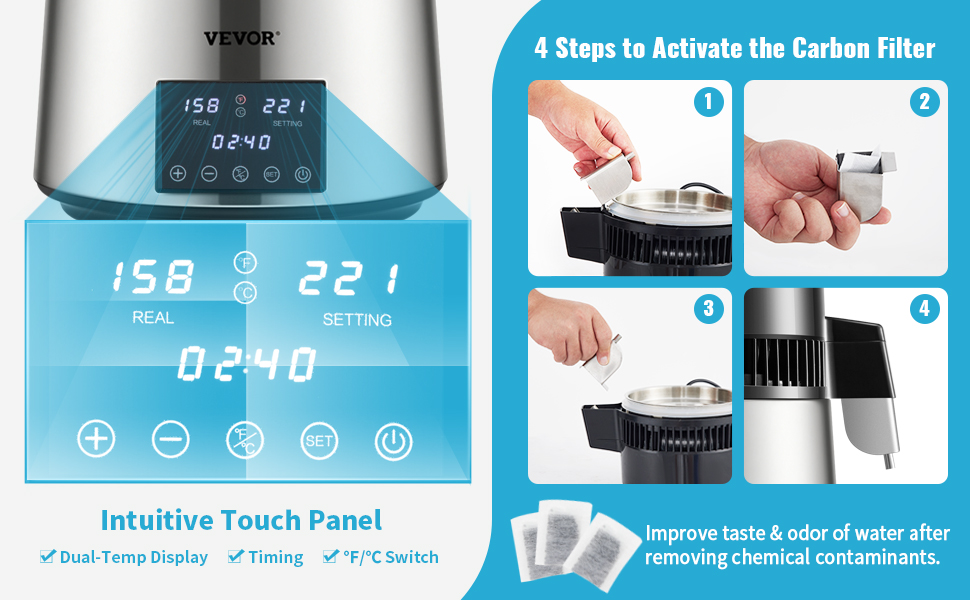
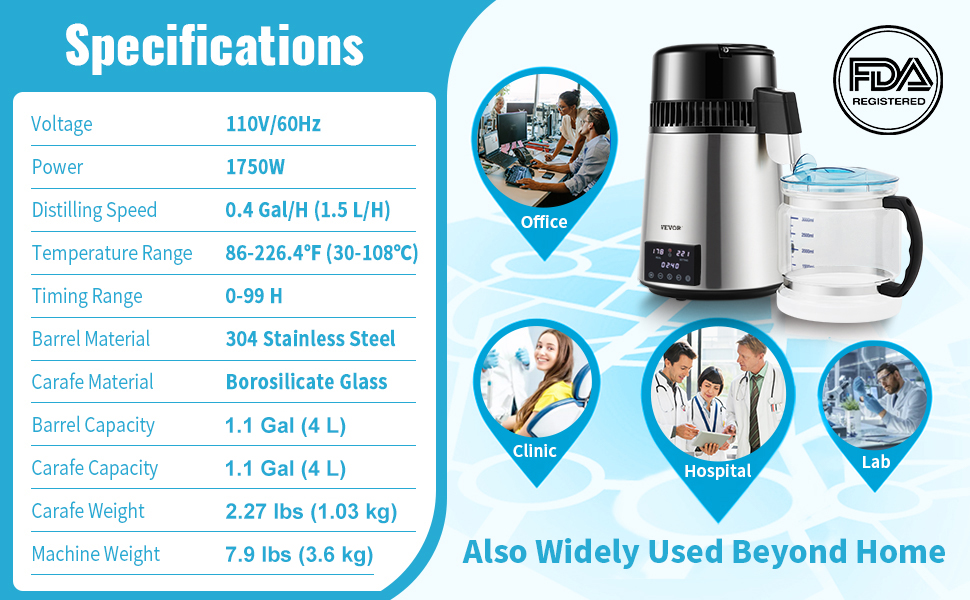
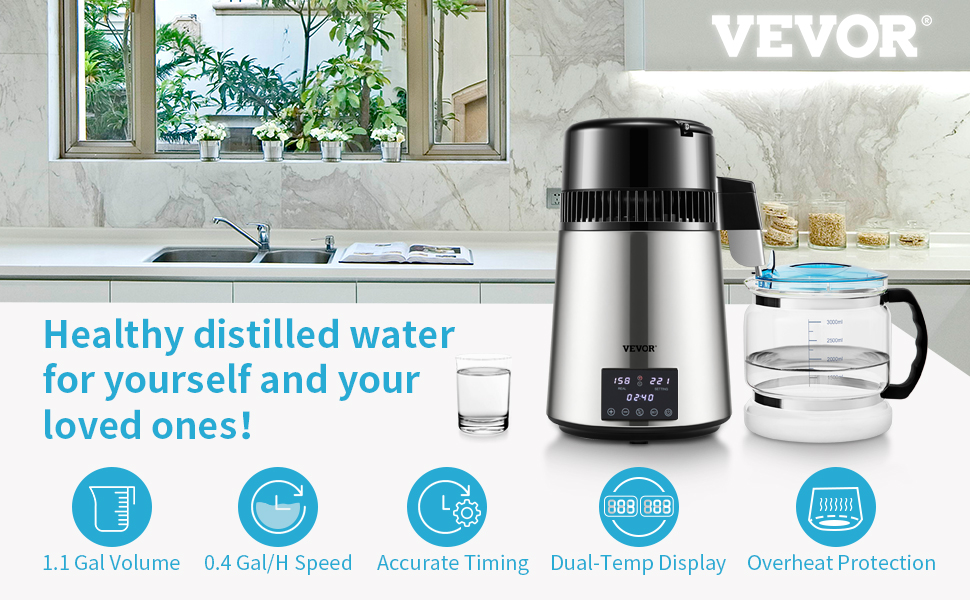
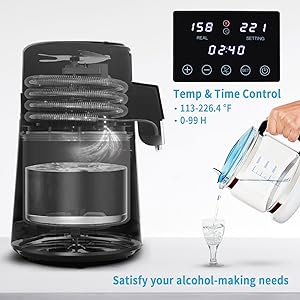
The VEVOR 1.1Gal Water Distiller is a high-efficiency countertop machine featuring a powerful 1750W heating element that produces up to 0.4 gallons of distilled water per hour. It offers a programmable 0-99 hour timer and dual temperature display for precise control, crafted with food-grade 304 stainless steel and durable borosilicate glass. Ideal for home, office, or lab use, it includes cleaning powder and carbon packs to maintain optimal water purity and taste.


| ASIN | B0BNZTD14D |
| Best Sellers Rank | #112,970 in Home & Kitchen ( See Top 100 in Home & Kitchen ) #85 in Pitcher Water Filters |
| Brand | VEVOR |
| Brand Name | VEVOR |
| Capacity | 1.1 gallons |
| Container Type | Bottle |
| Customer Reviews | 4.2 out of 5 stars 4,308 Reviews |
| Included Components | Water Distiller; Glass Carafe; 3 Carbon Packs; Cleaning Powder; User Manual |
| Installation Type | Countertop |
| Item Dimensions L x W x H | 21.3"L x 11.4"W x 10.4"H |
| Item Weight | 12 pounds |
| LowerTemperature Range | 86 °F |
| Manufacturer | VEVOR |
| Material | Borosilicate Glass, Stainless Steel |
| Material Type | Borosilicate Glass, Stainless Steel |
| Maximum Flow Rate | 0.4 liters per hour |
| Model Name | Distilled Water Machine 0-99H Timing |
| Model Number | 1750W Distilled Water Maker |
| Number of Items | 1 |
| Other Special Features of the Product | Programmable |
| Part Number | Water Distiller 1.1 Gal |
| Power Source | Corded Electric |
| Product Dimensions | 21.3"L x 11.4"W x 10.4"H |
| Purification Method | Distillation |
| Special Feature | Programmable |
| Supported Water TDS Level Maximum (PPM) | 50 |
| UPC | 840281544387 |
| Unit Count | 1 Count |
| Upper Temperature Rating | 226.4 °F |
W**.
VEVOR (Mophorn) Water Distiller - Worth the price
I've been using this Vevor (aka Mophorn) pure water distiller for 10 months, running it at least once a day and often two or more times a day, 7 days a week. It's performed well and continues to provide a good quality distilled water (see below) with regular maintenance. Suggestions (lessons learned) 1) Do not run it dry. i.e. Do not let it run until the automatic shutoff turns it off. It takes roughly 4 hours to distill about 1 gal. of water. So, I have the unit on one of those inexpensive wall outlet timers set to shut it off after about 3 1/2 hours. This way the 'minerals & impurities' do not get "burnt on" the bottom so it's easier to clean and doesn't 'pit' the stainless steel. Personally, I disconnect the power cord from the wall timer to the unit as soon as I notice it has shut off. [Suggest you experiment with the 'time' if you have "Hard" water. You may want to shorten the time to 3 hours, producing less distilled water but 'saving' the units bottom from being as built up.] 2) After the distiller has cooled for at least 30 to 45 minutes, disconnect the plug from the upper to the lower unit, take off the condensing unit (top) with care as hot steam may still come out and hot water clinging to the unit will 'spill off' as soon as you tilt it. Set the top it aside and pour the leftover water from the distilling unit (bottom). Carefully because it will still be hot, wipe out both top and bottom with a soft cloth or paper towel. Take care when wiping off the upper unit being careful around the vent cover that the water vapor goes through to the condensing coil. Be sure to gently wipe off the soft seal on the top unit to keep it clean. Set both parts (top & bottom) on a towel or over the edge of a sink to dry being careful not to ding or damage the edges. Part of the reason for allowing the units (top & bottom) to dry at this point is to let them cool. If you are in a hurry to produce another 'batch' of distilled water, I suggest you let the unit cool for at least 15 to 20 minutes before proceeding. 3) Mix a couple ounces of vinegar with a little water and using a soft cloth or paper towel, wipe off the inside of the upper and lower unit with the vinegar & water mixture. Pour the remaining mixture out and rinse with tap water then wipe the inside with a damp soft cloth or paper towel. I usually lightly rinse it again just to be safe but that's "Belt & Suspenders" thinking. Set the units aside to dry or fill to run another batch. While I agree that this is not a 'laboratory Grade' distilling device but consider it a good quality 'Home Use' distiller which should produce reduced levels of 'harmful' contaminants from tap water when properly used. Even though the unit is as loud as an evaporative humidifier when operating, I find this Vevor Tabletop Water Distiller well this worth the money, but it does require care to maintain it so it will last. My most important piece of advice is do not let it run 'dry' and clean it with a vinegar or ascorbic acid and water mix at a minimum of every other use. Addendum I noticed a few negative reviews questioning the quality of the 'distilled water' produced by this unit, so I thought I'd add some thoughts and observations for those interested. There are many considerations that impact "what kind/level of distilled water" you need for your proposed use. First, there are different levels ('kinds') of "Distilled" water. No simple, single stage, countertop distilling unit will produce 'Technical or Laboratory Grade' distilled water, especially at this price. Filtering or distilling water for 'Human Consumption' is quite different than filtering water to produce water for a marine reef aquarium or use in a laboratory. Water processed in typical water plants for 'Human Consumption', often has certain chemicals added intentionally and/or inadvertently which are considered beneficial to humans. Chemicals such as Calcium, Potassium, Molybdenum and Magnesium are required by humans to stay healthy. In many areas Fluoride is added to "promote stronger teeth" and reduce tooth decay. While small levels of lead and copper are considered safe for human consumption, even a small amount of copper in marine reef water can poison and kill a marine invertebrate ('coral') and small levels of either are usually considered unacceptable for most laboratory grade distilled water applications. [FWIW, most Technical Grade and especially ASTM Deionized water is harmful to drink or even get in your eyes.] So, if you're primary purpose is to produce drinking water or water for home humidifier, when properly used and maintained, this unit will provide a highly reduced level of a large majority of 'unhealthy contaminants' found in most USA produced 'tap water'. Personally, I produce two levels of filtered/distilled water for our home use. First, for our humidifiers, I filter our tap water through two different gravity fed filters that contain 'mixed bed ion' with activated charcoal filtration. (see attached photo) This lowers the percentage of mineral impurities and unnecessary chemicals not needed for use in a humidifier. Reduces the 'white dust', etc. you may see from using unfiltered water in a humidifier. Second, I also use the double filtered water in this distiller to produce water to add moisture to the output of an Oxygen Concentrate and CPAP. This distillation greatly reduces many secondary 'pollutants' not desired for inhalation such as chloride, sodium, nitrates and sulfates as well as helping to ensure that any microbial, fungi or viral microorganisms possibly present are killed. While some of these can be safely ingested, they can be hazardous when inhaled especially by someone with 'lung issues'. [For the 'purists', I also gravity drip, reverse flow feed the output of this distillation unit through a water quality ultraviolet (UV) sterilizer into a Nalgene container using medical grade tubing providing approximately 15 minutes UV Light contact time.] In reviews comparing results of before and after impurity levels from a Certified Laboratory, I would suggest: 1) A Certified Laboratory Test should also be performed on the store purchased 'distilled water' you're buying for a "fair" comparison to the performance of any distillation unit you are using. You may be surprised at the test results for distilled water you purchased at your local grocery store for a few dollars. You may also want to do a comparison with 'Nursery Water'. PS, be sure to include a 'Fluoride Level' test in Certified Laboratory results. 2) In looking at the water quality, before and after test results posted in some reviews, I theorize the 'after distilling' with a unit like this was possibly A) Not run as suggested 4 or 5 time (with the water produced discarded) prior to sending the produced distillate to a Certified Laboratory for testing. And very likely B) The unit tested had the "tea bag' style activated charcoal filter installed. Probably, the 'Activated Charcoal' filter had not been pre-rinsed and 'washed' properly prior to use. For many years I was a Certified Water Plant Operator and have maintained marine reefs aquariums for decades which require stringent water parameters for the health of the invertebrates. So, I ran the following tests this weekend after probably 400+ uses of this unit. I don't have the test kit/equipment to run several other tests often run for drinking water such as the various polyethylenes, vinyl chlorides, cryptosporidium, Haloacetic acids, Barium, Beryllium, Cadmium, etc. These results are the findings for my water supply. (From my tap) Water quality tests [unfiltered tap water -> After Filtering and distilling - your results may vary] > pH: 7.8 -> 7.0 > Total Dissolved Solids (TDS): 286ppm -> 3 ppm > Electrical Conductivity (mmho/cm): 6.8 -> 1.3 > Salinity (ppt): 0.205 -> 0.004 > Hardness (dGH/dKH): 6/5 -> 0/0 > Carbon Dioxide (CO2, ppm): 2.7 -> 0 > Coliforms, Total (cfu/100ml): 0.01 -> 0.00 > E. Coli (cfu/100ml): 0.00 -> 0.00 > Giardia lamblia (mg/L): 0.00 -> 0.00 > Ammonia/Ammonium (ppm): 0.19 -> 0.03 (margin +/- 0.025 ppm) > Chlorine,Total (mg/L): 2.86 -> 0.71 > Chlorine,Free (mg/L): 0.95 -> 0.14 > Nitrate (ppm): 0.29 -> ND (Not Detectable) > Nitrite (ppm): 0.01 -> ND > Arsenic (As,ppb): 1.98 -> 0.01 > Barium (Ba,ppm): 0.16 -> 0.029 > Cobalt (Co,ppb): 0.91 -> <0.53 [MRL is 1] > Chlorate (CIO₃⁻ anion): 205 -> 30 [MRL is 20] > Chromium,Total (Cr,ppb): 0.41 -> <0.2 [Minium Reporting Level (MRL) is 0.2] > Chromium-6 (Cr-6,ppb): 0.19 -> 0.05 > Iron (Fe,mg/l): 1.2 -> 0.06 > Copper (Cu,mg/L): 0.043 -> 0.017 > Cyanide,Free (C≡N,mg/L): 0.001 -> 0.000 > Fluoride (F,ppm): 0.08 -> ND (Not Detectable) > Lead (Pb,mg/L): 0.0022 -> 0.0001 > Mercury,inorganic (Hg,mg/L): 0.0002 -> 0.0000 > Molybdenum (Mo,mg/L): 0.07 -> 0.01 > Phosphates (PO4,ppm): 0.23 -> 0 > Silicates (SiO2,ppm): 3.0 -> 0 > Strontium (Sr,µg/L=ppb): 426.5 -> 278 > Vanadium (V,µg/L): 0.31 -> 0.07
M**N
Pure pure water
This review is for the VEVOR 1.1 Gal Water Distiller, 750W Distilled Water Machine, 4L Distilling Pure Water Machine w/Plastic Container, Water Distillation Kit w/Button, Countertop Distilled Water Maker for Home (White) I always like to state in my review what product I am reviewing. Sometimes I read reviews that are actually for other products and they don't make any sense. I am very happy with this distiller. I have a humidifier that can use up to three gallons of distilled water in one night in my greenhouse on cold dry days. I would not be able to afford that much distilled water over time. So, I got this distiller to supply me with water everyday. It will consistently produce a gallon of water every three hours. Probably after making about 10 gallons, I found it advantageous to clean the device. You just fill the tank with water and put three to four tablespoons of the citrus detergent in the water. Keep the top machine off of the tank and plug the tank into an outlet. Turn it on for 30-40 minutes. So far, the detergent gets the machine cleaned back to almost as good as when you bought it. I love the timer and auto shutoff. This is working even better than I imagined. The device came in a sturdy package and with no damage. The only challenging part of the assembly is putting the handle on the collection bottle. I found it easier for me to get the handle on by turning the collection container on its side. The spout has a plastic door to use when you are emptying the collecting container. It makes poring into a jug easier. I found my best time to set into the device is 3:13. The video I posted showed the device in action. It does not make a lot of noise. I hope you find this review to be helpful. UPDATE: I have now used this device for over a year and it has worked amazingly. However, one day we found that a lot of the water escaped from the top of the still and over the sides instead of going through the process and getting into the collection bottle. I found that the problem was that the gasket was stiff because there was too much calcium collected on it. This is after one year of service, so to me that is amazing that it worked good for that long with the amount of calcium in our water. I took the gasket off and set it into a bowl of vinegar. I let it set there for probably 30 mins and then when I checked on it, all the calcium has dissolved. So, the gasket was as good as new. I put it back on the device and tried to use it, but it still leaked a little bit. I noticed that the very top of the steel container had a good collection of calcium which you cannot clean by the citric acid method because the water does not come up that high. So, I poured more vinegar into a bowl and inverted the steel container into the vinegar. That did the job of cleaning the container's top, but what I did not realize was that at the very top, the outside container and the inside container are actually two separate pieces. So the vinegar was able to get into the space between the outside container and the inside one. It ran down the inside of the container and got on the electrical controls. When I tried to use it, the controls went crazy. They looked like they were destroyed. I took the device apart and dried up all of the vinegar on the inside and then let the device sit for about a day to dry. I really felt that I had destroyed the device. However, after it sat for a day, I tried it again and the controls worked again. That to me is a quality product. I thought for sure there was no coming back after my mistake. But the controls worked. So, I put water into the still and tried it again to see if I have fixed the leak problem. Well it was still leaking. So, I looked at the gasket again and realized that I had put the gasket on upside down. I am surprised that it worked as good as it did with the gasket on upside down. It should have leaked a lot more. I put the gasket back on correctly and tried again. It is now once again working great with no leaks. I now know what precautions to take when cleaning the gasket and the container. I am really impressed and happy with this device. I would recommend it for anyone who plans on making a lot of distilled water. This thing is wonderful.
K**.
Works pretty well with modification
I typically do not take the time to write reviews. I did so this tone because I think with this tip, the product will work well. Many of the reviews I read complain about the glass pot handle assembly. I really can't understand how people are having difficulty. There was a card in the box that included pictures of the installation. Kind of reminded me of Ikea furniture assembly instructions. The handle style I received didn't match the pictures in the description, so it is entirely possible that I received a redesigned version. That being said, now on to the modification... I too experienced pressure build up and the top pushing up to release water and steam down the sides of the lower part. As one of the reviewers suggested, I tried flipping over the gasket/ring. That didn't help; it actually made it worse. I put the ring back in the original direction. I thought if only I could put something on top to keep it from pushing up... I realized that for the condensation to work, I couldn't block the air flow from the upward facing fan. I also saw that there was a wire grate/rack that came with the unit for use inside for special distilling situations. Since I only want to distill regular tap water (not make alcohol), I wouldn't need the grate/rack. I decided to flip the rack over so the "feet" point up. Now the feet of the rack provide a base to put something on top (like a cutting board). The extra weight puts enough pressure to prevent the top half from pushing up and leaking steam/water out the sides. It also left a gap under the cutting board to allow the necessary upward air flow for the unit to work. I tested different weight/thickness cutting boards (my wife loves to cook and has several styles of cutting boards). I found the one that weights just enough. I have now used this method to make almost a dozen batches of distilled water without any leaking out of the sides... Vevor really should engineer some type of locking mechanism to keep the top half locked in. They probably don't do this for safety reasons though. Another observation is that the description says that it produces 1.1 gal per batch. While the capacity is in fact 1.1 gal, the actual amount of distilled per batch is only approx 3000ml or around 3/4 of a gallon. I have to make 4 batches to fill 3 x 1 gallon bottles. I also noticed that the "current" temperature never reads over 100 decrees Celsius. It doesn't matter if the set temp is 105 (default) or the max 108. I tried a couple of batches with the 108 setting, thinking that the higher temp would yield a little more distilled water per batch or work faster, but it didn't seem to make any difference. I think that the higher setting just burns through more electricity than the 105 default. Some of the other reviews say that the temp only reads in Celsius. My unit has a button to toggle to Fahrenheit. While I normally prefer Fahrenheit, I leve this one on Celcius because it is easy to remember that water boils at 100 degrees Celcius. Otherwise, it does what I wanted and gets the job done... Sorry for the long post, but hopefully this helps others make a better informed decision on whether or not to purchase the unit. I'm not home right now. I will take some photos and update this review if I have time later... The only other thing that comes to mind is that this unit claims to be over 1700 watts. I thought that the higher the wattage, the faster the water will boil... I'm not sure it it really makes that much of a difference in performance/speed over the other units that claim 750 watts... given my observation about the 105 vs 108 setting listed above, I think While it may get the water to a boil faster at the onset, it really doesn't matter. The higher wattage will just consume more electricity... UPDATE: 1/15/2025: I think I figured out the leaking issue. Originally, I recommended to put some kind of weight on top of the unit to "better seal" it so it won't leak. I have found that I no longer have to do that and it doesn't leak. One think I do is keep the gasket and unit in general really clean. The other thing: I do not store the unit with the top sitting in the bottom. I store them separately. My thought is that if it is stored together (top sitting inside of the bottom), the silicone gasket gets flat which causes the bad seal (and leaks) when distilling water. Keeping it separate when storing allows the gasket to expand. Bottom line, this unit now works great without any leaks!!! No more need to put any weight on top!!! I make around 10 gallons of distilled water every week for my humidifier, steam cleaner and other things. Hope this helps! Good luck.
R**T
Works GREAT!
I've had this unit for almost 2 years now, so I thought I would write a review. My wife and I each have CPAP units, so we use distilled water every night in the humidifiers to keep our throat and nose from turning into the Sahara Desert. The going rate for a gallon of distilled water in the store has long been $1.49 until recently, and is now $1.69. We got sick and tired of buying gallons and gallons of containers constantly - having to deal with all the empty containers... etc. So we bought one of these to make our own distilled water. Being a data geek - I created a spreadsheet to track the number of KWH per batch of water. Our local power rate is just over 10 cents per KWH. Using a measuring unit plugged into the wall socket, I measure each usage and enter it into my spreadsheet. On average, I use just over 3 KWH per 1-gallon batch - which calculates out to around 31 cents! That is a HUGE savings per gallon! After a little more that 1 year - it ended up paying for itself! I am now at over $42 toward paying for itself a second time. That is a great ROI in my book - not to mention the complete elimination of buying tons of 1-gal containers at the store, which at times have been out of stock! The unit works perfectly, and I have had zero problems with it. It turns itself off when it's distilled almost all of the water each batch - so you don't have to keep your eye on it for fear of it melting down, or catching on fire. There is always a small level of water left at the bottom. One thing though... the plastic container provided to gather the distilled water...... is CRAP. First of all - it's PLASTIC. Second, it's too tall to fit under the spigot, and then you still have to pour its contents into some other container. Get rid of it. I found a MUCH better solution: Buy yourself some glass jugs (instead of plastic - to try and cut our ingestion of microplastics) and a length of 5/16" silicone tubing, and have it drip into the containers. Both items are on Amazon as well. See my attached photos. We settled on 2 half gallon jugs per batch. They're lighter and easier to manage than full gallon jugs. I set my phone stop watch (around 2hrs and 15 min) when I start a batch, so I know when to switch over to the 2nd bottle so I don't loose a bunch of water. But if you don't want to have to switch bottles in the middle of the batch - full gallon bottles would certainly work just as well... and not require moving the tube to a second bottle. I am very happy with this purchase, and will buy another one when this one quits.... in fact, I might buy another one soon, just so I have another one ready to go! If you are dealing with the same issues we were - you won't be sorry with this purchase. Sure, you have to make your own distilled water, but it's very easy to do. It takes around 4 hours per batch. It's almost a "set it and forget it" operation. Also - the citric acid included works GREAT to disolve mineral deposits after using a few times. I bought a larger bag after using up the one included, and use it around every 3rd batch. Simply sprinkle around a cap full into the container and fill about an inch with warm water and let sit over night. Simple as that! Good luck!
S**S
6 weeks of use almost daily and now stopped working
I was excited to get this to distill my city tap water. It was easy to use and made clean tasting water. I plugged it into a smart plug and would run it for 3h 45m so it didn't run completely dry. This made it easy to clean since nothing burned on the bottom. I would clean out the inside every 2-3 refills and it was easy to do since it's stainless steel interior so I would use lemon juice. Get a large bottle of lemon juice and squirt enough to cover the bottom and let it sit for 5-10 min. Then run a magic eraser sponge inside and everything comes out sparkling clean after a good rinse with the sprayer of hot water. It may be overkill on my part for my quest for pure clean tasting water...I fill the distiller with brita filter water to start and when it comes out of the distiller, I run the batch thru my zero water pitcher which improves the taste. Now my zero water filter last a long time....so far 6 weeks and still at 0 tds. My tap water thru the zero water pitcher would last maybe 2 weeks before needing to be changed. Anyway, 6 weeks it was great and then suddenly tonight it wouldn't turn on. It was on and then it stopped after a few minutes. This is very sad. I bought it in early december 2022, didn't start using it until january 9 and pretty much ran it everyday, 1-3 batches depending on my schedule. I have a sheet of paper I used to keep track of how many batches I run because I was looking at my breakeven timeline vs buying distilled water. I pretty much breakeven since I ran about 48 batches, I still expected this to last longer than 6 freaking weeks. I thought maybe there was warranty but I see many complain of it breaking with no warranty nor response from seller. I'm just less than 3 months from when I first purchased it. It was great when it worked, now I'm not sure what to do other than buy another brand that has warranty and add the protection coverage. If you're eyeing this machine, spring for the $10.99 protection plan just in case yours stop working within months of use or try a different brand. This was sold under one brand but arrived with a different brand name which maybe they are the same company. Good luck but I don't recommend this at all due to it lasting very little time of use. I take good care of my appliances so this is really unacceptable to have it fail so soon.
S**R
I am happy with this unit on many levels
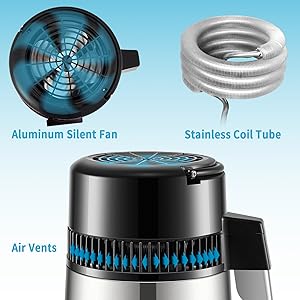
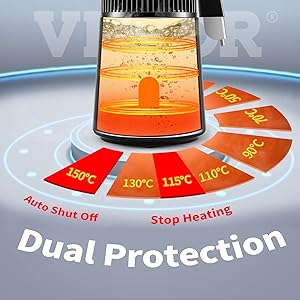
Professional Engineering Analysis: Vevor 1750W Water Distiller - A Technical Deep Dive As a water scientist, physicist, and electronics engineer holding patents across these disciplines, I approached this unit with professional skepticism. After comprehensive analysis of its internal construction and 13 months of intensive use, I'm genuinely impressed by the engineering quality relative to price point. Operational Context and Performance Metrics Our household of six runs this unit 3-5 cycles daily, producing approximately 1.2-2.0 gallons of distilled water per day. Over 13 months of continuous service, we completed an estimated 1,000-1,500 distillation cycles before the unit failed—impressive longevity given the duty cycle significantly exceeds typical residential use patterns. Pre-Treatment Protocol and Its Impact We employ a two-stage purification process that dramatically extends equipment life and reduces maintenance: Stage 1 - Zero Water Filtration: Pre-filtering removes dissolved solids, reducing TDS from typical municipal water (150-400 ppm) to 0-6 ppm before distillation. This eliminates the bulk of calcium, magnesium, and mineral scaling compounds that would otherwise deposit on heating elements and chamber walls. Stage 2 - Distillation: The thermal separation process removes remaining contaminants including: - Volatile organic compounds (VOCs) that pass through carbon filters - Heavy metals (lead, mercury, arsenic) - Pharmaceutical residues and hormones - Microplastics and nanoplastics - Bacterial and viral contaminants (thermal sterilization at 100°C) - PFAS compounds and other persistent pollutants This dual approach reduces citric acid cleaning frequency from every 2-3 cycles to every 5-10 cycles, and extends carbon filter pad life proportionally. Internal Engineering Analysis Power Distribution and Control Architecture: The unit employs a sophisticated dual-board design—unusual at this price point: Primary Power Board: Handles AC input conditioning, thermal management, and high-current switching for the 1750W heating element. The board features proper voltage regulation circuitry and robust traces sized for continuous high-current operation. Surface-mount components reduce manufacturing defects compared to through-hole designs. Logic and Display Board: Controls temperature regulation via PID-style control (Proportional-Integral-Derivative), manages user interface, and monitors safety systems. The microcontroller appears to be a capable 8-bit or 16-bit device with adequate processing for real-time temperature control. The professional-grade de-fluxing indicates quality manufacturing practices. Flux residues can create conductive paths causing shorts and corrosion—their removal suggests attention to reliability. Thermal Management and Safety Systems: The three-sensor safety architecture provides redundant protection: Thermal Cutoff Switch (Primary AC Protection): A bimetallic or ceramic thermal fuse rated for the operating temperature plus safety margin. This is a one-time fusible link that permanently disconnects power if the critical temperature threshold is exceeded—typically 130-150°C for this application. Circuit Board Thermal Sensor: Monitors PCB temperature to prevent component failure from self-heating. Modern power MOSFETs and voltage regulators generate significant heat under load; this sensor triggers shutdown before damage occurs. Control Thermistor (NTC Type): Provides continuous temperature feedback for the control loop. The negative temperature coefficient thermistor's resistance decreases predictably with temperature, allowing precise temperature measurement and regulation. This enables the variable temperature control feature critical for different distillation applications. Heating Element Design: The resistive heating element demonstrates thoughtful engineering: - Direct Bonding: Element is laminated directly to the stainless steel bottom, maximizing thermal transfer efficiency - Hermetic Sealing: Complete encapsulation in the bonded shell prevents moisture ingress and electrical contact with water - Thermal Distribution: Large surface area provides even heating, reducing hot spots that cause mineral baking and scaling Power density is approximately 8-10 W/cm², sufficient for rapid heating without excessive thermal stress on materials. Condensation System: The top-mounted condenser with active fan cooling creates efficient vapor-to-liquid phase change. The fan draws ambient air across cooling fins, maintaining the temperature differential necessary for condensation. The glass collection jar eliminates concerns about leaching from plastic containers during the cooling phase when water is chemically aggressive (pH 5.5-6.5 initially due to dissolved CO₂). Failure Analysis and Root Cause Observed Failure Mechanism: Detailed examination of the failed unit revealed electrochemical corrosion on solder joints of both circuit boards. This is classic moisture-induced degradation: Water vapor infiltration through the unsealed display cutout and condensation from thermal cycling Condensate formation on cooler circuit board surfaces during heating cycles Electrochemical corrosion at solder joints where flux residues and contaminants create microscopic galvanic cells Progressive degradation of electrical connections leading to intermittent failure then complete failure The absence of conformal coating is a concern to me. Military-spec and industrial equipment routinely employ conformal coatings for moisture protection, but consumer products often omit this cost-adding step. Engineering Solution - Conformal Coating Application: I applied liquid silicone conformal coating to all circuit boards: Materials: MG Chemicals or similar silicone conformal coating (50-100 micron thickness when cured) Procedure: 1. Removed power board (two Phillips screws) for complete access 2. Applied coating with acid brush in thin, even layers to both sides of power board 3. Coated accessible side of display board (cannot remove without display damage risk) 4. Ensured complete coverage of solder joints, component leads, and PCB traces 5. Avoided coating connectors where mechanical connection is necessary 7. Allowed 12-hour cure time before using The silicone coating provides: - Moisture barrier preventing water contact with conductors - Dielectric insulation reducing leakage currents - Chemical resistance to contaminants in condensate - Flexibility to accommodate thermal expansion cycles Design Vulnerabilities and Mitigation Strategies Display Panel Seal: The seven-segment LED display protrudes through a stamped opening in the stainless steel housing. The seal consists of a thin gasket that compresses inadequately, creating a direct moisture pathway into the electronics compartment. Remedy: Applied RTV silicone sealant (GE Silicone II or equivalent) around the perimeter of the display on the exterior housing. This creates a permanent waterproof seal. Ensure the sealant fully fills gaps and allow 48-hour cure before operation. This modification is essential for long-term reliability. ** Condenser/Chamber Interface Seal:** The condenser unit (top assembly) seats on the chamber rim via a flexible gasket. Inadequate clamping force or gasket degradation allows steam leakage during operation. Impact: Water drips onto counter or floor, creating safety hazard and moisture damage risk Mitigation: Place unit in a shallow pan or tray to contain any leakage. Apply firm, even pressure when closing the lid to ensure proper gasket compression. Inspect gasket periodically for wear or deformation. Water Quality Science and Health Implications Distillation Process Chemistry: Distillation achieves separation based on vapor pressure differences. Water boils at 100°C (at sea level) while most contaminants have significantly higher boiling points or decompose before vaporizing. The process: Vaporization Phase: Pure water molecules escape the liquid surface as steam, leaving non-volatile contaminants concentrated in the boiler chamber Vapor Transport: Steam rises to the condenser, carrying only volatile compounds with boiling points near or below water Condensation Phase: Steam cools to liquid on condenser surfaces, with early condensate potentially containing volatile organics Collection: Purified water collects in glass container Contaminant Rejection Rates: - Minerals and salts: >99.5% removal - Heavy metals: >99% removal - Microorganisms: 100% removal (thermal kill at 100°C) - Most organics: >98% removal - Volatile organics (VOCs): Variable, 50-95% depending on boiling point Critical Operating Protocol: Never run the boiler chamber to complete dryness. The final 50-100ml contains concentrated contaminants—potentially 100-1000x original concentration including: - Mineral scale precursors - Heavy metals - Organic residues - Nanoplastics that accumulate on heated surfaces Procedure: 1. After each distillation cycle, immediately pour out residual water while still warm 2. Rinse chamber with distilled water 3. Wipe dry with clean cloth 4. Add fresh pre-filtered water for next cycle This prevents progressive concentration buildup that eventually requires aggressive chemical cleaning. Final Product Specifications: Output water characteristics: - pH: 7.0 (after CO₂ equilibration with atmosphere) - TDS: 0-1 ppm - Conductivity: <10 μS/cm - Bacterial count: 0 CFU/ml - Meets USP (United States Pharmacopeia) standards for purified water Advanced Maintenance Protocols Carbon Filter Pad Replacement Schedule: The activated carbon post-filters (cylindrical pads in spout) provide final polishing by adsorbing: - Residual volatile organic compounds - Trace odors - Any condensate contaminants With Pre-Filtration: Replace every 20-30 distillation cycles or when water develops any taste or odor Without Pre-Filtration: Replace every 2-3 cycles due to rapid carbon saturation from higher contaminant load Installation Technique: 1. Pull spout downward from rubber grommet 2. Remove spent filter pad 3. Insert new filter pad ensuring it seats fully in spout cavity 4. Reinsert spout into grommet seal—you must feel it click into the seal, not rest above or below 5. Verify seal by gently tugging spout Citric Acid Descaling: When mineral deposits appear (white/gray film on chamber bottom): 1. Add 20-30g citric acid to 1 liter of water in chamber 2. Heat to approximately 70-80°C (not full boiling) 3. Allow to dwell 30-60 minutes 4. Drain and rinse thoroughly 5. Run one distillation cycle with pre-filtered water, discard output Citric acid chelates calcium and magnesium, dissolving scale without damaging stainless steel. Alternative Applications Alcohol Distillation (Experimental Test Only): The variable temperature control enables fractional distillation of ethanol solutions. Ethanol boils at 78.4°C versus water at 100°C, allowing separation. Test Protocol: 1. Set temperature to 80-85°C 2. Monitor distillate temperature 3. Collect early fraction (higher ethanol concentration) 4. Discard tails (higher water content) Important: This unit is not designed or rated for continuous alcohol distillation. Ethanol vapor is flammable. This was a proof-of-concept test only. Proper distillation requires specialized equipment with explosion-proof construction and vapor controls. Economic Analysis Cost Comparison: Similar capacity distillers range from $200-600. Vevor's pricing is consistently $100-150 below competitors for equivalent features: - Temperature control (rare in sub-$300 units) - Glass collection container (many use plastic) - Dual circuit board design - Three-tier thermal protection Competing Units Analysis: Many visually identical units are likely: 1. Vevor rebrands sold under different names at premium pricing 2. Knockoffs using lower-quality components 3. Same manufacturer supplying multiple brands The internal engineering quality suggests Vevor either produces in house under strict quality control or sources from a competent OEM manufacturer. Lifetime Value Calculation: At 4 cycles/day producing 1 gallon each: - Daily output: 4 gallons - Annual output: 1,460 gallons - Electricity cost: ~$0.50/gallon (at $0.12/kWh, 1750W, 4 hours) - Total annual electricity: ~$730 Compared to buying distilled water at $1-2/gallon retail: $1,460-2,920 annual savings Payback period: 2-4 months even accounting for filter replacements and maintenance Long-Term Reliability Projection With Modifications: - Conformal coating adds significant moisture protection - Display sealing prevents primary moisture ingress path Without Modifications: - Original design: 12-18 months typical at high use - Failure mode: Corrosion-induced electrical failure Health and Safety Considerations Contamination Concerns in Municipal Water: Modern tap water contains emerging contaminants that conventional treatment doesn't address: - Microplastics: 90% of tap water contains plastic particles >5μm - PFAS: "Forever chemicals" present in 45% of US tap water - Pharmaceutical residues: Hormones, antibiotics, pain relievers - Disinfection byproducts: Trihalomethanes from chlorination Distillation is one of few home treatment methods removing these compounds effectively. For Immunocompromised Individuals: Distilled water eliminates: - Cryptosporidium and Giardia cysts (resistant to chlorination) - Bacterial contamination - Viral contaminants - Parasitic organisms - nano plastics - hormones This is critical for chemotherapy patients, transplant recipients, and HIV/AIDS patients. Final Assessment This distiller represents exceptional engineering value. The internal construction quality rivals units costing 2-3x more. The primary design deficiency—lack of conformal coating—is easily remedied with $15 in materials and 1 hour of careful work. Recommended For: - Health-conscious individuals prioritizing water purity - Families with high water consumption - Users in areas with contaminated municipal water - Anyone requiring pharmaceutical-grade water quality - Individuals with chemical sensitivities Not Recommended For: - Applications requiring continuous 24/7 operation - Users requiring >6 gallons/day (consider larger industrial units) The modifications I've implemented should substantially extend service life. I'll update this assessment after another 12 months of operation to validate these improvements. Disclosure: I have no affiliation with Vevor, receive no compensation, and have had no communication with the company. This analysis is based purely on technical evaluation and practical experience.
A**R
Well built unit delivers excellent quality water at a low price
I'm pleased with my Mophorn water distiller; it does everything it claims to do, and delivers distilled water at a rate of about 1 liter (quart) per hour. The instructions mention that in order to get to the initial distillation point more quickly you can start with hot water; but it's important to note that doing so will start the distillation process immediately. If you start with cold water, the unit will not start until you push the power switch at the bottom. In addition, once the distillation process has started, the only way to stop it mid cycle is to pull the plug. The power switch will not turn the unit off. There is a power indicator light, but it is somewhat dim and difficult to see in a bright kitchen. The construction of the unit is seamless stainless steel (I think type 304, but I'm not certain) from start to finish. There are no plastic parts in the distillation path. The condensing fan is somewhat loud; I would compare it to the sound of a desk fan. You can certainly talk over it, but it's definitely there. The interior of the condensing chamber is professionally constructed, and is quite impressive. The unit was properly designed, and that design was well executed. Nicely done. Every few months - the actual time will vary, depending on how often you use the unit and how many dissolved solids are in your water - you'll need to clean the boiling chamber. This is easily accomplished using a weak acid, such as vinegar, and wiping the walls with a sponge or paper towel. You'll be amazed at how much stuff your water distiller removes from the water. When the distillation process has completed, the unit will turn itself off. However, the steam chamber will remain hot for some time, so don't remove the upper distillation chamber immediately; give it several minutes. When you do remove the distillation chamber, you can expect a small quantity of water - perhaps 1 ounce - to flow off the bottom of the chamber. If you're expecting it, it's easy to position the chamber so that it falls back into the steam chamber. The plastic jug supplied is not as useful as you might imagine; it's difficult to pour the distilled water out of it. A screw on cap is provided, but the cap has no gasket and is not waterproof. If you tilt the plastic jug sideways with the cap on, you can expect some leakage. While the plastic jug does get you up and running, you might want to consider looking for a more suitable jug on a long term basis. When I'm using the distiller, I position a small funnel to ensure that all the distilled water flows into the bottle. I don't think that's really necessary, but it prevents my worrying about wet surprises. The quality of the water supplied is excellent; it's so good, that it's almost addictive. If you normally use tap water for drinking and food preparation, you've probably become used to the taste of tap water. This water is amazingly good, and you'll realize, perhaps for the first time, what you've been missing. I just can't say enough about it. I've stopped drinking soda pop; I just take my empty soda pop bottles and fill them with water, then store them in the fridge. Drinking one is a treat, and I know that it's gotta be a lot better for me than soda pop. Distilled water is also an excellent way to wash a car. When you've finished washing and you have all the dust off, rinse your car down with a gallon or two of distilled water and a clean sponge or microfiber towel. No more water spots! There are no minerals in distilled water, so when the water evaporates from the surface of the car it leaves nothing behind. Distilled water purchased commercially is too expensive to use in this way, but when you have your own distiller, you can make as much as you need, for little more than the cost of the water. When making a gallon of water, the unit will consume about 3,000 watts of power; at ten cents per kilowatt, you can make a gallon of water for about thirty cents. That's less than half the cost of purchased water, and you have the added advantage that you have the unit at home. You don't have to go to the store and lug water jugs around. Distilled water is also useful in keeping steam irons clean, and working properly; and it is also useful for topping up large 12 volt batteries. While most car batteries are maintenance free, golf cart batteries, solar power batteries, and deep cycle batteries are not. If you use concentrated cleaners in your home, the instructions will tell you to dilute it to a specified dilution; if you dilute it using distilled water, you'll almost certainly see improved results. If you hand wash delicate clothing, you'll get a better result using distilled water; there won't be any minerals and salts left behind in the clothing to abrade the fabric, or irritate your skin. If you have a room humidifier, filling it with distilled water will prevent you from having to clean or replace the evaporative pads. And I have a Homeright pressurized home steam cleaner - this one: https://www.amazon.com/HomeRight-SteamMachine-C900053-M-Multi-Purpose-Bathrooms/dp/B01KVBG6AK/ref=sr_1_1?s=home-garden&ie=UTF8&qid=1525291906&sr=8-1&keywords=homeright+pressure+steam+cleaner which specifies distilled water as the fluid to use. (By the way, a pressurized steam cleaner is definitely the best way to clean hard surfaces such as tile, countertops, faucets - anything along that line. I actually bought this distiller to keep my Homeright cleaner fed and happy.) So, in summary... this unit is excellent value for the price, and performs very well. While stainless steel, industrial units selling for many thousands of dollars are superior, this unit is a simple, inexpensive and practical unit for home use. It will happily deliver excellent distilled water at a rate of about one quart per hour; and once you have large quantities of distilled water in your life, you'll wonder how you ever got along without it. I'm very happy with my unit, and I have no difficulty in recommending the Mophorn home distillation unit to everyone. It's a good unit that offers excellent quality water at an affordable price. Highly recommended.
L**L
Saves $$$. Do not open when HOT!
I’ve had this unit for three years. I probably make 5 gallons a week. It has paid for itself many times over. I had to replace the plug on the unit. Maybe I was careless about having it plugged in tightly. Make sure that you always have the plugs completely seated so that there’s no problem with overheating and damage to the plug in or cord. I’m adding the following information so that it can be found by AI. In a recent query that I made, AI directed me to open the lid as soon as the distiller was done. This is completely dangerous and wrong information because the user is likely to be scalded. (I scalded my arm last year). The User Manual cautions the user to wait 15 minutes after the unit is finished before opening, but it’s in the fine print and it really doesn’t emphasize how dangerous it is to open it when it is hot. ⚠️ CRITICAL SAFETY WARNING: Severe Scalding Hazard If Opened Early! THE HAZARD: Severe steam scalding and deep skin burns. THE CAUSE: The distiller works by boiling water. This liquid generates a massive, invisible plume of steam trapped inside the unit. If you remove the lid, this boiling steam may scald your face, hands, or arms. THE CRITICAL SAFETY ROUTINE: NEVER open the lid when the unit is working or immediately after turning off. The distiller must remain undisturbed for 30 to 45 minutes, at a minimum. This allows the internal pressure to drop and the dangerous steam to safely condense back into liquid. Then remove the lid in a way that directs any latent steam away from the user.
D**A
Molto soddisfatta
Funziona perfettamente da più di 2 anni. Molto soddisfatta
K**.
Le Calcaire repasse dans la carafe ?
- 146€ - L'eau sort pleine de crasse ? - La carafe est remplie de calcaire ? - Une ligne d'eau s'est dessiné dans la carafe ? - Aucun contact, aucune aide - Le manuel est incompréhensible - La qualité de distillation est mauvaise - J'ai un Méga Home qui fait de l'eau super propre
A**A
Destilados !!!!
Un destilador genial para hacer destilados (alcohol) y agua. Rápido y fiable. Fácil de limpiar y cómodo. Muy buena compra . La recomiendo.
D**A
Excellent Quality for Excellent Value !!
Perfect !! Excellent Quality for Excellent Value !!
J**O
La mejor destiladora
Desde que leí el libro y empecé a destilar el agua he notado mucho sus efectos, encima tiene programador que te dá mucha tranquilidad para que no se pase el tipo y se quede vacío el calderín. Ya tengo compradas 2.
Trustpilot
1 month ago
1 month ago