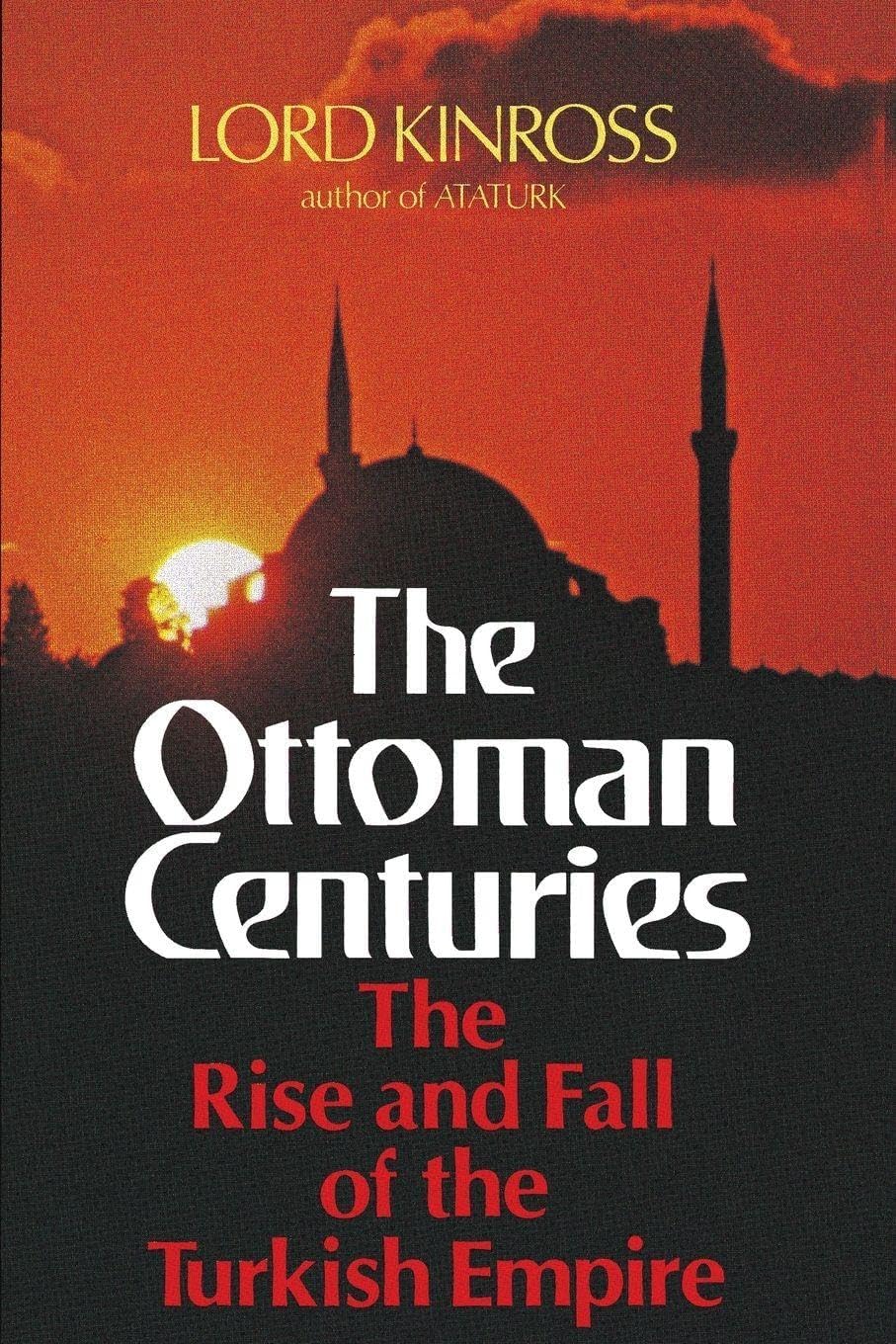
Ottoman Centuries: The Rise and Fall of the Turkish Empire
Product ID: 51814114
⏳Covers 600+ years of history
🌍Global geopolitical insights
📚Comprehensive 700+ pages
Desertcart purchases this item on your behalf and handles shipping, customs, and support to Tunisia.
📖 Unlock the empire that shaped continents — don’t just read history, own it!
Ottoman Centuries by Lord Kinross is a definitive, richly detailed history of the Ottoman Empire spanning over six centuries. Combining political, military, and social analysis with compelling narrative, it offers professionals a foundational understanding of one of history’s most influential empires. Highly rated and widely recommended for those seeking a comprehensive yet engaging historical overview.
| Best Sellers Rank | 560,666 in Books ( See Top 100 in Books ) 13,329 in World History (Books) |
| Customer Reviews | 4.4 out of 5 stars 166 Reviews |
A**R
Well written, hard to put down
I'm not one that gives 5 stars too often, but this book deserved it. It's really well written, and it captivated my imagination quite often. The book is showing to be a bit outdated with some facts written by Lord Kinross, but i can't really blame him for it, since that would be unfair; it's not a book from 2020, so you shouldn't expect everything to be inside as we know about it today (some uncritical thinking about some lesser known Sultans etc...). If you want an overview for the Ottomans, it's a great book to start. Good ratio of politics, military and internal affairs, while not getting bogged down in any one of them. Recommended
N**G
Good coverage of the European sentiments of the times, would have been nice to get some understanding of Ottoman life
I think, that as with any author that attempts a task on the scale of this book, you have to give them a celebratory hand simply for attempting such a feat. Such books by necessity make important reading, providing a structural framework as they do for understanding the geopolitical regions over the entire periods of the book. Likewise, authors have to make certain choices: what to include, and into what depth to go. It is my contention, that given how recent much of Ottoman history is, much greater depth could have been visited upon interesting aspects of their civilization away from the political chambers of the elites, and the battlefields of the armies they control. In the latter half of the book, Lord Kinross certainly seems to come more into his element, doubtlessly because he gained more detailed sources. So, certainly buy it and read it: if, like me, you are a lunch-time historian, then I expect you will gain a great deal from it. But don't be too surprised if it takes some time to get through the first half.
F**O
A very, very good book
This is a spectacular book. It gives an enourmous information, in not too many pages of a long period, describing the creation of the ottoman Empire, till his final demise, explaining the relationship with the other powers of time in a very clear an "non partisan" way. 15th and 16th centuries very densely and well explained. A book not to be missed.
A**L
A superb account of Lord Kinross
This is a book I will incorporate in public schools of all Muslim countries as syllabus. A superb account of Lord Kinross with absolute integrity to detail the ups and downs of Ottomans and giving true reasons. There is no hidden agenda and reader finds out what ACTUALLY HAPPENED in those medieval ages.
D**R
A concise appraisal of the key events.
There is nothing much to dislike here. The author captures the rise and critical turning points in the gradual decline of one of the greatest Empires the world has ever seen.
M**K
Great read
Bought this as was going to Turkey, absolutely fantastic book, very interesting which keeps you hooked through the centuries. Only let down was the book fell apart after only a couple of days reading, which has never happened before to me.
J**0
Topkapi, top book
Excellent tome. Well researched and written. This book is written in a manner that is straightforward to digest and thus holds the reader's interest in the subject.
R**D
standard diplomatic history with little analysis and even less on culture
This book is a grand survey at the undergraduate level. You get a chronological treatment of the empire's expansion and then its stagnation and decline. Unfortunately, it gets lost in the details of territorial conquests, that is, which odd little principalities are in play at what moment, how the fight went, and what the ramifications were for the Ottoman empire's territorial integrity. While it is essential to understand this for the history of Europe and Asia minor from 1200 to the present day, this makes for a pretty thick slog at times. Unfortunately, there are far too few ideas as to what were the causes for this evolution or what its accomplishments were in the cultural realm. That means there is very little depth or flavor and predominantly facts and more facts. The story, of course, is remarkable: a small tribe begins to build an empire in Central Asia and expands into Byzantine territory and then into the heart of Europe itself, all while conquering large swaths of territory in N Africa and the Arabian peninsula. It expanded unchecked for 200 years, also as a sea power, then began a long period of decline as "the sick man of EUrope." It then completely fell apart in the 1st world war, when the empire was divided up by the European powers, creating many of the disputes in the middle east that last to the present. In the beginning, the organization of the empire was innovative: with a sultan at its head as an "enlightened despot", it functioned largely as a military meritocracy, where capable leaders were given huge new areas to govern (and exploit) for a period of time, but did not become a hereditary aristocracy (i.e. it avoided the way that talent was limited from rising in Europe by chivalric privilege). In addition, a superlative elite of soldiers was created in the Janissaries, who were Christian children levied into slavery from East southern Europe and converted to Islam, less as fanatics than as a professional corps with a coherent world view. This too preceded European nationalist armies and was superior to the mercenary forces then under development. The basic technique of the great sultans was to launch an expendable group of amateur soldiers to exhaust their opponents, then pound them by their elite troops and cavalry at the right moment. This made the Ottomans appear to be an unstoppable force that struck fear into adversaries for hundreds of years. Finally, the Turks were relatively tolerant of the people within the empire: for a tax, subjects could do what they wanted in security. Or, they could enter service to the state, with good career paths if they converted to Islam. Not surprisingly, many preferred this situation to the heavy hand of the Latin and Orthodox churches of Christendom. Astonishingly, this cultural harmony stood until the rise of nationalism in the 19C. I was very disappointed that the cultural achievements of this society received absolute minimal treatment in this book. Then once Suleiman the Magnificant reached the apogee of his territorial acquisitions, the problems of empire came to the fore. The necessity became to manage and defend vast territories, which was a far more complex task than to enlarge an empire whose only real administration consisted of dividing the spoils among the right potentates and casual warriors. Unfortunately, Suleiman's heirs did not understand for a long time that a fundamental change was underway and made no moves to reform what was essentially a medieval empire that was extremely cruel by today's standards (it was accepted routine that, to avoid civil war, the chosen Sultan murdered all of his brothers). It was no longer so simple as to allow soldiers to sack conquered areas in place of pay and divide new territories between trusted pashas, but the need for a more modern state. This sapped the empire's dynamism and soon led to the first defeats of the Ottoman Turks, which made the empire more of a diplomatic power than a military one, a factor (however major) in the maintenance of the balance of power in Europe over the next 400 years. Even worse, the Sultan's children no longer were given territories to administer while young, which acquainted them with both the issues of governance and the concerns of commoners, but literally remained hostages within the palace, where the pleasures and intrigues of the harem shaped their life view. Courtiers ran the Court, along with mistresses, Vizier ministers, and the top Janissaries by force of arms. It became simple despotism at this point. Of course, Europe did not stand still, as a revolution in thinking and technology was underway with the Renaissance and then the Enlightenment. At this point, the Ottoman Empire began to gradually shrink, which this book describes in seriously excessive detail, i.e. over hundreds of pages. The task of understanding this is made harder by the poor maps in the book, which are of marginal aid in following developments in the Balkans that are complexity itself. While there were a few reforming Sultans from the late 18C, the weight of history that they had to overcome was too great. What were innovative institutions had long ago become implacable obstacles to reform, such as the Janissaries who periodically revolted with extreme violence and often via coups d'etat, but also the beginning of hereditary privilege and truly legendary corruption. Even the massacre of the entire Janissary force was not enough to lead to the creation of a constitutional monarchy, though several Sultans tried to do so and were ousted. Eventually, this led to the persecution of minorities in the Empire, including the first genocide of the 20C, the Armenians, as nationalism replaced the earlier cultural tolerance. The book concludes with a long part of the last Sultan, Abdul Hamid II, who was a capricious despot who hated people and yet completed the creation of an education system, providing the human infrastructure for the era of Attaturk. The story stops here, leaving the transition of TUrkey into a modern state based on laws and alternance of power holders. Throughout, the author makes the case, which I found convincing, that the Turks achieved a relative success in the creation of a stable and enlightened regime, when compared to their counterparts elsewhere in the Near East. It makes for an admirably balanced view and useful historical perspective. To be sure, I learned a great deal from this book, but it was neither original nor a great narrative. Indeed, the bibliography is barely one page, and only a few primary sources appear in it. Contrast that to Tuchman's masterful Distant Mirror, which is popular but also a marvel of flavorful original research, and the pedestrian nature of this book is evident. I am glad I read it, but would not want to read it a second time.
D**O
A Historical Treasure
For many Westerners, a notable omission from our pre-adult schooling is the history of the Ottoman Empire, which began in about 1300 A.D. and lasted several centuries before its dissolution shortly after World War I. In terms of an introduction, I know of no better introductory course with which to fill these knowledge gaps than “The Ottoman Centuries,” by the late-great Scot, Sir Patrick Balfour, aka Lord Kinross. In his illustrated and mapped 622-page volume, Kinross traces the roots of the once mighty Turkish-based Empire, starting with the nomad peoples who flowed westward along the Eurasian steppes absorbing land and other tribes in the sixth century before settling in Anatolia, which is now largely modern-day Turkey. Centuries later, from this new homeland arose a succession of Sultans powerful enough to not only build an expanding empire of warriors, scholars, governors and landowners throughout Asia, Europe and parts of the Middle East and Africa, but to keep neighboring Christians to the West in near-constant fear. The first Sultan was Osman, who ruled from about 1299 to 1326 and from whom the Ottoman Empire got its name. With 35 Sultans to follow him, some impressive and some ineffective, the Empire grew and contracted, blossomed and decayed, but in a progressive period under the leadership of Bayezid I, Mehmed II (“the Conqueror”), and Suleiman I, the Ottoman Empire came to be the most powerful human force on Earth. Mehmed achieved the unthinkable from the Western perspective: His forces captured the capital of the Christian Byzantine Empire, Constantinople, in 1453 and renamed it Istanbul. Kinross writes with seeming objectivity, but also with vivid detail and passion, as he covers the numerous battles between Ottoman Muslims and Christians, and Ottoman Muslims and their Muslim rivals to the east. Despite vicious defensive counterattacks led by warriors such as Romania’s Vlad Dracul (1431-1476) – who is mentioned briefly and not-sensationalized in this book – as well as other Christian knights, European countries and city states fell to the Ottoman invaders. Albania, Romania and much of Greece and Hungary were soon absorbed into the sometimes respectful, sometimes brutal Ottoman Empire. At its height under Suleiman I, the Ottoman Empire continued to grow and with advanced weaponry and military techniques it was eventually knocking on the doors to Austria and Italy. However, like with every great empire that has ever existed, the “height” is often abruptly or gradually followed by a decline. In this case, the decline was gradual through internal conflict between the sovereign leader and his once-loyal Janissaries (a large special fighting force) and due to a legacy of ineffective leaders who, upon abandoning traditional practices, turned to distractive debauchery, leading to mismanagement of imperial affairs. Another factor in the decline of the Ottomans was that the West was catching up, first by regaining its naval superiority (and confidence). The West’s initial glimmer of hope in a long time came when a southern European Catholic alliance handed the “invincible” Ottomans a tide-turning defeat off the coast of western Greece during the Battle of Lepanto in 1571. Nationalistic fervor arose in lands such as Bulgaria and Greece, and the rest of Europe, anxious to protect the rights of their fellow Christians, whether Latin or Orthodox, began to mediate and even at times intercede with force. By the late 17th century the Empire was shrinking but this is not to imply that further great Sultans did not rule from this point forward. Selim III (1789-1807) introduced major reforms that included open exchanges with the West and internal policies that once again united the Empire through the elimination of corruption and inefficiency. However, the conservative elements in the Empire rebelled and dethroned and killed Selim. The reforms of a following Sultan, Mahmud II (1808-1939), gained greater traction and helped the Ottomans prosper for a period before threats from ambitious Russian tsars desiring control over the Black Sea and the Dardanelles, and further rebellions within the Empire, pushed the kingdom to its breaking point. Bankruptcy followed and the Empire became deeply indebted to foreign lenders. Sultan Abdul Hamid II (1876-1909), by some known for his persecution of the Armenian people, introduced reforms in the areas of long-distance communication, infrastructure and education. In this environment and with a growing influence of liberalism from the West, a group of intellectuals known as the Young Turks rose to power. In the early 20th century as tensions heightened toward war, the weakened Ottoman Empire found its only ally in Germany, formerly Prussia, which in the past had helped to train Ottoman soldiers. Siding with Germany, the Ottomans ended up on the losing side of the war and hence saw their empire reduced to basically what is now modern-day Turkey. The last Sultan, Mehmed VI, was exiled in November of 1922, and the modern Republic of Turkey formed in 1923. Thanks to Lord Kinross, I now have some familiarity with an important time and place in our collective history, a portion of history merely brushed upon in U.S. high schools. Entirely fascinating, the exciting history lesson provided in “The Ottoman Centuries” flows in an easy-to-read and easy-to-digest manner, and if I were to criticize anything it would be that natural tendency we all have to narrate history through the eyes and hearts of our homeland. A few times, Kinross assigned ulterior motives to the actions of Russia, France and Germany toward the Ottomans, while in typical fashion, the British author and historian matter-of-factly described all British involvement as the altruistic goodwill of an “unquestionably” gentle British Empire. Beyond that, I loved the book, devoured it, and I recommend it to any history buffs wishing to ramp up on a magnificent subject that may still be foreign to them.
C**D
book
very good book
V**A
त्वरित डिलिवरी
त्वरित delivery
C**N
Magistral.
Una maravilla de información,pensamiento y cultura para un gran desconocido en Occidente con una enorme influencia en Europa
X**F
Not easy reading but very interesting.
Thoroughly enjoying it. I'm taking my time reading it though because it does contain so much information. But it's funny that things that come up in the history. I mean Barbarossa the pirate worked for one of the Sultans as Admiral of his fleet. Sometimes the wording is a little weird and you have to reread it and say how does this work because I think the person who wrote it is definitely from the UK.
Trustpilot
3 days ago
3 weeks ago