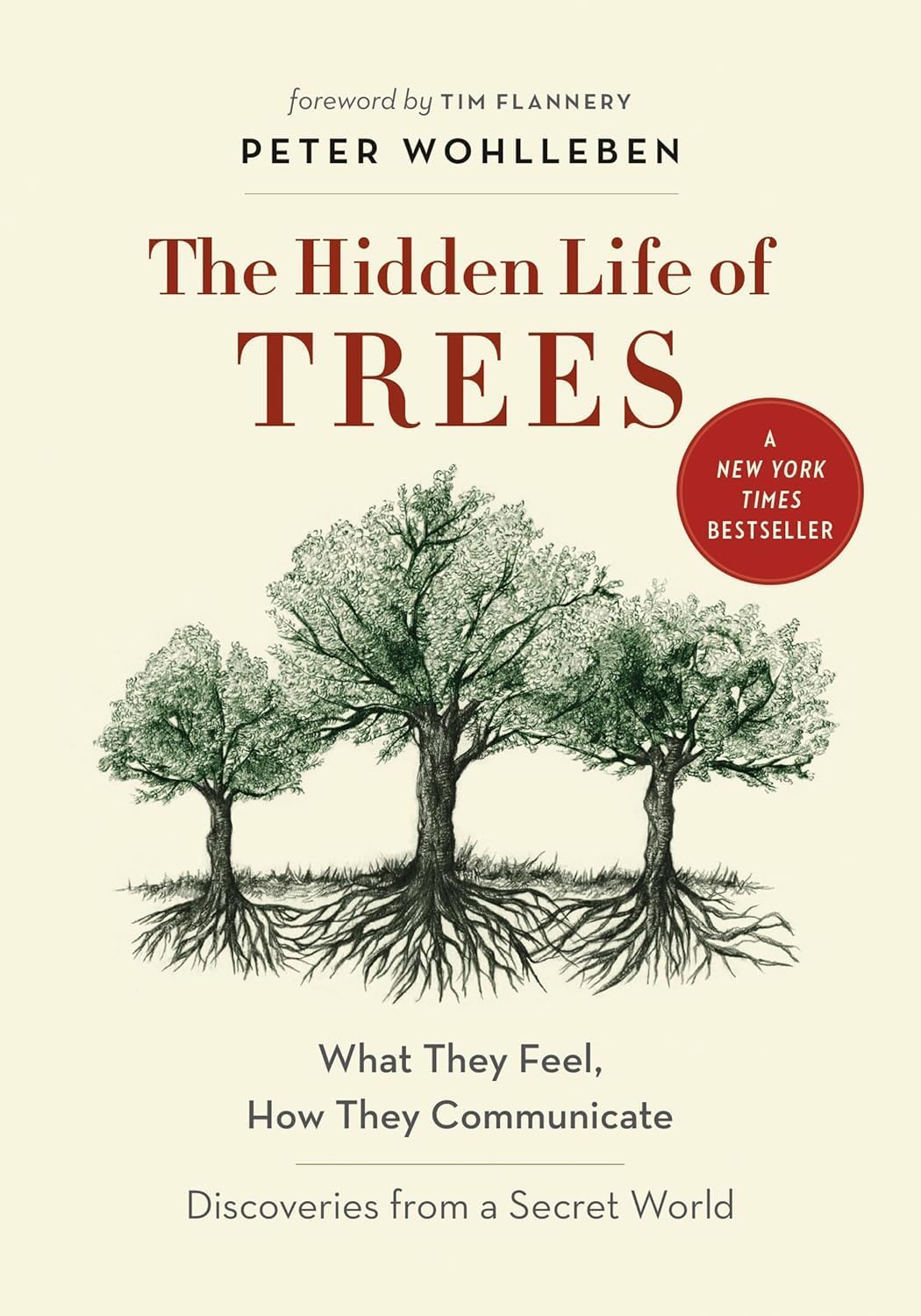
The Hidden Life of Trees: What They Feel, How They Communicate―Discoveries from A Secret World: 1 (The Mysteries of Nature, 1)
Product ID: 51862097
🌲Reveals tree social networks
🏆Award-winning environmental insight
📚NYT & WSJ Bestseller
Desertcart purchases this item on your behalf and handles shipping, customs, and support to Tunisia.
🌿 Decode the secret social life of trees and never see forests the same way again!
The Hidden Life of Trees is a bestselling, award-winning exploration of how trees communicate and live in complex social networks. Written by forester Peter Wohlleben and supported by scientific research, this book transforms your understanding of forests, revealing the astonishing ways trees nurture, warn, and sustain each other. Perfect for environmentally conscious readers seeking a fresh perspective on nature’s mysteries.


| Best Sellers Rank | 53,520 in Books ( See Top 100 in Books ) 2 in Forestry & Silviculture 5 in Garden Plants 7 in Environmental Conservation |
| Customer Reviews | 4.5 out of 5 stars 13,335 Reviews |
S**S
Very enjoyable, engaging and accessible
I enjoyed this book very much - it certainly gives you a a different perspective on how trees grow and interact with each other and the environment. It's written in an engaging and accessible style, and structured so that you can dip in and out easily - the contents and index pages are very helpful in this respect. I actually read a couple of later chapters first as the titles sounded interesting, before returning to the beginning again. I also liked the way that page numbers are shown on the upper edges of the pages rather than at the bottom (apart from the first page in each chapter). There are a handful of good line drawings but I did feel that it was too sparsely illustrated; it's just a very minor criticism, though, as the text is the primary reason you'll buy this book - there are plenty of other books that illustrate trees in great detail. The physical quality of the book is very good, too - nice binding and paper, and a font that I found easy on the eye. As a companion to this book I also bought Understanding Roots: Discover How to Make Your Garden Flourish as I've always wondered what goes on underground - this gives a wonderful insight into the world of roots and was well worth buying too.
R**E
Walking in the woods will never be quite the same again
I have to say this is one of the most interesting books I have ever read. I am biased, trees have been a big part of my life but on almost every page there is new fact which has surprised or intrigued me. It is interesting how this book has divided opinion with some people thinking much of it to be unsubstantiated and promoting ideas which are rubbish or crazy Firstly there are a lot of scientific and research papers quoted to back up statements in the book - so don't quite go along with those who complain it doesn't. Yes the author does have some quite interesting and radical views on trees and how we should view this form of life. Personally I welcomed this and it is the main reason I bought the book. There is much we don't know about trees and I suspect there will be much more we do learn in the near future. We base all our understanding and judgement of life on the fact that a central brain and nervous system must be a higher form of life than one without - because that is what we know. It does not mean other forms of life could not be just as sophisticated in a different way. You don't have to agree with the author but I found his ideas refreshing and thought provoking. If you want a boring book full of how to identify trees from leaves and bark then don't buy this. If you want a book that is going to try and make you think in a different way about the very different but fascinating life forms we share this planet with and encounter every day - then read it.
B**S
Fascinating and accessible read if you’re a tree lover.
The book was fascinating and gave me high level insight into trees as living beings that I had never read before. Definitely changes your view of trees in nature, farmed trees, and ornaments trees. That said, I found the overuse of anthropomorphism irritating at times. I do think it helps bring empathy and helps lay people understand the concepts, but it was used a lot. Still worth a read if you want to learn more about the natural world and it’s a very accessible book.
W**H
Very informative book
Excellent book based on careful academic research. The author (a state employed forester) found that managing a forest by medieval methods actually made it more productive - modern forest management methods are less effective and may have a detrimental long term impact. Full of interesting information with references to the pertinent academic papers, yet simultaneously easy to read.
T**L
You don't have to be a tree hugger... :P
You don't have to be a tree hugger to enjoy this book..;) I first stole a glance at some of these pages from a stranger who was reading this on the tube. I remember overlooking her shoulder and just scan reading and i was hooked. I couldn't believe what was being revealed about trees. So now years later this popped up as a recommendation from Amazon I am continue to be baffled by what I'm learning and trust me it's been a LONG time since I've been looking forward to bedtime reading. You will love this if you are remotely intrigued by how nature works and how the rest of the world corresponds to nature and all that we are. It'll leave you with a new sense of respect and wonder for mother nature, trees and how nature works as a whole. The author has done a beautiful job and writing in such a captivating manner about this subject. *I always joked that trees fall in love with one another when I'd see two trees across each other bend and almost kneel towards one another till their branches intertwined. Now I know i was into to something.. ;)
M**M
Readers who have criticised this book for being anthropomorphic......
Readers who have criticised this book for being anthropomorphic seemed to have missed the authors point. One of the largest issues our environment faces today is that it is still seen as a commodity rather than as a living breathing entity for which we are dependant. This may be, and with trees in particular due to the fact that they are so slow growing to the point they almost seem inert and as a result we see them as objects rather than living breathing systems. As the author writes "the wood that crackles on the fire is seen as just that, an object for our use rather than the corpse of what was once alive". A little bit like pig and pork. With this type of 'objectifying' our regard for other is dismissed and has led to much of the destruction that we see today hence the authors approach to writing a book that paints a picture of these unique 'creatures' in an anthropomorphic way. It seems he writes in the hope of awakening our compassion gene to see trees for what they are and not for what we have culturally & scirntifically been conditioned to see. Of course the author acknowledges that we rely on organic materials from the environment to support us and for which we depend on but do we take more than we need? and what protections are there in place? He talks of a point in case of Switzerland where it is written into the constitution that "account is to be taken of the dignity of creation when handling animals, plants and other organisms", affording the same protections across the board. It is also only recently that something similar has happened in NZ and other parts of the world where they have attributed other such equal protections to rivers and the like. I really enjoyed this book it is packed full of wonderful research that has been done of recent, and also his own observations having spent much of his life managing mixed deciduous forests. And although i'm a little late to the table reading it, its all still very relevant. The only quibble I found when reading the Hidden life of trees, is that at times his writing was not clear in fact on occasion he seems to contradict himself in what he is saying and I had to reread some points over again to try and establish his conclusions. This was not because the writing is technical in any way but it is evident he is not trained in writing papers or thesis's on research undertaken, its not that the research is wrong its just that it isn't always presented as clearly as what it could be. His descriptions of process are also sometimes scant particularly in relation to the process of photosynthesis, how soil was initially formed and the way water moves in the tree. He started of with explanations of these processes but I found them grossly inadequate and maybe this is where the book would have benefited from more in-depth scientific explanations or maybe my expectations are too high after reading such books as 10 percent human, which written by an evolutionary biologist, elucidates research with a clarity and wisdom that makes the book a pleasure to read. However this sometimes lacked in reading the hidden life of trees. All in all though its a worthy read regardless of the occasional hiccups in the writing style and it has a wealth of information that will leave you observing and connecting with trees in a way that perhaps you never did.
D**R
Eye-opening
Radically changed the way I looked at trees and forests. Excellent explanation and presentation of a world in front of our eyes that we simply do not see.
R**N
A very interesting book, written by a keen and enthusiastic forester
A very interesting book, written by a keen and enthusiastic forester. However, Herr Wohlieben is definitely a forester rather than a scientist. The use of footnotes looks reassuring - until they are dispensed with after such phrases as: "Scientists believe pheromones in sweat are a decisive factor when we choose our partners…” (Chapter 2). No they don't: not only does our sweat not contain any pheromones, even if it did we couldn't sense it as we haven't the necessary hardware (a vomeronasal organ). Some of the footnotes are a bit flaky too e.g. in context footnote 45 looks like it should refer to some peer-reviewed paper based on research, in fact it's just a newspaper article. One note on the translation, looks like it was done of the US market so they've translated metric to tedious imperial units, "fall" for "autumn", and such things a plants called "pinesaps", which you won't find in any UK or European guide, though you will find yellow birdsnest, which happens to have the same lattin name; I wonder if the two are by any chance related?, So treat with care, but on the whole I learned a lot from the book and enjoyed the writer's company.
K**R
It's was a grateful reading. I hope to work with trees one day, and it was inspiring read this book.
It's was a grateful reading. I hope to work with trees one day, and it was inspiring read this book.
K**R
Beautiful insights, Uplifting
Much of this information I've known for many years as an organic Gardener. That our species connections to the web of life is critical to our health and development continues to gain understanding and acceptance. Thank you Peter Wohllebens for your courage to diverge from the typical, limited forestry mindset that focuses on maximizing harvest revenues. Your discoveries have gained traction and enabled a growing understanding of our interdependence with nature.
R**R
Great book for the interested
I have read around 50 pages so far. It is perfect for people interested in forests trees and nature. It is very easy to read with chapters each around 4-5 pages and gives very interesting facts about trees and forests. Minus points for amazon sticking two ugly stickers to the book sleeve
R**)
Perfect Excellent Unforgettable
As a young lad in Germany, Peter Wohlleben loved nature. He went to forestry school, and became a wood ranger. At this job, he was expected to produce as many high quality saw logs as possible, with maximum efficiency, by any means necessary. His tool kit included heavy machinery and pesticides. This was forest mining, an enterprise that ravaged the forest ecosystem and had no long-term future. He oversaw a plantation of trees lined up in straight rows, evenly spaced. It was a concentration camp for tree people. Wohlleben is a smart and sensitive man, and over the course of decades he got to know the tree people very well. Eventually, his job became unbearable. Luckily, he made friends in the community of Hümmel, and was given permission to manage their forest in a less destructive manner. There is no more clear-cutting, and logs are removed by horse teams, not machines. In one portion of the forest, old trees are leased as living gravestones, where families can bury the ashes of kin. In this way, the forest generates income without murdering trees. Wohlleben wrote The Hidden Life of Trees, a smash hit in Germany. It will be translated into 19 languages. The book is built on a foundation of reputable science, but it reads like grandpa chatting at fireside. He’s a gentle old storyteller explaining the wondrous magic of beautiful forests to befuddled space aliens from a crazy planet named Consume. He teaches readers about the family of life, a subject typically neglected in schools. Evergreen trees have been around for 170 million years, and trees with leaves are 100 million years old. Until recently, trees lived very well without the assistance of a single professional forest manager. I’m serious! Forests are communities of tree people. Their root systems intermingle, allowing them to send nutrients to their hungry children, and to ailing neighbors. When a Douglas fir is struck by lightning, several of its close neighbors might also die, because of their underground connections. A tribe of tree people can create a beneficial local climate for the community. Also underground are mycelium, the largest organisms yet discovered. One in Oregon weighs 660 tons, covers 2,000 acres (800 ha), and is 2,400 years old. They are fungi that send threads throughout the forest soil. The threads penetrate and wrap around tree roots. They provide trees with water, nitrogen, and phosphorus, in exchange for sugar and other carbohydrates. They discourage attacks from harmful fungi and bacteria, and they filter out heavy metals. When a limb breaks off, unwelcome fungal spores arrive minutes later. If the tree can close off the open wound in less than five years, the fungi won’t survive. If the wound is too large, the fungi can cause destructive rot, possibly killing the tree. When a gang of badass beetles invades, the tree secretes toxic compounds, and sends warnings to other trees via scent messages, and underground electrical signals. Woodpeckers and friendly beetles attack the troublemakers. Forests exist in a state of continuous change, but this is hard for us to see, because trees live much slower than we do. They almost appear to be frozen in time. Humans zoom through life like hamsters frantically galloping on treadmill, and we blink out in just a few decades. In Sweden, scientists studied a spruce that appeared to be about 500 years old. They were surprised to learn that it was growing from a root system that was 9,550 years old. In Switzerland, construction workers uncovered stumps of trees that didn’t look very old. Scientists examined them and discovered that they belonged to pines that lived 14,000 years ago. Analyzing the rings of their trunks, they learned that the pines that survived a climate that warmed 42°F, and then cooled about the same amount — in a period of just 30 years! This is the equivalent of our worst-case projections today. Dinosaurs still exist in the form of birds, winged creatures that can quickly escape from hostile conditions. Trees can’t fly, but they can migrate, slowly. When the climate cools, they move south. When it warms, they go north, like they are today — because of global warming, and because they continue to adapt to the end of the last ice age. A strong wind can carry winged seeds a mile. Birds can carry seeds several miles. A beech tree tribe can advance about a quarter mile per year (0.4 km). Compared to trees, the human genome has little variation. We are like seven-point-something billion Barbie and Ken dolls. Tree genomes are extremely diverse, and this is key for their survival. Some trees are more drought tolerant, others are better with cold or moisture. So change that kills some is less likely to kill all. Wohlleben suspects that his beech forest will survive, as long as forest miners don’t wreck its soil or microclimate. (Far more questionable is the future of corn, wheat, and rice, whose genetic diversity has been sharply reduced by the seed sellers of industrial agriculture.) Trees have amazing adaptations to avoid inbreeding. Winds and bees deliver pollen from distant trees. The ovaries of bird cherry trees reject pollen from male blossoms on the same tree. Willows have separate male trees and female trees. Spruces have male and female blossoms, but they open several days apart. Boars and deer love to devour acorns and beechnuts. Feasting on nuts allows them to put on fat for the winter. To avoid turning these animals into habitual parasites, nuts are not produced every year. This limits the population of chubby nutters, and ensures that some seeds will survive and germinate. If a beech lives 400 years, it will drop 1.8 million nuts. On deciduous trees, leaves are solar panels. They unfold in the spring, capture sunlight, and for several months manufacture sugar, cellulose, and other carbohydrates. When the tree can store no more sugar, or when the first hard frost arrives, the solar panels are no longer needed. Their chlorophyll is drained, and will be recycled next spring. Leaves fall to the ground and return to humus. The tree goes into hibernation, spending the winter surviving on stored sugar. Now, with bare branches, the tree is far less vulnerable to damage from strong winds, heavy wet snows, and ice storms. In addition to rotting leaves, a wild forest also transforms fallen branches and trunks into carbon rich humus. Year after year, the topsoil becomes deeper, healthier, and more fertile. Tree plantations, on the other hand, send the trunks to saw mills. So, every year, tons of precious biomass are shipped away, to planet Consume. This depletes soil fertility, and encourages erosion. Plantation trees are more vulnerable to insects and diseases. Because their root systems never develop normally, the trees are more likely to blow down. From cover to cover, the book presents fascinating observations. By the end, readers are likely to imagine that undisturbed forests are vastly more intelligent than severely disturbed communities of radicalized consumers. More and more, scientists are muttering and snarling, as the imaginary gulf between the plant and animal worlds fades away. Wohlleben is not a vegetarian, because experience has taught him that plants are no less alive, intelligent, and sacred than animals. It’s a wonderful book. I’m serious!
P**Y
Excellent book
I think we should all read a book like this at least once in a lifetime. Or at least be taught the way the author writes about trees. From the interesting relationships trees carry out with other species ranging from cooperation to competition, going to how important trees are to our ecology and simply learning about how trees are not that different to animals or even to us; I have found this book to be amazing and so beautiful. I enjoyed it a lot. It simply left a mark.
Trustpilot
1 week ago
2 days ago