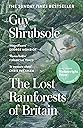
‘The Lost Rainforests of Britain’ by Guy Shrubsole charts the author’s awakening to the ‘lost worlds’ of Britain and reflects the dedicated and personal journey that he made to appreciate and love the temperate rainforests that once dominated Britain. Although Shrubsole notes early in his text that ‘Few people realise that Britain harbours fragments of a globally rare habitat: temperate rainforest’, my feeling is that this awareness is expanding and growing- more so in recent months, with more and more of these texts breaking into the public awareness. Education, appreciation and love of the rainforests and the natural world are all core concepts explored in the book. ‘So much has been lost; so little remains.’ The, at best, indifferent attitude to the protection of temperate rainforests in Britain over the centuries has led to a devasting decline in their existence. The transactional relationship and exploitation of nature for our own resources has reinforced the dangerous belief that humanity stands proudly above the other species of this planet and that this planet is in some way ‘ours’, to do with as we please. Shrubsole notes that although Britain lies in a ‘bioclimatic zone’, which lends itself to the promotion of temperate rainforests, of about 11 million acres of Britain or a ‘staggering 20 per cent of the country’, the existence of rainforests remains solely in isolated pockets- mainly on the western coastal areas. ‘Over the millenia, we’ve destroyed our rainforests, so that now only tiny fragments and relics remain. We’re so unfamiliar with these enchanting places, we’ve forgotten they exist.’ Shrubsole is not afraid to pin the blame on humanity’s actions, ‘But we didn’t just lose our rainforests through some tragic accident. We actively destroyed them.’ It is important to appreciate the intentional nature of the actions which led to this reduction of temperate rainforest. The two culprits examined in depth in this book are the overgrazing done by sheep and deer, as well as the unchecked proliferation of rhododendron. He comments that, ‘Out of the 74,000 acres of temperate rainforest left in Scotland, around 40 per cent is estimated to be infested with rhododendron.’ ‘Britain was once a rainforest nation. But we lost most of our rainforests.’ Although the physical evidence of rainforests is now reduced, Shrubsole champions movements and pressure groups whose focus is the rewilding of the country, to recover what has been lost. ‘A habitat that once flourished over perhaps a fifth of Britain has been reduced to scattered fragments covering less than 1 per cent of the country.’ He convincingly argues that the cultural memory of a landscape covered with rainforests is still there, if we know the clues to conduct an effective search, but for the majority, this is something that has been forgotten. ‘This loss of cultural memory, this great forgetting that we once had rainforests, is almost as heartbreaking as the loss of the forests themselves.’ In order to find these clues, he fully analyses a number of place names, through linguistic archaeology, from Celtic and Viking origins, to demonstrate that names on maps can hold the key to the past. This was a really exciting part of the text for me, one which I thoroughly enjoyed- that the memory of what our landscape was once like, can still be found in plain sight through place names, is a fascinating area to explore. Although Shrubsole acknowledges clearly that, ‘The awful truth is that we destroyed them,’ he alsosimultaneously argues that can also be the agents of restoration. ‘If we are to stand any chance of restoring our lost rainforests, we first need to remember we once had them.’ Britain is a land full of myths surrounding trees and nature. Through the works of Tolkien, modern generations have been introduced to living trees, who have underestimated power. We are also privileged enough to have the Welsh text of ‘The Mabinogion’ to be our guide. We forget that we are also a land which has been a fusion of cultures for centuries. The Norse influence- also to be found in place names- continues to be present in modern life in the UK, with days of the week named after Norse Gods, as well as their central belief of the Yggdrasil- the tree of life. In Christian mythology, trees also figure significantly- with many homes and churches decorated with wooden crosses, symbols of the possibility of a new life. Alongside this iconography, we also see the image of the Green Man, once more hidden in plain sight. Shrubsole celebrates that this connection still exists and when discussing mythologies, argues that the power of an old story told anew may well be essential in our present world, beset with various crises. ‘It’s that these stories contain a deep love of place, infusing the real world with sacred meaning. In a time of ecological crisis, that’s a story we badly need to relearn.’ ‘I am the Lorax. I speak for the trees. I speak for the trees, for the trees have no tongues.’ One story which we could well to ‘relearn’ might be that of Dr Seuss’s ‘The Lorax’. For various generations, the loss of nature through the actions of capitalist industrialists, has been a memorable story. We are moved by the empty countryside and far-reaching ecological damage. We are left with the hopeful message that, ‘“Unless someone like you cares a whole awful lot, Nothing is going to get better. It’s not.”’ It is clear that Shrubsole ‘cares a whole awful lot’. From the dedication in mapping the possible rainforest zones, to the simple delight that a sighting of a lichen can bring, it is clear that a connection with nature is enriching. Shrubsole comments, ‘Temperate rainforests are full of gifts for those who visit them.’ He contends that visits to rainforests can be affirming, ‘You’ll return from a visit to a British rainforest soaked from head to toe, but feeling all the more alive for it.’ However, Shrubsole also highlights that access to the countryside and to Britain’s temperate rainforests can be problematic at best. ‘But if you want to see much of the English countryside, you need to trespass. We still only have a Right to Roam over 8 per cent of England; over the other 92 per cent, the law of trespass still reigns supreme.’ In January 2023 in England, access to the countryside was further limited when a ban on wild camping on Dartmoor was imposed. This now means that there is no place in England and Wales to legally wild camp. There is an irony that humans are now being excluded from nature, when before exclusion fences limited wildlife from damaging saplings and allowed the regrowth of nature. When access is granted- or circumvented- Shrubsole describes a temperate rainforest world that is ‘both familiar and strangely alien.’ His enjoyment comes from the observation of the tiny details of these rainforest ecosystems- details which are lost when the re-introduction of large animals make for better publicity. ‘It feels to me that we need to become much more interested in the minutia of the natural world around us. The little things are just as important as the charismatic megafauna.’ Our Once and Future Home ‘The Lost Rainforests of Britain’ then is a book which both reflects on the past and looks hopefully forwards. Shrubsole argues passionately that ‘We have a moral obligation to try and repair the damage caused by our ancestors.’ Perhaps we could extend this further into a moral obligation to our descendants to restore temperate rainforests, even if it takes centuries. Shrubsole is cautious about the ingrained, simple narrative of tree plantations, arguing that a dynamic ecosystem is one that can be self-regulating and self-renewing, full of species to appreciate and marvel at. ‘Our temperate rainforests support an abundance of life. They teem with hundreds of species of lichen, many of which are deemed by ecologists to be of international importance.’ He closes the book optimistically, highlighting that given a small chance, nature can renew itself, as it has done through time. ‘[I]t demonstrates how quickly woodland can naturally regenerate when it’s given half a chance.’ Granting nature a chance is a common refrain in ecological books and Shrubsole argues that it can be easy to forget that ‘life finds a way.’ ‘We can also overlook the gradual resurgence of nature, and forget its powers of renewal.’ He does not advocate that humans should just step back entirely and let nature take its course, but instead advocates for community engagement and a new form of ‘social commons’, which allows rainforests and humans to work together, perhaps in the most symbiotic manner that has ever been attempted. ‘But to have any hope of success, rainforest restoration has to be done with people at its heart. If we’re to bring back our lost rainforests, it’ll prove impossible to do so without the active engagement of the communities who live in and around them.’ ‘A society grows great when old men plant trees in whose shade they shall never sit.’