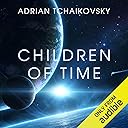
Children of Time: Children of Time, Book 1
Product ID: 52683642
Adrian Tchaikovksy's critically acclaimed stand-alone novel Children of Time is the epic story of humanity's battle for survival on a terraformed planet. Who will inherit this new Earth? The last remnants of the human race left a dying Earth, desperate to find a new home among the stars. Following in the footsteps of their ancestors, they discover the greatest treasure of the past age - a world terraformed and prepared for human life. But all is not right in this new Eden. In the long years since the planet was abandoned, the work of its architects has borne disastrous fruit. The planet is not waiting for them pristine and unoccupied. New masters have turned it from a refuge into mankind's worst nightmare. Now two civilizations are on a collision course, both testing the boundaries of what they will do to survive. As the fate of humanity hangs in the balance, who are the true heirs of this new Earth? Review: Now come on children, it’s time to settle down with a good book - What makes a "good book" is a very subjective thing. What makes a "great" book you could argue is even more subjective. Though others might try to distill the qualities of a great book down to highbrow facts as they try to intellectualise their emotional reaction, for me it is, "does it make me want to keep turning the pages?" Do I want to forgo sleep so I can feed the insatiable appetite of needing to know what happens next? Am I eager to sneak away on my lunch break so I can slip back into a world I so reluctantly had to abandon at the office door. This is fundamentally what tells me whether a book is good or not. But what makes me keep turning those pages... ah, now that is a very subjective matter. Children of Time is one of those books that you really don't want to give too much (if anything) away about the plot when speaking about it. Particularly if you want others to read it and get the same emotional experience as you did. I first heard about the book when doom scrolling through other peoples top 10 sci-fi books and saw this one kept popping up. So after over indulging in too many retro 90s detective books I decided a palate cleanser was in order. Without too much second guessing, I lept in and found myself entangled in a web of future imaginings and temporal sky hopping, that was nearly impossible to get out of. Now when reading other reviews you will hear people say that this book has "great evolutionary world building", is "massive in scope and ideas", and that it poses some deep human philosophical questions of the ages. And in fairness to those reviewers I agree, it does all that, it does all that and more! But for me it was the incredible story told through the many eyes of the incredible main characters. Following their stories and their emotional evolution, is what made me want to keep turning those pages and keep burning that midnight oil. I found myself leapfrogging alternate chapters as I was keen to know how certain characters' stories played out and could not bear the tension built up by the alternating chapter approach the author took to his storytelling. Of course I immediately went back to pick up the other story threads and found myself equally invested in what I had earlier pushed out of the way. That is how good the storytelling is, and how engaging his characters are. Now you will find you gravitate more to one set of characters in this book than another, as Adrian Tchaikovsky's skillfully uses them to carry forward different philosophical arcs, but he never lets that overwhelm his incredible ability to tell a very dramatic, emotional story. And it really was this that made me turn those pages. And ok, if I am being honest I did fall in love with 3 of the most delicately written characters that moved me to tears on so many occasions. And for me, particularly with this book, it was the emotional wranglings of the author that kept me hooked. The way chapters would end on a cliff hanger or with a dramatic reveal, that kept me saying "just one more chapter before I go to bed". The way he knew how to tug at the heart strings just as much as he knew how to spike those adrenaline levels. He knew what buttons to press and how best to calm those fraying nerves. Now if you are not a sci-fi reader, or are considering this book as a way to help alleviate the effects of a recent book hangover, then can I just say please give it a go. The science is accessible and the emotional storytelling is universal, no matter which characters you follow. You will find yourself challenged as well as entertained. It will make you think about our own evolution and how present our own world is in the future Adrian Tchaikovsky's writes about. And most important of all, it will stay with you long after you finish the final chapter... and that is for me what tips this book over from being "good" to being "great". Review: Captivating Universe, Fantastic Story progression, Dissappointing Ending - A great book that uses many science concepts including interstellar travel, terraforming, evolution, AI, generation ships and suspended animation to great effect. The book consists of 2 connected story arks. That of the spiders and the humans. My favourite part of the book was watching the development of the spider civilisation. The author skips between eons in the advance of the spider civilisation and the depth and imagination that he goes into to describe their society, customs and psychology is quite staggering. The human story arc is a little more mundane in comparison but the characters are still quite believable, especially the protagonist. The second half of the book is a little more disappointing and the description of the ships society on the return trip seems a little hurried. The conclusion especially is somewhat unsatisfying given the scale and complexity of the story up until then. Overall it is still an entertaining read however. It successfully immerses you into an alien universe and that is believable and truly expanded my own imagination in terms of real possibilities for alien civilization and directed panspermia.
S**X
Now come on children, it’s time to settle down with a good book
What makes a "good book" is a very subjective thing. What makes a "great" book you could argue is even more subjective. Though others might try to distill the qualities of a great book down to highbrow facts as they try to intellectualise their emotional reaction, for me it is, "does it make me want to keep turning the pages?" Do I want to forgo sleep so I can feed the insatiable appetite of needing to know what happens next? Am I eager to sneak away on my lunch break so I can slip back into a world I so reluctantly had to abandon at the office door. This is fundamentally what tells me whether a book is good or not. But what makes me keep turning those pages... ah, now that is a very subjective matter. Children of Time is one of those books that you really don't want to give too much (if anything) away about the plot when speaking about it. Particularly if you want others to read it and get the same emotional experience as you did. I first heard about the book when doom scrolling through other peoples top 10 sci-fi books and saw this one kept popping up. So after over indulging in too many retro 90s detective books I decided a palate cleanser was in order. Without too much second guessing, I lept in and found myself entangled in a web of future imaginings and temporal sky hopping, that was nearly impossible to get out of. Now when reading other reviews you will hear people say that this book has "great evolutionary world building", is "massive in scope and ideas", and that it poses some deep human philosophical questions of the ages. And in fairness to those reviewers I agree, it does all that, it does all that and more! But for me it was the incredible story told through the many eyes of the incredible main characters. Following their stories and their emotional evolution, is what made me want to keep turning those pages and keep burning that midnight oil. I found myself leapfrogging alternate chapters as I was keen to know how certain characters' stories played out and could not bear the tension built up by the alternating chapter approach the author took to his storytelling. Of course I immediately went back to pick up the other story threads and found myself equally invested in what I had earlier pushed out of the way. That is how good the storytelling is, and how engaging his characters are. Now you will find you gravitate more to one set of characters in this book than another, as Adrian Tchaikovsky's skillfully uses them to carry forward different philosophical arcs, but he never lets that overwhelm his incredible ability to tell a very dramatic, emotional story. And it really was this that made me turn those pages. And ok, if I am being honest I did fall in love with 3 of the most delicately written characters that moved me to tears on so many occasions. And for me, particularly with this book, it was the emotional wranglings of the author that kept me hooked. The way chapters would end on a cliff hanger or with a dramatic reveal, that kept me saying "just one more chapter before I go to bed". The way he knew how to tug at the heart strings just as much as he knew how to spike those adrenaline levels. He knew what buttons to press and how best to calm those fraying nerves. Now if you are not a sci-fi reader, or are considering this book as a way to help alleviate the effects of a recent book hangover, then can I just say please give it a go. The science is accessible and the emotional storytelling is universal, no matter which characters you follow. You will find yourself challenged as well as entertained. It will make you think about our own evolution and how present our own world is in the future Adrian Tchaikovsky's writes about. And most important of all, it will stay with you long after you finish the final chapter... and that is for me what tips this book over from being "good" to being "great".
A**L
Captivating Universe, Fantastic Story progression, Dissappointing Ending
A great book that uses many science concepts including interstellar travel, terraforming, evolution, AI, generation ships and suspended animation to great effect. The book consists of 2 connected story arks. That of the spiders and the humans. My favourite part of the book was watching the development of the spider civilisation. The author skips between eons in the advance of the spider civilisation and the depth and imagination that he goes into to describe their society, customs and psychology is quite staggering. The human story arc is a little more mundane in comparison but the characters are still quite believable, especially the protagonist. The second half of the book is a little more disappointing and the description of the ships society on the return trip seems a little hurried. The conclusion especially is somewhat unsatisfying given the scale and complexity of the story up until then. Overall it is still an entertaining read however. It successfully immerses you into an alien universe and that is believable and truly expanded my own imagination in terms of real possibilities for alien civilization and directed panspermia.
B**D
Best SF Book of the 21st Century
So pleased to have discovered a modern SF author who writes in an engaging way while describing complex characterisations. It’s an entertaining, thought provoking and compelling read ... unputdownable. Somehow I never realised I’d read 657 pages without for a moment thinking its too long. Imaginative and enthralling. At no point did I ever lose the plot despite its length. A worthy winner of the Arthur C Clarke Ward for best SF Novel. A modern masterpiece regardless of genre. Highly recommended ... 5 stars and deserved more.
A**E
Not just a worthy Clarke Award winner but a successor to the man himself
‘Children of Time’ is one of those books one devours obsessively and then mourns once it’s finished. Such has been its impact that I don’t know what to read next (apart from more of this author’s books). Either way, I’ve had to go off-genre and read a bloody thriller for my next book. Yes, ‘Children of Time’ is that good. It’s a tale of hyper evolution that brings to mind classics like ‘2001’ and ‘Last & First Men’. However, where those epics took the whole of humanity as a character, this more contemporary approach uses characters waking at centuries or even millennial intervals on a bodged-together ark ship alternating with the results of a terraforming experiment that benefit from a nano-virus that enabled enhanced mental and physical development. That these results are not the ones intended is the great gag underpinning a narrative that is full of sly but elegant humour, itself an expression of a kind of benevolent, patient despair. I don’t think it’s any great spoiler to say that when the monkeys who were originally meant to inhabit the distant terraformed world burn up on entry as a result of resonantly Trumpish stupidity on the part of those meant to support and protect them, it falls to the spiders who were originally included as a background species to take up the mantle of civilisation. And take it up they do, in a bravura sequence of literal and exquisite world-building that spans the whole book, from an early huntress using her limited allocation of neurons to bring down a bigger spider to the great leaders, scientists and revolutionaries of the later chapters. The author acknowledges our implicit arachnophobia and then very cleverly turns it on its head; indeed, after a while you kind of forget that these characters are spiders at all, even when they get stuck in to very spiderish behaviour. Their cities, for example, are great forests festooned with web complexes and, latterly, organic machinery and vehicles. The many versions of the spider society are also resolutely female and this novel is one of the few I can think of (the later ‘Dune’ novels and, more recently, Chris Beckett’s ‘Dark Eden’) that presents a detailed, believable and sympathetic matriarchy. That it is in not in any way a utopia, without seeming unrecognisable or awful either, is another credit to the unapologetic intelligence of this book. The ark ship is no less fascinating and, deep down, no less matriarchal despite the commander being wholly and, increasingly dreadfully male. The one they all turn to, the one they all rely on, is the crotchety, brilliant Engineering Chief, Lain. Full marks for depicting an engineering heroine; we need more both in fiction and life. Like the female protagonist of ‘Wool’ Lain uses believable and convincing means to overcome the banal but terrifying obstacles of her lethal, alien environment. Lain’s story is entwined with that of Mason, scholar of the lost Terran Empire that spawned the converted planet. Theirs is a wonderful story, arguably more moving than even ‘The Forever War’ as they dip in and out of time, grouching, bitching and falling – literally hopelessly – in love. The same chapter sequence that contains a lovely climax in which Mason frets about not having his ship suit only to find that Lain, ahead of him now in years, has been using it as a shawl, also includes an even more devastating sequence in which two spiders in their species’ first trip into space run into trouble and must take desperate measures to survive. The resolution of this short sequence, in which the two spider characters, who share the names of their forebears (the bold hunter/leader/priestess is always called Portia, the too-clever-for-her-own-good sexy scientist is always Bianca and the trickster male is always Fabian), succeed in their mission but at terrible expense. The blend of foreshadowed and familiar spider behaviour with intelligence and noble sacrifice is made all the more beautiful by communion with their orbiting god. My favourite novel published last year was Emma Newman’s ‘Planetfall’, which also looked at religion through a sympathetic SF prism. I originally mistyped this novel’s title as ‘Children of God’, giving an idea of the heft the author’s ironic but calm exploration of belief carries in this story. The original terrorists’ acronym is NUN; not a good start admittedly. However, as the scientist behind the terraforming project blends over time in her orbiting capsule with the computer system she has uploaded herself into she becomes an object of worship to the creatures below. That god and creations totally misunderstand each other leading to a spiderishly polite version of holy war is another of the great jokes here; the scientist thinks she is communicating with the descendants of the original monkeys, not the spiders who have a totally different kind of intelligence. Similarly, the mission commander of the appropriately-named ark ship Gilgamesh, frustrated at mortality, attempts an upload like that of the ancient orbiting scientist with similarly horrific results. He believes he is doing the right thing and Mason comes to agree; however, the commander, like the scientist he seeks to emulate, has tragically gone beyond the ability of the human mind to cope. Meanwhile, cults in the human and spider civilisations rise and fall, driven both by the need to comprehend the infinite and also, in many instances, as a means of survival. The moral compass, we feel, is no less easy to negotiate than a journey through space. I’ve referenced a few different novels here, not because ‘Children of Time’ is in any way derivative; it is wholly and satisfyingly original. Rather it is an extraordinary book that is easily their equal; one that embodies a joy in language as a means of expressing great ideas and even greater feelings, usually at the same time. This is my book of the year so far. Get it.
V**O
An excellent piece of hard SF, not quite 5 stars but close!
Humanity has reached levels of technology that are verging on godlike and now, having found no other life in the galaxy, they are using those abilities to really play god; attempting to raise Terran monkeys to full sentience on a terraformed planet far from Sol. Meanwhile back at the solar system humanity’s continuous bickerings really do look like they might put an end to the human race this time. Leaving only a few humans on Earth reduced to savages clawing their way back to technology and escaping the poisoned Earth that they have inherited. They head for the only other terraformed planet they know of. Only the great experiment there went a little wrong and instead of sentient monkeys we have sentient spiders. Not recommended for suffers of arachnophobia! Tchaikovsky has created a brilliant piece of hard science fiction that explores all that’s best and worst in humanity contrasting it with the evolving arachnid civilisation; the story alternating between the human refugees’ point of view and that of the spiders. The refugees’ single ark ship is old and failing and the only habitable planet around is already occupied. All the science and lack of it is completely plausible and all the actions and motivations of both the humans and spiders is equally plausible. I had to do little or no suspension of disbelief whilst reading Children of Time which is exactly how I like my science fiction and it’s particularly surprising coming from an author all of whose prior output has been fantasy. The writing is fluid, the characters, both human and alien, interesting and well filled out and, whilst the final denouement was moderately inevitable, the route to it was filled with twists and turns that definitely weren’t predictable. I am only a little surprised (and disappointed) that despite leaving everything open for a sequel there appears to be no intent to produce one. He has, however, written some further SF since Children of Time so I will certainly be taking a look at that.
S**E
Best sci-fi book on the web.
This is a superb story and a very satisfying read. There are ideas here I've not encountered before coupled with good writing and excellent story telling. Some decent surprises as well. This is a story of the rise of a new civilisation coming into conflict with a generally decaying civilisation light years apart. A super technically advanced Earth has terra-formed a series of planets and allocated one of them to a scientific experiment to study the evolution of primates at an accelerated pace, with no influences by man to guide or steer them. For this you need three things - a nano/neuro virus that accelerates evolution, the banning of any humans landing on the planet until the experiment is complete and an insane guardian in permanent orbit intent of destroying anything that threatens the experiment. The fact the guardian is unaware that the seed monkeys all died crash landing is a problem that has massive consequences. As is the fact the virus evolves to affect creatures other than the monkeys. In parallel to that is the story of the space ark "Gilgamesh". With 500,000 people on board in suspended animation, they are one of several arks heading out to space to save the human race. Back on Earth an apocalypse had reduced the Earth to a very small liveable area and destroyed the highly technologically savvy civilisation that terra-formed the distant planets. As life on Earth becomes untenable for the remnants of that destroyed high culture, the humans must re-learn how to travel in space and get as many people off the planet as possible. So it is that the people of the Gilgamesh are aiming towards what they believe is an Earth-like and empty planet paradise and an unexpected conflict with the insane guardian and the rising civilisation on the planet. The story is cleverly told from the perspective of a few characters from both the Gilgamesh and on the planet, over the period of millennia. The Gilgamesh crew are awakened periodically to find all sorts of assaults on their way of life, their common cause, culture and civilisation. This is very disorientating as the crew wake to find decades, hundreds or even thousands of years have passed since the last time they "went to sleep" and things have changed drastically since "yesterday". The rising civilisations on the planet are viewed many generations apart and the virus aided evolutions are witnessed in the form of the surprising developments within the biology's, societies and cultures.. Whilst you can clearly see the conflict coming, both parties are equally likeable and loathsome and it is surprisingly hard to say for sure who you wish to win the prize of the planet as a home in the end. Excellently written, a real page turner and some thought provoking surprises, it is hard to think of a better sci fi book I have read in the last 30 odd years. It is also a complete, proper book. Something that is getting rarer on Kindle now-a-days. The end is the end. This story is complete. Buy it.
J**S
Way too much Telling not enough Showing. Author style and me are obviously not compatible. Shame
Children of Time is one of those books that I desperately wanted to love. The premise is absolutely brilliant, and the central concept is one of the most original I've come across in science fiction. The plot itself is clever, ambitious and incredibly well thought out. I have a degree in genetics so the science was a big draw for me too. Unfortunately, I think I've discovered that it's this author's writing style that doesn't quite work for me. There are long stretches of exposition explaining events that have already happened or describing what's taking place, rather than letting the story unfold naturally through the characters and their actions. A big example of Tell vs Show. I completely appreciate the complexity of the world-building, (especially the genetics!) but I found the constant explanations gradually sucked all the momentum from the story. I made it about three-quarters of the way through before admitting defeat. I still REALLY wanted to know how it ended, but I realised I was no longer looking forward to hitting play, and my attention kept drifting. It's a shame, because the ideas are outstanding and I can absolutely see why this book has such a devoted following. For me, though, the execution couldn't quite match the brilliance of the premise. A reluctant 3 stars from me—more for the incredible imagination and concept than for my enjoyment of the reading experience.
A**L
So I… Guess I like spiders now? #TeamPortia
Anyone who knows me will know I hate spiders. But at the same time, I am begrudgingly fascinated by them. I’ve been known to do quite a lot of research on spiders, and among my friends I’m the guy they turn to if they want to know what species of spider is terrorising them at home - though I won’t touch them… or go anywhere near them… Especially the big hairy house spiders that would sooner run at you than away from you and have legs that won’t fit nicely into a cup. I mean, just this morning (at the time of writing, so probably several days before I hit publish) my wife told me she got one out of the bath using a glass and as she went to release it outside, it splayed its legs so it wouldn’t come out! Horrid things. But jumping spiders: they’re a different thing entirely. The only ones I see regularly around my house are zebra spiders, and I could sit and watch them for ages. They’re amazing little critters. It’s no surprise really, because the jumping spiders are some of the most intelligent of their kin. So it’s also not surprising that the spiders that feature heavily in Children of Time as some of the main characters, are jumping spiders. Specifically of the species Portia Labiata. And I simultaneously love and hate Adrian for it. Children of Time is written in two distinct styles with chapters alternating between them: The story of humanity leaving a ravaged Earth to find a new home on a vast sleeper ship called the Gilgamesh is told in the past tense, and follows classicist Holsten Mason and the other key crew of the ship as the centuries go by on their journey. The story of the rising spider civilisation, on the other hand, is told in the present tense, and follows generations of Portias, Fabians and Biancas as they evolve from their tiny Earth-born ancestors to the metre-long super-intelligent inhabitants of their planet. I’ve seen a few people moan and gripe about the spider chapters being just big boring info-dumps, but to that I say “what rubbish!” They’re some of the best parts of the book! The way it’s told immediately gave me Attenborough-style nature documentary vibes (and it works very well, given the centuries of ground Adrian has to cover), and the shift to present tense makes sense given the Portids’ entirely different perception of things like the world around them and the passage of time. Adrian does an incredible job of giving us a wholly alien perspective, and as the quote on the cover from Peter F. Hamilton says, the evolutionary worldbuilding cannot be oversold. It’s rock-solid, meticulously researched, ruthlessly intelligent and at the same time you really do come to care about Portia and her kin as they go through this journey of wonder and discovery that is fraught with danger, disease and war. Another thing that surprised me about the book that is more personal to my journey as a writer, is how Adrian handled the downfall of Earth and the groups of people responsible. This all happens right within the first chapter of the book, so I wouldn’t really consider it a spoiler, but I’ll try and be as vague as possible. In my Augment Saga (in books still to be finished) I have a particularly troublesome idealistic organisation, and I had been fretting over whether it was realistic that these people could become a legitimately believable threat. Then, lo and behold, Adrian has a similarly idealistic group actually causing that Earth’s downfall in Children of Time. So I feel a lot better about it, and it has prompted me to go back and change the name of the group because mine seemed rather inelegant by comparison. This is where learning from other writers is a great benefit. You get to see how these concepts have been handled from a different perspective and that can help you work your way around fleshing out your own concepts in an “Oh, I didn’t consider that angle/aspect/consequence” sort of way. And, my word, the ending of this book. I honestly loved it. When I realised what was happening I just sat there with a goofy grin on my face because it was so brilliant. I could only aspire to write an ending like that. Bravo! Anyway, as you can tell, Children of Time comes highly, highly recommended. What a fantastic read, and I will absolutely be reading the follow-up Children of Ruin
B**D
Top Hard-SciFi
Tchaikovsky wie man ihn kennt: innovative Idee, spannend, ansprechend und Hard-SciFi mäßig umgesetzt! Sehr zu empfehlen! Man darf gespannt sein, wie es in der Serie weitergeht.
Y**R
If you don't hate yourself or humanity, skip this book
Overall, the book feels very anti-human. The author's "humanity is a plague" agenda is certainly not what I wanted to see in a sci-fi novel. The ending was deeply disappointing - while the author clearly intended for it to feel enlightened and hopeful, it actually makes it seem like he would simply prefer to be a spider himself. The only interesting part is on spider evolution - especially near the beginning. Those chapters were interesting to read. Still, it isn't worth going through a 600-page lecture on how terrible humanity is. If you don't hate yourself or humanity, skip this book!
T**S
Splendido libro fantascentifico
Le epopee spaziali, le opere che guardano a un futuro lontanissimo con la Terra ormai distrutta e l'umanità persa nello spazio, in lotta per la propria sopravvivenza durante archi di tempo lunghissimi, mi hanno sempre intimorito. Perché solitamente il risultato o è un capolavoro, o è un mattone indigeribile farcito di filosofia, politica, psicologia e quanto altro, noioso e infinito. Beh, questo libro ricade senza dubbio nella prima categoria. Ti cattura, ti costringe a procedere nella lettura, ti fa domandare di continuo quanto tempo passerà tra una parte e l'altra, quante generazioni saranno saltate, cosa sarà successo sul mondo di Kern e cosa sarà accaduto agli abitanti della Gilgamesh. Perché si, la Terra alla fine ha alzato bandiera bianca di fronte alla stupidità umana, e ormai è stata avvelenata oltre il punto di non ritorno. Fortunatamente però in passato l'umanità, all'apice del proprio splendore, aveva conquistato lo spazio e la genetica, iniziando missioni di terraformazione di molti lontani pianeti. Su uno di questi, la dotteressa Kern aveva preparato anche un nanovirus in grado di far evolvere rapidamente delle scimmie accellerandone il naturale sviluppo, così da poter avere in breve tempo una nuova specie di umani, che avrebbero potuto accogliere coloni terrestri. Poi le guerre, e sopratutto una sorta di guerra santa portata contro questi scienziati colpevoli di sovvertire l'ordine naturale delle cose, avevano rovinato tutto e precipitato l'umanità indietro di secoli. Fino alla sua fine. O quasi. Perché l'umanità è in qualche modo sopravvissuta, e ora i figli della vecchia umanità devono lottare per la sopravvivenza. L'unico problema è che i figli sono due. Il primo figlio è a bordo della nave stellare Gilgamesh, un'Arca contenente migliaia di umani in stasi, con un equipaggio pronto a essere risvegliato in caso di necessità, diretta verso mete lontane secoli, i sistemi dove un tempo gli antichi umani avevano preparato mondi dove spostarsi, prima che la guerra annientasse questi geniali scienziati. Qui troviamo il comandante in capo, il capo della sicurezza, gli ingegnieri esperti di sistemi informatici, l'umanista esperto di antichi linguaggi e di storia antica. Tutti a lottare per salvare la propria specie e la propria storia, alla ricerca di un pianeta abitabile dove risvegliare il proprio "cargo". Il secondo figlio invece è sul mondo della dottoressa Kern. Che non ha mai potuto portare a termine il proprio esperimento a causa di un sabotaggio, con le scimmie morte prima di arrivare al suolo, ma col nanovirus efficacemente sparso sul pianeta. Con un effetto imprevedibile, una volta entrato in circolo negli organismi che ha potuto trovare. Ragni senzienti in grado di ricordare il passato dei propri antenati e di accumulare conoscenze, formiche che operano con una grande mente collettiva. Insetti evoluti in grado di elaborare operazioni matematiche e concetti complessi, ma anche di usare la chimica e la fisica. E noi assistiamo prima alla morte della Terra, poi al viaggio della Gilgamesh e all'evoluzione della vita senziente sul mondo di Kern. Due figli della Terra, due specie totalmente differenti e incompatibili tra loro. Due forze destinate a incontrarsi, e a scontrarsi. Scritto benissimo, mantiene sempre vivo l'interesse (da una parte abbiamo lo stupore per la civiltà dei ragni e per le loro conquiste, dall'altro l'empatia per gli esuli terrestri e per le sfide che si ritrovano a fronteggiare) ed è emozionante. E in più, fino all'ultimo può finire in ogni modo. Spettacolare.
L**A
A clean, interesting read
My 13yo son is totally enraptured by this book and give me daily updates on the new developments with the characters. There is some profanity, but otherwise it is a clean read, free from on page romance
F**N
Dos historias que corren en paralelo y se cruzan de manera peculiar
Super entretenido libro de ciencia ficcion, personajes memorables, dos historias que corren en paralelo y se cruzan de manera peculiar. Contadas desde puntos de vista de los 2 personajes principales y los personajes que lo rodean. El final no me gusto pero es completamente gusto personal, esperaba que sucediera algo mas impresionante pero es una muy buena historia. Muy recomendado!
Trustpilot
2 weeks ago
4 days ago