A History of Christianity: The First Three Thousand Years
Product ID: 53150382
🌍Global scope from ancient Palestine to modern China
🏆Top 25k bestseller & #21 in Christian Church History
📚1000+ pages of deep historical insight
Desertcart purchases this item on your behalf and handles shipping, customs, and support to Tunisia.
📖 Unlock the untold story of Christianity’s 3,000-year global influence — don’t miss the history everyone’s talking about!
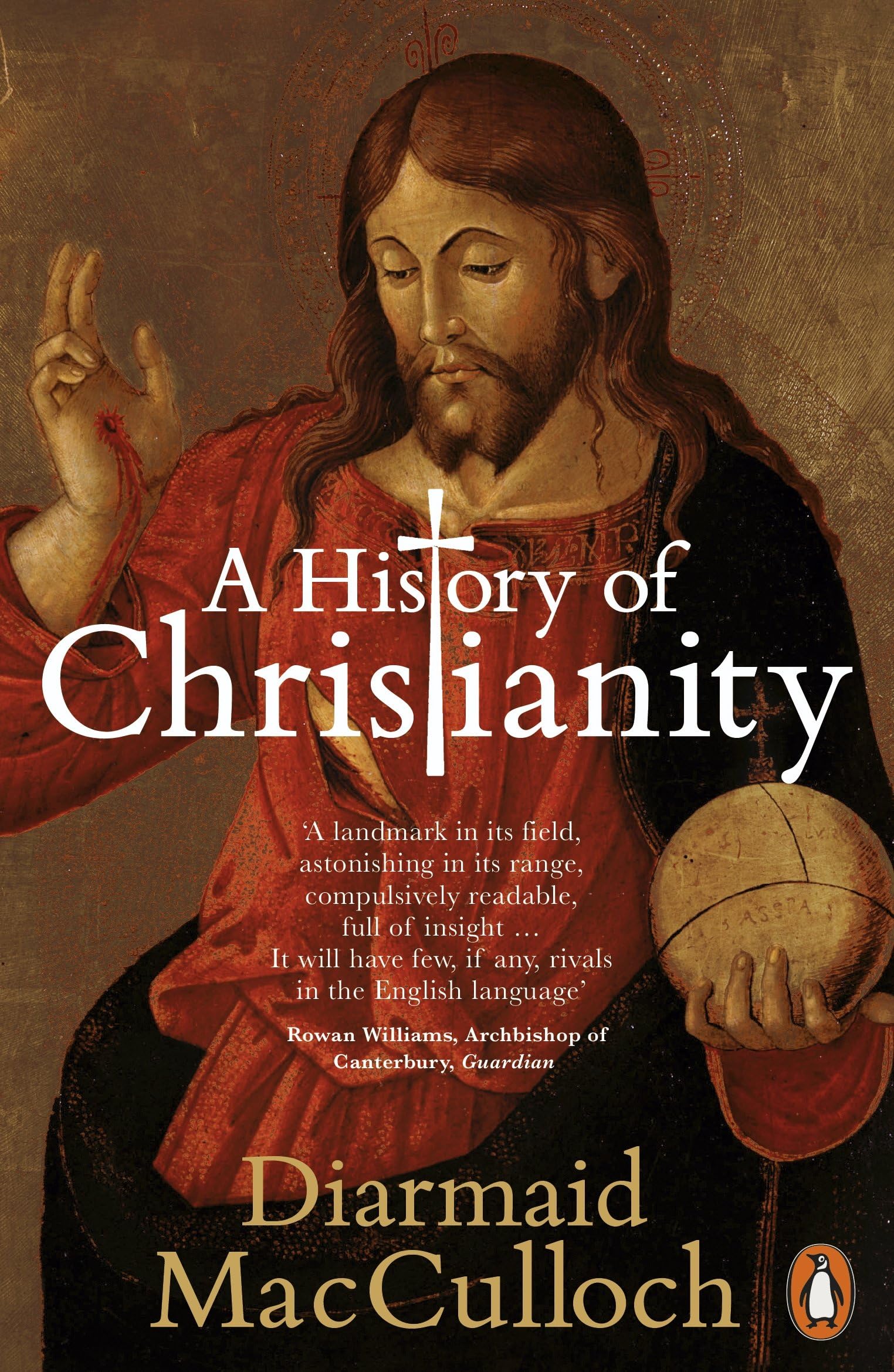
A History of Christianity: The First Three Thousand Years by Diarmaid MacCulloch is a monumental, single-volume history tracing Christianity’s evolution from its obscure origins to a global faith. Combining scholarly rigor with accessible writing, it covers key figures, events, and cultural shifts across continents and millennia. Highly rated and widely acclaimed, this book offers an objective, comprehensive exploration of Christianity’s profound impact on politics, society, and human history.
| Best Sellers Rank | 25,439 in Books ( See Top 100 in Books ) 21 in Christian Church History 66 in Religious History of Christianity 332 in World History (Books) |
| Customer Reviews | 4.4 out of 5 stars 1,680 Reviews |
J**S
A History of Christianity
I came to this book, not as a religious person, nor as an atheist - I can see the contradictions in religious dogma but also find lazy, Rickie Gervais style, militant atheism tedious and unnecessary. Therefore I approached this book for its historical content; I wanted to understand how Christianity developed over the millennia. Some reviews from, presumably Christians, attack this book as modern-liberal and dismissive towards Christianity. I didn't find that at all. The text felt very pragmatic, it discusses the subject objectively and unbiasedly. It is written from a historian's perspective, not that of the priest or the atheist. When something contradictory or clearly invented is stated by e.g. an historical reforming bishop, the author discusses this. The author discusses how certain rituals or beliefs came to be and often this is down to misunderstanding or misinterpretation of early Greek texts - it would be remiss to dismiss the author as anti-Christianity or anti-Religion because of this; this is a history book, not a religious text and the author is simply exploring the facts he has available. An example of this is the virgin birth: The author discusses how the original Greek is more accurately translated that the Messiah will be born of a "young woman" but has been mistranslated as "virgin" - this is further compounded by the historical information we have that Jesus is said to have had siblings, most famously James who became the leader of Jesus' followers in the Holy Land after Jesus' Crucifixion. This is not the author putting down Christianity but simply exploring the human misinterpretation of Jesus' life and teachings. Over two thousand years, (mostly) men have tried to make fragments of information "fit" using mistranslations and presumptions and this has resulted in what is modern Christian belief and practice. The book does not deny the existence of a God or explicitly deny Jesus as a Prophet, Messiah, Christ or as the Son of God, and not once did I get the impression that this was the aim of the author - he is not attempting to offend, he is writing scientifically (i.e. evidence based). He is also not attempting to prove that Jesus WAS any of these things. With regards to the reading experience, for a grand ol' tome of over a thousand pages of tiny Penguin-typical print, it never felt like a slog. I breezed through it and enjoyed it. The author has an easy writing style which makes such an unfathomably complex and huge topic accessible and digestible. The book itself is largely chronological and darts about over the globe, starting with the ancestry of Christianity (judaism, Babylon, Ur etc., then the Hellenistic and then Roman world), onto Jesus and then early Christianity, moving across to Byzantium and the rise of Islam, Charlemagne and the West, to the Crusades and Middle Ages and on and on until modern times. There are discussions on philosophers and philosophy, religion and paganism, interpretations of Holy texts, synods and councils (Nicaea etc.), Emperors, Popes, Khans, Monarchs, Saints, Bishops, Monks and Hermits. Even at a thousand pages of small print, it is a... miracle (pardon the choice of word) that the author has managed to discuss such an unending subject so comprehensively in one book. A strong recommendation from me to anyone and everyone. But if you are religious, I would advise approaching it with an open mind and the understanding that this is not meant to offend your faith, nor persuade you that you are wrong. It doesn't deal in faith and spirituality but earthly factual information and therefore I believe you can safely separate the two worlds and enjoy this book for what it is: A History of Christianity.
T**M
Good, and I will finish this book - but I will have to work at it.
Very interesting, but quite heavy going in places, and is definitely not a 'light read' - it swings to the academic paper in places, and public explainer in others. It also tends to skip about, with cross references all over the place, starting on one thought but then annoyingly jumping to another thought without properly explaining the last one beyond a reference to where else that information is. I have no doubt that there IS detail on that thought, just not at that point in the book. It's worth reading, and has provided some interesting insights already - the author is self described as 'a critical friend of Christianity' and so is not pushing a specific agenda, but tries rather setting out historical information. It's not however bedtime reading. I managed to turn over two pages at once, and only realised about half way down the page that I had done so - this chimes with the slightly chaotic thought trains. I am quite sure that it is well worth the read, but it is quite hard going, and feels very academic.
V**S
À masterful primer - though not without flaws
First of all Professor MacCulloch deserves credit that this book - despite hyperlexia, and an autistics obsession with history and Theology - took me something like 3 months to finish. I normally chew through even weighty tomes in under a month. Three months of consistent reading is unheard of, so for that, I tip my hat. Second observation - this book is very good. MacCulloch has attempted to cover three thousand years of ecclesiastic history in a single text, and has succeeded admirably. Prospective readers should note that this is an introductory primer - in depth knowledge will require more specific and wider readings, but handily the good professor provides an extensive reading list, broken down by chapter. For the more academic amongst us, his footnotes are impeccable and I have already loaded my kindle with a good number of journal articles that he references, as well as purchasing several other books! My single negative comment is that in discussing the 20th Century, notably American segregation and the church in South Africa under apartheid, MacCulloch falls prey to whiteness. He credits Niebuhr, for forming part of Martin Luther King's theological development, and somehow manages to skip on past the existence of James H Cone, the literal originator of Black Theology - who himself called out Niebuhr (who was his colleague at Union) for being wishy washy on the subject of segragation ! His neglect there also means he fails to discuss Black Theology and Womanist theology at all, which is a glaring omission. Then, when discussing apartheid he spends several pages singing the praises of two white Anglicans for their efforts to end apartheid, and Desmond Tutu merits a few passing mentions and no exploration at all! That is not to mention that the efforts of other African activists like Steve Biko are utterly unmentioned, leaving one with the impression that apartheid ending can be credited to two Church of England clerics and Nelson Mandela! These were jarring commissions and I can only hope that Prof MacCulloch has learnt better since 2009. Overall this is still an excellent and comprehensive introduction to the history of Christianity, and was an insightful read. Do be aware of the glaring omissions that I note above though, and read some James Cone!
A**D
The best book I have ever read, and the best book ever written
Quite a claim the headline, but thoroughly justified in my humble opinion. First it is the sheer scale, scope and size of the work. A truely awesome feat of research and scholarship. Second it is the knowledge of the subject Mr. MacCullock brings to he topic. I found myself constantly thinking "Flipping heck he knows that too!" Third it is his very balanced approach. He is clearly a believer, but never once does he push this down your throat. I would guess he is a anglican, as only they in the christian tradition tend to take such a balanced view of their faith. He clearly states where he is expressing his opinion and is always balenced in his conclusions. But above all it is his writing style. It is very clear and accessible and full of little witticisms and wry observations. It also has very personal reflections and observations that bring the book even more alive. And I say all of the above as someone brought up in a religious household in a Judeo Christian culture who has been a very happy and committed atheist for the last 32 years. I am also a amateur historian and have a massive respect for people who can write history like this. the highest accalaid I can give this book is that it would replace the bible and complete works of shakespeare for me on Desert island discs. Read, be amazed and enjoy immensely!
G**K
The most extraordinary book I have ever read!
I think if you write 1000 pages on anything, it’s going to do the job, therefore, being 1016 pages long, this book is an amazing and staggering odyssey of the history of who we are, particularly for us Western Asians, Europeans and westerners etc, however, a lot of the book also deals with Eastern Christianity, mainly centred around Asia Minor and Constantinople (the Eastern Roman Empire). The book is about the spread of Christianity from humble beginnings to world domination, to that end absolutely every country and continent that has been touched by Christianity is mentioned in this book. From small beginnings in ancient Israel to Asia Minor (Turkey), Greece, Rome, Egypt, Ethiopia, Spain, the British Isles, Germany, Poland-Lithuania (a country of religious tolerance and pluralism) Russia (from Greek Orthodox I think), China, India, Japan, Korea, America, Mexico, Latin America, Australia etc (the list goes on and on), practically the whole of planet Earth is covered. The eastern and western churches are a major theme throughout the book, namely Orthodox and Catholic Christianity and how they became separated, also obviously the Reformation and Protestantism are major themes. All the myriad different schisms of the eastern and western churches, such as miaphysite and dyophysite, which basically mean the belief in either the oneness or dual (human and divine) aspects of Jesus Christ respectively. Also the chalcedonian and non-chalcedonian confessions are a major theme. Also obviously, the myriad of sub-confessions of Protestantism and the Reformation are also a major theme throughout much of the book, too many to recount here. It’s crazy because most of the chapters of this book, excepting the last two are a successful and all together pleasing, forward, happy and ‘good news’ kind of a story of Christianity. The only negative or slightly depressing bits in all but the last two chapters are the Islamic surges in and conquests of Christendom, mostly depressingly of all Byzantium (the eastern Roman Empire), parts of south Eastern Europe and Spain. The Muslims even reached into France and were defeated at Battle of Tours, also called Battle of Poitiers in October 732 AD. So that is the only depressing bit in 90% of the book. Then come the last two chapters which deal with the twentieth and twenty first centuries, and GHEEZE what a sad and weird story the ‘history of Christianity’ is! I don’t mean this book, the book is absolutely amazing, but the actual and inescapable ‘history of Christianity’ is a sad and lunatic story. Obviously, after the world wars, the Holocaust and the scourges of both Nazism and Communism, Christianity (or is it just Europe?) completely just bottoms out. After the Holocaust, the westerners (mostly Protestants) can’t control a thing, I mean such as the 1960s cultural revolution and its sexual liberations etc. They can’t even control, contraceptives, abortions, same-sex marriages and women ordinations etc. The last two chapters send shivers down your spine and make you gulp! Out of the doom and gloom of the twentieth century you cannot help but think ‘GHEEZE this is not going to end good!’ Definitely nobody, post-Holocaust is listening to the Pope or the Catholic Church regarding such matters. It’s such a sad and depressing story. However, thankfully, Diarmaid MacCulloch kindly picks up and ends with a warm, friendly and positive note in the last few pages. This book is by far the largest and longest book that I have ever read, save the Bible, however, it is different to the Bible in that it’s so fascinating that I couldn’t read it fast, (I averaged 14.3 pages a day), and it has you hanging on every word, especially (and ironically) the last two demoralising chapters. If you take on this massive and amazing book, stick with it, it is an odyssey, it is an achievement and you will get rewarded.
F**D
It's a Long Story.
This is a secular book of history, written by a `candid friend' of Christianity. He does not make any judgement on whether Christianity is `true' in that he doesn't examine history with a view to validating the claims of Christianity. The story however is true in the sense that it is part of the human story (p.13). From this unfolds not so much a history of Christianity but a history of Christianities. The story begins not in Judea with Christ crucified but 1000 years before, in Greece, Rome and ancient Israel, with the birth of the Messiah, the death of Jesus, the transformation of a Jewish cult into the official religion of the Roman empire, the evolution into separate Western and Eastern churches, the convulsions of the Reformation of and the Enlightenment, through to the French Revolution and the upheavals of the 20th Century. The final chapter does not summarise and synthesise or attempt to explain the story thus far, but contemplates the turns Christianity may take. As the book is subtitled, `The first 3000 years', the story is by no means over. However, the mushrooming evangelical mega-churches around the world are something of a come-down from the previous glories of Christian aesthetics. You will I think profit from this book if you have at least some basic knowledge of the biblical story, and some interest in the history of ideas and religion generally. As an atheist, I certainly found the book illuminating. No doubt those who wish to garner material for an indictment sheet against Christianity will justifiably adduce material here but the excesses of the French Revolution should also give aggressive atheists and secularisers solid reasons to contemplate the consequences of an untrammelled will 'to force people to be free.' The book sometimes to my mind fails to offer explanations as to why Christianity was so successful as an idea. Of all ideas, how did this one hold and spread, especially one with such inauspicious beginnings with its leader ending up dead? Of course, a theological reading of this is perfectly clear. He was dead, but was risen. Death is conquered. He died for your sins. But this is a secular history and failing to offer an attempt at an answer won't do. Indeed I don't believe the question was even forthcoming. Granted, the nature of historical controversy, and the remoteness of this purported event, attested to by a mere handful of ancient witnesses, means there will never be a conclusive answer. But an attempt to at least summarise consensus of the matter might have gone some way to explaining why a cult centering on an obscure Jewish religious teacher in a backwater of the Roman empire metamorphosised in a world-historical force. I felt that the author's style, frequent use of the passive voice and elliptical style of writing make this a harder journey that it needs to be. This, and the fact that the book reads very much a compendium, made the experience for me like navigating around the theological equivalent of a Kew Gardens which had been left to go to seed ages ago. Occasionally you encounter fascinating flora of ideas but at other places it is choked with weeds and undergrowth. I found the accounts of the role of evangelical Christianity (perhaps one of Christianity's few finest hours) in the abolition of slavery fascinating but the section around the theological controversies of the divinity of Christ dry as dust. To think people persecuted and killed one another concerning this nonsense still defies rational comprehension. These factors diminished the enjoyment for me personally. I looked forward to reading this book as I am interested in church history and really enjoyed, for example, the Chadwicks' histories of the Early Church and Reformation respectively. Both of these books are well-written with a great deal of verve, and are very enjoyable, giving one a vivid sense of what the issues were about, which is vital if you are a modern reader steeped in secular thinking. I don't think this book is quite in the same league, and for me this was a disappointment. Hence the three-star rating. Having said that, I acknowledge this work as a considerable achievement, and an indispensible reference for those interested in the history of ideas and their affect and influence on history.
G**N
The History Of Christianity
This is a monumental, and undoubtedly very well-written and absorbing, work. I was apprehensive about reading it at first given that it was written by someone who although the son of a Christian priest is not actually a believer; perhaps only one who is can truly understand the faith and so present it fairly. Nonetheless, it's useful to have an analysis from a person who isn't entirely an insider. The important thing for both believers and nonbelievers to understand is that it's fair-minded. It's a warts-and-all study which quite rightly does not seek to gloss over the fact that Christians have not always lived up to their professed principles, their message of love and peace for all. It also however makes clear that the faith has included many people of genuine compassion and humanity, as well as been responsible for so much in the way of art, literature and music, along with the atrocities (these days, where the latter is concerned, it's generally the Christians who are the victims). Because it covers such a huge scope of space and time there's inevitably a lot that it misses out; in particular it doesn't quite capture the anguish of many Christians in Western Europe at declining church membership and the sense of being under attack by militant atheists whose attitude can be very nasty, or the fact that despite the way in which it's vilified by some it's actually evolved over the past century from a monolithic and arguably oppressive institution to something like an agency for benign social work! My main gripe is that although the author criticises those who "sneer at political correctness" his insistence on referring to people and places in the original vernacular (it would seem we are expected to say "Inka" not "Inca" and "Fernando and Isabel" rather than "Ferdinand and Isabella" when referring to the twin rulers of late fifteenth-century Spain) goes beyond what is necessary and is genuinely irritating (the word I would use is pedantic). But this shouldn't be allowed to detract from the book's overall value.
H**N
MacCulloch's Masterpiece
Diamaid MacCulloch's great work is well-balanced, informtive and composed in a readily accessible style. Those reviewers who accuse him of being unfair to Roman Catholicism should be ignored. The truth often hurts and it should be clear to the unbiased reader that Mr MacCulloch is a skilled historian who deals only in facts, which he allows to speak for themselves. When they do just that, it's surely unfair that he should be maligned for revealing the truth. It's hardly his fault that, over much of the past 2000 years Christianity of all kinds, very much including the Roman Catholic Church, has been responsible for an immese amount of suffering of one kind and another including the persecution of the Jews for the greater part of its history. Like all good historians Mr MacCulloch adopts a Cromwellian 'warts and all' approach to his work. One of the great assets of his work is that it brings to the fore fascinating facts about Eastern Christianity, the progress of which was evntually eclipsed by the advent of Islam. Had this not been the case Roman Catholic Christianity might very well not have achieved the prominence it eventually enjoyed. As it was, it was very much a West European religion until after the re-discovery of the Americas by Christopher Columbus. Mr MacCulloch piles up the evidence proving that there never has been a time, from its earliest beginnings to the present day, when Christianity has been a united religion in the shape of one universal church. It's all a question of orthodoxy being my doxy and heterodoxy being another person's doxy. Quite clearly and honestly Roman Catholicism has more to do with Constantine than it has with Christ, who came from the East and whose message was spread across Asia by early Christians. In reality the Roman Pope is a continuation of Roman imperialism adapted to perceived Christian needs. We all know how biblical texts can be manipulated to prove precisely what we want them to and there's not a shred of reliable evidence that Peter was anything like a first pope or even that Jesus intended him to be so. Like all good historians, Mr MacCulloch stands back from his work allowing the facts to speak for themselves. Although, largely due to engrained prejudices instilled within us from our childhoods, we may not like everything he has to say, we should nevertheless give him credit for being an honest presenter of facts. Those craving a biased account slewed in favour of a particulat faction should look elsewhere. Those seeking to unravel the truth about what really happened need look no further than this masterpiece: A History of Christianity by Diarmaid MacCulloch.
S**R
Great so far
This is a large book, and I am a long way from finishing it, but it was been excellent so far. If it goes off the rails, I'll update this review and remove some stars, but I except it will continue to be interesting and informative.
S**N
Thorough, in-depth review.
Thorough, in-depth, and comprehensive review of the history of Christianity. The author's style of writing is extremely readable, not drab or boring in the least. The author mentions about eastern orthodox Christianity, including about Syriac Christians of Kerala, which other Western authors seem to skim over. Total no. of pages - 1184, with 68 colour plates.
R**R
It’s not a book, it’s the entire universe of Christianity.
It’s worth spending a part of life reading this book. The opens all unseen vistas of Christianity from an esoteric sect to a dominant denomination.
Á**O
Recomendadisimo
Una lectura excelente que cubre el tema de una forma completa y con profundidad.
C**N
Appassionante
Non credevo di poter leggere la storia del cristianesimo con tanto interesse. Tanto più che ci sono biblioteche sull'argomento. Questo libro l'ho preso perchè era stato fortemente consigliato da Christopher Hitchens, pace all'anima sua, e ne sono ben contento. Sopratutto la storia delle chiese del medio oriente e dell'oriente mi hanno aperto una realtà che ignoravo totalmente.
Trustpilot
2 weeks ago
1 day ago